Ampliz vs Snappy Leads 2026: Which B2B Data Tool Wins?
A neutral, hands-on breakdown of Ampliz vs Snappy Leads in 2026 — data coverage, accuracy, pricing, and the use cases where each one actually earns its seat in your stack.
TL;DR
- Ampliz is a depth play: a curated B2B and healthcare (HCP/HCO) intelligence database with firmographic, technographic, and intent layers — strong if you sell into medical, life sciences, or enterprise accounts.
- Snappy Leads is a speed play: a lightweight email-finder and Chrome-extension prospecting tool aimed at SDRs who want contacts fast without a heavyweight platform.
- Neither is a clean winner. Ampliz wins on data richness and niche coverage; Snappy Leads wins on simplicity and per-lead cost for generalist B2B prospecting.
- Both rise or fall on email accuracy — and that is where a dedicated verification layer (or a tool like Tomba) changes your outcomes more than the logo on the dashboard.
- This guide compares coverage, accuracy, pricing, and workflow so you can pick by use case instead of marketing copy.
What are Ampliz and Snappy Leads?#
Here is the short version before the detail: Ampliz is a data depth tool, Snappy Leads is a data speed tool. They overlap on "give me a prospect's email," but they were built for different buyers.
Ampliz positions itself as a global B2B contact and company intelligence provider, with a well-known specialization in healthcare data — physicians, nurses, hospital decision-makers, and the organizations (HCOs) around them. It layers firmographics, technographics, and buying-intent signals on top of contact records, so it reads more like a database subscription than a quick lookup widget.
Snappy Leads sits at the other end. It is a prospecting and email-finding utility — usually used through a browser extension and a simple web app — that surfaces a contact's likely business email while you are on a company site or a LinkedIn profile. The pitch is friction: find the email, drop it into your sequence, move on.
Think of it like buying produce. Ampliz is the wholesale supplier with cold storage, provenance records, and bulk pricing. Snappy Leads is the corner grocer you run into for exactly what you need today. Both sell tomatoes; the right one depends on whether you are catering a wedding or making dinner.
How do Ampliz and Snappy Leads compare at a glance?#
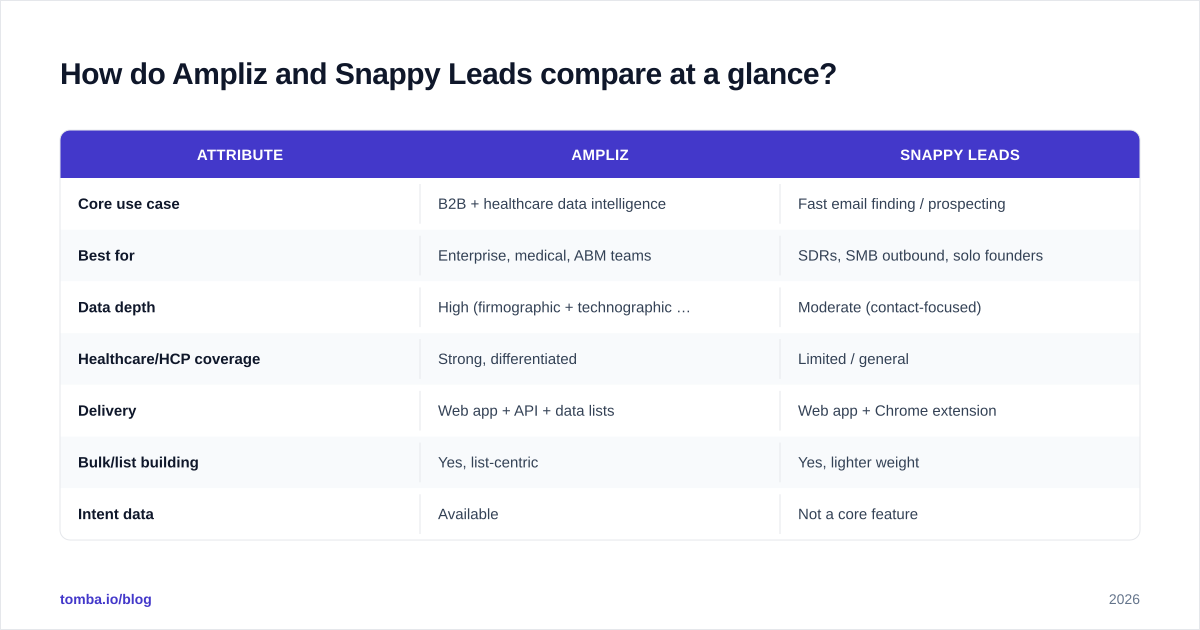
| Attribute | Ampliz | Snappy Leads |
|---|---|---|
| Core use case | B2B + healthcare data intelligence | Fast email finding / prospecting |
| Best for | Enterprise, medical, ABM teams | SDRs, SMB outbound, solo founders |
| Data depth | High (firmographic + technographic + intent) | Moderate (contact-focused) |
| Healthcare/HCP coverage | Strong, differentiated | Limited / general |
| Delivery | Web app + API + data lists | Web app + Chrome extension |
| Bulk/list building | Yes, list-centric | Yes, lighter weight |
| Intent data | Available | Not a core feature |
| Verification built in | Partial | Partial |
| Pricing model | Custom / credit-based, higher | Lower, per-credit friendly |
| Learning curve | Steeper | Minimal |
Read the table as a fork in the road, not a scoreboard. If three or more rows in the Ampliz column describe your reality (enterprise deals, healthcare ICP, intent-driven ABM), that is your tool. If the Snappy Leads column reads like your week (fast lists, small budget, one rep doing everything), start there.
Which tool has better data coverage and accuracy?#
Ampliz wins on breadth and niche depth; accuracy is a wash that you should never trust on faith from either vendor.
Ampliz's edge is its healthcare and global enterprise records. If your total addressable market includes hospital procurement leads, practicing physicians, or life-sciences buyers, that specialization is hard to replicate with a general email finder. The records also carry more context — company size, tech stack, and intent — which matters when you score and route leads rather than blast them.
Snappy Leads optimizes for the common case: a B2B professional with a corporate email at a company with a website. For mainstream SaaS, agency, or services prospecting, that is often enough, and the per-lead economics are friendlier.
But here is the uncomfortable truth that applies to every provider in this category, including both of these: a contact record is a snapshot, and people change jobs constantly. Industry churn estimates from sources like G2 and analyst reviews consistently show B2B data decaying double digits per year. A platform can hand you a "verified" email that bounced into a void last quarter.

That is why accuracy is less about which vendor you choose and more about whether you verify before you send. Running every list through an independent email verifier — and a catch-all verifier for those tricky accept-all domains — does more for your bounce rate than swapping one data vendor for another. Treat the source tool as a starting hypothesis, not gospel.
)
How does pricing compare between Ampliz and Snappy Leads?#
Snappy Leads is cheaper to start; Ampliz costs more because you are buying a database, not a lookup.
Ampliz typically sells through custom or credit-based plans aimed at teams, and pricing climbs with data volume, intent access, and seats. That is normal for an enterprise data product — you are paying for curation, the healthcare specialization, and support. Expect to talk to sales rather than swipe a card, and expect the annual figure to look like a software contract.
Snappy Leads leans toward self-serve, credit-friendly pricing that an individual rep or small team can adopt without procurement. The tradeoff is depth: you get contacts, not a full intelligence layer.
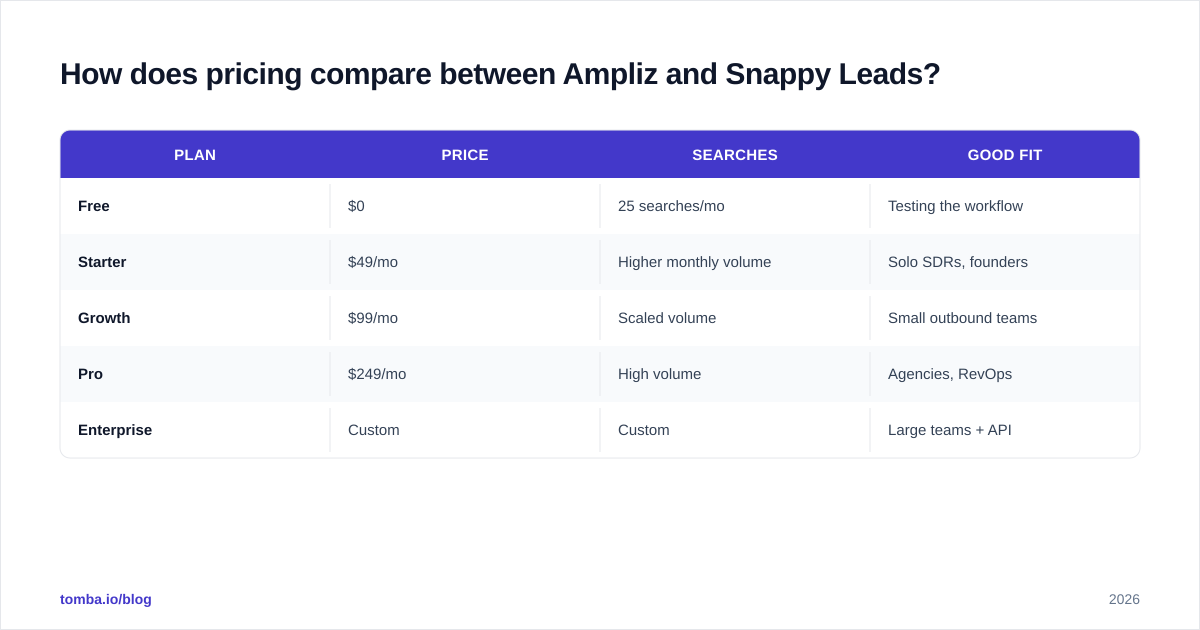
For context, here is how a dedicated email-finding tool like Tomba prices, since many teams pair a finder/verifier with whatever database they use:
| Plan | Price | Searches | Good fit |
|---|---|---|---|
| Free | $0 | 25 searches/mo | Testing the workflow |
| Starter | $49/mo | Higher monthly volume | Solo SDRs, founders |
| Growth | $99/mo | Scaled volume | Small outbound teams |
| Pro | $249/mo | High volume | Agencies, RevOps |
| Enterprise | Custom | Custom | Large teams + API |
You can see full Tomba pricing for current limits. The takeaway for the Ampliz vs Snappy Leads decision: budget is not just sticker price, it is cost per usable, verified contact. A cheaper tool that surfaces stale emails you then have to clean is not actually cheaper.
Which workflow fits your team better?#
Pick by how your reps actually work, not by the feature list.
Ampliz fits a list-first, ops-driven motion. A RevOps or marketing team builds segmented account lists, enriches them with firmographic and intent data, scores them, and hands curated lists to sales. The Tomba API crowd will recognize this pattern — it is systematic, repeatable, and CRM-centric. Ampliz rewards teams that plan campaigns in advance.
Snappy Leads fits a rep-first, in-the-moment motion. An SDR is researching on LinkedIn or a company site, needs the email now, grabs it via extension, and pushes it into a sequence. It rewards individual hustle over centralized list-building.
Ask yourself three questions:
- Who sources leads — a central ops team or individual reps? Central → Ampliz. Reps → Snappy Leads.
- Is intent data part of your scoring? Yes → Ampliz. No → Snappy Leads is enough.
- Do you sell into healthcare or regulated enterprise? Yes → Ampliz's specialization is the deciding factor.
Whichever you choose, the last mile is the same: enrich and verify before outreach. A layer of data enrichment fills the gaps a single source leaves behind, and a verification pass protects your sender reputation. Many teams use a finder like the Tomba Email Finder alongside their primary database precisely to cross-check and fill holes.
)
What are the pros and cons of each?#
Ampliz pros
- Deep, specialized healthcare (HCP/HCO) data that generalist tools cannot match
- Firmographic + technographic + intent layers for real lead scoring
- Strong fit for ABM and enterprise list-building
- API and bulk delivery for ops-driven teams
Ampliz cons
- Higher cost and sales-led buying process
- Steeper learning curve; overkill for simple prospecting
- Data freshness still requires your own verification discipline
Snappy Leads pros
- Fast, low-friction email finding via extension
- Friendly per-credit pricing for individuals and SMBs
- Minimal onboarding — productive in minutes
- Good for mainstream B2B SaaS/services prospecting
Snappy Leads cons
- Shallower data; little intent or deep firmographics
- Weaker for niche verticals like healthcare
- Less suited to centralized, list-first ops workflows
If you scan those lists and feel torn, that usually means your need is finding and verifying contacts efficiently rather than subscribing to a full intelligence database — which points toward a focused finder-plus-verifier stack instead of either platform alone.
Is there a better alternative for most teams?#
For most B2B teams whose main pain is "find the right email and make sure it lands," a dedicated finder-and-verifier is the more direct fix than either platform.
Ampliz is the right answer when your moat is data depth in healthcare or enterprise ABM. Snappy Leads is the right answer when your moat is rep speed on mainstream accounts. But a large middle group does not need a heavyweight database or a bare-bones extension — they need accurate emails, verified, at predictable cost, with a CRM connection.
That middle group is where a tool like Tomba fits. You can run domain search to pull every contact at a target company, find individual addresses, verify them in bulk, and push the clean list straight into your CRM. Reviews on platforms like Capterra consistently show that teams care more about verified deliverability and integrations than about owning the largest raw database.
A practical hybrid many teams land on:
- Use Ampliz or Snappy Leads to source the initial contact pool (depth vs speed, your call).
- Run the pool through an independent finder/verifier to fill gaps and confirm addresses.
- Sync verified contacts into your CRM and only then start sequences.
This decouples "where the data comes from" from "is it safe to send," which is the single biggest lever on cold-email performance.
How do I decide between Ampliz and Snappy Leads?#
Use this quick decision rule:
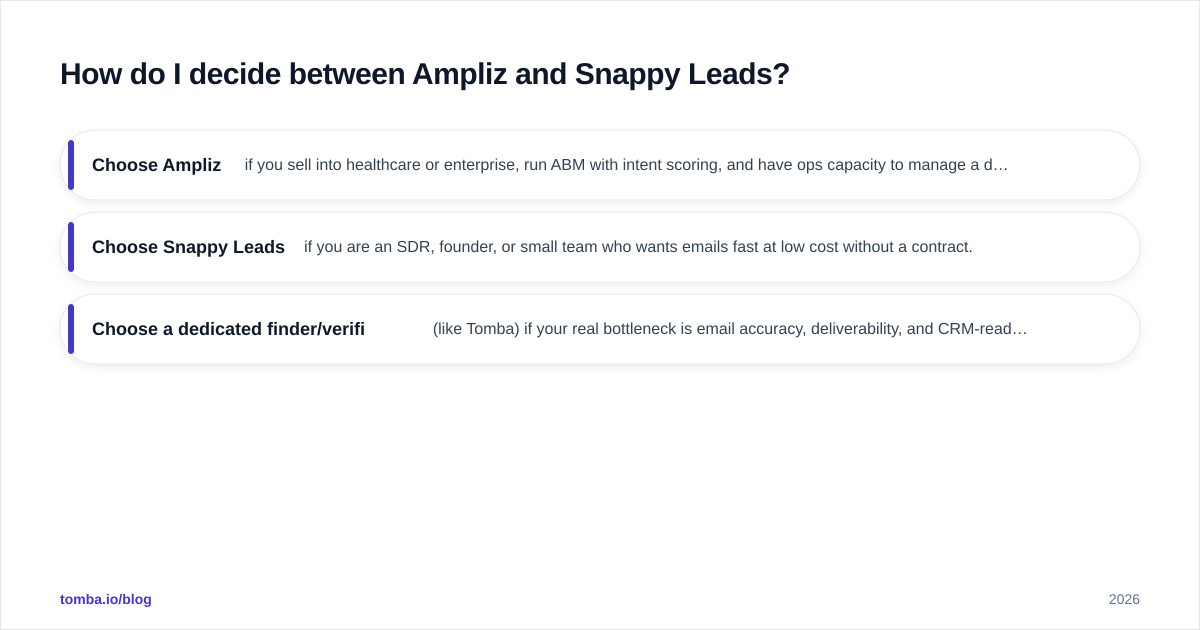
- Choose Ampliz if you sell into healthcare or enterprise, run ABM with intent scoring, and have ops capacity to manage a data platform.
- Choose Snappy Leads if you are an SDR, founder, or small team who wants emails fast at low cost without a contract.
- Choose a dedicated finder/verifier (like Tomba) if your real bottleneck is email accuracy, deliverability, and CRM-ready lists rather than database breadth.
There is no shame in combining them. The best-performing outbound teams in 2026 treat data sourcing and data verification as two separate jobs handled by two specialized tools — and they measure success in verified, replied-to contacts, not in record counts.

The bottom line#
Ampliz and Snappy Leads solve different problems wearing similar clothing. Ampliz is depth and specialization for teams selling into healthcare and enterprise; Snappy Leads is speed and simplicity for reps who need emails now. Match the tool to your motion and your ICP, and ignore the feature-count arms race.
Then close the accuracy gap that every data source leaves behind. If your goal is verified emails, full company contact lists, and clean data that lands in inboxes and syncs to your CRM, start with the Tomba Email Finder and its built-in verification — grab the free tier (25 searches a month), test it against whatever database you are using today, and let bounce rate decide. The dashboard logo matters far less than the email actually arriving.
// get started
Find, verify and enrich your first contacts today
Start on the free plan with 25 searches a month, then scale when your team is ready.
Free plan · No credit card required · GDPR & CCPA
// about the author