Ampliz vs Techsalerator 2026: B2B Data Providers Compared
A neutral 2026 breakdown of Ampliz vs Techsalerator — coverage, pricing models, data accuracy, and which B2B data provider fits your GTM stack.
You are choosing between two B2B data vendors that look similar on a feature grid but solve different problems in practice. This guide compares Ampliz and Techsalerator on coverage, accuracy, pricing model, and fit — without pretending either one is the answer for every team.
TL;DR — Ampliz vs Techsalerator at a glance#
- Ampliz is strongest for APAC and healthcare/intent-led account targeting, sold as a SaaS subscription with a contact-database UI and Chrome extension.
- Techsalerator is a broad global data marketplace — you buy datasets (firmographic, consumer, financial, geospatial) often as one-time or licensed files rather than a self-serve prospecting tool.
- Pick Ampliz if you want a working sales/marketing data platform with intent signals; pick Techsalerator if you need bulk, custom, or non-standard datasets to load into your own systems.
- Neither is a dedicated email-finder; both ship contact data whose freshness you should verify before sending. Pair either with a real-time email verifier to protect deliverability.
- Budget honestly: Ampliz pricing is quote-based per seat/credits; Techsalerator pricing scales with dataset size and licensing scope.
What are Ampliz and Techsalerator?#
Ampliz positions itself as a B2B data and sales intelligence platform with notable strength in the Asia-Pacific region and in healthcare/life-sciences contacts. You log into a dashboard, search by firmographic and people filters, pull contacts, and push them to your CRM. It layers on intent data and an "ideal customer" scoring angle, so it behaves like a prospecting tool, not just a raw file.
Techsalerator is a global data provider and marketplace. Its catalog spans B2B firmographics, consumer/B2C records, financial data, geospatial and mobility data, and industry-specific sets across many countries. The buying motion is closer to "license a dataset for our use case" than "search and click." That makes it flexible for data teams, but heavier to operationalize for a single rep who just wants verified contacts today.
The core distinction: Ampliz sells you a product you use; Techsalerator sells you data you take.
How do Ampliz and Techsalerator compare on features?#
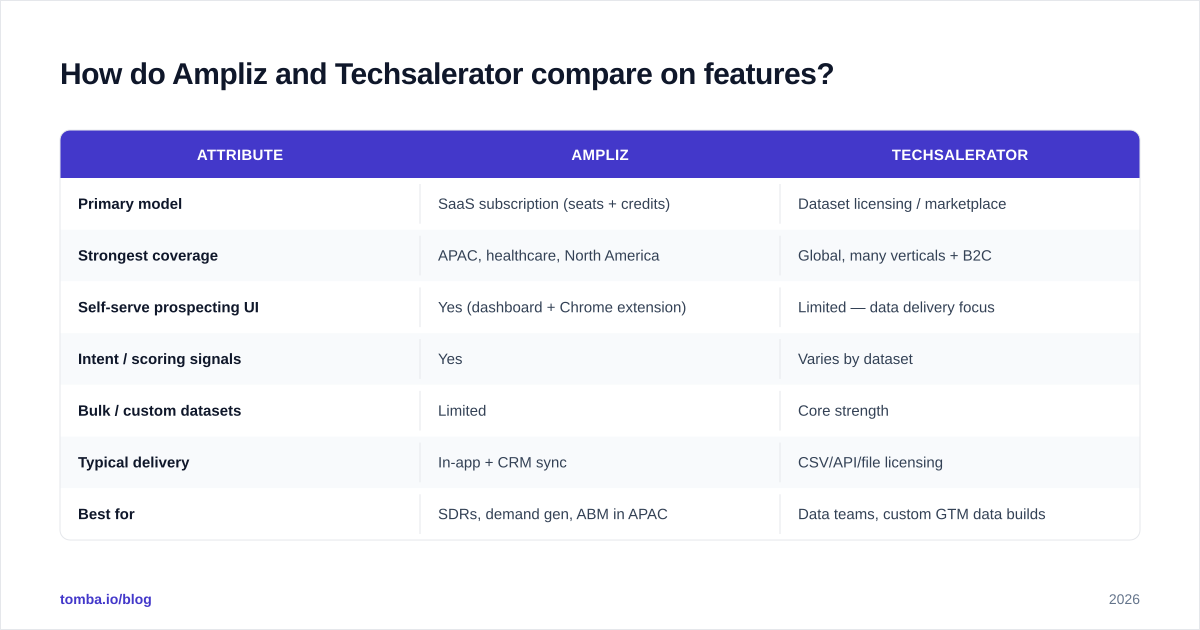
Use the table below as a starting point, then validate against your own region and industry — vendor coverage claims vary widely by geography.
| Attribute | Ampliz | Techsalerator |
|---|---|---|
| Primary model | SaaS subscription (seats + credits) | Dataset licensing / marketplace |
| Strongest coverage | APAC, healthcare, North America | Global, many verticals + B2C |
| Self-serve prospecting UI | Yes (dashboard + Chrome extension) | Limited — data delivery focus |
| Intent / scoring signals | Yes | Varies by dataset |
| Bulk / custom datasets | Limited | Core strength |
| Typical delivery | In-app + CRM sync | CSV/API/file licensing |
| Best for | SDRs, demand gen, ABM in APAC | Data teams, custom GTM data builds |
| Real-time email verification | Not the focus | Not the focus |
The honest read: these are not direct head-to-head competitors for the same buyer. An SDR leader will lean Ampliz. A RevOps or data engineering team assembling a custom B2B database will get more from Techsalerator's catalog.

Which has better data accuracy?#
Accuracy is where both vendors — and every list-based provider — deserve scrutiny. B2B contact data decays roughly 25–30% per year as people change jobs, so any dataset you license is a snapshot, not a guarantee.
Ampliz publishes human-plus-machine verification claims and tends to do better in its core APAC and healthcare segments than in long-tail regions. Techsalerator's accuracy depends heavily on which dataset you buy and how recently it was compiled — a freshly sourced firmographic set behaves very differently from an aggregated consumer file.
Two practical rules:
- Never trust a provider's accuracy percentage at face value. Run a paid sample against your own known-good records before signing.
- Verify at send time, not buy time. Even a 95%-accurate file degrades between purchase and your first campaign. Routing contacts through email verification and a catch-all verifier before outreach is what actually protects your sender reputation.
For how source quality drives downstream accuracy, the data sources breakdown explains why provenance matters more than headline percentages.
How does pricing compare?#
Both vendors use quote-based pricing, so treat any number you see online as approximate and get a written quote scoped to your usage.
- Ampliz is typically priced per seat plus credit consumption, with tiers that scale by number of contacts revealed and access to intent features. This rewards predictable, ongoing prospecting volume.
- Techsalerator prices by dataset — size, geography, refresh cadence, and licensing terms (internal use vs resale). One-time pulls and recurring feeds are priced differently. This rewards specific, scoped data needs rather than continuous seat usage.
A quick way to decide on cost structure:
| Buying pattern | Lower total cost with |
|---|---|
| Daily rep prospecting, steady volume | Ampliz |
| One large, specific dataset | Techsalerator |
| Niche/custom verticals or geographies | Techsalerator |
| Ongoing ABM + intent triggers | Ampliz |
| Tight budget, mostly need verified emails | Neither alone — add a finder + verifier |
If your real requirement is "find and confirm work emails at known companies," a focused tool with transparent pricing often beats a broad data license you only partly use.
Is Ampliz or Techsalerator better for cold outreach?#
For cold email specifically, both have the same gap: they hand you records, not deliverability. A large purchased list sent cold is the fastest way to get domains blacklisted.
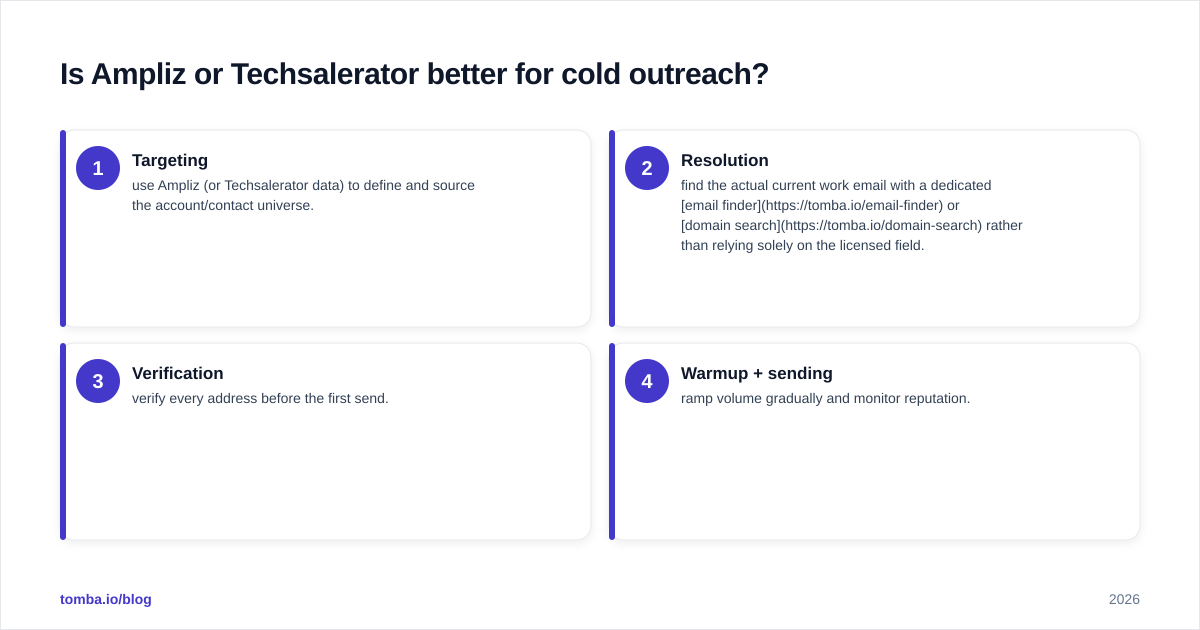
If outreach is the goal, the winning stack usually looks like:
- Targeting — use Ampliz (or Techsalerator data) to define and source the account/contact universe.
- Resolution — find the actual current work email with a dedicated email finder or domain search rather than relying solely on the licensed field.
- Verification — verify every address before the first send.
- Warmup + sending — ramp volume gradually and monitor reputation.
Ampliz fits step 1 more naturally because it is a usable app; Techsalerator fits step 1 when you need scale or unusual segments. Steps 2–4 sit outside both products.
What about integrations and workflow?#
Ampliz offers CRM sync and a browser extension, so it slots into an SDR's day with minimal setup. Techsalerator's delivery is file- or API-based, which is powerful for engineering-led pipelines but assumes you have somewhere to load and operate the data.
If your team lives in spreadsheets and a CRM, the practical path is often a lighter tool that connects directly — for example pulling and enriching inside Google Sheets or syncing to HubSpot — rather than standing up a data pipeline for a marketplace feed. For deeper firmographic fill-in on records you already own, data enrichment is usually a better fit than buying an entire dataset.

Ampliz vs Techsalerator: pros and cons#
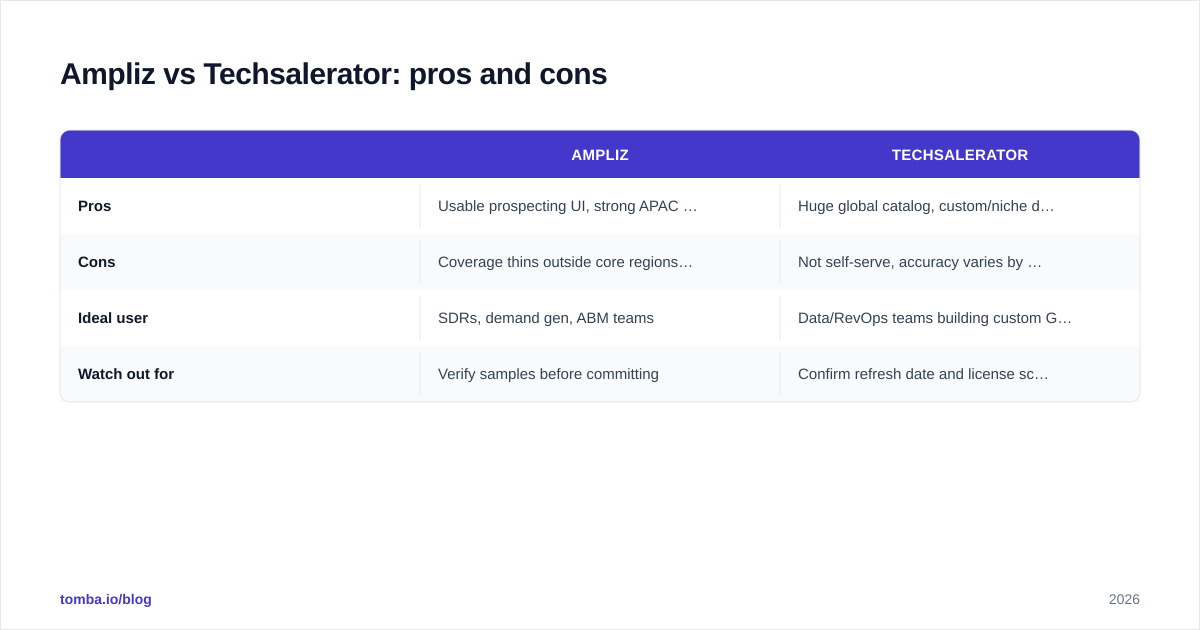
| Ampliz | Techsalerator | |
|---|---|---|
| Pros | Usable prospecting UI, strong APAC + healthcare, intent signals, CRM/extension | Huge global catalog, custom/niche datasets, flexible licensing, B2C + specialty data |
| Cons | Coverage thins outside core regions, quote-based pricing, not an email-finder | Not self-serve, accuracy varies by set, heavier to operationalize, no built-in verification |
| Ideal user | SDRs, demand gen, ABM teams | Data/RevOps teams building custom GTM data |
| Watch out for | Verify samples before committing | Confirm refresh date and license scope |
You can cross-check current sentiment on independent review sites like G2 and Capterra — read the 3-star reviews, not the 5-star ones, since those describe the real edge cases.
Which should you choose?#
Decide by your dominant job-to-be-done:
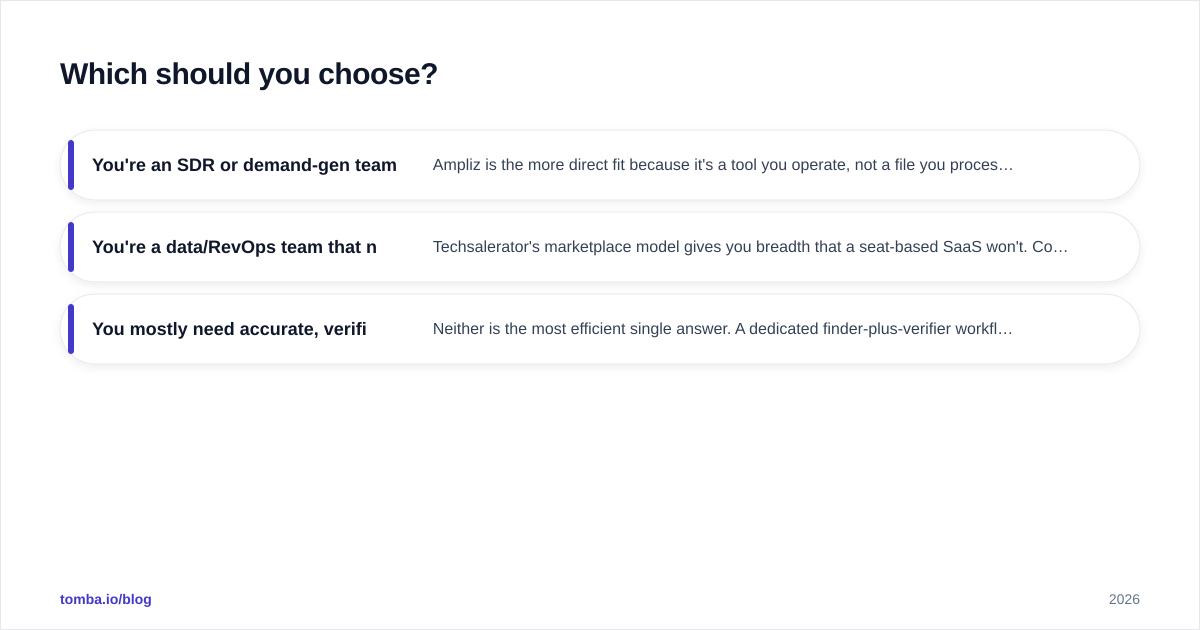
- You're an SDR or demand-gen team targeting APAC, healthcare, or running ABM with intent. Ampliz is the more direct fit because it's a tool you operate, not a file you process. Validate coverage in your exact segment first.
- You're a data/RevOps team that needs specific, bulk, or unusual datasets to power custom models or systems. Techsalerator's marketplace model gives you breadth that a seat-based SaaS won't. Confirm freshness and licensing in writing.
- You mostly need accurate, verified work emails at named companies, fast. Neither is the most efficient single answer. A dedicated finder-plus-verifier workflow will cost less and protect deliverability better than a broad data license.
Whichever you pick, treat purchased contact data as a starting point, not a send-ready list. The vendors that win in 2026 are the ones whose data you re-verify at the moment of outreach.
The bottom line#
Ampliz and Techsalerator aren't really fighting over the same buyer. Ampliz is a usable prospecting platform with regional and vertical strengths; Techsalerator is a flexible global data marketplace for teams that build their own pipelines. Both give you contacts — neither guarantees those contacts are still valid when you hit send.
That last mile is the part that decides whether your campaigns land or bounce. Start by finding and confirming the right addresses with the Tomba Email Finder — search by domain, name, or company, then verify before you send — so the data you sourced from Ampliz or Techsalerator actually reaches a human inbox. Spin it up on the free tier (25 searches/month) and only scale to a paid plan once it's proving out against your own list.
Ready to find emails that actually work?
Join 150,000+ professionals who stopped guessing and started sending. Free credits on signup — no credit card required.
Get the Tomba newsletter
Practical outbound tactics and product updates — once every two weeks.
About the author