Ampliz vs UpLead (2026): Which B2B Data Tool Wins?
Ampliz leans APAC and healthcare intelligence; UpLead bets on 95% verified US contacts. Here's a neutral, side-by-side breakdown of accuracy, coverage, pricing, and the right fit for your pipeline in 2026.
Picking a B2B data vendor is really a bet on whose database matches the territory you actually sell into. Ampliz and UpLead both promise accurate contacts, but they optimize for different worlds: Ampliz is strongest in APAC and healthcare intelligence, while UpLead built its reputation on a 95% accuracy guarantee for North American B2B contacts. This comparison breaks down where each one wins, where each one quietly loses, and how to decide without burning a quarter of wasted credits.
TL;DR — Ampliz vs UpLead at a glance#
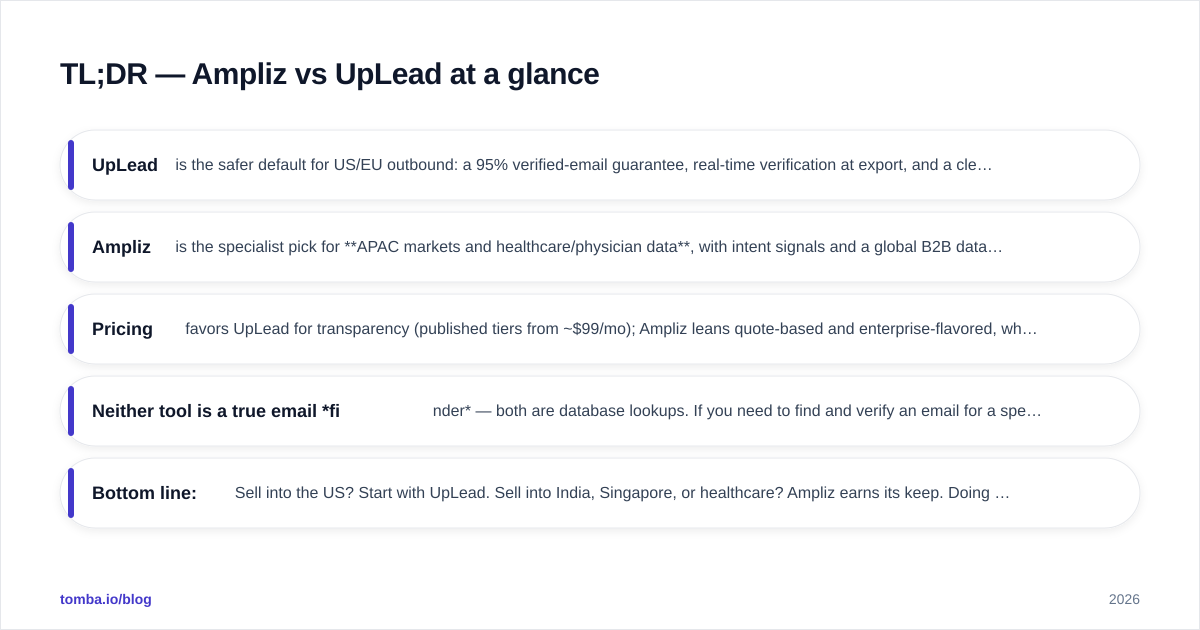
- UpLead is the safer default for US/EU outbound: a 95% verified-email guarantee, real-time verification at export, and a clean credit model that refunds bad records.
- Ampliz is the specialist pick for APAC markets and healthcare/physician data, with intent signals and a global B2B database that competitors thin out outside North America.
- Pricing favors UpLead for transparency (published tiers from ~$99/mo); Ampliz leans quote-based and enterprise-flavored, which slows down small teams.
- Neither tool is a true email finder — both are database lookups. If you need to find and verify an email for a specific person at a specific domain, a dedicated finder like the Tomba Email Finder is faster and cheaper per lookup.
- Bottom line: Sell into the US? Start with UpLead. Sell into India, Singapore, or healthcare? Ampliz earns its keep. Doing targeted one-to-one prospecting? Pair either with a finder.
What is Ampliz and who is it built for?#
Ampliz is a B2B data intelligence platform that positions itself around global and APAC-region contact data, with a notable specialty in healthcare intelligence — physicians, hospitals, NPI-coded provider records, and decision-makers in life sciences. It also sells general B2B firmographic and technographic data, plus buyer intent signals.
The reason Ampliz keeps coming up in vendor shortlists is geographic. Most US-born data providers are deep in North America and shallow everywhere else. If your ICP includes a Bangalore CTO, a Jakarta procurement lead, or a hospital network in the Gulf, the typical "millions of contacts" database returns thin, stale rows. Ampliz invests where others coast, and that focus is its entire value proposition.
The trade-off: Ampliz feels more enterprise and consultative. Pricing is largely quote-based, onboarding is heavier, and the self-serve experience is less polished than a product built for a solo SDR to swipe a credit card and start exporting. For a deeper primer on how contact databases differ from on-demand lookups, Tomba's B2B glossary is a useful neutral reference.
What is UpLead and who is it built for?#
UpLead is a B2B prospecting database with one headline promise: a 95% data accuracy guarantee backed by real-time email verification at the moment you export. Instead of selling you a static list and hoping it ages well, UpLead re-checks each email before it spends your credit — and if a record is bad, you generally don't pay for it.
That model is the whole pitch. UpLead is built for the SDR, founder, or growth marketer who wants to filter a clean list by 50+ attributes (industry, headcount, tech stack, location, revenue), preview matches, and push verified contacts into a CRM or sequencer without babysitting bounce rates. Its sweet spot is North American and Western European B2B, where its coverage is densest.
UpLead's published pricing and free trial make it easy to evaluate. You can read its current plans directly on uplead.com, and its G2 profile is a decent gut-check on real-user sentiment around accuracy and support.
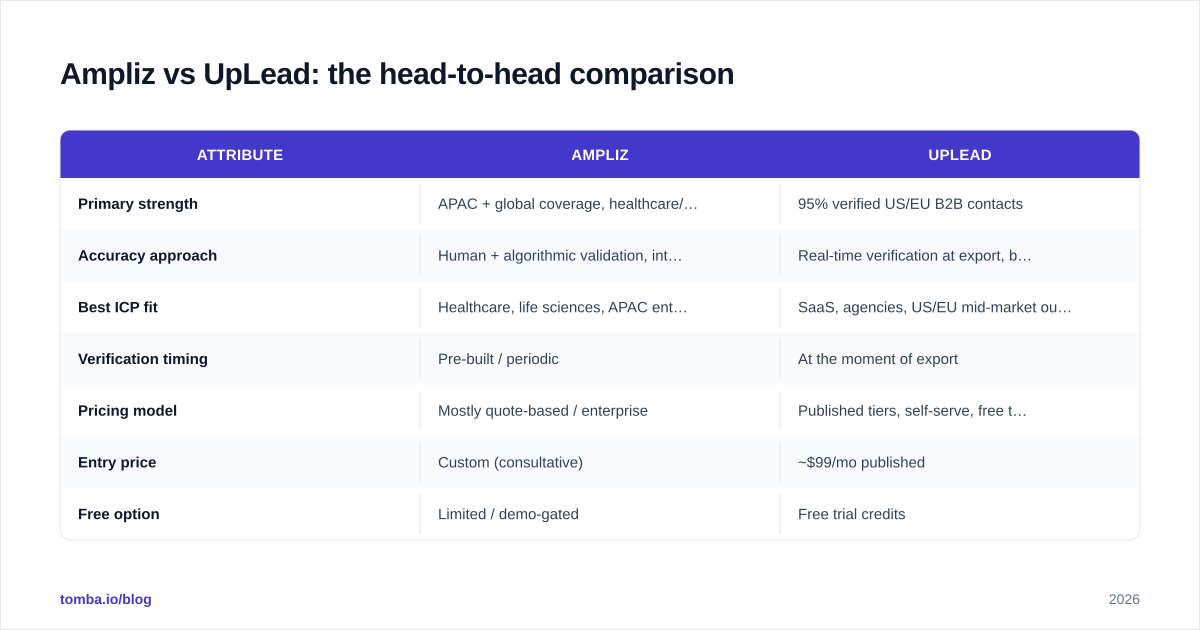
Ampliz vs UpLead: the head-to-head comparison#
Here's the side-by-side that actually matters when you're choosing between them.
| Attribute | Ampliz | UpLead |
|---|---|---|
| Primary strength | APAC + global coverage, healthcare/physician data | 95% verified US/EU B2B contacts |
| Accuracy approach | Human + algorithmic validation, intent signals | Real-time verification at export, bad-record credit refund |
| Best ICP fit | Healthcare, life sciences, APAC enterprise | SaaS, agencies, US/EU mid-market outbound |
| Verification timing | Pre-built / periodic | At the moment of export |
| Pricing model | Mostly quote-based / enterprise | Published tiers, self-serve, free trial |
| Entry price | Custom (consultative) | ~$99/mo published |
| Free option | Limited / demo-gated | Free trial credits |
| Intent data | Yes | Limited |
| Phone numbers | Yes (region-dependent) | Yes (direct dials) |
| Ease of self-serve start | Moderate | High |
A few honest caveats on this table. Accuracy "guarantees" are marketing instruments, not physics — every database decays, and a 95% claim is a statement about freshly verified exports, not the entire universe of records. And coverage density swings hard by region: UpLead's accuracy in Mumbai is not the same as its accuracy in Austin, and Ampliz's depth in healthcare is not matched by its depth in, say, US construction SMBs.
How should you actually choose between them?#
Don't choose on brand. Choose on the intersection of territory, industry, and motion. Here's a simple decision framework.
1. Map your territory first. If 70%+ of your pipeline is North America or Western Europe, UpLead's density and verification will give you a cleaner list with less manual scrubbing. If a meaningful slice is APAC, the Middle East, or emerging markets, run a coverage test with Ampliz before committing — the geographic edge is real and hard to replicate.
2. Check the industry fit. Healthcare, pharma, and provider-network selling is Ampliz's home turf. NPI-level physician data is genuinely hard to source cleanly, and generic databases fumble it. For horizontal B2B SaaS or agency prospecting, UpLead's attribute filters and tech-stack targeting are more than enough.
3. Match the sales motion. Building large filtered lists for sequenced outbound? Both work, with UpLead edging ahead on self-serve speed. Doing surgical, account-based, one-contact-at-a-time prospecting? A full database subscription is overkill — you'll pay for breadth you never touch.
That third case is where a lot of teams quietly overspend. If your real job is "I have a name and a company, get me the verified email," you don't need a 100-million-row database. You need a precise lookup. That's a different tool category entirely.
Where do email finders fit in this picture?#
Ampliz and UpLead are databases — you query a corpus and pull what's already stored. An email finder is a resolver — you give it a name and a domain, and it constructs and verifies the most likely address in real time, even for contacts no static database has indexed yet.
The two approaches are complementary, not competitive. A common, cost-efficient stack looks like this:
- Use a database (UpLead or Ampliz) for discovery — building the initial list of accounts and roles that fit your ICP.
- Use a domain search to pull every known email pattern at a target company in one shot.
- Use a dedicated email finder to resolve the specific decision-makers a database missed or returned stale.
- Run everything through an email verifier before it ever hits your sequencer, so your sender reputation survives the campaign.
This matters more than it sounds. Even a 95% accurate export means 1 in 20 sends could bounce, and a string of hard bounces is one of the fastest ways to wreck email deliverability. Verifying at the point of send — not just at the point of export — is the difference between landing in the inbox and landing in spam.
A quick coverage-test recipe#
Before you sign anything, run the same 50-contact test against both tools (and a finder):
- Pick 50 real target contacts you can independently confirm.
- Pull each one from Ampliz, UpLead, and an email finder.
- Score three things: match rate (did it return anything?), accuracy (is the email real?), and freshness (is the job title current?).
- Divide cost by verified matches, not raw matches. The cheapest sticker price often loses on cost-per-usable-record.
This 30-minute exercise tells you more than any vendor deck. Vendors quote their best-region numbers; your ICP is your ICP.
How do pricing and credits compare?#
Pricing philosophy is where these two diverge most.
UpLead publishes its tiers, offers a free trial, and uses a straightforward credit-per-contact model with refunds for unverifiable records. You can self-serve from roughly $99/mo and scale up. That transparency is a real advantage for small teams and for anyone who hates "book a demo" walls.
Ampliz runs a more consultative, quote-based motion. That's normal for enterprise and healthcare data — those datasets are expensive to maintain and often sold with compliance and licensing terms attached — but it slows down evaluation and rules Ampliz out for a lot of bootstrapped SDR teams who just want to start today.
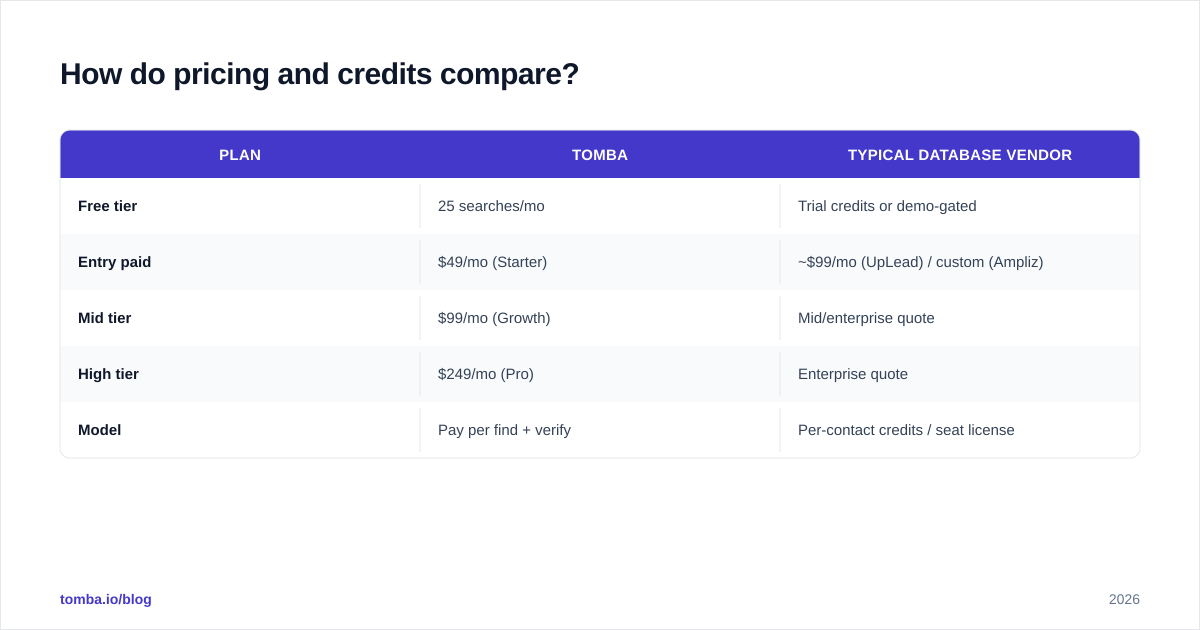
If your priority is predictable, low-friction cost, here's how a dedicated finder stacks up on transparency, using published Tomba pricing as the reference point:
| Plan | Tomba | Typical database vendor |
|---|---|---|
| Free tier | 25 searches/mo | Trial credits or demo-gated |
| Entry paid | $49/mo (Starter) | ~$99/mo (UpLead) / custom (Ampliz) |
| Mid tier | $99/mo (Growth) | Mid/enterprise quote |
| High tier | $249/mo (Pro) | Enterprise quote |
| Model | Pay per find + verify | Per-contact credits / seat license |
The point isn't that one number is "cheaper" — it's that finders and databases price different things. Databases charge for access to a corpus; finders charge for resolved lookups. If you're buying breadth, a database; if you're buying precision, a finder.
Which integrations and workflows matter?#
Both tools push data into the usual destinations — CRMs and sequencers — but the friction lives in the last mile: getting clean, deduplicated, verified contacts into the system your reps actually live in.
UpLead integrates with mainstream CRMs and offers CSV export plus an API. Ampliz supports API access and enterprise data delivery, which suits batch enrichment more than one-off lookups. Whichever you choose, plan for a verification and dedupe step between the database and your CRM — raw exports always carry duplicates and decayed rows.
If your workflow is CRM-centric, it's worth checking native connectors before committing. Tomba, for instance, ships direct integrations like HubSpot and Salesforce plus bulk processing for list cleanup, so the find → verify → sync loop stays inside one pipeline instead of three exports and a spreadsheet. For broader CRM strategy context, HubSpot's own sales resources are a solid neutral read.
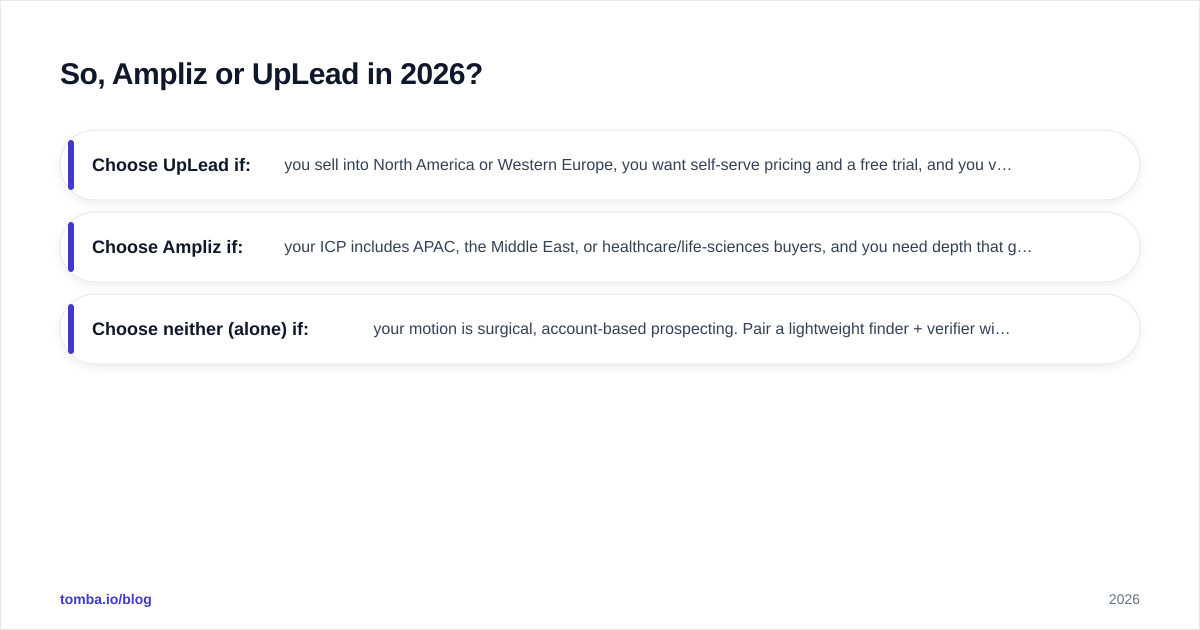
So, Ampliz or UpLead in 2026?#
There's no universal winner — there's a winner for your territory.
- Choose UpLead if: you sell into North America or Western Europe, you want self-serve pricing and a free trial, and you value verification-at-export with bad-record refunds. It's the lower-friction, more transparent option for most horizontal B2B teams.
- Choose Ampliz if: your ICP includes APAC, the Middle East, or healthcare/life-sciences buyers, and you need depth that generic US databases can't match. The consultative model is worth tolerating for the coverage.
- Choose neither (alone) if: your motion is surgical, account-based prospecting. Pair a lightweight finder + verifier with whichever database you pick, and only pay for the breadth you genuinely use.
The smartest 2026 stacks don't treat this as either/or. They use a database for discovery, a finder for precision, and a verifier as the gate before every send. That combination beats any single vendor's accuracy claim because it stacks three independent checks instead of trusting one.
Find and verify the contacts your database misses#
If you've ever exported a "verified" list and still watched bounces roll in, the gap is precision. Databases are great at telling you who to reach; they're weaker at handing you a live, deliverable address for the exact person you want today. That's the job the Tomba Email Finder is built for — give it a name and a domain, and it resolves and verifies the email before it ever reaches your sequencer, with a published free tier so you can test it against your own Ampliz or UpLead exports first. Run a 50-contact head-to-head this week, divide cost by verified matches, and let the numbers pick your stack.
// get started
Find, verify and enrich your first contacts today
Start on the free plan with 25 searches a month, then scale when your team is ready.
Free plan · No credit card required · GDPR & CCPA
// about the author