Ampliz vs Vainu 2026: B2B Data Platform Comparison
Ampliz and Vainu both promise clean B2B data, but they win on different continents and use cases. Here's the honest 2026 breakdown of coverage, pricing, and fit.
TL;DR
- Ampliz is strongest if your ICP lives in APAC or healthcare — it leans on physician, hospital, and Asia-Pacific contact data that most Western vendors thin out on.
- Vainu is built around real-time company (firmographic) intelligence with deep Nordic and European coverage, native CRM enrichment, and trigger-based prospecting signals.
- Neither tool is a pure email finder. Ampliz sells contact records; Vainu sells company records. Your hit rate on a specific decision-maker's verified email varies a lot by region.
- Pricing on both is quote-based and sales-gated, which makes side-by-side budgeting hard. Expect annual commitments rather than month-to-month flexibility.
- If you mostly need accurate, verified work emails on demand without an annual contract, a dedicated finder like Tomba is a cheaper, faster complement — or a replacement for the contact-data half of the job.
What are Ampliz and Vainu?#
Both are B2B data platforms, but they solve different halves of the prospecting problem.
Ampliz is a sales and marketing intelligence platform with a notable specialization: APAC coverage and healthcare data (physicians, hospitals, NPI-style records). Think of it as a contact-and-company database that happens to be unusually deep in regions and verticals where US-centric vendors run dry. If you sell into Singapore, India, or to hospital procurement teams, that depth is the point.
Vainu approaches things from the company side first. It's a real-time company data platform built in the Nordics, with strong European firmographics and "trigger" signals — funding rounds, hiring spikes, tech-stack changes — that tell you when an account is worth touching. Vainu's pitch is keeping your CRM clean and current automatically, then layering prospecting signals on top.
The simplest mental model: Ampliz answers "who are the people, especially in Asia and healthcare?" Vainu answers "which companies in Europe are moving right now, and is my CRM still accurate?"
Because they emphasize different data layers, "which is better" is the wrong question. The right one is "which gap am I filling — contact-level coverage in a hard region, or company-level freshness and intent in Europe?" This is the core of any B2B data and intelligence buying decision: match the dataset to your actual ICP, not to the loudest feature list.
How do Ampliz and Vainu differ on data coverage?#
Coverage is where these two genuinely diverge, so it deserves more than a feature-checklist glance.
Ampliz indexes contacts and companies with a tilt toward Asia-Pacific and healthcare. Its healthcare module surfaces clinicians by specialty, hospital affiliation, and location — data that's painful to source anywhere else legally and cleanly. For general B2B, it carries email and direct-dial fields, firmographics, and technographics, but its differentiator is the regions and verticals where it's deep rather than raw global volume.
Vainu indexes companies first, with claimed coverage of tens of millions of organizations and particularly granular detail in Finland, Sweden, Norway, Denmark, and the Netherlands, where it pulls from official registries. Contact-level data exists but is secondary to the company record and the signal layer. Vainu's strength is that the company data is fresh — updated continuously rather than scraped once and left to rot.
A practical consequence: if you hand both tools the same list of 500 Nordic mid-market companies and ask "tell me what changed this quarter," Vainu wins easily. Hand both a list of 500 hospital procurement leads in Southeast Asia and ask for verified contacts, and Ampliz is the safer bet. Outside those sweet spots, both degrade toward "decent but not special," and that's where a dedicated finder earns its keep.

Ampliz vs Vainu: full comparison table#
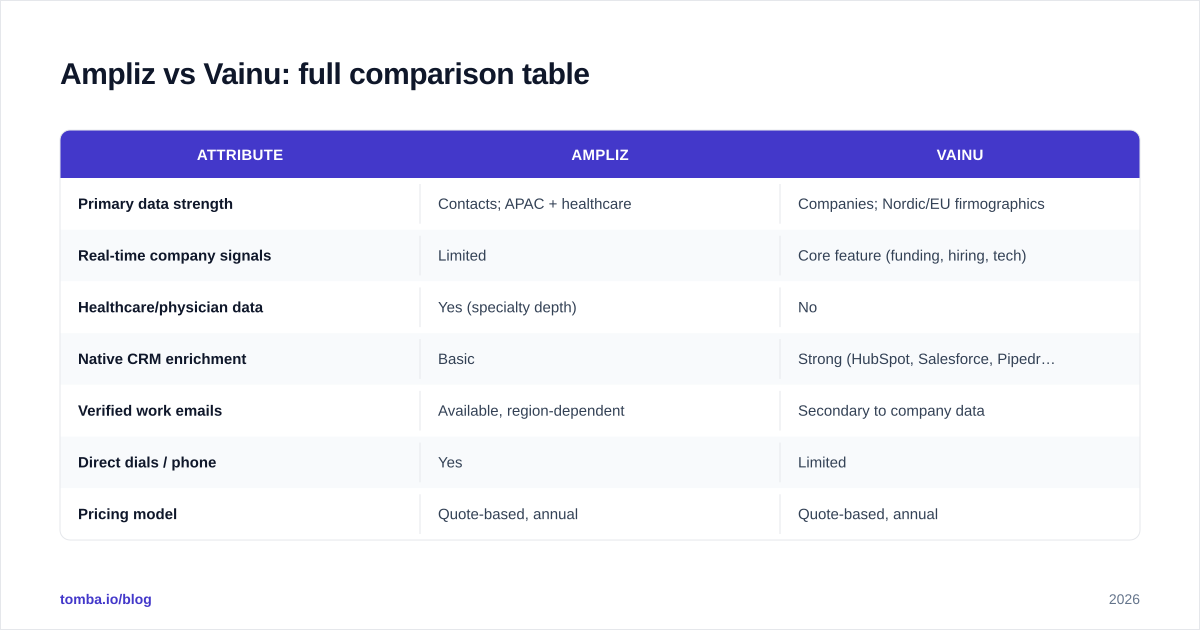
Here's the head-to-head on the attributes that actually move a buying decision. Treat the pricing rows as directional — both vendors gate real numbers behind a sales call.
| Attribute | Ampliz | Vainu |
|---|---|---|
| Primary data strength | Contacts; APAC + healthcare | Companies; Nordic/EU firmographics |
| Real-time company signals | Limited | Core feature (funding, hiring, tech) |
| Healthcare/physician data | Yes (specialty depth) | No |
| Native CRM enrichment | Basic | Strong (HubSpot, Salesforce, Pipedrive) |
| Verified work emails | Available, region-dependent | Secondary to company data |
| Direct dials / phone | Yes | Limited |
| Pricing model | Quote-based, annual | Quote-based, annual |
| Free self-serve tier | No | No (trial/demo only) |
| Best fit | APAC + healthcare sellers | EU account-based teams |
| Weakest spot | Coverage outside APAC | Contact-level email depth |
The pattern is consistent: each tool is excellent inside its lane and ordinary outside it. If your territory or vertical sits squarely in one lane, the choice makes itself. If you sell globally across mixed segments, neither alone will fully cover you — and you'll likely pair it with an on-demand finder or data enrichment layer to fill the gaps.
How do Ampliz and Vainu pricing plans compare?#
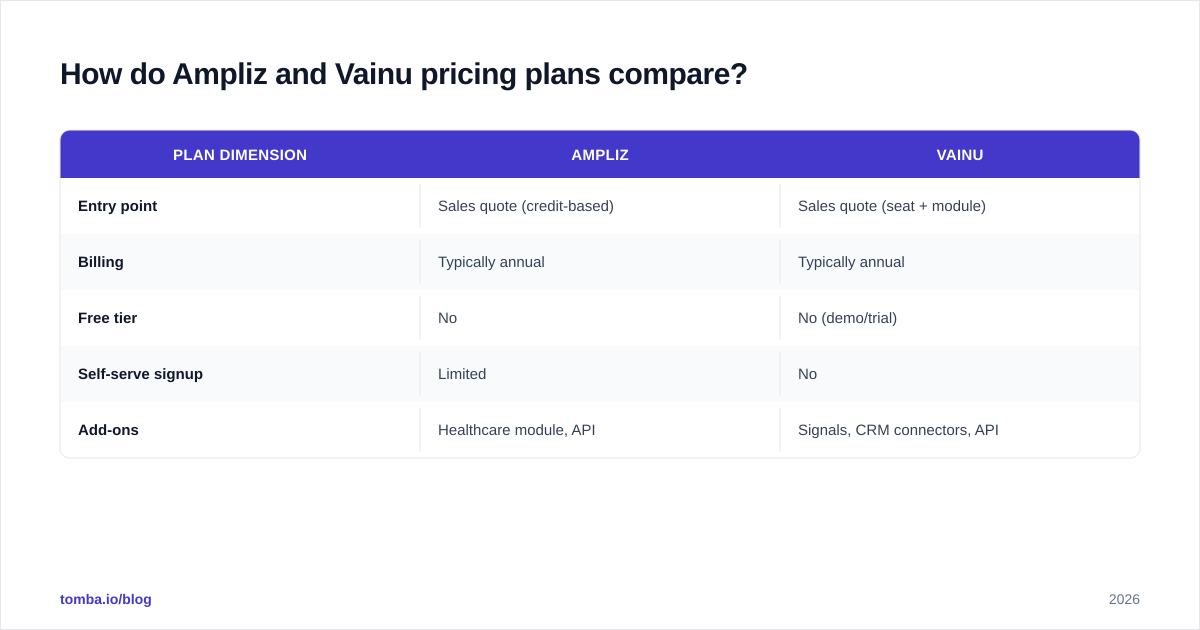
Short version: both are enterprise-style, quote-based, and annual. Neither publishes a transparent self-serve price page the way newer tools do, which means you're negotiating, not comparing line items.
| Plan dimension | Ampliz | Vainu |
|---|---|---|
| Entry point | Sales quote (credit-based) | Sales quote (seat + module) |
| Billing | Typically annual | Typically annual |
| Free tier | No | No (demo/trial) |
| Self-serve signup | Limited | No |
| Add-ons | Healthcare module, API | Signals, CRM connectors, API |
For a small team or a single SDR, that quote-based, annual posture is the real friction. You can't swipe a card, run 200 lookups this month, and stop. Tools built for that motion — including Tomba's pricing, which starts free at 25 searches/month and moves to a transparent $49/mo Starter tier — fit a very different buyer than Ampliz or Vainu's enterprise contracts. Match the commercial model to how your team actually buys, not just to the dataset.
For independent verification of pricing tiers and user sentiment before any call, cross-check both vendors on G2 rather than trusting a single sales deck.
Is Ampliz better than Vainu for your use case?#
Run your situation through these honest scenarios instead of asking which tool is "best."
You sell into healthcare or APAC. Pick Ampliz. Its physician and Asia-Pacific depth is the entire reason to consider it, and Vainu simply doesn't compete here.
You run account-based outbound in Europe and want freshness + intent. Pick Vainu. The real-time signals and registry-grade Nordic data are built for exactly this, and the native CRM sync keeps your pipeline from decaying.
You need verified emails for named decision-makers, fast, in mixed regions. Honestly, neither is ideal as a standalone. Both will leave gaps, and you'll burn credits guessing. This is where a dedicated email finder plus an email verifier outperforms a broad data platform on cost-per-valid-contact.
You want a clean CRM with minimal manual upkeep. Vainu edges it, thanks to continuous company updates and strong connectors. Ampliz enrichment is more basic.

What are the limitations of each tool?#
No vendor volunteers its weak spots, so here they are plainly.
Ampliz limitations
- Coverage falls off sharply outside APAC and healthcare. For North American SaaS prospecting, you'll find thinner, sometimes staler records than with US-native vendors.
- Email verification quality is region-dependent. A "valid" flag in a strong region isn't the same confidence level as in a weak one — always re-verify before a real send.
- Pricing opacity and annual commitment make it a poor fit for spiky, low-volume needs.
Vainu limitations
- It's a company-data platform first. If your daily job is "get me this exact person's verified email," contact depth can disappoint outside its core European markets.
- The signal layer is genuinely useful but adds cost and complexity; small teams may pay for sophistication they won't operationalize.
- Outside the Nordics and a handful of EU markets, the registry-grade advantage shrinks toward parity with cheaper tools.
The shared limitation is the commercial model. Both assume you're an enterprise signing annually, which is friction for anyone who wants to test coverage on their actual ICP before committing budget. Always run a real sample of your accounts — not the vendor's curated demo list — and measure valid-email rate and bounce rate yourself. If you maintain your own B2B database, a quick overlap test against known-good contacts tells you more than any sales call.
Where does Tomba fit between Ampliz and Vainu?#
Tomba isn't a like-for-like rival to either — it's the contact-accuracy layer that both platforms underweight.
Ampliz and Vainu sell breadth: big databases, signals, enrichment, CRM sync. Tomba sells precision on the one field that decides whether your outreach lands — the verified work email. When you've identified the right account in Vainu or pulled a healthcare lead from Ampliz, you still need a deliverable address for the specific human you're targeting. That's a finder-and-verifier job.
A common, cost-effective stack looks like this:
- Use Vainu (EU) or Ampliz (APAC/healthcare) to select the right accounts and timing.
- Use a dedicated finder to resolve and verify the named contact's email, by domain or by name.
- Push clean, verified records into your CRM and sequence.
This keeps you from over-paying a broad platform to do precision work it isn't optimized for. If your real bottleneck is "I have the company, I need the person's verified email — without an annual contract," that's exactly the gap Tomba closes. You can also compare options directly via Tomba's Vainu alternative breakdown.
Frequently asked questions#
Is Ampliz or Vainu more accurate? It depends entirely on region and data type. Ampliz is more accurate for APAC and healthcare contacts; Vainu is more accurate for European company records and freshness. Neither is universally "more accurate" — accuracy is a coverage question, so always test against your own ICP.
Do Ampliz and Vainu publish pricing? No. Both use quote-based, sales-gated pricing with typically annual commitments. If transparent, low-commitment pricing matters, that's a meaningful mark against both for smaller teams.
Can either replace a dedicated email finder? Partially. Both include contact data, but verified-email depth for named individuals in mixed regions is not their core strength. Pairing them with a finder and verifier usually beats relying on the platform alone.
Which is better for CRM enrichment? Vainu, in most cases — its continuous company updates and native connectors are built for keeping a CRM current. Ampliz enrichment is more basic.
What if I sell globally across many segments? Neither tool alone will fully cover you. Expect to combine a regional data platform with an on-demand finder to control cost-per-valid-contact.
The bottom line#
Ampliz and Vainu aren't really competitors so much as specialists pointed at different maps. Ampliz owns APAC and healthcare contacts; Vainu owns European company freshness and intent. Choose by where your ICP lives and which data layer you're missing — not by feature-count.
But both share the same blind spot: precision on the verified work email of the specific person you're trying to reach, on demand, without an annual contract. That's the half of the funnel that decides whether anything else matters. Start with the Tomba Email Finder — free for your first 25 searches — to find and verify decision-maker emails by domain or name, then layer it onto whichever data platform fits your territory. It's the fastest way to turn "we have the account" into "the email actually landed."
// get started
Find, verify and enrich your first contacts today
Start on the free plan with 25 searches a month, then scale when your team is ready.
Free plan · No credit card required · GDPR & CCPA
// about the author