Ampliz vs Warpleads (2026): Which B2B Lead Tool Wins?
Ampliz sells curated B2B and healthcare intelligence; Warpleads pushes unlimited lead exports. Here's how the two stack up on data, pricing, and fit in 2026.
You are choosing between two very different bets. Ampliz is a curated B2B and healthcare data platform that sells depth and segmentation. Warpleads is a volume play built around unlimited lead exports for high-velocity outbound. The right answer depends entirely on whether you value precision or scale — and this guide breaks down exactly where each one earns its keep in 2026.
TL;DR — Ampliz vs Warpleads in 30 seconds#
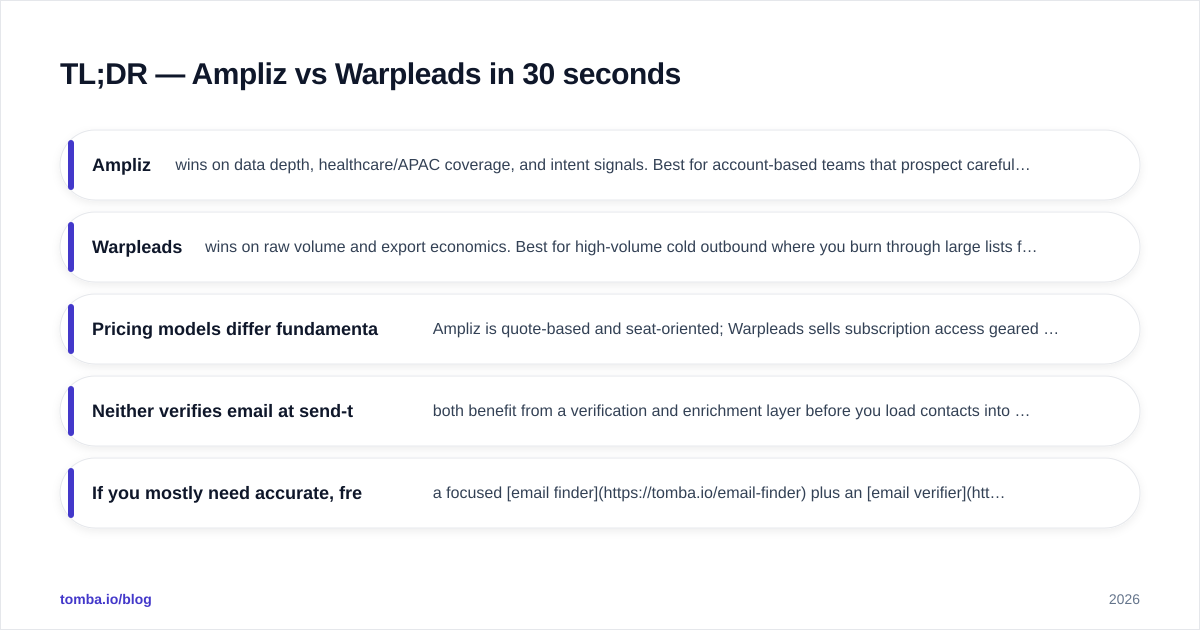
- Ampliz wins on data depth, healthcare/APAC coverage, and intent signals. Best for account-based teams that prospect carefully into specific industries.
- Warpleads wins on raw volume and export economics. Best for high-volume cold outbound where you burn through large lists fast.
- Pricing models differ fundamentally: Ampliz is quote-based and seat-oriented; Warpleads sells subscription access geared to unlimited or large-volume exports.
- Neither verifies email at send-time the way a dedicated tool does — both benefit from a verification and enrichment layer before you load contacts into a sequencer.
- If you mostly need accurate, fresh email addresses, a focused email finder plus an email verifier often beats paying for a full database you won't fully use.
What are Ampliz and Warpleads?#
Ampliz is a B2B sales and marketing intelligence platform. Its reputation is strongest in healthcare data (the "Ampliz People Finder" and healthcare intelligence products) and Asia-Pacific coverage, where many US-centric databases thin out. It positions itself around contextual intelligence: firmographics, technographics, and intent layered on top of contact records, so you can build narrow, qualified lists rather than dumping everyone with a title.
Warpleads is a newer lead-generation tool built for outbound volume. The core promise is unlimited (or very high-volume) exports of B2B leads, so teams running aggressive cold email can pull large lists without per-contact anxiety. It leans into the "more shots on goal" philosophy of modern outbound rather than surgical account targeting.
In one line: Ampliz sells qualified context, Warpleads sells quantity and export freedom. That single distinction drives almost every other difference below.
How do Ampliz and Warpleads compare at a glance?#
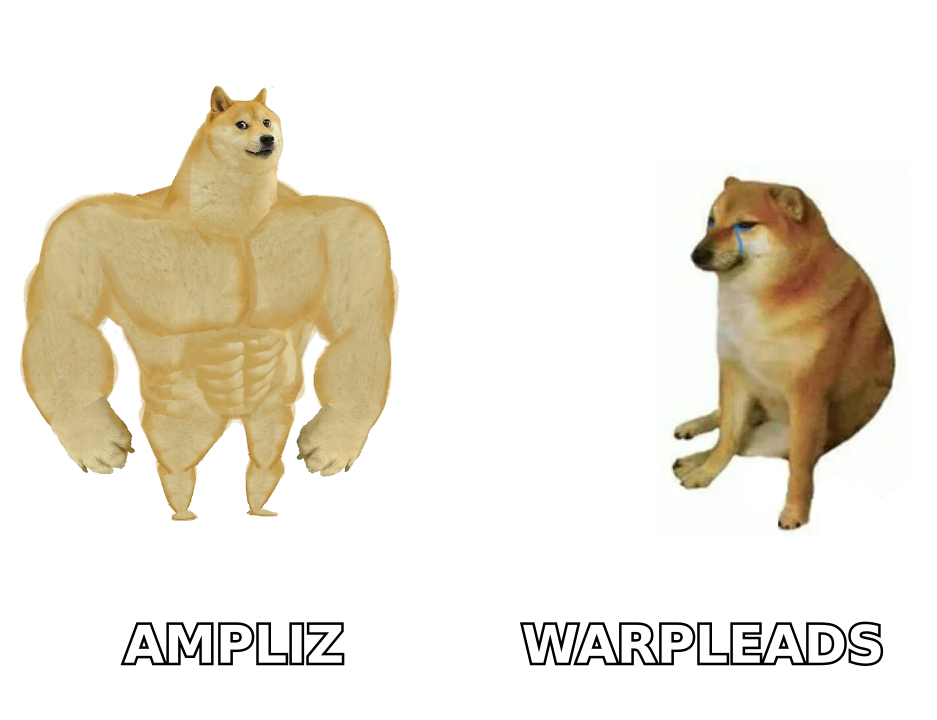
Here is the head-to-head on the attributes that actually change your buying decision.
| Attribute | Ampliz | Warpleads |
|---|---|---|
| Primary strength | Curated B2B + healthcare intelligence | High-volume / unlimited lead exports |
| Best-fit motion | Account-based, targeted prospecting | High-velocity cold outbound |
| Standout coverage | Healthcare, APAC, intent data | Broad B2B contact volume |
| Data signals | Firmographic, technographic, intent | Contact-level firmographics |
| Pricing model | Quote-based, seat-oriented | Subscription, export-volume oriented |
| Free entry point | Limited free/trial credits | Trial-based access |
| Email verification | Provided, but verify before send | Verify before send recommended |
| Ideal team size | SMB to enterprise ABM teams | Lean, volume-driven outbound teams |
The pattern is clear: if your funnel rewards precision (long sales cycles, expensive deals, regulated buyers), Ampliz fits. If your funnel rewards reach (short cycles, low-touch offers, A/B tested cold email at scale), Warpleads fits.
What is Ampliz best for?#
Ampliz is the better choice when who you contact matters more than how many you contact.
Healthcare and life-sciences prospecting. This is Ampliz's flagship use case. If you sell into hospitals, clinics, payers, or medical device buyers, the depth of healthcare-specific attributes (specialties, NPI-style identifiers, facility data) is hard to match with a generic database.
Asia-Pacific expansion. Many popular databases are US- and EU-heavy. Teams expanding into India, Southeast Asia, or broader APAC markets often find Ampliz's regional coverage stronger, which reduces the "empty search" problem.
Intent-driven ABM. Ampliz layers intent and firmographic context so you can prioritize accounts showing buying signals instead of spraying a flat list. For a marketing qualified lead motion, that context is the difference between a warm hand-raise and a cold guess.
The tradeoff: depth costs money and time. You are paying for curation, and you will not get the "export 50,000 rows tonight" experience that volume sellers want.
What is Warpleads best for?#
Warpleads is built for teams whose growth model is throughput.
High-volume cold email. If your playbook is to send thousands of touches across many micro-segments, you need lists you can export freely without metering every contact. Warpleads is designed around exactly that economic model.
Lean, scrappy outbound teams. Startups and agencies running outbound-as-a-service often care most about cost-per-exported-lead and speed. Warpleads removes the friction of credit accounting so SDRs keep moving.
Top-of-funnel list building. When you are testing offers, niches, and messaging, you want raw fuel. Warpleads gives you that fuel; you bring the targeting discipline and the verification layer.
The tradeoff: volume without verification is a deliverability landmine. Large exports always contain stale, role-based, and catch-all addresses. Send to them raw and you torch your sender reputation fast. The fix is cheap and non-negotiable — clean before you send (more on that below).
How should you choose between Ampliz and Warpleads?#
Use this decision framework. Map your dominant constraint, then follow the branch.
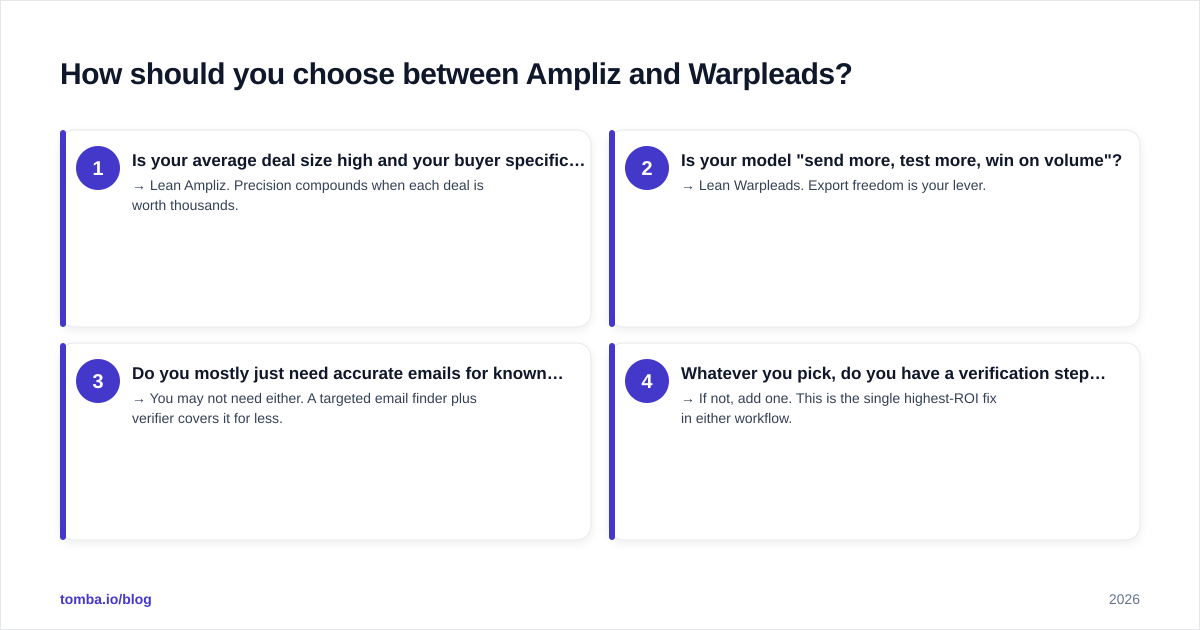
- Is your average deal size high and your buyer specific (especially healthcare/APAC)? → Lean Ampliz. Precision compounds when each deal is worth thousands.
- Is your model "send more, test more, win on volume"? → Lean Warpleads. Export freedom is your lever.
- Do you mostly just need accurate emails for known companies? → You may not need either. A targeted email finder plus verifier covers it for less.
- Whatever you pick, do you have a verification step before the sequencer? → If not, add one. This is the single highest-ROI fix in either workflow.
The honest read: most teams over-buy database breadth and under-invest in data hygiene. The tool that finds the contact matters less than whether the address actually lands in an inbox.
How do pricing models differ?#
Pricing is where the two diverge most, and where you should be careful — both vendors steer you toward annual commitments.
Ampliz is quote-based and seat-oriented. You talk to sales, you get a plan sized to your team and data needs, and pricing scales with coverage and seats. That is normal for intelligence platforms but means less transparency upfront.
Warpleads sells subscription access oriented around export volume, which is friendlier to teams that want predictable, high-throughput costs without per-lead metering.
Because both publish limited public pricing and change tiers often, verify current numbers directly on Ampliz and Warpleads before committing, and cross-check user-reported pricing on G2.
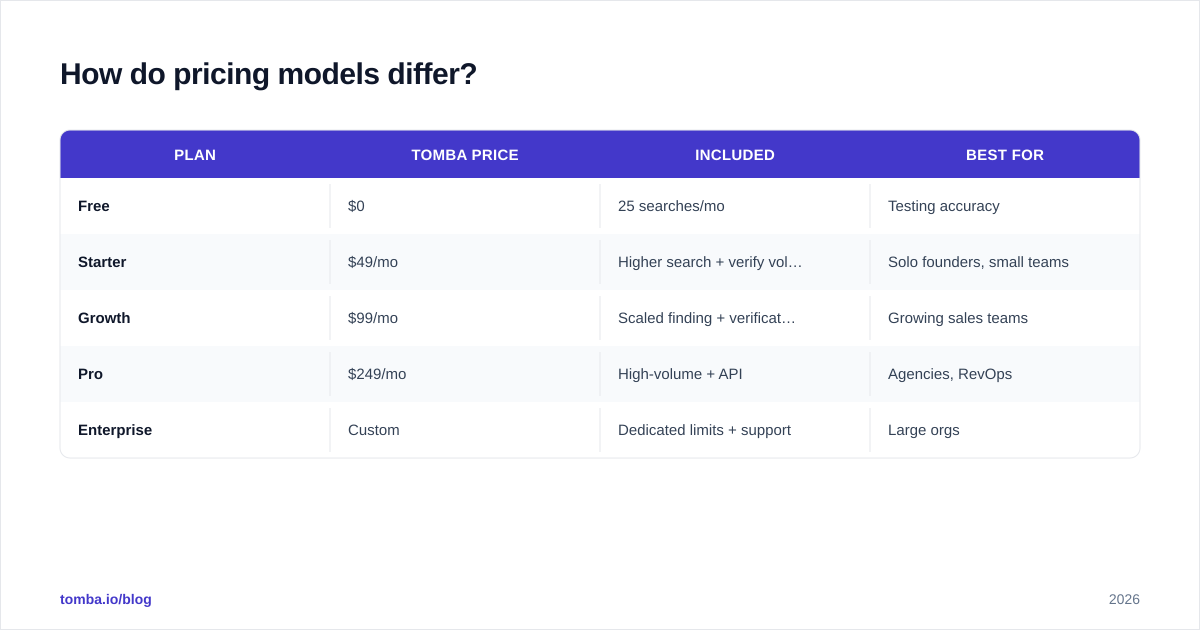
For reference, here is how a focused, transparent alternative stacks up — useful as a price anchor when a database quote comes back high:
| Plan | Tomba price | Included | Best for |
|---|---|---|---|
| Free | $0 | 25 searches/mo | Testing accuracy |
| Starter | $49/mo | Higher search + verify volume | Solo founders, small teams |
| Growth | $99/mo | Scaled finding + verification | Growing sales teams |
| Pro | $249/mo | High-volume + API | Agencies, RevOps |
| Enterprise | Custom | Dedicated limits + support | Large orgs |
See full Tomba pricing for current limits. The point is not that one replaces the other in every case — it is that you should know what accurate contact data should cost before you sign a database contract sized for a team twice yours.
Is Ampliz more accurate than Warpleads?#
Accuracy is not a single number — it depends on the segment. Ampliz tends to be more accurate within its strong segments (healthcare, APAC) because the data is curated and enriched. Warpleads optimizes for breadth, and breadth at volume almost always means a wider accuracy spread: more rows, more decay, more catch-all domains.
But here is the part both vendors gloss over: B2B contact data decays roughly 2–2.5% per month as people change jobs. Even a great database is partly wrong within a quarter. That is why accuracy is a process, not a purchase. You verify at the moment of send, not the moment of export.
That is also why a dedicated verification step matters regardless of which platform you buy. Run exported lists through an email verifier to drop invalid addresses, and use a catch-all verifier to handle the domains that accept everything and tell you nothing. For large pulls from Warpleads especially, bulk verify before the data ever touches your sequencer.
Where do both Ampliz and Warpleads fall short?#
No tool is the whole stack. Honest gaps to plan around:
Ampliz
- Quote-based pricing reduces transparency and slows procurement.
- Strength is concentrated; outside healthcare/APAC, coverage is more ordinary.
- Curation means lower raw volume than pure export tools.
Warpleads
- Volume without built-in send-time verification invites deliverability damage.
- Less depth of intent/firmographic context for true ABM.
- Newer tool with a thinner public track record than incumbents.
Both
- Neither is a sending platform — you still need warmup, sequencing, and inbox monitoring.
- Both benefit from an enrichment and verification layer to close data gaps and protect reputation.
- Pricing and feature tiers shift; always re-check before renewal.
A practical stack looks like: database for discovery (Ampliz or Warpleads, by fit) → verify + enrich → sequencer with proper warmup. Skipping the middle step is the most common reason good lists produce bad results.
Which tool should each team pick?#
- Healthcare / life-sciences sales team: Ampliz. The segment depth pays for itself.
- APAC market-entry team: Ampliz. Regional coverage beats US-centric databases.
- High-volume cold-email agency: Warpleads. Export economics fit the model — paired with strict verification.
- Founder/SMB who just needs reliable emails: Neither full database; a focused email finder plus verifier is cheaper and faster.
- RevOps standardizing data quality: Whichever you buy, add verification and enrichment as a required pipeline stage, not an afterthought.
The bottom line#
Ampliz and Warpleads are not really competitors so much as opposite philosophies: curated precision versus uncapped volume. Pick Ampliz when who you reach drives revenue. Pick Warpleads when how many you reach drives revenue. And in both cases, remember that the database is the start of the workflow, not the end — the data still has to be verified, enriched, and sent well.
If your real bottleneck is simply finding accurate, current email addresses for the companies you already want to reach, start with the Tomba Email Finder. Search by name, domain, or company, verify in the same flow, and pull from transparent, documented data sources — without committing to a full enterprise database before you've proven the use case. Try the free tier first, then scale only if the accuracy earns it.
Ready to find emails that actually work?
Join 150,000+ professionals who stopped guessing and started sending. Free credits on signup — no credit card required.
Get the Tomba newsletter
Practical outbound tactics and product updates — once every two weeks.
About the author