Ampliz vs Webbula 2026: B2B Data & Email Tool Comparison
Ampliz sells B2B contact intelligence; Webbula cleans and enriches email lists. Here's which one fits prospecting, deliverability, and budget in 2026.
Ampliz and Webbula get lumped into the same "B2B data" bucket, but they solve opposite ends of the same pipeline. One helps you find contacts. The other helps you make sure the contacts you already have are real. Picking the wrong one wastes budget and, worse, hides the gap you actually needed to close.
This comparison breaks down what each platform does well, where each falls short, and which one belongs in your stack in 2026 — including where a dedicated email finder fits when neither is the right anchor tool.
TL;DR: Ampliz vs Webbula at a glance#
- Ampliz is a B2B contact-intelligence and lead-database platform, strongest in healthcare data and APAC coverage. Use it to source net-new contacts and firmographics.
- Webbula is an email validation and data-hygiene specialist. Use it to clean, verify, and append data you already collected — not to discover new leads.
- They are complements more often than competitors: Ampliz (or another finder) sources, Webbula scrubs.
- Neither publishes transparent self-serve pricing; both lean toward sales-led, list-based or volume deals.
- If your core problem is finding accurate work emails at scale with predictable pricing, a focused email finder like Tomba is usually a better anchor than either.
What is Ampliz and who is it for?#
Ampliz is a B2B sales-intelligence platform built around a contact and company database. Its pitch is account and contact discovery: search by industry, geography, job title, or technology, then export verified-looking contact records with emails, phone numbers, and firmographic context.
Two things make Ampliz distinct from generic data vendors:
- Healthcare and life-sciences depth. Ampliz markets a dedicated healthcare database (physicians, NPI-linked records, hospital and clinic decision-makers). If you sell into providers, payers, or medical device buyers, that vertical depth is the main reason to look at it.
- APAC and emerging-market coverage. Many US-centric data tools thin out fast outside North America and Western Europe. Ampliz positions itself as stronger in India and the broader Asia-Pacific region.
In practice, you use Ampliz the way you'd use Apollo, Lusha, or ZoomInfo: build a list, enrich it, push it into your CRM or sequencer. It's a sourcing tool. The implied promise is that the data is accurate enough to act on — which is exactly the promise every data vendor makes and the one you should test before committing.
What is Webbula and who is it for?#
Webbula is not in the lead-discovery business. It's a data-quality company. Its flagship work is email verification, hygiene, and enrichment — taking a list you already own and telling you which addresses are deliverable, which are risky, and which are outright traps.
Webbula's calling card is its multi-method approach to email hygiene. Instead of a single syntax-and-MX check, it layers several validation techniques and a large known-threats dataset to catch:
- Hard bounces (dead mailboxes, invalid domains)
- Spam traps and honeypots
- Known complainers and litigators
- Bots and malicious addresses
- Catch-all and role-based risk
On top of verification, Webbula offers demographic and data append — adding attributes (location, company, interests, B2B firmographics) to records you already have. So it spans two jobs: keep your list clean, and make each record richer.
The audience is teams whose pain is deliverability and list rot, not contact discovery. Email marketers sending to large owned databases, agencies protecting sender reputation, and ops teams trying to cut bounce rates before a big send are the natural buyers.
Ampliz vs Webbula: how do they compare directly?#
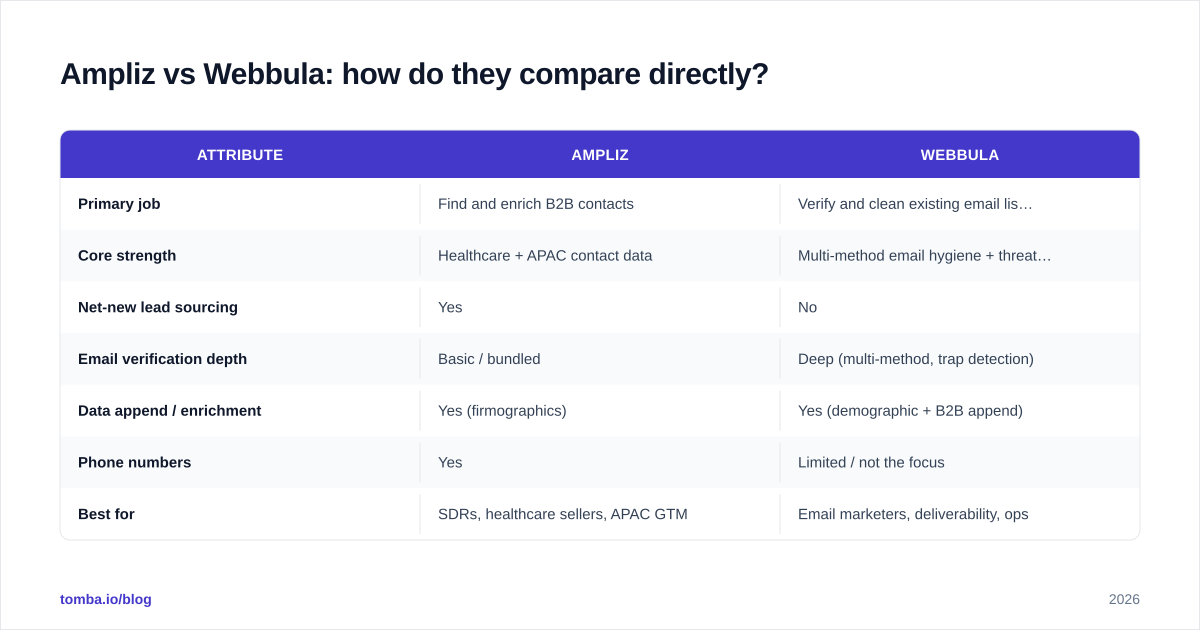
The honest answer is that they're aimed at different stages of the funnel. But buyers still ask "which one," so here's the head-to-head on the attributes that actually drive a decision.
| Attribute | Ampliz | Webbula |
|---|---|---|
| Primary job | Find and enrich B2B contacts | Verify and clean existing email lists |
| Core strength | Healthcare + APAC contact data | Multi-method email hygiene + threat data |
| Net-new lead sourcing | Yes | No |
| Email verification depth | Basic / bundled | Deep (multi-method, trap detection) |
| Data append / enrichment | Yes (firmographics) | Yes (demographic + B2B append) |
| Phone numbers | Yes | Limited / not the focus |
| Best for | SDRs, healthcare sellers, APAC GTM | Email marketers, deliverability, ops |
| Pricing model | Sales-led, list/credit based | Sales-led, volume/list based |
| Self-serve free tier | Limited | No standard free self-serve |
| Weak spot | Coverage outside core verticals | No prospecting / discovery |
The pattern is clear: Ampliz puts contacts in your pipeline; Webbula keeps the contacts you have from poisoning your deliverability. If you only buy one and you have no list yet, you need a sourcing tool, and Webbula won't help. If you already have a million-record database that bounces, Ampliz won't fix that.
Which is more accurate — and how would you even know?#
Accuracy is the whole game, and it's also where marketing claims are least trustworthy. Both vendors will tell you their data is "verified." The useful question is verified how, and how recently.
For a sourcing tool like Ampliz, accuracy means two things: does the contact still work there, and is the email actually deliverable today? B2B data decays fast — people change jobs constantly, and a record that was perfect six months ago is now a bounce. Vertical specialists can be more accurate inside their niche (Ampliz in healthcare) and noticeably worse outside it.
For a hygiene tool like Webbula, accuracy means catching the bad addresses without nuking good ones. The expensive failure mode is a false positive: flagging a deliverable, engaged contact as risky and suppressing them. Webbula's multi-method design exists to reduce exactly that, but no verifier is perfect on catch-all domains, where the server accepts everything and tells you nothing.
The only reliable way to judge either is a controlled test:
- Take a known sample — addresses you've recently emailed and gotten replies from (known-good) plus addresses you know bounced (known-bad).
- Run the sample through the tool.
- Measure how many known-good it kept and how many known-bad it caught.
Don't trust a single accuracy percentage on a landing page. The denominator is never disclosed, and a "98% accurate" claim against an easy list means nothing on your messy real-world data. If you want a deeper benchmark of how finders and verifiers stack up, this comparison is a useful reference point:

Catch-all domains deserve special attention because both tools struggle there in different ways. A dedicated catch-all verifier that scores deliverability probability is often worth bolting on regardless of which platform you choose.
Ampliz vs Webbula pricing: what should you expect to pay?#
Neither company runs a clean, public, self-serve pricing page the way modern PLG tools do. Both lean sales-led, which means quotes depend on volume, contract length, and which datasets you want.
- Ampliz generally sells on a credit or list basis — you pay for contacts revealed or records exported, often with annual commitments for the better rates. Expect a sales call before you see real numbers, and expect healthcare/specialty data to cost more than generic B2B.
- Webbula prices on validation volume — cost per record verified or appended, with tiered rates as volume climbs. One-time list cleans and ongoing API verification are usually priced differently.
The practical takeaway: budget for a quote, not a checkout. And because pricing is opaque, the total cost of getting a usable contact (sourced → verified → deliverable) can balloon once you stack a finder, a verifier, and an enrichment vendor. That stacking cost is the single biggest argument for consolidating where you can.
For comparison, transparent flat-rate tooling exists. Tomba publishes plans openly — a free tier with 25 searches/month, Starter at $49/mo, Growth at $99/mo, and Pro at $249/mo — so you can model cost before talking to anyone. You can see the full breakdown on the Tomba pricing page.

When should you choose Ampliz?#
Choose Ampliz when your bottleneck is finding the right people, and especially when those people are in its strong verticals.
Ampliz is the better pick if:
- You sell into healthcare or life sciences and need physician, hospital, or clinic decision-maker data with vertical depth.
- A meaningful share of your TAM is in India or APAC, where US-first databases get thin.
- You need net-new contacts and firmographics, not just cleaner versions of a list you already have.
- You want phone numbers alongside emails for a multi-channel cadence.
It's the wrong pick if your lists are already large and your real problem is bounce rate, deliverability, or compliance risk. Sourcing more contacts into a leaky list just adds fuel to a fire.
When should you choose Webbula?#
Choose Webbula when your bottleneck is trusting the data you already have.
Webbula is the better pick if:
- You send to a large owned database and bounce rates or spam complaints are hurting email deliverability.
- You need to scrub spam traps, complainers, and known-threat addresses before a major campaign — the stuff a basic syntax check misses.
- You want demographic or firmographic append to enrich records you've collected through forms, events, or partnerships.
- Protecting your domain's sender reputation is a board-level concern, not a nice-to-have.
It's the wrong pick if you have no list yet, or if your list is small and clean and you simply need more prospects. Webbula makes good data better; it doesn't manufacture leads.
Can you use Ampliz and Webbula together?#
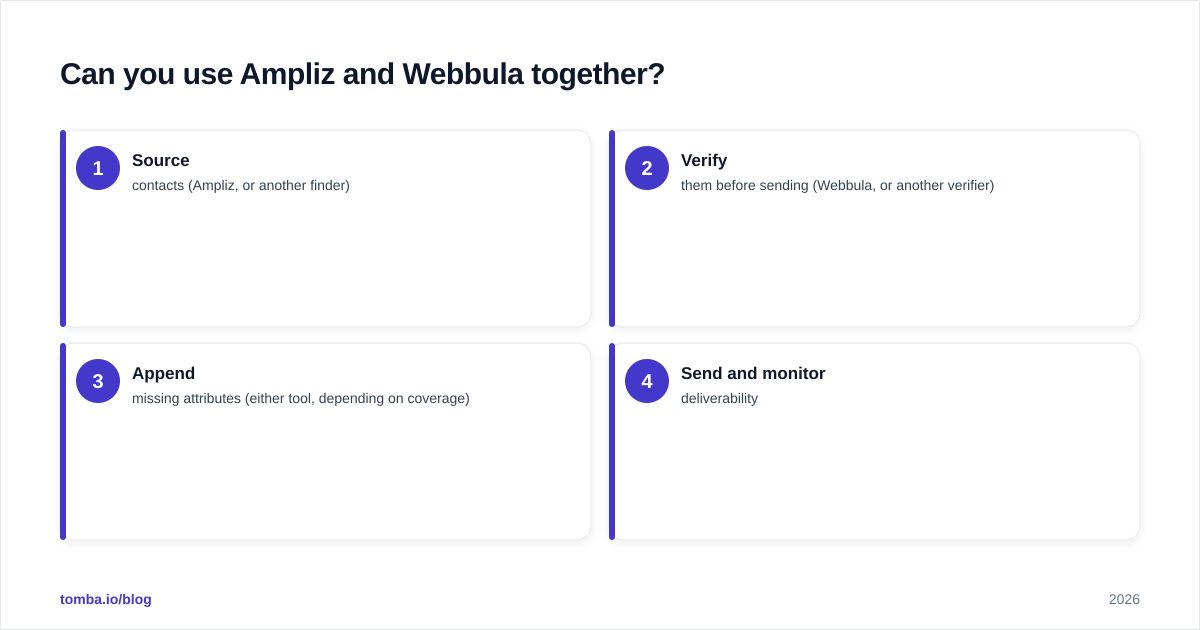
Yes — and for many teams that's the honest answer. They occupy adjacent links in the same chain:
- Source contacts (Ampliz, or another finder)
- Verify them before sending (Webbula, or another verifier)
- Append missing attributes (either tool, depending on coverage)
- Send and monitor deliverability
The friction is cost and integration overhead. Running two sales-led vendors means two contracts, two data formats to reconcile, and two pricing models to forecast. That's defensible at enterprise scale where the verticals demand it. For most mid-market teams it's heavier than necessary.
This is where a consolidated platform changes the math. If a single tool can find the email and verify it and enrich the record with transparent pricing, you collapse three line items into one. That doesn't make Ampliz or Webbula bad — it makes them specialists you add only when a specialist is genuinely required.
Where does a dedicated email finder fit?#
Most teams comparing Ampliz and Webbula are really asking a simpler question: how do I get accurate, deliverable B2B emails without overpaying or overcomplicating my stack?
That's the job an email finder is built for. Instead of buying a healthcare-specialty database you don't need, or a heavyweight hygiene suite for a list you don't have yet, you start with a tool that:
- Finds professional emails by name, company, or domain search
- Verifies deliverability in the same workflow with an email verifier
- Enriches records and pulls phone numbers when you need multi-channel
- Prices transparently so finance can model it
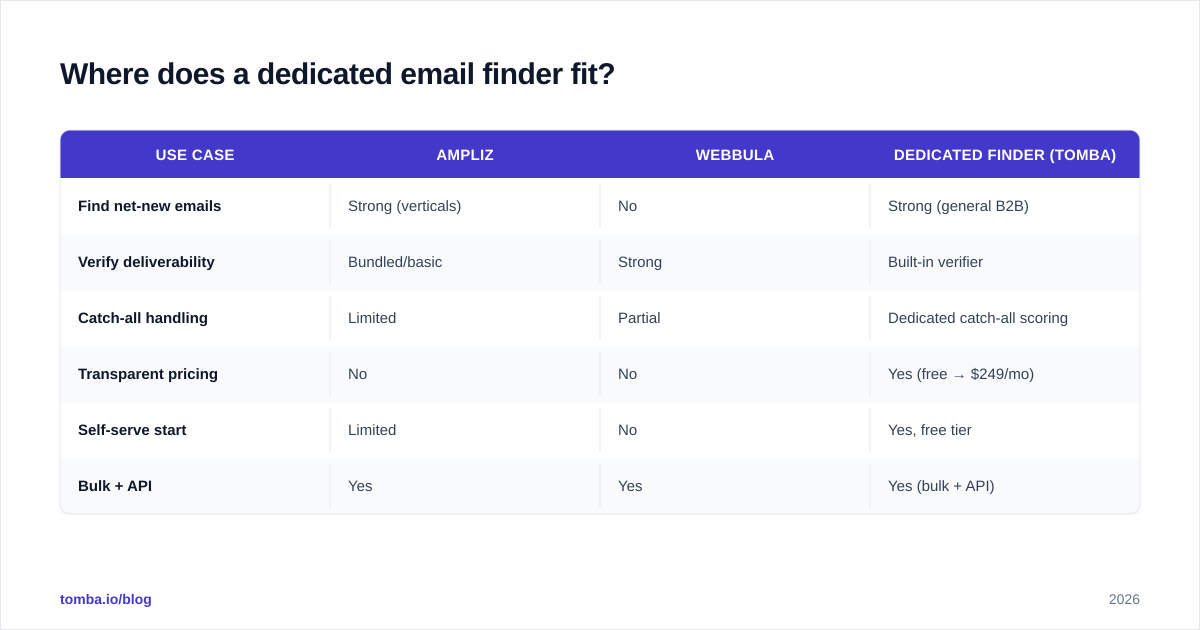
Here's how the consolidated approach compares against buying point solutions:
| Use case | Ampliz | Webbula | Dedicated finder (Tomba) |
|---|---|---|---|
| Find net-new emails | Strong (verticals) | No | Strong (general B2B) |
| Verify deliverability | Bundled/basic | Strong | Built-in verifier |
| Catch-all handling | Limited | Partial | Dedicated catch-all scoring |
| Transparent pricing | No | No | Yes (free → $249/mo) |
| Self-serve start | Limited | No | Yes, free tier |
| Bulk + API | Yes | Yes | Yes (bulk + API) |
For sourcing volume without a sales call, the bulk email finder and the email finder API cover both manual list-building and programmatic enrichment. You can also validate an existing list cheaply before committing to a heavyweight hygiene contract.
The bottom line: Ampliz vs Webbula in 2026#
Ampliz and Webbula aren't really rivals — they're specialists at opposite ends of the data pipeline. Pick Ampliz when you need to find contacts and your buyers live in healthcare or APAC. Pick Webbula when you need to clean and enrich a list you already own and deliverability is on the line. Run both only when the verticals and volume justify two sales-led contracts.
But if you're a mid-market sales or growth team whose actual problem is "get accurate work emails, verify them, and not blow the budget," neither point solution is the most efficient anchor. Start with a finder that does discovery and verification in one place, then add a specialist only when a specific gap — deep healthcare data, enterprise-grade hygiene — forces your hand.
Want to test that approach before talking to anyone? Try the Tomba Email Finder free — 25 searches a month, no sales call, deliverability scoring built in. Source, verify, and enrich from a single platform, then layer Ampliz or Webbula on top only if your use case genuinely demands a specialist.
// get started
Find, verify and enrich your first contacts today
Start on the free plan with 25 searches a month, then scale when your team is ready.
Free plan · No credit card required · GDPR & CCPA
// about the author