Ampliz vs Xverum 2026: B2B Data Provider Comparison
Ampliz vs Xverum compared for 2026: data coverage, freshness, pricing, delivery, and which B2B data provider fits your go-to-market motion.
Choosing a B2B data provider is less about who has "more contacts" and more about whose data fits the way your team actually works. Ampliz and Xverum both sell company and contact intelligence, but they solve different problems: one leans toward curated, persona-ready contact records, the other toward large-scale, structured web data you pipe into your own systems.
This guide breaks down where each tool wins, where each falls short, and how to decide without a 30-day trial of regret.
TL;DR#
- Ampliz is a sales-intelligence platform with a strong healthcare and APAC contact focus, browser-based prospecting, and human-assisted data requests — good for reps who want ready-to-call records.
- Xverum is a B2B data-as-a-service provider built for scale: company profiles, contact datasets, and web-scraped feeds delivered via API or bulk export — good for data teams and enrichment pipelines.
- Pricing models differ fundamentally: Ampliz sells credit-based seats; Xverum sells dataset access and volume-based feeds, often as a flat subscription.
- Freshness and delivery are the real decision axis: pick Ampliz for guided in-tool prospecting, Xverum for programmatic bulk ingestion.
- Whichever you choose, verify before you send — no provider is 100% accurate, so a dedicated email verifier belongs in your stack either way.
What are Ampliz and Xverum?#
Ampliz positions itself as a B2B sales-intelligence and contact-data platform. Its best-known strength is depth in healthcare data (the "Ampliz Healthcare Intelligence" product) and broader coverage across the Asia-Pacific region, where many US-centric databases thin out. You search for accounts and personas, pull contact details, and — when a record is missing — request a custom data pull that a team helps fulfill. You can read its positioning on the Ampliz homepage.
Xverum is a B2B data-as-a-service provider. Instead of a rep-facing prospecting cockpit, the core offering is structured data at scale: company datasets, professional-profile data, and continuously refreshed web feeds you consume through an API or scheduled bulk delivery. The audience is data engineers, RevOps teams, and product builders who want raw, queryable data rather than a UI to click through. See the Xverum homepage for its dataset catalog.
In one line: Ampliz hands a rep a list; Xverum hands an engineer a pipeline.
)
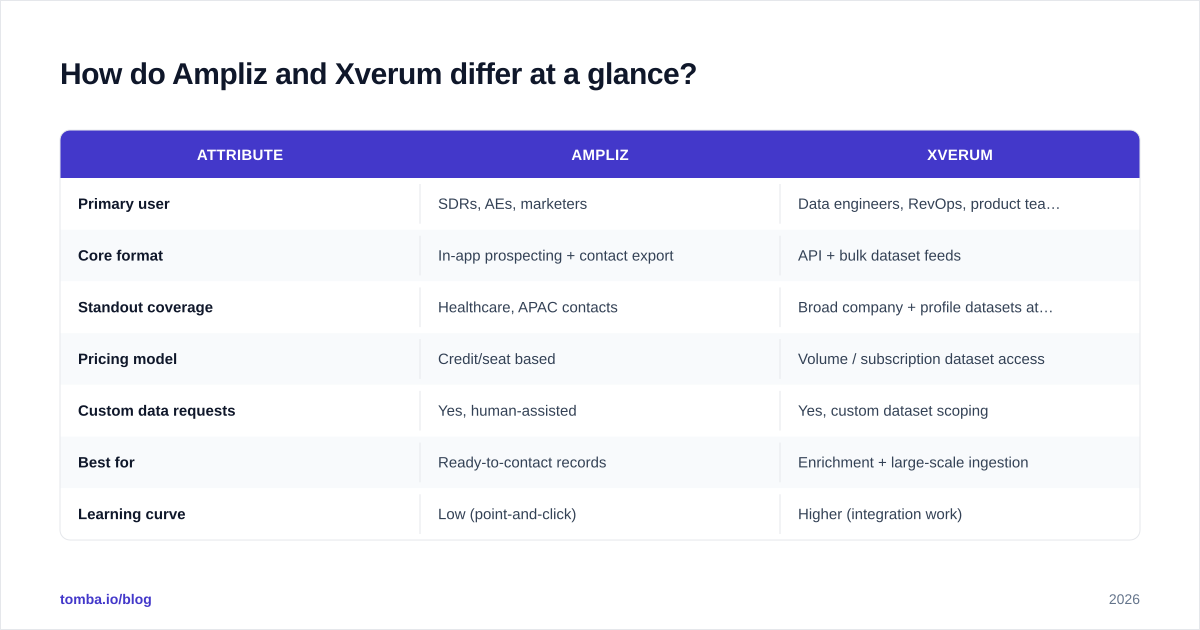
How do Ampliz and Xverum differ at a glance?#
| Attribute | Ampliz | Xverum |
|---|---|---|
| Primary user | SDRs, AEs, marketers | Data engineers, RevOps, product teams |
| Core format | In-app prospecting + contact export | API + bulk dataset feeds |
| Standout coverage | Healthcare, APAC contacts | Broad company + profile datasets at scale |
| Pricing model | Credit/seat based | Volume / subscription dataset access |
| Custom data requests | Yes, human-assisted | Yes, custom dataset scoping |
| Best for | Ready-to-contact records | Enrichment + large-scale ingestion |
| Learning curve | Low (point-and-click) | Higher (integration work) |
The table makes the split obvious. If your team lives in a CRM and wants contacts they can email today, Ampliz's model is friendlier. If you're building an internal data product, scoring leads at scale, or feeding a warehouse, Xverum's delivery model removes the manual export tax.
What data does Ampliz provide?#
Ampliz centers on contact and account records you can act on inside its interface. Typical fields include name, title, company, email, phone, and firmographics, with persona and intent layers depending on plan.
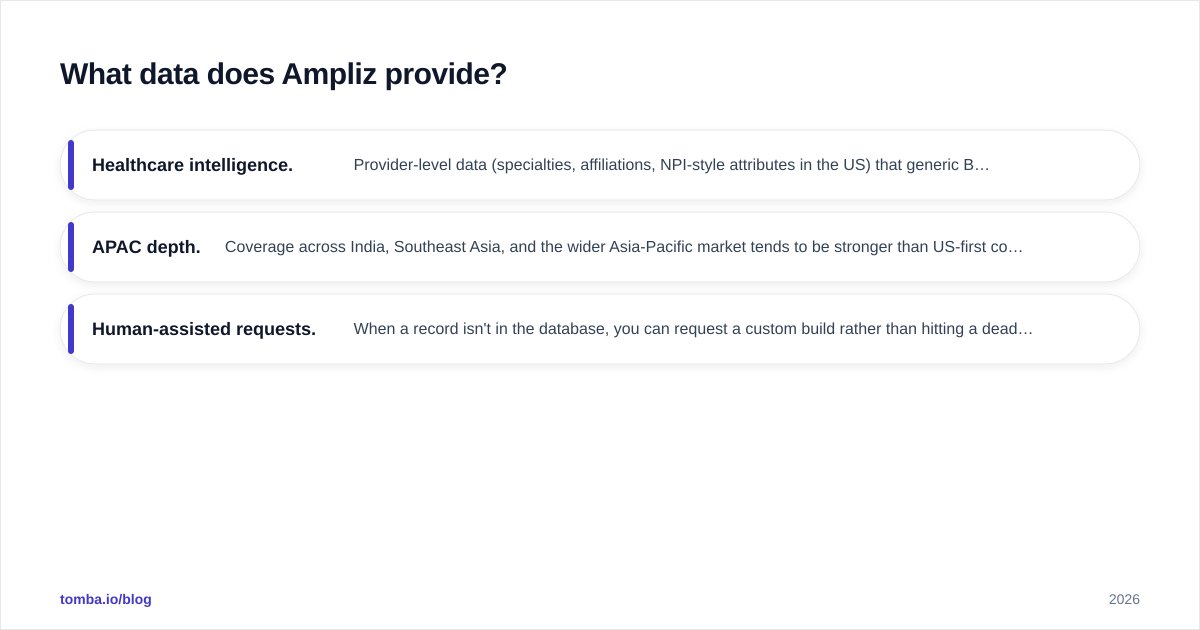
Its differentiators:
- Healthcare intelligence. Provider-level data (specialties, affiliations, NPI-style attributes in the US) that generic B2B databases rarely match. If you sell into hospitals, clinics, pharma, or medical devices, this is the headline reason to look at Ampliz.
- APAC depth. Coverage across India, Southeast Asia, and the wider Asia-Pacific market tends to be stronger than US-first competitors.
- Human-assisted requests. When a record isn't in the database, you can request a custom build rather than hitting a dead end.
The trade-off: Ampliz is a curated, request-driven model. That's a feature when you need quality on a specific niche, and a constraint when you need millions of rows yesterday. Independent reviews on G2 are a useful sanity check on coverage claims before you commit.
What data does Xverum provide?#
Xverum sells datasets, not seats. The catalog typically spans:
- Company data — firmographics, technographics, industry, size, location, and web presence.
- Professional / contact profile data — role, seniority, and company linkage sourced from public web data at scale.
- Fresh web feeds — continuously updated extracts you subscribe to, so your copy of the data doesn't rot between quarterly refreshes.
Delivery is the point. You query an API, schedule a bulk drop, or scope a custom dataset to your ICP, then load it straight into your warehouse, CRM, or scoring model. For a data team, that removes the copy-paste-and-clean loop entirely.
The trade-off runs the other direction from Ampliz: there's no hand-holding prospecting cockpit, and you'll do integration work before value shows up. If nobody on your team writes SQL or wires an API, the time-to-value is longer.
How does pricing compare?#
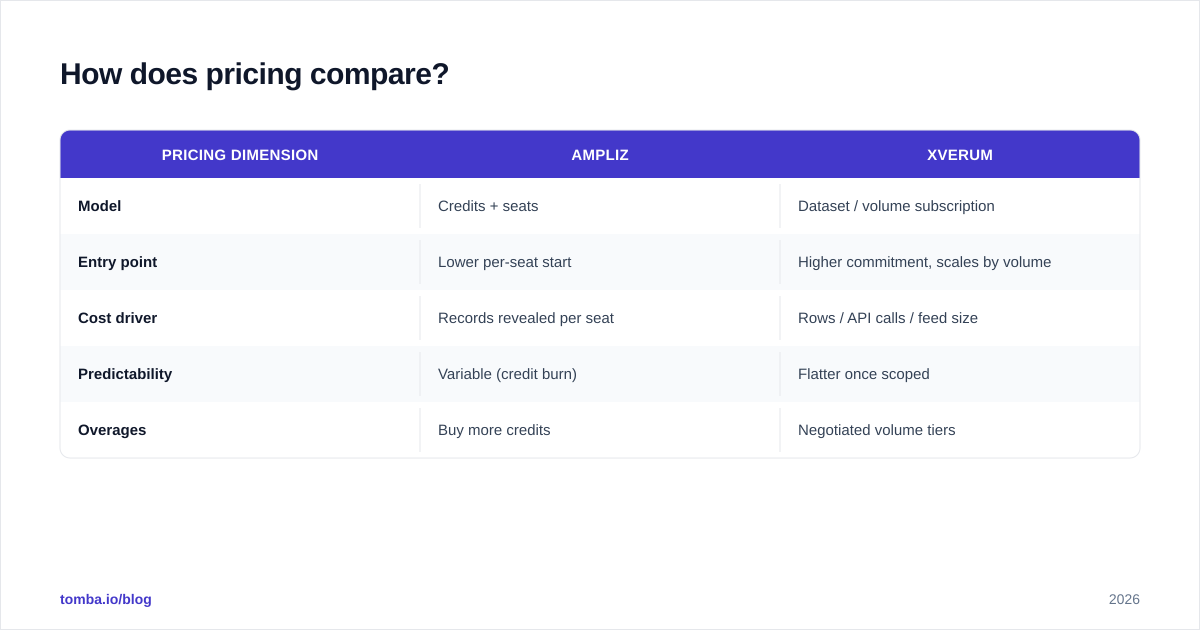
Neither vendor publishes simple flat numbers for every tier — both lean on "talk to sales" for serious volume — but the models are clear and they matter more than the sticker.
| Pricing dimension | Ampliz | Xverum |
|---|---|---|
| Model | Credits + seats | Dataset / volume subscription |
| Entry point | Lower per-seat start | Higher commitment, scales by volume |
| Cost driver | Records revealed per seat | Rows / API calls / feed size |
| Predictability | Variable (credit burn) | Flatter once scoped |
| Overages | Buy more credits | Negotiated volume tiers |
The practical read: Ampliz is cheaper to start and easy to over-spend on if your reps burn credits fast. Xverum costs more to begin but gets more predictable per record once you're ingesting volume. A team pulling 500 hand-picked healthcare contacts a month will pay less with Ampliz; a team enriching 2 million records a quarter will almost always pay less per row with Xverum.
)
Which is better for your use case?#
Match the tool to the motion, not the marketing.
Choose Ampliz if:
- You sell into healthcare or APAC markets specifically.
- Your reps prospect inside a UI and want export-ready contacts.
- You value human-assisted custom pulls over self-serve scale.
- Your volume is moderate and persona-precise.
Choose Xverum if:
- You're feeding a data warehouse, lead-scoring model, or internal product.
- You need fresh, structured data via API or scheduled bulk delivery.
- Your team can handle integration work to unlock lower per-record cost.
- You operate at scale where manual exports don't survive contact with reality.
A simple decision sequence helps here.
Ask, in order: Is my ICP healthcare or APAC? If strongly yes, Ampliz earns a serious look. Do I consume data in a UI or a pipeline? UI points to Ampliz, pipeline to Xverum. What's my monthly volume? Low-to-mid favors Ampliz economics; high favors Xverum's. Three questions usually settle it.
How fresh is the data, really?#
Freshness is where most B2B data buyers get burned, and it's the axis where these two genuinely diverge.
Xverum's pitch leans on continuously refreshed feeds — the whole reason to buy data-as-a-service is that your copy stays current instead of decaying between manual refreshes. If your use case is enrichment that has to stay accurate (deduping, scoring, routing), that recurring refresh is the product.
Ampliz's curated + request model means individual records can be high quality, but your exported list is a point-in-time snapshot. People change jobs roughly every couple of years, so a list exported in Q1 is measurably staler by Q3 regardless of how good it was on day one.
Neither model removes the need to validate at send time. Job changes, typos, and catch-all domains slip through every provider. Running contacts through an email verifier before a campaign — and a catch-all verifier for ambiguous domains — protects your sender reputation no matter which database the data came from. If you want background on the underlying data pipeline, Tomba documents where its data comes from.
Where do dedicated email finders fit in?#
Both Ampliz and Xverum are databases — you query what they already hold. That's powerful for coverage, but it has a blind spot: the specific person who isn't in either index yet.
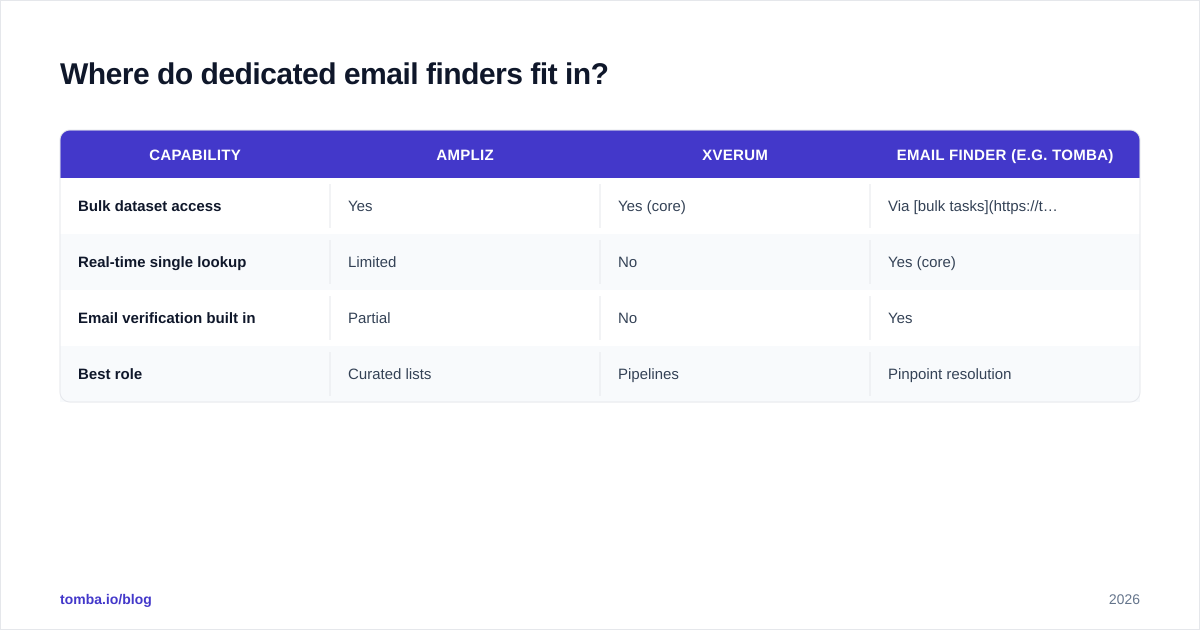
That's the gap a real-time email finder fills. When you have a name and a domain — a founder you saw on a podcast, an author of a study, a hiring manager from a job post — a finder resolves the address on demand instead of hoping a static dataset already cataloged them. It's complementary, not competitive: use a bulk database for volume, use a finder for the precise, high-value contacts that volume databases miss.
| Capability | Ampliz | Xverum | Email finder (e.g. Tomba) |
|---|---|---|---|
| Bulk dataset access | Yes | Yes (core) | Via bulk tasks |
| Real-time single lookup | Limited | No | Yes (core) |
| Email verification built in | Partial | No | Yes |
| Best role | Curated lists | Pipelines | Pinpoint resolution |
Many teams run all three layers: a scale database for the long tail, a finder for named targets, and a verifier as the gate before anything gets sent.
Frequently asked questions#
Is Ampliz or Xverum more accurate? It depends on segment. Ampliz tends to be more accurate inside its healthcare/APAC niches because the data is curated; Xverum tends to be more consistent at scale because feeds refresh continuously. Always verify a sample before buying volume.
Can I use both together? Yes, and many do. Use Xverum for warehouse-scale enrichment and Ampliz for rep-driven prospecting in healthcare/APAC. They overlap less than they appear.
Do either replace an email verifier? No. Treat verification as a separate, mandatory step. Database accuracy degrades over time, so validate at send time regardless of source.
Which has the lower total cost? Low-to-moderate, persona-precise usage favors Ampliz. High-volume, pipeline-driven usage favors Xverum's per-record economics once scoped.
The bottom line#
Ampliz and Xverum aren't really competing for the same buyer. Ampliz is the better pick for reps who want curated, ready-to-contact records in healthcare and APAC. Xverum is the better pick for data teams who want fresh, structured data delivered programmatically at scale. Decide by your delivery model and volume first; let coverage claims be the tiebreaker, not the headline.
Whichever database you land on, the contacts you can't find in a static index — and the addresses you must confirm before sending — are still on you. That's where Tomba slots in. Use the Tomba Email Finder to resolve the named, high-value prospects no bulk dataset has indexed yet, pair it with built-in verification to keep your sender reputation clean, and check the Tomba pricing tiers — starting free with 25 searches a month and scaling from $49/mo — to layer pinpoint accuracy on top of whatever database you choose. Start free, find the contacts that matter, and verify everything before it hits send.
// get started
Find, verify and enrich your first contacts today
Start on the free plan with 25 searches a month, then scale when your team is ready.
Free plan · No credit card required · GDPR & CCPA
// about the author