Ampliz vs Zintlr: B2B Data Platform Comparison (2026)
Ampliz leans healthcare and APAC data; Zintlr pushes personality-led prospecting. Here's an honest 2026 breakdown of coverage, accuracy, pricing, and the best fit for your team.
Choosing between Ampliz and Zintlr usually comes down to one question your sales ops lead keeps asking: which one actually returns usable contacts for your market? Both sell themselves as B2B sales intelligence platforms, but they were built for different buyers. This breakdown cuts through the marketing pages and shows you where each tool earns its seat in your stack.
TL;DR — Ampliz vs Zintlr at a glance#
- Ampliz is strongest for healthcare/life-sciences targeting and APAC + global firmographic coverage, with a credit-based model and a research-team option for custom list building.
- Zintlr leans into "personality intelligence" and intent, pairing contact data with behavioral and psychographic signals aimed at faster, more personalized outbound.
- Accuracy is comparable on paper; both depend heavily on your ICP region. Neither replaces an independent verification step before you send.
- Pricing is opaque on both sides — expect to talk to sales for anything beyond entry tiers. Budget for credits, not flat seats.
- Best combo for most teams: use either platform for discovery, then run every address through a dedicated email verifier so bounce rates stay under control.
What are Ampliz and Zintlr, really?#
Ampliz is a B2B data and sales intelligence provider that made its name in healthcare and life-sciences contact data — think physicians, hospital decision-makers, and pharma — before expanding into broader global firmographics with a noted strength in Asia-Pacific markets. You can read their positioning on the official Ampliz site. Its core selling points are regional depth and a managed data-research service for teams that want lists built to spec rather than self-served.
Zintlr is a newer entrant that frames itself around "personality intelligence." Beyond standard contact and company data, it surfaces psychographic and behavioral signals — communication style, likely motivators — and bundles intent data to help reps personalize the first touch. The pitch on the official Zintlr site is speed: find a prospect, understand how to talk to them, and reach out in one motion.
The practical difference: Ampliz optimizes for who and where (vertical and geographic precision), while Zintlr optimizes for how to approach (personalization layer on top of contact data).
How do Ampliz and Zintlr compare on features?#
Here's the side-by-side that matters when you're scoring tools against your ICP. Treat vendor-published numbers as directional — coverage claims rarely survive contact with a niche segment.
| Attribute | Ampliz | Zintlr |
|---|---|---|
| Primary strength | Healthcare/life-sciences + APAC firmographics | Personality + intent-led prospecting |
| Data types | Emails, direct dials, firmographics, technographics | Emails, phone, firmographics, psychographic signals |
| Standout feature | Managed data-research team for custom lists | "Personality intelligence" enrichment |
| Intent data | Limited / add-on | Built into core positioning |
| Geographic sweet spot | APAC, India, global healthcare | Global, growing |
| Chrome extension | Yes | Yes |
| Pricing transparency | Low (sales-led) | Low (sales-led) |
| Free trial / tier | Limited trial | Limited free plan |
| Best for | Vertical-specific outbound, regional ABM | SDR teams wanting fast personalization |
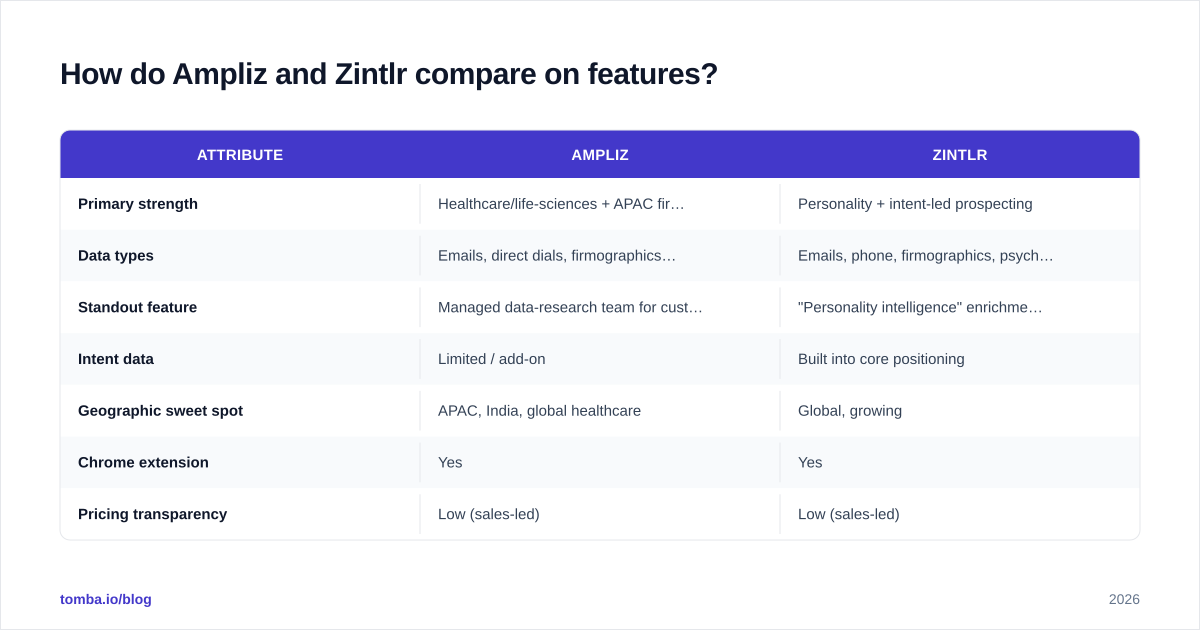
The honest read: if your motion is "sell medical devices to hospital procurement leads across India and Southeast Asia," Ampliz has a structural edge. If your motion is "high-volume SDR outbound where reply rate hinges on the first line feeling human," Zintlr's personalization layer is the more interesting bet.
Which platform has more accurate data?#
Neither vendor will hand you an independent accuracy audit, so anchor on method instead of marketing. Accuracy in B2B data is a function of three things: how fresh the source is, how often records are re-validated, and whether the address survives an SMTP check at send time.
Ampliz's managed-research option can produce very clean lists for narrow asks because a human is curating them — but that quality doesn't automatically extend to the entire self-serve database. Zintlr's enrichment is broader and more automated, which is great for speed and less predictable on long-tail records.
Two things are true for both: data decays at roughly 2–3% per month as people change jobs, and a "found" email is not a "deliverable" email. That's why mature teams treat any provider — Ampliz, Zintlr, Apollo, ZoomInfo — as a discovery layer and verify downstream. Running discovered contacts through a verification pass and good data enrichment before they hit your sequencer is the single biggest lever on bounce rate.
If you want to understand why even a "95% accurate" database still produces hard bounces, it's the catch-all problem and stale-record problem stacking. A quick pass through a catch-all verifier on ambiguous domains catches the addresses that look valid but silently dump your mail.
How do Ampliz and Zintlr pricing models compare?#
Both companies keep pricing behind a "contact sales" wall for serious volume, which makes apples-to-apples hard. From publicly visible plans and user reports on directories like G2, the shape looks like this:
| Tier | Ampliz (typical) | Zintlr (typical) |
|---|---|---|
| Entry | Credit packs / limited trial | Limited free plan |
| Mid | Sales-quoted, credit-based | Per-user + credits |
| Enterprise | Custom, includes research team | Custom, intent add-ons |
| Billing model | Credits per contact reveal | Credits + seats |
| Gotcha to watch | Research service priced separately | Intent data can be an upsell |
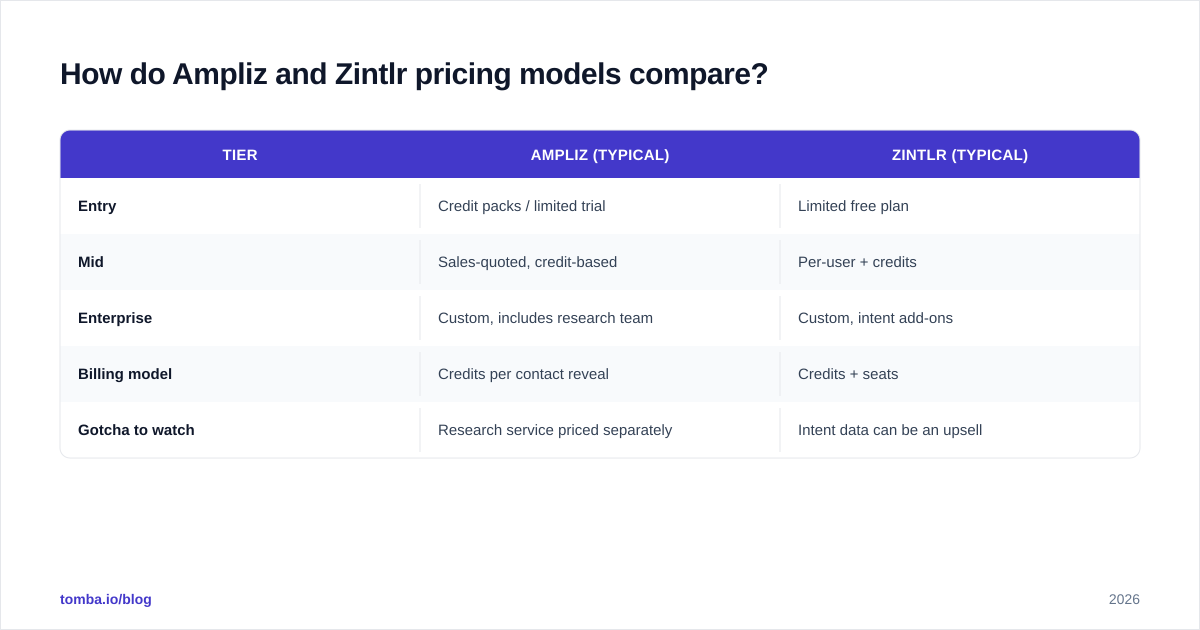
The credit model is where budgets quietly blow up. A "5,000 credit" plan sounds generous until half your reveals return records you don't use, or you re-reveal the same contact across campaigns. Before committing, ask both vendors two questions: do unused credits roll over, and are partial/incomplete records charged the same as full ones?
For comparison, transparent flat pricing exists elsewhere in the market — for example, Tomba pricing publishes its tiers openly (Free at 25 searches/mo, Starter $49/mo, Growth $99/mo, Pro $249/mo). You don't have to switch vendors to use that as a negotiating anchor: a published number gives you leverage in a sales-led quote.
When should you choose Ampliz over Zintlr?#
Pick Ampliz when:
- Your ICP is healthcare or life sciences. This is its founding vertical and the coverage shows, especially for clinical and hospital roles.
- You sell into APAC or India. Regional depth is a real differentiator here versus US-centric databases.
- You want done-for-you lists. The managed research team is valuable when your asks are specific and your internal ops bandwidth is thin.
- You run account-based plays in a defined territory and need firmographic precision more than personalization gimmicks.
Ampliz is the safer pick when coverage of a hard-to-reach segment is the bottleneck — because no amount of personality data helps if the contact simply isn't in the database.
When should you choose Zintlr over Ampliz?#
Pick Zintlr when:
- Reply rate is your constraint, not list size. The personality/psychographic layer is built to make first touches land.
- You run high-volume SDR outbound and want intent signals baked into prospecting rather than bolted on.
- Your team values speed-to-personalization — finding a lead and knowing how to frame the pitch in the same workflow.
- You're targeting broad B2B segments where deep vertical coverage matters less than approach quality.
Zintlr is the more compelling choice for modern outbound teams chasing response rate gains through relevance, where the differentiator is the message, not the raw count of contacts.

What do Ampliz and Zintlr have in common — and where do both fall short?#
Both tools share the same core gaps, and naming them keeps your expectations honest:
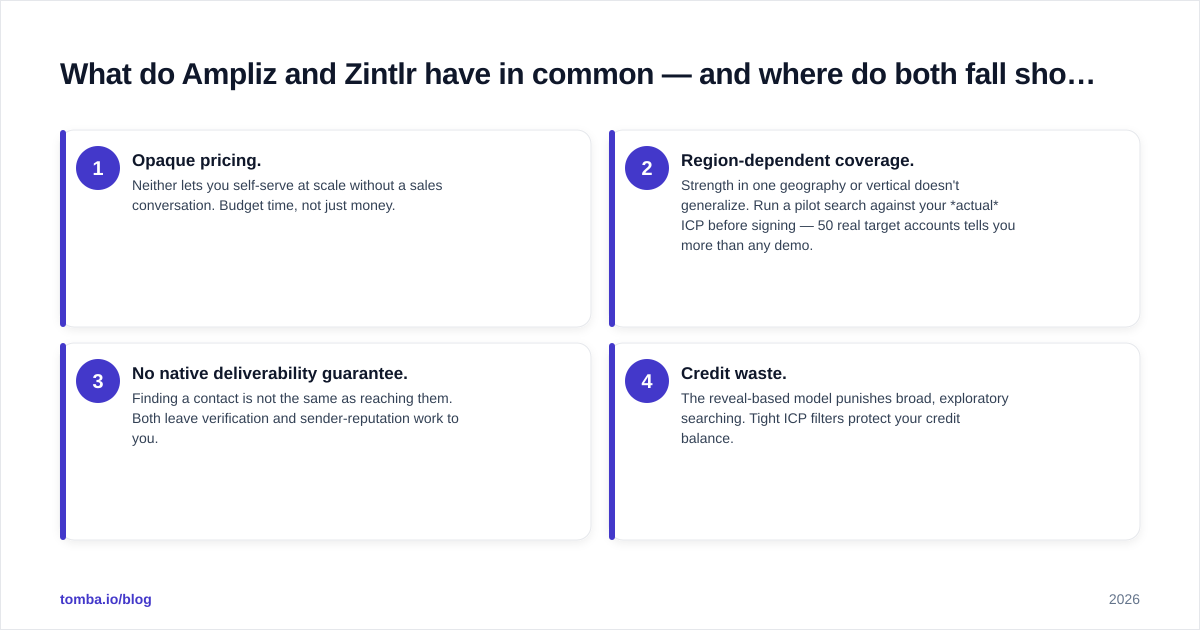
- Opaque pricing. Neither lets you self-serve at scale without a sales conversation. Budget time, not just money.
- Region-dependent coverage. Strength in one geography or vertical doesn't generalize. Run a pilot search against your actual ICP before signing — 50 real target accounts tells you more than any demo.
- No native deliverability guarantee. Finding a contact is not the same as reaching them. Both leave verification and sender-reputation work to you.
- Credit waste. The reveal-based model punishes broad, exploratory searching. Tight ICP filters protect your credit balance.
The fix for #3 and part of #4 is the same: bolt a verification and finding layer onto whichever platform you choose. If a record comes back without an email, a dedicated email finder can recover it from the domain and name, and a verification pass strips the addresses that would bounce — so you're not burning credits and sender reputation on dead contacts. Pairing discovery with an independent B2B database for fallback coverage closes most of the gaps either tool leaves open.
How should you actually test Ampliz vs Zintlr?#
Don't trust the demo — trust a controlled bake-off. Here's a one-week test that costs almost nothing and ends the debate:
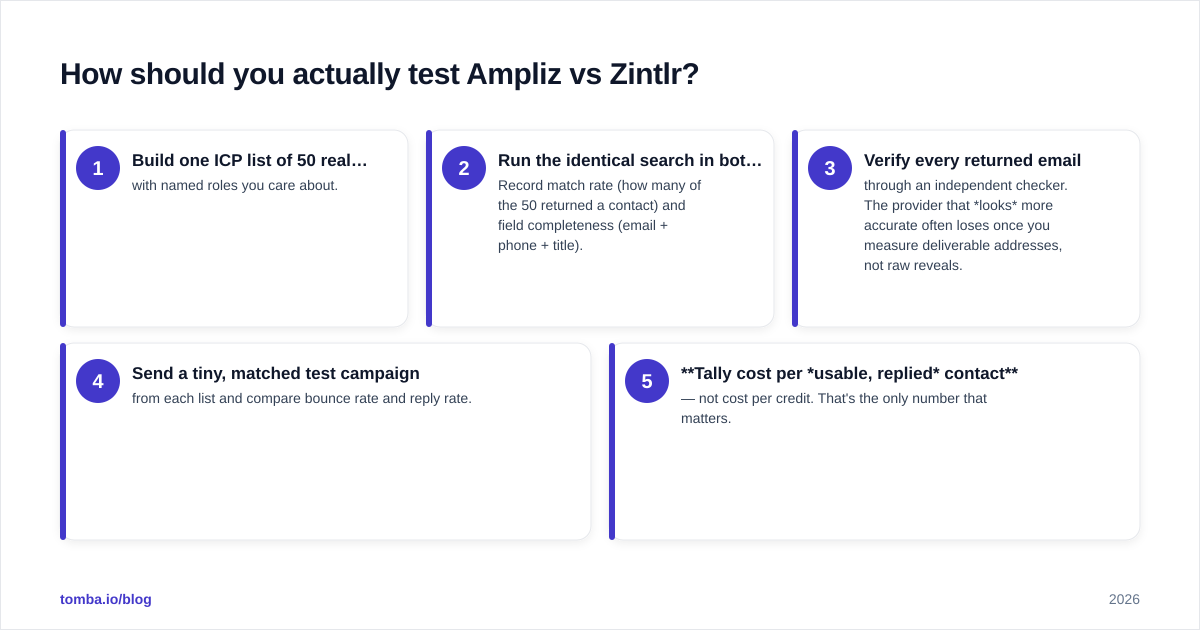
- Build one ICP list of 50 real target accounts with named roles you care about.
- Run the identical search in both tools. Record match rate (how many of the 50 returned a contact) and field completeness (email + phone + title).
- Verify every returned email through an independent checker. The provider that looks more accurate often loses once you measure deliverable addresses, not raw reveals.
- Send a tiny, matched test campaign from each list and compare bounce rate and reply rate.
- Tally cost per usable, replied contact — not cost per credit. That's the only number that matters.
This method neutralizes marketing claims because you're measuring outcomes on your own pipeline. Nine times out of ten the "winner" depends entirely on your region and vertical — which is exactly why a generic ranking can't decide this for you.
Verdict: Ampliz vs Zintlr in 2026#
There's no universal winner, and any post that declares one is selling you something. Choose Ampliz if your edge comes from reaching hard-to-find contacts in healthcare or APAC, or you want curated lists built for you. Choose Zintlr if your edge comes from personalized, intent-driven outbound at volume and you want the "how to pitch" layer included.
What both leave to you is the part that actually protects your domain and your numbers: verification and finding. A great list still bounces if you skip the deliverability step, and credit-based tools make every wasted send more expensive.
That's where it pays to add a focused finding-and-verification layer on top of whichever intelligence platform you pick. Tomba's Email Finder recovers missing professional emails by domain, name, or company and pairs with built-in verification, so the contacts you pull from Ampliz or Zintlr arrive clean and ready to sequence — fewer bounces, healthier sender reputation, and far less wasted spend. Start free with 25 searches a month, then scale on transparent pricing as your outbound grows.
Ready to find emails that actually work?
Join 150,000+ professionals who stopped guessing and started sending. Free credits on signup — no credit card required.
Get the Tomba newsletter
Practical outbound tactics and product updates — once every two weeks.
About the author