Ampliz vs ZoomInfo 2026: Which B2B Data Tool Wins?
Ampliz vs ZoomInfo compared on data accuracy, coverage, pricing, and APAC vs US strength. See which B2B data platform fits your team in 2026 — and the cheaper third option.
Choosing between Ampliz and ZoomInfo usually comes down to one question that the sales pages dodge: how much B2B data do you actually need, and how much are you willing to commit up front to get it? One is a focused, APAC-strong healthcare-and-tech data provider you can start small with. The other is the heavyweight US-centric platform that wants an annual contract before you see a single record.
This is a neutral breakdown — accuracy, coverage, pricing, support, and the use cases each tool genuinely wins. We'll also flag where a pay-as-you-go email finder beats both for teams that just need verified contacts without a platform-sized invoice.
TL;DR#
- ZoomInfo is the deeper, broader dataset — strongest in North America, richest in intent signals, org charts, and firmographics. It's also the most expensive, with annual contracts that commonly start around $15,000/year.
- Ampliz is the lighter, more affordable challenger — notably strong in APAC and healthcare (the "Ampliz SalesBuddy" and HealthCare Intelligence products), with flexible credit-based pricing and no five-figure floor.
- Accuracy is comparable on core US firmographics; ZoomInfo edges ahead on depth and freshness, Ampliz holds its own on niche APAC and healthcare contacts.
- Pick ZoomInfo if you're an enterprise GTM team that lives on intent data and integrations. Pick Ampliz if you target APAC/healthcare and want to start cheap.
- If you only need verified email addresses at a fair price, a dedicated tool like Tomba's email finder covers that job for a fraction of either platform.
What are Ampliz and ZoomInfo?#
ZoomInfo is the market-leading B2B data and go-to-market intelligence platform. It combines a massive contact database with buyer-intent signals, technographics, org charts, website-visitor tracking, and a sales-engagement layer (ZoomInfo Sales, formerly part of the broader ZoomInfo platform). Public since 2020, it's the default "data spine" for many mid-market and enterprise revenue teams in the US.
Ampliz is a B2B data provider best known for two things: its APAC coverage and its healthcare intelligence dataset. The flagship products are SalesBuddy (a Chrome extension that surfaces contact and company data while you browse) and the HealthCare Intelligence database aimed at medtech, pharma, and provider-targeting teams. It positions itself as the accessible, region-aware alternative to the US incumbents.
Think of it like buying a vehicle. ZoomInfo is the fully loaded enterprise van — every feature, every seat, and a price to match. Ampliz is the efficient compact that gets you where you're going, especially on roads (APAC, healthcare) the van wasn't built for.
How do Ampliz and ZoomInfo compare at a glance?#
| Attribute | Ampliz | ZoomInfo |
|---|---|---|
| Best for | APAC + healthcare targeting, SMB budgets | US enterprise GTM, intent-driven outbound |
| Database size | ~120M+ contacts (regionally concentrated) | 260M+ contacts, 100M+ companies |
| Strongest region | APAC, India, Middle East | North America |
| Intent data | Limited | Extensive (proprietary + Bombora) |
| Pricing model | Credit-based, flexible tiers | Annual contract, platform license |
| Typical entry cost | Hundreds to low thousands/yr | ~$15,000/yr and up |
| Free trial | Yes (limited credits) | Demo / limited trial |
| Chrome extension | SalesBuddy | ReachOut |
| Healthcare dataset | Dedicated product | General coverage |
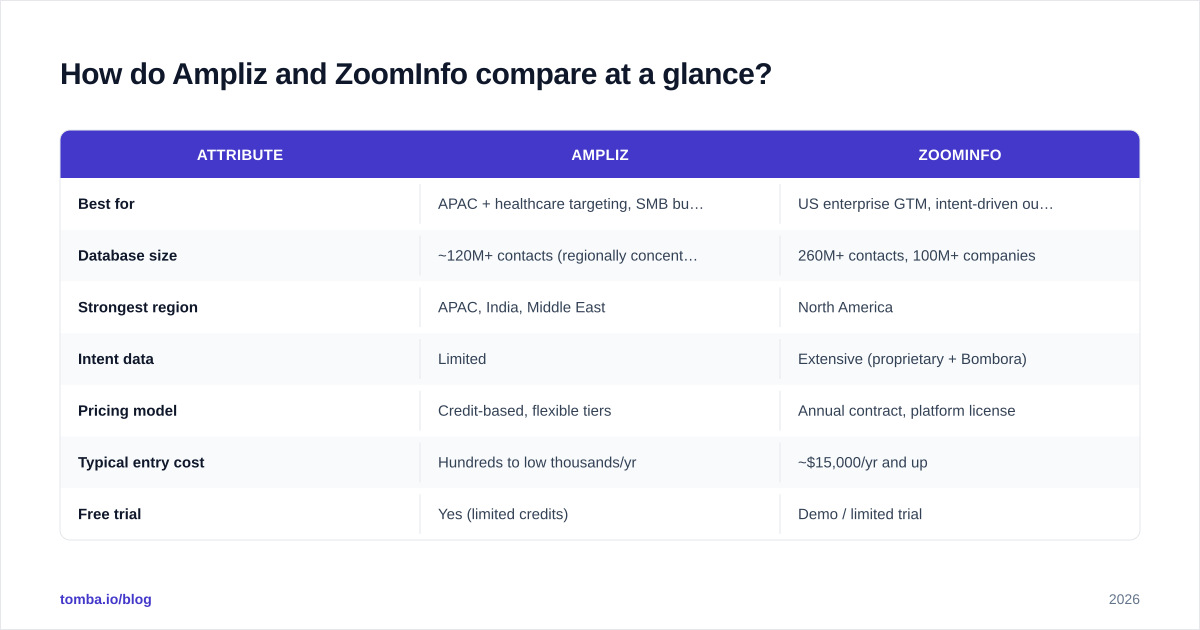
The headline: ZoomInfo wins on raw scale and signal depth; Ampliz wins on price flexibility and regional/vertical focus.

Whose data is more accurate?#
Accuracy is the metric every vendor claims to lead, so judge it by methodology, not marketing. Both platforms blend public web crawling, contributory data, partnerships, and verification passes.
ZoomInfo has the larger verification operation and refreshes records frequently, which generally shows up as higher accuracy on US-based contacts and deeper org-chart and direct-dial coverage. Independent reviews on G2 consistently praise its breadth while flagging that data can still go stale for smaller companies and recently-changed roles.
Ampliz is competitive on the segments it specializes in. For APAC contacts, Indian and Middle Eastern companies, and healthcare provider data, its records often beat the US-centric incumbents simply because those datasets get less attention from larger vendors. Outside those niches, coverage thins out.
The practical takeaway: no database is 100% accurate, and both decay at the industry-standard ~2-2.5% per month as people change jobs. Whatever you choose, run contacts through an email verifier before you send. Verification is the cheapest insurance against a damaged sender reputation — bounced sends hurt email deliverability far more than a missing record does.

How does pricing compare?#
This is where the two diverge most sharply.
**
ZoomInfo** sells annual platform licenses. Pricing is opaque and quote-based, but credible reports and reseller data put entry packages around $15,000/year, scaling well into five and six figures with add-ons for intent data, additional seats, credits, and integrations. You commit before you fully know your usage.
Ampliz uses a credit-based model with lower, more flexible tiers and a free trial. You can start in the hundreds-to-low-thousands range annually and scale credits as you go — no five-figure floor to clear.
| Cost factor | Ampliz | ZoomInfo |
|---|---|---|
| Contract length | Flexible / monthly options | Typically 12-month minimum |
| Entry price | Low (credit packs) | ~$15,000/yr reported |
| Pricing transparency | Published tiers + trial | Quote-only |
| Overage model | Buy more credits | Credit blocks / renegotiation |
| Best for budget | SMB, startups, regional teams | Funded enterprise GTM |
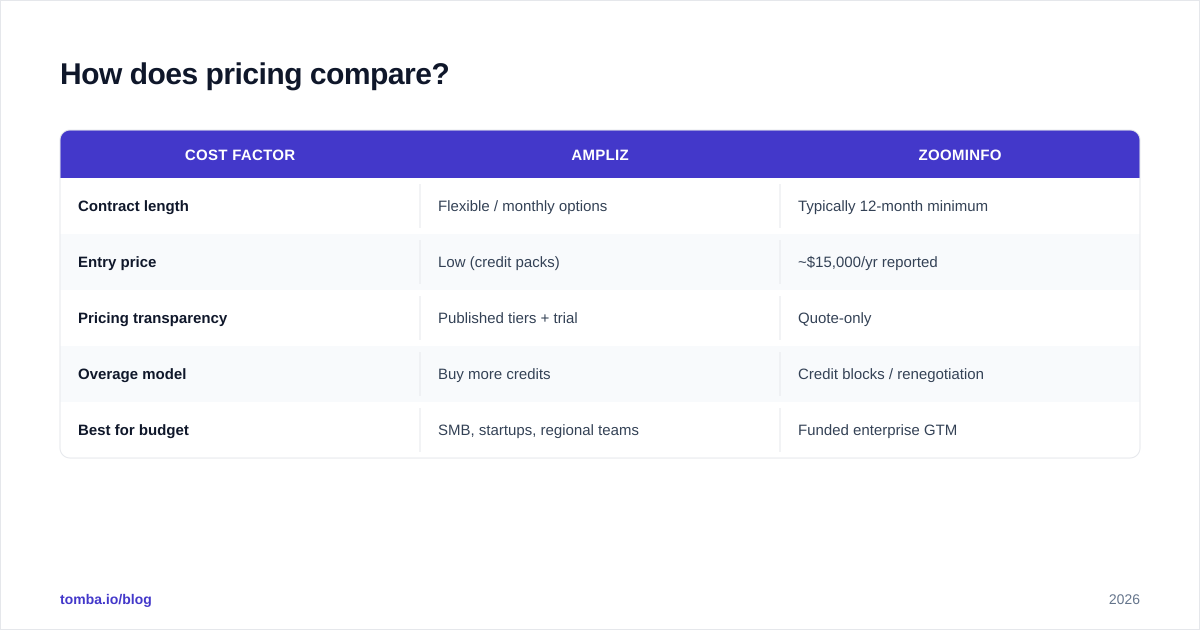
If your blocker is the up-front commitment rather than the feature set, this single table likely decides it for you.

Which has better features and integrations?#
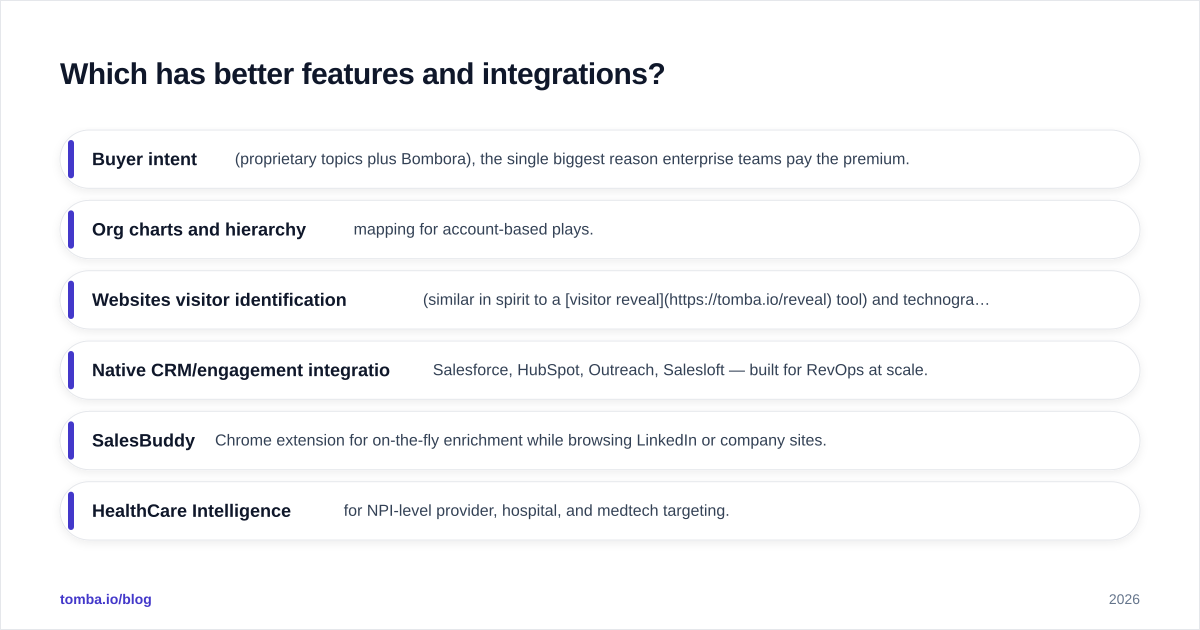
ZoomInfo is the more complete platform. Beyond contact data you get:
- Buyer intent (proprietary topics plus Bombora), the single biggest reason enterprise teams pay the premium.
- Org charts and hierarchy mapping for account-based plays.
- Websites visitor identification (similar in spirit to a visitor reveal tool) and technographics.
- Native CRM/engagement integrations — Salesforce, HubSpot, Outreach, Salesloft — built for RevOps at scale.
Ampliz is leaner and more targeted:
- SalesBuddy Chrome extension for on-the-fly enrichment while browsing LinkedIn or company sites.
- HealthCare Intelligence for NPI-level provider, hospital, and medtech targeting.
- Contextual intelligence and basic firmographic filtering, with API access for enrichment.
If your motion depends on intent signals and tight CRM workflows, ZoomInfo is hard to match. If you mostly need clean contact and company data for a specific region or vertical, Ampliz delivers that without the surrounding (and costly) platform.
Which should you choose — Ampliz or ZoomInfo?#
Match the tool to your situation rather than the spec sheet.
Choose ZoomInfo if:
- You sell into North American enterprises and need the deepest dataset available.
- Buyer-intent data is central to your prioritization.
- You have RevOps maturity and budget to justify a platform license and annual contract.
- You want one system covering data, intent, and visitor identification.
Choose Ampliz if:
- Your ICP is in APAC, India, or the Middle East, or in healthcare specifically.
- You're an SMB or startup that can't (or won't) clear a $15K floor.
- You want a free trial and credit-based flexibility to test before scaling.
- You need solid contact data without paying for intent and visitor tooling you won't use.
Consider neither if your real need is just verified email addresses and phone numbers for a target list. That's a narrower job than either platform is priced for — and it's exactly where a focused finder wins.
Is there a cheaper alternative to both?#
Yes — if the core job is "get me accurate, verified contact details," you don't need a full GTM platform. A dedicated email-finder and enrichment tool covers that at a far lower entry price.
Tomba pricing starts with a free tier (25 searches/month), then Starter at $49/mo, Growth at $99/mo, and Pro at $249/mo — no annual commitment, no five-figure floor. You get domain search to pull every email pattern at a company, a bulk email finder for list building, a phone finder for direct dials, and built-in verification.
| Capability | Ampliz | ZoomInfo | Tomba |
|---|---|---|---|
| Find email by name + domain | Partial | Yes | Yes |
| Domain-wide email search | No | Limited | Yes |
| Bulk finding + verification | Partial | Add-on | Yes |
| Free tier | Trial only | No | 25/mo free |
| Entry price | Low | ~$15K/yr | $49/mo |
| Buyer intent data | No | Yes | No |
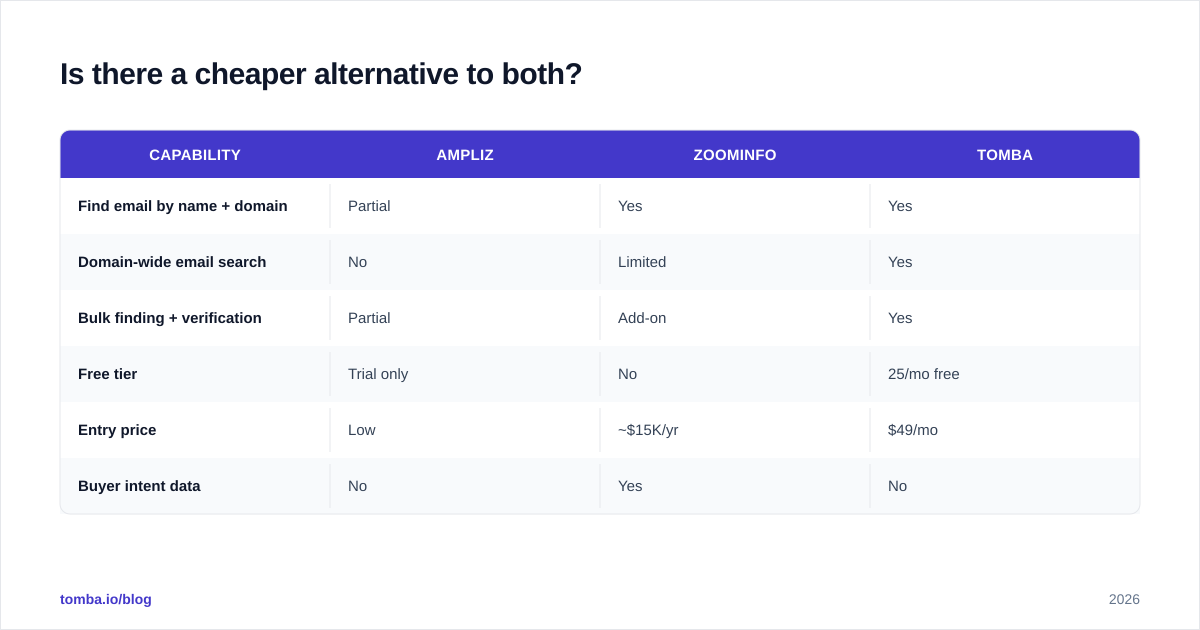
It's not an apples-to-apples replacement for ZoomInfo's intent engine — Tomba doesn't pretend to be a full GTM suite. But for prospecting teams whose bottleneck is reliable contact data, it removes the platform tax entirely. Many teams pair an affordable finder for contact discovery with a lightweight CRM, and skip the enterprise license altogether. You can compare options on directories like Capterra before committing.
What about data sourcing and compliance?#
Both vendors operate under GDPR and CCPA obligations, and both publish privacy and opt-out mechanisms. ZoomInfo has faced public scrutiny over how contact data is collected and the friction of its removal process — worth reviewing if you operate in heavily regulated markets. Ampliz, being smaller, draws less attention but you should still verify its sourcing aligns with your compliance posture.
Whichever you pick, transparency about data sources matters. Ask each vendor directly: where does the data come from, how often is it refreshed, and what's the documented opt-out path? A provider that answers clearly is one you can defend to your legal team.
The bottom line#
ZoomInfo is the more powerful, more expensive choice — buy it when intent data and US enterprise depth justify a platform license. Ampliz is the lighter, regionally smart pick — buy it for APAC and healthcare targeting on a flexible budget. Neither is "better" in the abstract; they're built for different buyers.
And if you strip the question down to "I just need verified emails and phone numbers that actually land," you may not need either. Start free with the Tomba Email Finder, pull verified contacts by name or domain, and only graduate to a full data platform when intent signals and org charts become the thing you're actually paying for. Spend on the job you have — not the platform you've been sold.
Ready to find emails that actually work?
Join 150,000+ professionals who stopped guessing and started sending. Free credits on signup — no credit card required.
Get the Tomba newsletter
Practical outbound tactics and product updates — once every two weeks.
About the author