Antideo Pricing, Reviews, Pros and Cons (2026 Guide)
Is Antideo worth it in 2026? A no-spin look at Antideo's free tier, paid pricing, real user reviews, accuracy, and the alternatives B2B teams pick instead.

TL;DR
- Antideo is a developer-first API for email validation, IP reputation, phone checks, and profanity filtering — it leans free and lightweight rather than enterprise-grade.
- The free tier is genuinely generous (free API key, no card), but throughput caps and limited bulk tooling push serious senders toward paid usage or a different vendor.
- Pros: free to start, simple REST API, multiple validation types in one key. Cons: thin documentation in places, no built-in email finder, and accuracy that trails dedicated verification specialists.
- Pricing is volume/credit-based and changes often — always confirm current numbers on antideo.com before budgeting.
- If you also need to find and enrich contacts (not just validate them), pair or replace Antideo with a finder-plus-verifier platform like Tomba.
What is Antideo and who is it for?#
Antideo is a set of lightweight validation APIs aimed at developers who want to clean inputs at the point of entry. Think of it less like a CRM-grade data platform and more like a Swiss Army knife you bolt onto a signup form: it can check whether an email looks valid and isn't disposable, whether an IP is on a blacklist, whether a phone number is plausible, and whether a piece of text contains profanity.
That positioning matters for this Antideo pricing reviews pros and cons breakdown. Antideo competes for the "validate at the boundary" job — stopping junk before it enters your database — rather than the "build a pipeline of qualified leads" job. If you came looking for a way to discover decision-maker emails, that's a different tool category (a email finder), and Antideo doesn't do it.
The typical Antideo user is a solo developer, an indie SaaS team, or a backend engineer who needs a quick, free-to-start endpoint to reject obvious garbage during registration. The typical non-fit is a sales or growth team that needs bulk list cleaning, catch-all resolution, and CRM integrations.
What does Antideo actually do?#
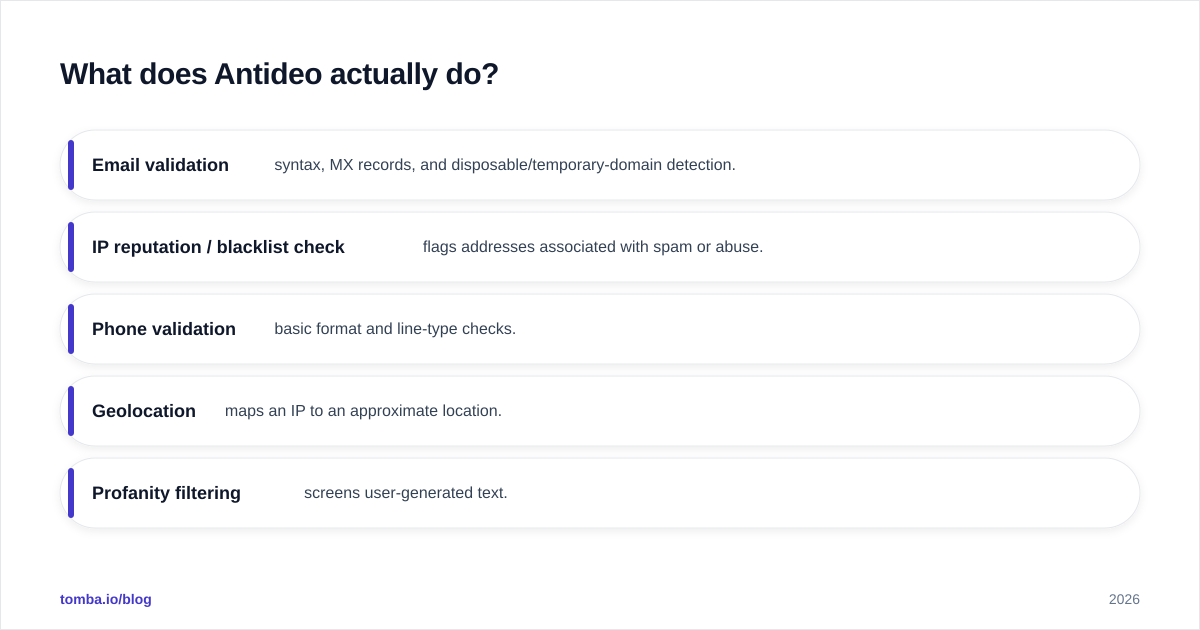
Antideo bundles several validation endpoints under one API key:
- Email validation — syntax, MX records, and disposable/temporary-domain detection.
- IP reputation / blacklist check — flags addresses associated with spam or abuse.
- Phone validation — basic format and line-type checks.
- Geolocation — maps an IP to an approximate location.
- Profanity filtering — screens user-generated text.
The appeal is consolidation: one credential covers multiple checks. For a signup flow that needs to block disposable emails and screen abusive usernames, that's convenient. But notice what's missing — there's no email discovery, no domain-wide contact search, no enrichment, and limited bulk processing. Antideo validates what you already have; it doesn't help you build a list.
If your real bottleneck is finding verified work emails for a target account, you'd start with domain search and then confirm each address with an email verifier — two jobs Antideo only partially touches.
How much does Antideo cost in 2026?#
Here's the honest answer first: Antideo's headline draw is a free tier with a free API key and no credit card, then usage-based paid plans for higher request volume. Antideo has historically priced by request throughput and credits rather than per-seat, which keeps it cheap for small projects.
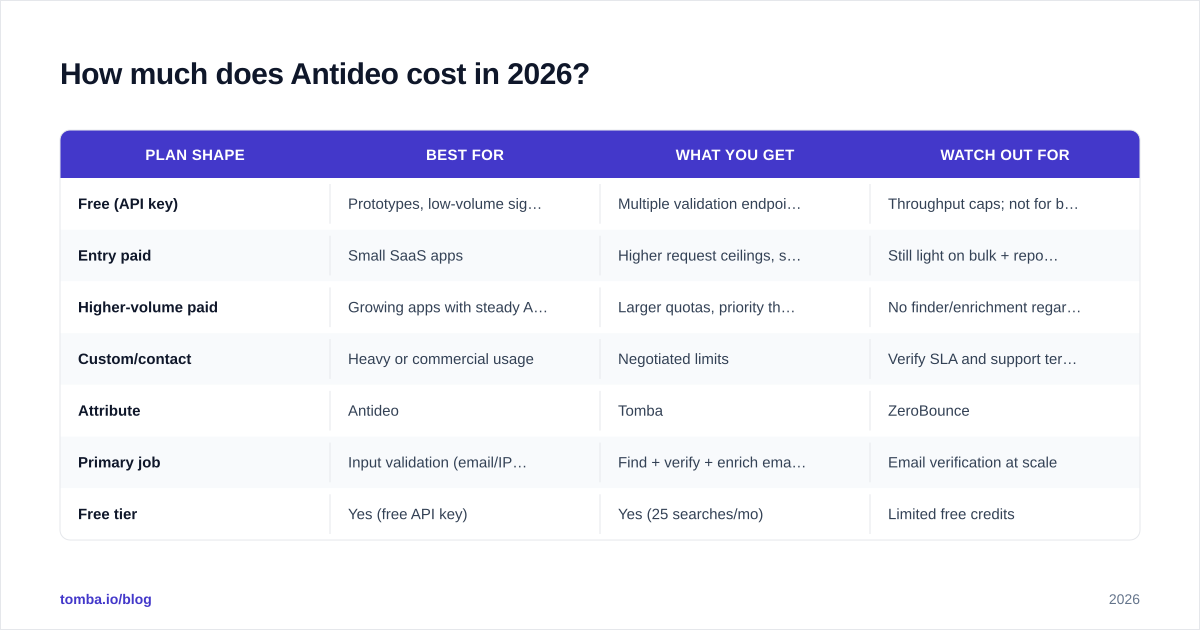
I'm not going to invent exact dollar figures — Antideo adjusts its tiers periodically, and a pricing review that quotes a stale number is worse than no number. Confirm the current rate on antideo.com before you commit a budget. What's stable enough to plan around is the shape of the pricing:
| Plan shape | Best for | What you get | Watch out for |
|---|---|---|---|
| Free (API key) | Prototypes, low-volume signup checks | Multiple validation endpoints, hard rate limits | Throughput caps; not for bulk lists |
| Entry paid | Small SaaS apps | Higher request ceilings, same endpoints | Still light on bulk + reporting |
| Higher-volume paid | Growing apps with steady API traffic | Larger quotas, priority throughput | No finder/enrichment regardless of tier |
| Custom/contact | Heavy or commercial usage | Negotiated limits | Verify SLA and support terms |
Compare that to a verification-and-finder platform with published tiers. For reference, Tomba pricing runs a Free tier at 25 searches/month, Starter at $49/mo, Growth at $99/mo, Pro at $249/mo, and custom Enterprise — and those plans include finding, verifying, domain search, and enrichment rather than validation alone.
Antideo vs Tomba vs#
ZeroBounce: a side-by-side
| Attribute | Antideo | Tomba | ZeroBounce |
|---|---|---|---|
| Primary job | Input validation (email/IP/phone) | Find + verify + enrich emails | Email verification at scale |
| Free tier | Yes (free API key) | Yes (25 searches/mo) | Limited free credits |
| Email finder | No | Yes | No |
| Catch-all handling | Basic | Dedicated catch-all verifier | Yes |
| Bulk list cleaning | Limited | Yes (bulk tools) | Yes (core strength) |
| Entry paid price | Usage-based (check site) | $49/mo Starter | Pay-as-you-go credits |
| Best fit | Devs validating form inputs | Sales/growth building lists | Teams cleaning large lists |
The takeaway: these tools overlap on the word "validation" but solve different problems. Antideo is the cheapest way to screen inputs in code. ZeroBounce is built for scrubbing big lists. Tomba is the one that both finds the contact and verifies it. If your shortlist is genuinely about list hygiene at volume, our ZeroBounce alternative page walks through that specific tradeoff.
What do Antideo reviews say?#
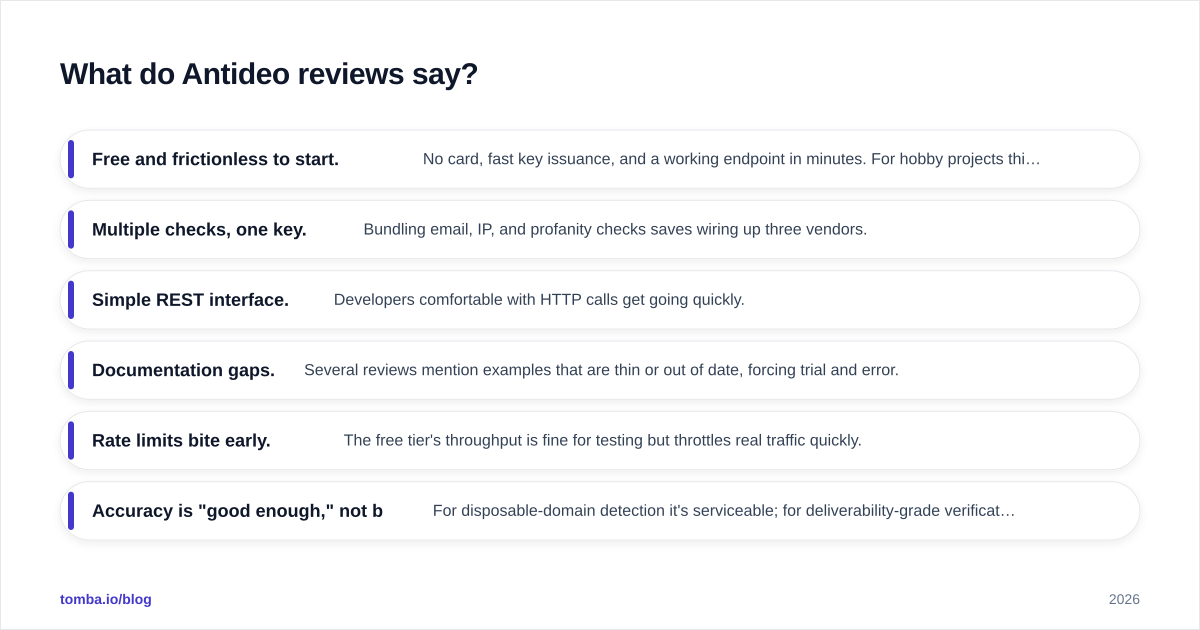
Pulling together public sentiment from developer forums and review sites like G2 and Capterra, a consistent pattern emerges. Treat the themes below as the signal, not any single star rating.
What users praise:
- Free and frictionless to start. No card, fast key issuance, and a working endpoint in minutes. For hobby projects this is the headline.
- Multiple checks, one key. Bundling email, IP, and profanity checks saves wiring up three vendors.
- Simple REST interface. Developers comfortable with HTTP calls get going quickly.
What users criticize:
- Documentation gaps. Several reviews mention examples that are thin or out of date, forcing trial and error.
- Rate limits bite early. The free tier's throughput is fine for testing but throttles real traffic quickly.
- Accuracy is "good enough," not best-in-class. For disposable-domain detection it's serviceable; for deliverability-grade verification, specialists pull ahead.
- No finder or enrichment. Reviewers who hoped to source contacts were disappointed — that's simply not the product.
A fair summary: Antideo earns goodwill for being free and easy, and loses points the moment you scale or expect enterprise polish. That's a reasonable trade for a free-first tool — just go in with the right expectation.

What are the pros and cons of Antideo?#
Pros#
- Free tier with a real API key. You can ship a basic validation check without spending anything.
- Multi-purpose API. Email, IP reputation, phone, geolocation, and profanity in one integration.
- Developer-friendly. Clean REST calls, JSON responses, low setup overhead.
- Cheap to scale modestly. Usage-based pricing keeps small projects inexpensive.
- Good for the "front door." Excellent at rejecting disposable emails and obvious junk at signup.
Cons#
- No email finding or enrichment. It validates what you have; it can't build a list.
- Limited bulk tooling. Not designed for cleaning a 100k-row CSV the way a dedicated verifier is.
- Accuracy ceiling. Fine for syntax and disposable checks; weaker on catch-all and risky mailboxes.
- Documentation can lag. Expect some trial-and-error.
- Rate limits. Free and entry tiers throttle quickly under real traffic.
The deciding question is which job you're hiring the tool for. If it's "stop junk at the form," Antideo is a strong, cheap pick. If it's "find and qualify buyers," it's the wrong category — and you'll end up bolting on a finder anyway.
How does Antideo handle accuracy and catch-all domains?#
Accuracy is where free validation tools and paid verification platforms separate. Basic checks — valid syntax, MX records present, domain not on a disposable list — are easy and Antideo does them well. The hard part is catch-all domains, where the mail server accepts every address whether or not the mailbox exists. A naive verifier marks these "valid" and you discover the truth only when the email bounces.
Dedicated tools invest heavily here. A purpose-built catch-all verifier uses additional signals to estimate whether a specific mailbox on a catch-all domain is real, instead of shrugging and passing it through. If a large share of your prospects sit on catch-all domains (common in enterprise B2B), this single capability changes your bounce rate more than anything else — and it's the area where a lightweight validator like Antideo is weakest.
Accuracy also depends on the underlying data. Verification quality tracks the breadth and freshness of the signals behind it; you can read how that works on Tomba's data sources page. The general principle, echoed in industry write-ups on email verification, is that no single check is sufficient — confidence comes from layering syntax, DNS, SMTP, and historical signals.
Is Antideo the right choice, or do you need an alternative?#
Use this quick decision framework:
- Choose Antideo if: you're a developer adding input validation to a form, you want a free start, and you don't need to find or enrich contacts.
- Choose a dedicated verifier (ZeroBounce, Bouncer, etc.) if: your main job is scrubbing large existing lists for deliverability.
- Choose a finder-plus-verifier (Tomba) if: you need to discover verified work emails, search by domain, handle catch-alls, and enrich records — i.e., real B2B prospecting.
Many teams discover the limitation the hard way: Antideo cleans the inputs, but they still have no way to source the right contacts. At that point you're integrating a second tool regardless, so it's worth asking whether one platform should cover both. For comparison shopping across the validation space, the DeBounce alternative and Clearout alternative breakdowns map the same tradeoffs against other vendors.
How does Antideo fit into a real outbound stack?#
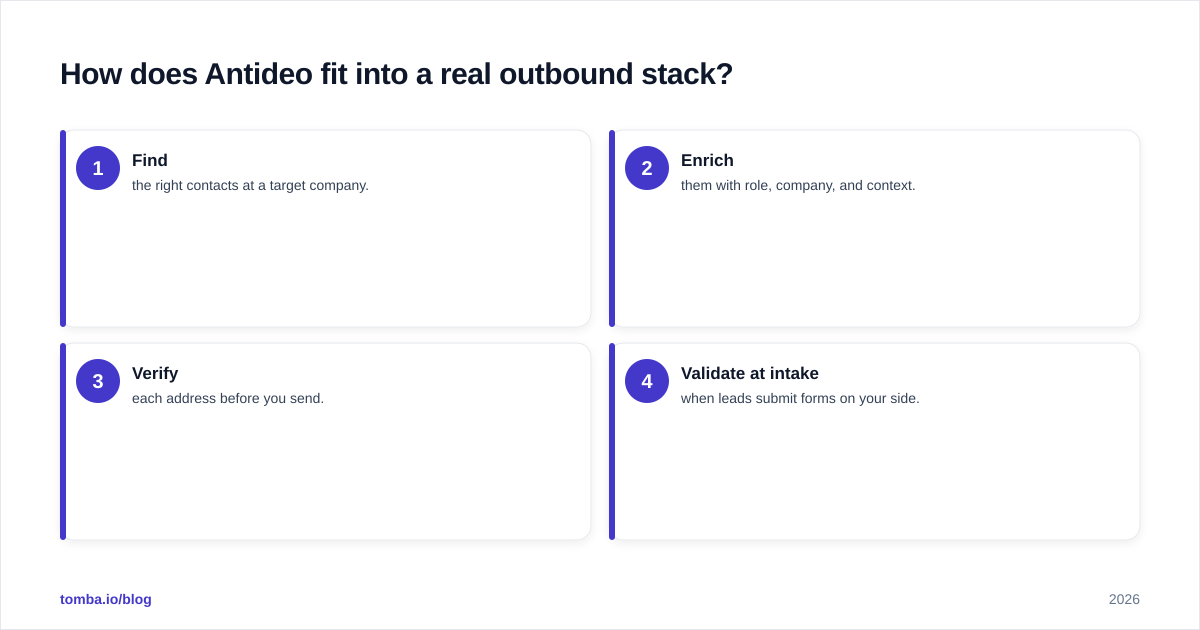
In practice, validation is step three of a four-step flow:
- Find the right contacts at a target company.
- Enrich them with role, company, and context.
- Verify each address before you send.
- Validate at intake when leads submit forms on your side.
Antideo is built for step four. It does little to nothing for steps one through three. A platform like Tomba covers one through three and the bulk side of three — which is why teams running outbound rarely standardize on a pure input-validator as their core data tool. If you mostly need step four and your volume is low, Antideo's free tier is hard to beat on price. If you need the whole pipeline, you'll consolidate elsewhere and let Antideo (or nothing) handle the form.
Final verdict and recommendation#
Antideo is a solid, genuinely free-to-start validation API that punches above its price for input screening — and it's clearly outside its lane the moment you need to find, enrich, or bulk-verify contacts for B2B sales. The pros (free tier, multi-check API, developer simplicity) are real; the cons (no finder, limited bulk, accuracy ceiling, doc gaps) are equally real. Match the tool to the job and you won't be disappointed; expect a prospecting platform and you will.
If your actual goal is to build a clean, deliverable list of decision-makers — not just bounce a few bad form entries — start with the Tomba Email Finder. Find professional emails by domain, name, or company, verify them in the same workflow, resolve catch-alls, and enrich the records, all on plans that start free and scale to a $49/mo Starter. You can validate inputs with Antideo all day; Tomba is how you get the contacts worth validating in the first place.
Ready to find emails that actually work?
Join 150,000+ professionals who stopped guessing and started sending. Free credits on signup — no credit card required.
Get the Tomba newsletter
Practical outbound tactics and product updates — once every two weeks.
About the author