Antideo vs Arounddeal 2026: Which B2B Data Tool Wins?
Antideo is a free validation API; Arounddeal is a B2B contact database. Here's how they actually compare on data, accuracy, and price in 2026.
Antideo and Arounddeal show up in the same search results, but they solve almost opposite problems. One is a lightweight validation API. The other is a full B2B contact database with a browser extension. If you picked one expecting the other, you would be disappointed for reasons that have nothing to do with quality.
This guide breaks down what each tool actually does, where the overlap ends, and which workflows each one fits in 2026.
TL;DR: Antideo vs Arounddeal at a glance#
- Antideo is a free-first data validation API — email validation, IP reputation, phone validation, and spam/profanity checks. It does not find new contacts.
- Arounddeal is a B2B sales intelligence platform — a contact database, LinkedIn extension, and email finder built for prospecting at scale.
- They overlap only on email checking. For everything else, they target different buyers: developers (Antideo) versus sales and marketing teams (Arounddeal).
- Pricing models are unrelated: Antideo leans on a generous free API tier; Arounddeal sells credit-based prospecting plans.
- If you need to find and verify business emails in one place, neither is a perfect fit — a dedicated email finder plus email verifier usually wins.
What is Antideo?#
Antideo is a developer-focused data quality API. Its core job is to tell you whether a piece of data is trustworthy before it enters your system: is this email disposable, is this IP a known spam source, is this phone number formatted correctly, does this text contain profanity.
It is built around a free tier that allows a fixed number of API calls per hour without a credit card, which is why it shows up in so many "free email validation" lists. You send a request, you get a structured JSON verdict. There is no dashboard full of contacts, no list building, and no prospecting. Antideo assumes you already have the data and just need to score it.
Typical Antideo users are engineers wiring validation into a signup form, a lead-capture endpoint, or a moderation pipeline. The appeal is simplicity and price, not depth of B2B intelligence.
What is Arounddeal?#
Arounddeal is a B2B sales intelligence and prospecting platform. It maintains a contact and company database, ships a Chrome extension that pulls contact details from LinkedIn profiles, and offers email finding plus basic verification, sequences, and CRM-style features depending on the plan.
Where Antideo checks data you already own, Arounddeal gives you new data. You search by company, role, or industry, and it returns names, business emails, and sometimes phone numbers. It competes with tools like Apollo, Lusha, and RocketReach rather than with validation APIs.
The trade-off is the usual one for contact databases: coverage and accuracy vary by region and seniority, and you pay per credit for the contacts you reveal. You can read independent user reviews on G2 to gauge real-world data quality before committing.
Antideo vs Arounddeal: how do they actually compare?#
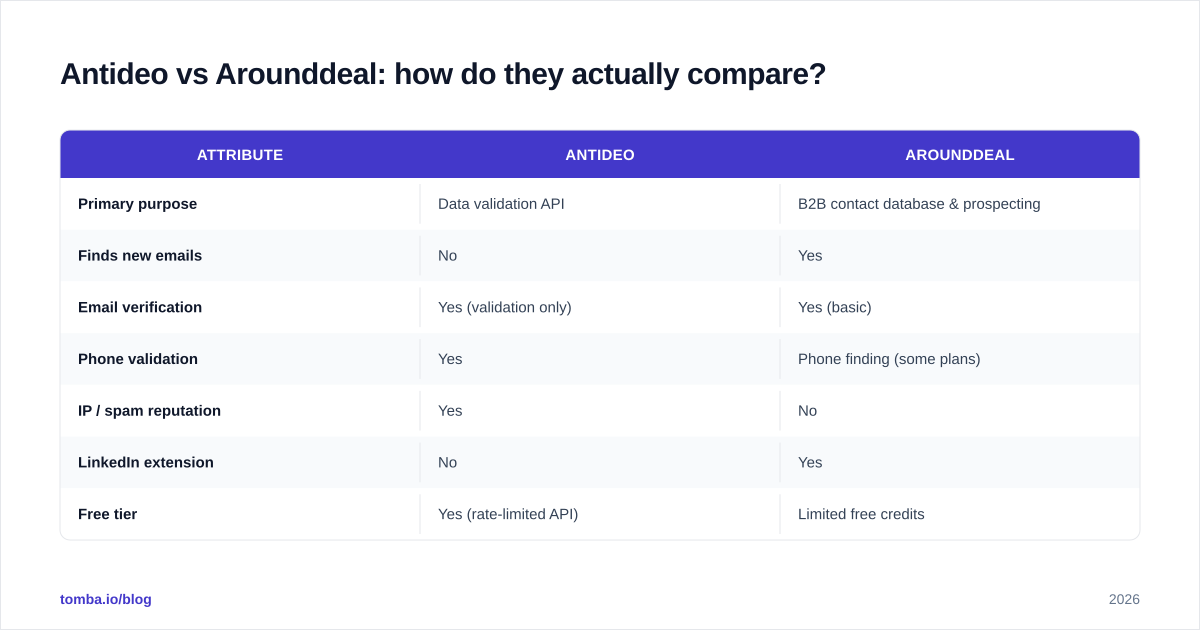
Here is the honest version. These tools barely compete. The table below maps them against the dimensions that matter when people search "antideo vs arounddeal" — usually because they are not sure which problem they are solving.
| Attribute | Antideo | Arounddeal |
|---|---|---|
| Primary purpose | Data validation API | B2B contact database & prospecting |
| Finds new emails | No | Yes |
| Email verification | Yes (validation only) | Yes (basic) |
| Phone validation | Yes | Phone finding (some plans) |
| IP / spam reputation | Yes | No |
| LinkedIn extension | No | Yes |
| Free tier | Yes (rate-limited API) | Limited free credits |
| Best for | Developers, form validation | Sales & marketing teams |
| Pricing model | Free + usage tiers | Credit-based subscriptions |
The key takeaway: if your question is "which one finds business emails," the answer is Arounddeal, because Antideo simply does not do that. If your question is "which one cleans my list cheaply via API," the answer is Antideo.
Is Arounddeal better than Antideo for prospecting?#
Yes — but only because Antideo never tried to be a prospecting tool.
Arounddeal is purpose-built for outbound. You install the extension, browse target accounts on LinkedIn, and pull verified-ish contact details into lists or sequences. For a sales development rep building a pipeline, that workflow is the entire job. Antideo offers none of it.
The fair criticism of Arounddeal is the same one every contact database earns: data decays, and accuracy drops for non-US markets and for senior or technical roles that guard their addresses. That is why experienced teams treat any prospecting database as a starting point and run a separate verification pass before sending. Bouncing on cold outreach quietly destroys your email deliverability, and a database's own "verified" flag is rarely strict enough to protect a sending domain.

So Arounddeal wins on finding contacts. It does not automatically win on send-safe contacts — and that gap is where a dedicated verifier earns its place in the stack.
How accurate is each tool's email data?#
Accuracy is the wrong single number to chase, because the two tools measure different things.
Antideo's "accuracy" is about classification: did it correctly flag a disposable domain, a malformed address, or a risky IP? For syntax and disposable-domain detection, simple rule-based checks like Antideo's are reliable. They are weaker at the hard part — confirming a real, deliverable mailbox at a corporate domain, especially behind catch-all servers.
Arounddeal's accuracy is about the contact being real and current. That is a coverage-and-freshness problem. The contact existed when the record was scraped; whether the person still works there, and whether the email still routes, is the open question on every B2B database.
This is the core reason serious senders separate finding from verifying. A purpose-built email verifier performs SMTP-level checks, MX validation, and catch-all detection that a prospecting database typically only approximates. For genuine catch-all domains, a dedicated catch-all verifier goes further than either Antideo or Arounddeal does natively.

The chart above illustrates why a tool that specializes in deliverability checks tends to beat a generalist database's built-in flag — depth of verification, not breadth of records, is what keeps bounces down.
What does each tool cost?#
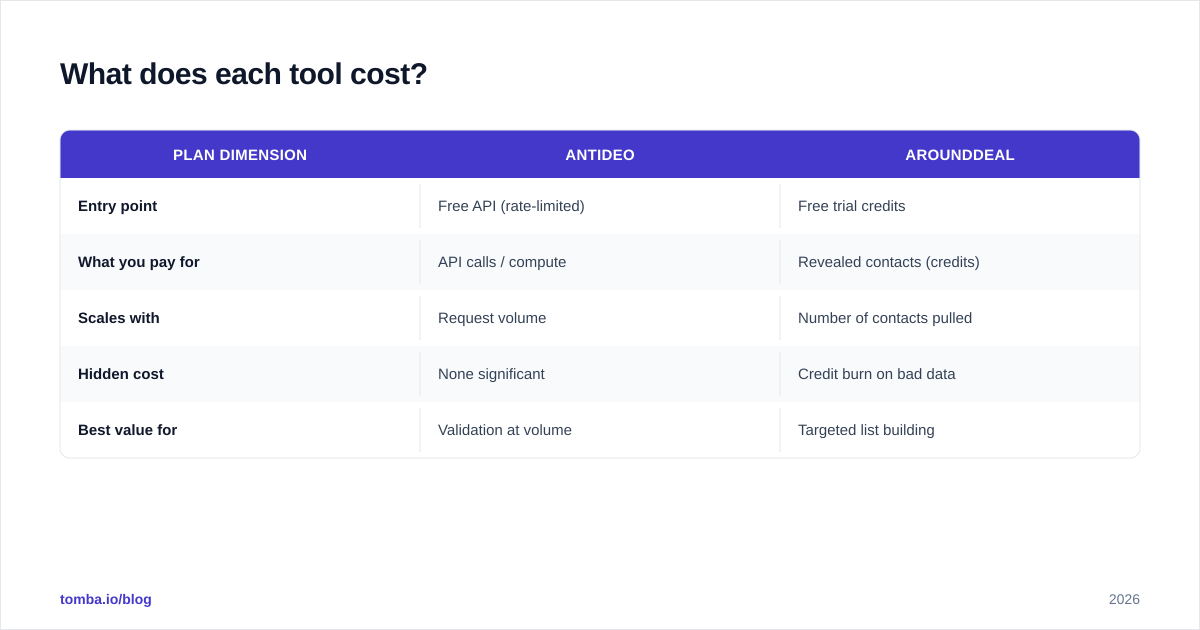
Pricing is where the two diverge most, and where the "free" label causes the most confusion.
Antideo's value proposition is its free API tier: a set number of calls per hour with no card required, then paid tiers as volume grows. It is cheap to start and cheap to scale for pure validation, because you are paying for compute, not for proprietary contact data.
Arounddeal charges for data. Plans are credit-based — each revealed contact consumes credits — so the real cost depends on how many new emails and phone numbers you pull each month. That is normal for the category, but it means "free" Arounddeal usage runs out quickly once you start prospecting in earnest.
| Plan dimension | Antideo | Arounddeal |
|---|---|---|
| Entry point | Free API (rate-limited) | Free trial credits |
| What you pay for | API calls / compute | Revealed contacts (credits) |
| Scales with | Request volume | Number of contacts pulled |
| Hidden cost | None significant | Credit burn on bad data |
| Best value for | Validation at volume | Targeted list building |

If budget is the deciding factor and you only need validation, Antideo is hard to beat. If you need contacts, compare Arounddeal's per-credit economics against alternatives before locking in — credit burn on stale records is the real expense, not the sticker price.
Which should you choose in 2026?#
Decide by the job, not the brand.
Choose Antideo if you are a developer who needs to score data you already collect — block disposable signups, flag risky IPs, sanity-check phone formats — and you want a free, no-friction API to do it. Antideo is a clean fit for that and overkill-free.
Choose Arounddeal if you are a sales or marketing team that needs to generate a pipeline of B2B contacts from LinkedIn and company searches, and you can budget for credit-based prospecting. It is a reasonable mid-market option in the Apollo/Lusha tier.
Choose neither, alone, if your real workflow is find accurate business emails and keep them deliverable. That is two jobs — discovery and verification — and bolting Antideo's validation onto Arounddeal's database means juggling two vendors, two billing models, and two accuracy ceilings.
A cleaner answer is a platform that finds and verifies in one place. Tomba pairs an email finder with native verification, domain search for mapping every address at a company, and data enrichment to fill in the rest — all under one transparent pricing model (Free tier with 25 searches/month, Starter at $49/mo, Growth at $99/mo, and Pro at $249/mo). You can cross-check the categories on independent directories like Capterra before deciding.
The honest verdict#
Antideo and Arounddeal are not really rivals — they are tools from different aisles that happen to both touch email. Antideo is the better validator because that is all it does. Arounddeal is the better prospecting database because Antideo does not prospect at all. The "winner" depends entirely on whether you need to check data or create it.
If your goal is outbound that actually lands — finding the right contact and confirming the address won't bounce — start with a tool built for both. Spin up the Tomba Email Finder on the free plan, run a domain or two, and verify the results in the same dashboard. You will see in minutes whether discovery-plus-verification in one place beats stitching two single-purpose tools together.
Ready to find emails that actually work?
Join 150,000+ professionals who stopped guessing and started sending. Free credits on signup — no credit card required.
Get the Tomba newsletter
Practical outbound tactics and product updates — once every two weeks.
About the author