Antideo vs BookYourData (2026): Data & Verification Compared
Antideo validates and scores contact data through an API; BookYourData sells pre-built B2B lists by the record. Here's which one fits your stack in 2026 — and where a third option beats both.
TL;DR
- Antideo is a real-time validation and threat-scoring API. You send it an email, IP, or phone number and it tells you whether the value is risky, disposable, or deliverable. It does not hand you new contacts.
- BookYourData is a self-service marketplace for pre-built B2B contact lists. You filter by industry, title, and geography, then buy records by the credit. It does not validate your existing CRM in real time.
- They solve different halves of the same problem: BookYourData gives you contacts, Antideo cleans contacts. Comparing them head-to-head only makes sense once you know which job you're hiring for.
- BookYourData advertises ~95%+ accuracy with a bounce guarantee; Antideo's strength is fraud/abuse signals (disposable domains, proxy IPs) rather than list volume.
- If you actually want fresh, verified emails sourced on demand — not a static CSV and not just a yes/no score — a domain-and-name email finder like Tomba is the better center of your stack. More on that at the end.
What are Antideo and BookYourData?#
Think of it like a kitchen. BookYourData is the grocery delivery service that drops a box of ingredients on your porch — lots of contacts, sorted by type, ready to cook with. Antideo is the food-safety inspector who checks whether each ingredient has gone bad before you serve it. One supplies, one screens.
Antideo is an API-first data-quality and fraud-prevention service. Its endpoints cover email validation, IP reputation and geolocation, phone validation, and disposable-domain detection. Developers wire it into signup forms, checkout flows, and lead-capture pages to block junk before it enters the database. The output is a verdict and risk metadata, not a person's contact details.
BookYourData is a pay-as-you-go B2B contact database. You build a segment in the UI — say, "VPs of Marketing at US SaaS companies with 50–200 employees" — preview the count, and buy the records. It markets a high accuracy rate and an email-bounce guarantee, and it sells records outright rather than renting access by seat.
So the honest framing of antideo vs bookyourdata isn't "which tool is better." It's "do you need to acquire contacts or validate them?" Most teams eventually need both functions — and many discover a single email finder plus verifier covers the overlap more cleanly than stitching these two together.
How do Antideo and BookYourData actually differ?#
The split runs along four axes: what you get, how you pay, how it integrates, and what "accuracy" even means for each.
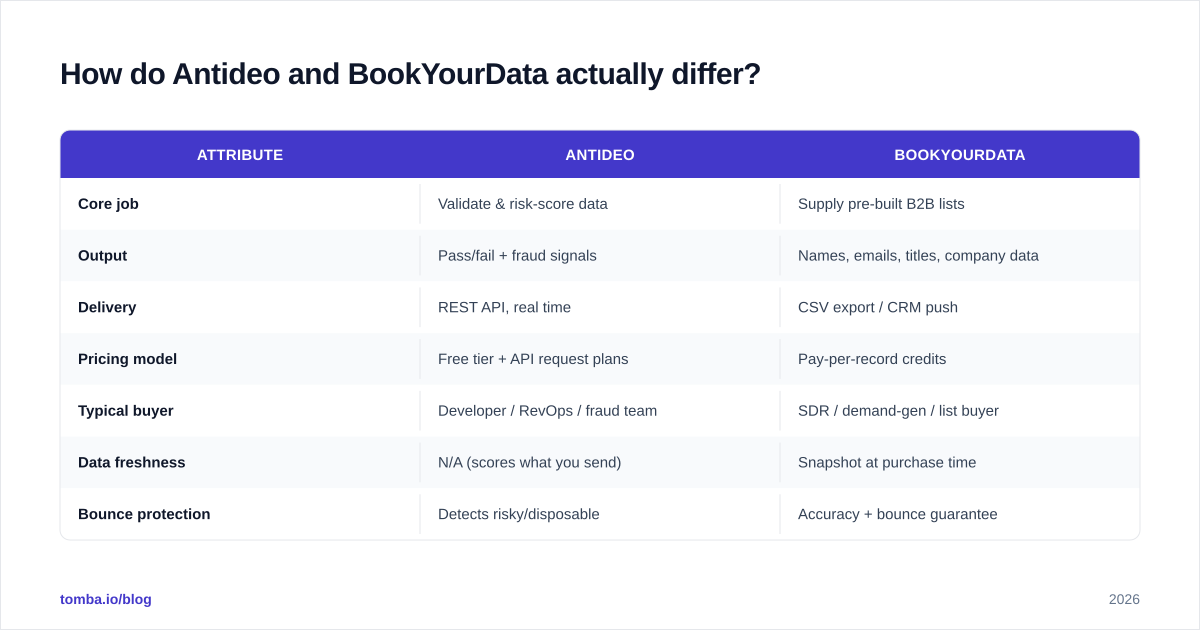
| Attribute | Antideo | BookYourData |
|---|---|---|
| Core job | Validate & risk-score data | Supply pre-built B2B lists |
| Output | Pass/fail + fraud signals | Names, emails, titles, company data |
| Delivery | REST API, real time | CSV export / CRM push |
| Pricing model | Free tier + API request plans | Pay-per-record credits |
| Typical buyer | Developer / RevOps / fraud team | SDR / demand-gen / list buyer |
| Data freshness | N/A (scores what you send) | Snapshot at purchase time |
| Bounce protection | Detects risky/disposable | Accuracy + bounce guarantee |
| Best at | Blocking junk signups | Filling a list fast |
A few things worth calling out beyond the table.
Antideo is consumption-based plumbing. You rarely look at its dashboard; it runs invisibly inside a form or a nightly cleanup job. Its disposable-email and IP-reputation checks are genuinely useful for stopping free-trial abuse and fake registrations — a use case BookYourData simply doesn't touch.
BookYourData is a front-loaded purchase. You spend credits, you get a file, and from that moment the data starts aging. Job changes, departures, and rebrands erode any static list at roughly 2–2.5% per month. The bounce guarantee softens the risk, but a guarantee is a refund mechanism, not a freshness mechanism.
That aging problem is the quiet tax on every list-buying strategy:
)
Which one is more accurate?#
Different denominators, so "accuracy" means two different things.
For BookYourData, accuracy is a claim about the records it sells you — the share of emails that are deliverable at purchase time. A 95%+ figure with a bounce guarantee is competitive for a marketplace, but it's measured against the list it hands you, and it decays the moment you download.
For Antideo, accuracy is about classification — did it correctly flag a disposable address, a high-risk IP, or an invalid syntax? It can tell you an address is malformed or that a domain is throwaway, but on a tricky catch-all domain (where the server accepts everything at the SMTP layer) any validation-only tool, Antideo included, is forced to guess. That's an industry-wide ceiling, not an Antideo-specific flaw.
The practical takeaway: a validation API and a list vendor can both report "high accuracy" and both be telling the truth, because they're grading different exams. If your real goal is a correct email for a specific person at a specific company, neither metric answers your question directly. You want a finder that sources the address and a verifier that confirms it — ideally measured against the same record.
This is also where data sources matter more than headline percentages. Where the data comes from, and how recently it was confirmed, determines whether "95% accurate" survives contact with your send.
What does each cost?#
Pricing reflects the model. Antideo charges for API throughput; BookYourData charges for records pulled. Direct dollar comparison is apples-to-oranges, so anchor on what you're buying per dollar.
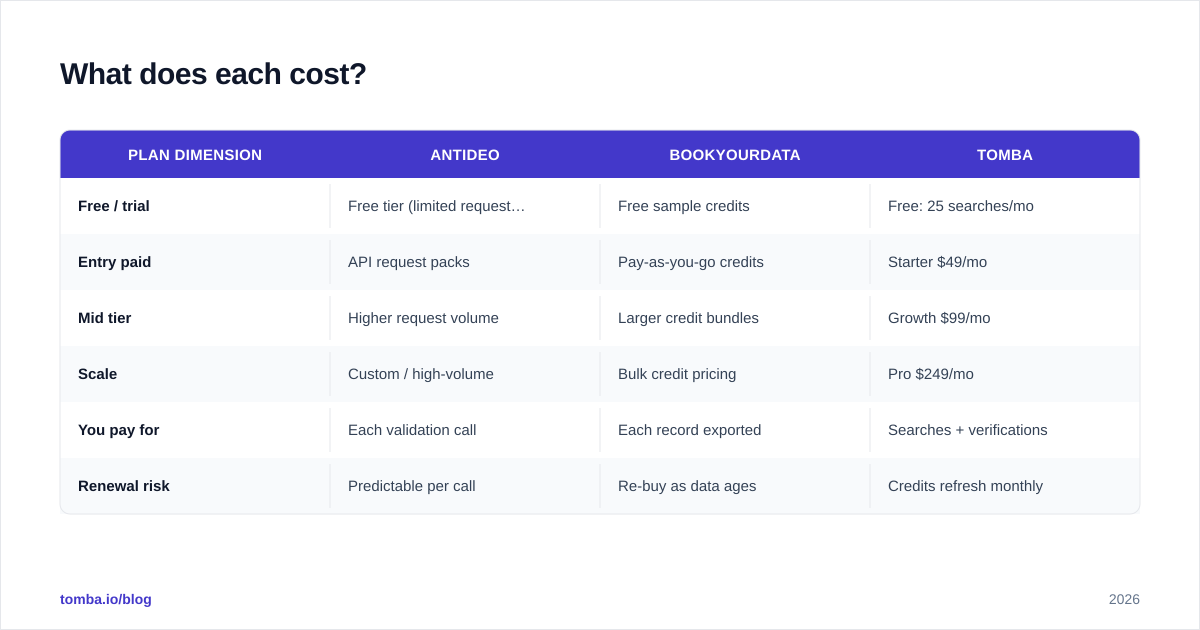
| Plan dimension | Antideo | BookYourData | Tomba |
|---|---|---|---|
| Free / trial | Free tier (limited requests) | Free sample credits | Free: 25 searches/mo |
| Entry paid | API request packs | Pay-as-you-go credits | Starter $49/mo |
| Mid tier | Higher request volume | Larger credit bundles | Growth $99/mo |
| Scale | Custom / high-volume | Bulk credit pricing | Pro $249/mo |
| You pay for | Each validation call | Each record exported | Searches + verifications |
| Renewal risk | Predictable per call | Re-buy as data ages | Credits refresh monthly |
Two budgeting traps to avoid:
- With BookYourData, the sticker price isn't the real price. Because lists decay, the honest cost is "records × how often you re-buy to stay current." A list you purchase quarterly costs four times its headline number per year.
- With Antideo, volume spikes bite. Consumption pricing is friendly at low volume and can surprise you during a launch or a bot attack when request counts balloon.
For a transparent monthly comparison you can model against both, the Tomba pricing page lays out searches and verifications per tier without per-record re-buys — which is why it sits in the table above as a reference point rather than a footnote.
When should you choose Antideo?#
Pick Antideo when the contacts already exist and you need to police quality or stop abuse. Strong-fit scenarios:
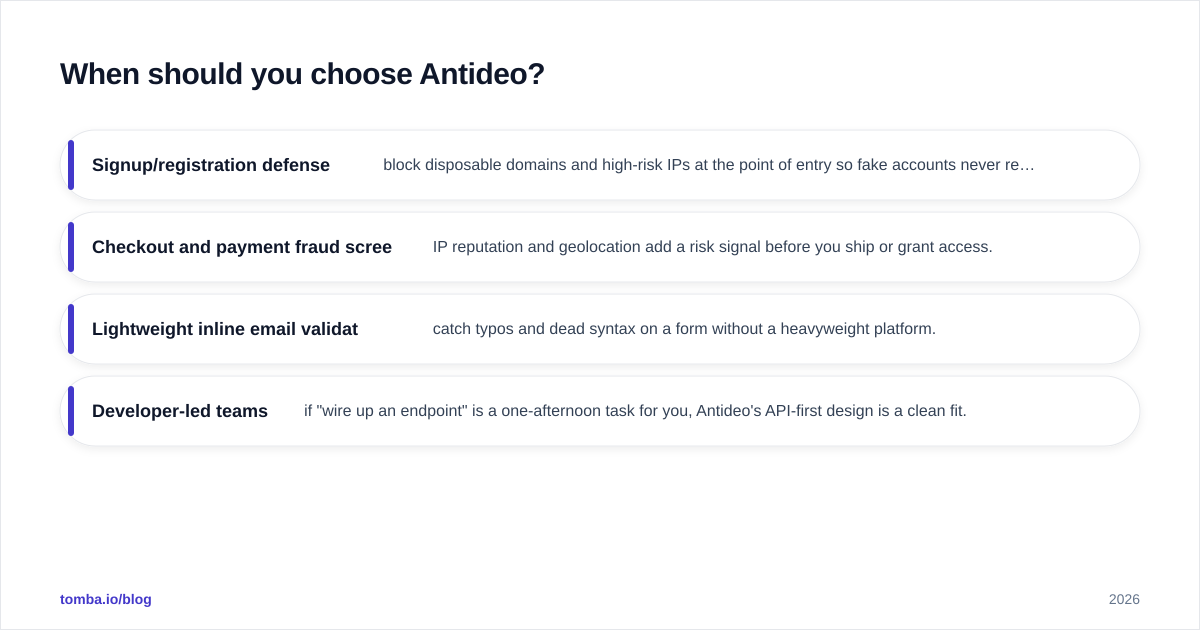
- Signup/registration defense — block disposable domains and high-risk IPs at the point of entry so fake accounts never reach your database.
- Checkout and payment fraud screening — IP reputation and geolocation add a risk signal before you ship or grant access.
- Lightweight inline email validation — catch typos and dead syntax on a form without a heavyweight platform.
- Developer-led teams — if "wire up an endpoint" is a one-afternoon task for you, Antideo's API-first design is a clean fit.
Antideo is a poor fit if your actual need is new contacts. It will never tell you who the VP of Engineering at a target account is — that's outside its job description entirely.
When should you choose BookYourData?#
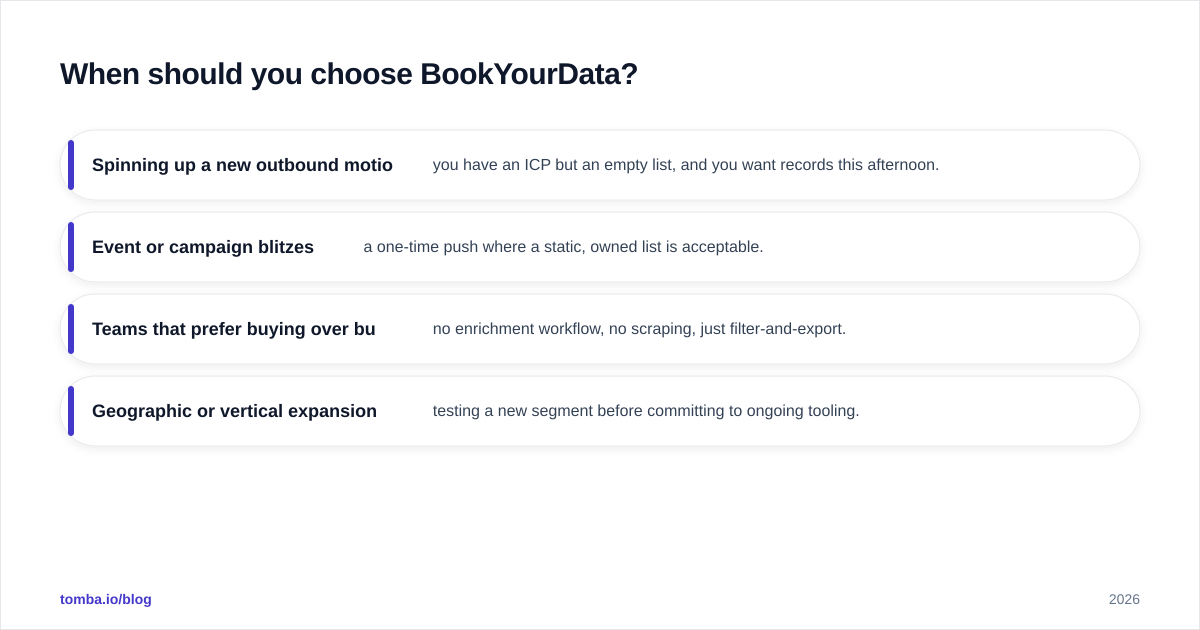
Pick BookYourData when you need a volume of B2B contacts right now and prefer to own the file. Strong-fit scenarios:
- Spinning up a new outbound motion — you have an ICP but an empty list, and you want records this afternoon.
- Event or campaign blitzes — a one-time push where a static, owned list is acceptable.
- Teams that prefer buying over building — no enrichment workflow, no scraping, just filter-and-export.
- Geographic or vertical expansion — testing a new segment before committing to ongoing tooling.
BookYourData is a poor fit if you need continuously fresh data, real-time enrichment inside your CRM, or per-contact sourcing on demand. A snapshot is a snapshot. The bounce guarantee helps, but it won't tell you that your prospect changed companies last month — it'll just refund the bounce after you've already burned the touch.
)
Is there a better option than either?#
Often, yes — and it's not a third version of the same trade-off. The gap both tools leave is the find-then-verify workflow: source a real, current email for the exact person you're targeting, confirm it's deliverable, and push it into your sequence — without buying a bulk file you'll have to re-buy, and without limiting yourself to scoring data you already possess.
That's the lane a dedicated email finder + verifier sits in. With Tomba you can:
- Find email addresses by name and domain on demand, so you're sourcing the contact you actually need instead of a list you mostly don't.
- Verify emails with real-time SMTP checks before you send — the validation job Antideo does, folded into the same workflow.
- Run a domain search to pull every known address pattern at a target company, then bulk verify the output in one pass.
- Sync results straight into your stack through native integrations like HubSpot, Salesforce, and Pipedrive — no CSV round-trips, no import-cleanup ritual.
Here's the workflow difference in one view:
The point isn't that Antideo or BookYourData are bad at their jobs — they're competent at the specific slices they own. It's that most teams are quietly paying for two partial solutions (a list vendor and a validator) to approximate one complete one. According to independent reviews on G2, buyers consistently rank data freshness and workflow integration above raw list size — exactly where the buy-a-list-then-score-it approach struggles.
How do you decide in practice?#
Run your situation through three quick questions:
- Do I need to acquire contacts, or clean the ones I have? Acquire → BookYourData or an email finder. Clean → Antideo or a verifier.
- Do I need the data to stay fresh over time? Yes → favor on-demand finding over a static list. No → a one-time purchase may be fine.
- Is this developer plumbing or a go-to-market workflow? Plumbing (forms, fraud, signups) → Antideo. GTM (prospecting, sequences, CRM) → a finder-plus-verifier platform.
If you answered "acquire," "yes, keep it fresh," and "GTM" — which describes most outbound teams — you don't want either tool in isolation. You want sourcing and verification in one loop. Compare the underlying data accuracy and the B2B database coverage before you commit budget to a model that re-bills you as your data ages.
The bottom line#
Antideo and BookYourData aren't really rivals — they're two different stations on the same assembly line. Antideo inspects; BookYourData supplies. If you genuinely only need fraud-grade validation, Antideo is a clean, developer-friendly choice. If you only need a one-time list and accept the decay, BookYourData ships records fast with a guarantee to back them.
But if you're building a repeatable outbound or RevOps motion, the stronger move is to collapse "buy a list" and "validate the list" into one find-and-verify workflow. Start free with the Tomba Email Finder — 25 searches a month, no card — and source verified, current contacts on demand instead of buying a snapshot or scoring data you already have. Find the person, confirm the email, sync it, send. One loop, no re-buys.
Ready to find emails that actually work?
Join 150,000+ professionals who stopped guessing and started sending. Free credits on signup — no credit card required.
Get the Tomba newsletter
Practical outbound tactics and product updates — once every two weeks.
About the author