Antideo vs Clodura.ai 2026: Data API & Sales Tool Compared
Antideo is a lightweight data-validation API; Clodura.ai is a full sales-intelligence platform. Here's which one fits your B2B data stack in 2026 — and where a dedicated finder beats both.
TL;DR
- Antideo is a lightweight, API-first data-validation toolkit — email, IP, phone, and profanity checks — priced for developers who want to bolt checks onto a form or signup flow.
- Clodura.ai is a full B2B sales-intelligence platform: a contact database, email finder, sequencing, and intent signals aimed at SDR and marketing teams running outbound.
- They are not really the same product. Antideo cleans and guards data; Clodura.ai sources and works leads.
- Pick Antideo if you need cheap, scriptable validation. Pick Clodura.ai if you need a prospecting database with built-in outreach.
- If your real goal is finding accurate, verified B2B emails at scale, a dedicated email finder often beats both on cost-per-valid-contact.
Why compare Antideo and Clodura.ai at all?#
These two tools end up on the same shortlist for one reason: both touch B2B contact data. But they sit at opposite ends of the pipeline.
Think of building a house. Antideo is the building inspector who checks that what you already have is sound — is this email real, is this IP a known abuser, is this phone number formatted correctly. Clodura.ai is the developer who hands you the land, the blueprints, and the crew — a database of companies, contacts, and the tooling to reach them.
If you confuse the two, you overpay for one and underuse the other. This guide breaks down what each actually does, where they overlap, and which one belongs in your 2026 stack.
What is Antideo?#
Antideo is a developer-focused data-validation and threat-intelligence API. Its core jobs are narrow and well-defined:
- Email validation — syntax, MX records, disposable-domain detection, and deliverability scoring.
- IP reputation — flag VPNs, proxies, Tor exits, and known spam sources.
- Phone validation — format and carrier-level checks.
- Profanity / content filtering — catch junk in user-generated fields.
The pitch is simplicity. You call an endpoint, you get a clean JSON verdict, you reject or accept the input. Antideo leans on a freemium model with a generous free tier for low-volume use, which makes it popular for indie developers guarding signup forms against fake or throwaway accounts.
What Antideo is not: it does not find you new contacts. There is no prospecting database, no company search, no sequencing. It validates data you already collected. If you point it at an empty list, it returns nothing useful — there is nothing to enrich.
What is Clodura.ai?#
Clodura.ai is a B2B sales-intelligence and engagement platform. It bundles several jobs that an SDR team would otherwise buy separately:
- A contact and company database (the vendor cites hundreds of millions of contacts).
- An email finder and verifier to pull and confirm work addresses.
- Direct dials and org charts for account mapping.
- Buyer-intent and technographic signals to prioritize accounts.
- Email sequencing and cadence tools to run outreach inside the platform.
In other words, Clodura.ai wants to be the place where prospecting, data, and outreach all live. That breadth is its main selling point — and its main cost driver. You are paying for a platform, not a function.
Antideo vs Clodura.ai: how do they compare head-to-head?#
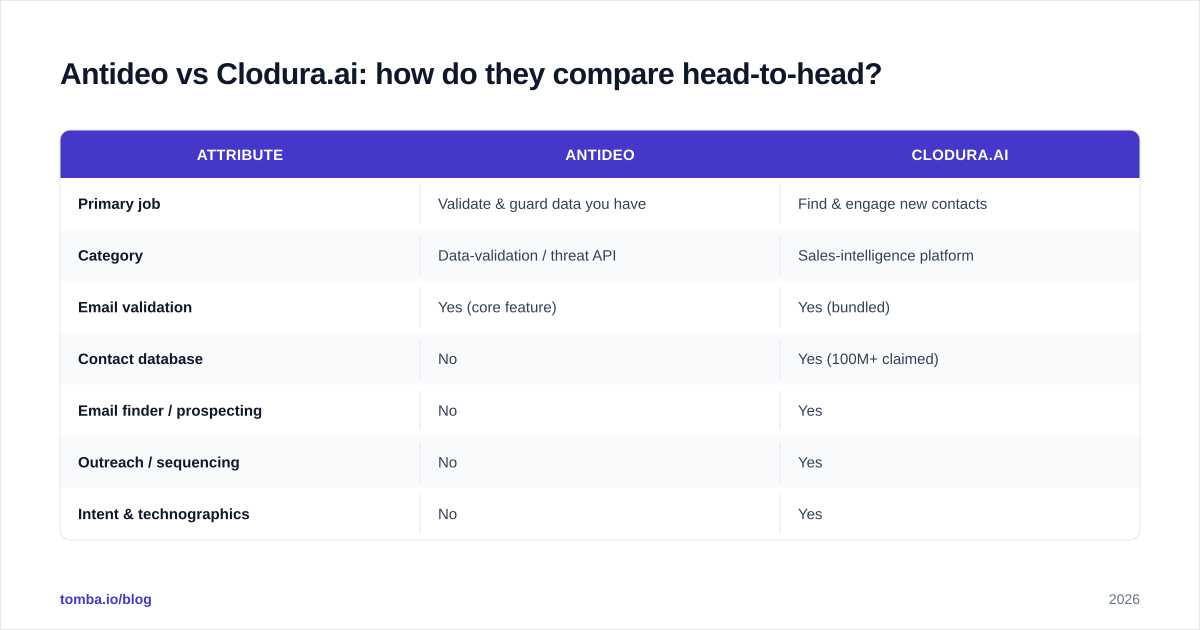
The honest summary: these tools solve different problems, so "better" depends entirely on the job. Here is the side-by-side.
| Attribute | Antideo | Clodura.ai |
|---|---|---|
| Primary job | Validate & guard data you have | Find & engage new contacts |
| Category | Data-validation / threat API | Sales-intelligence platform |
| Email validation | Yes (core feature) | Yes (bundled) |
| Contact database | No | Yes (100M+ claimed) |
| Email finder / prospecting | No | Yes |
| Outreach / sequencing | No | Yes |
| Intent & technographics | No | Yes |
| Pricing model | Freemium API, low-cost tiers | Platform subscription (per seat) |
| Best for | Developers, form/signup defense | SDR & marketing teams |
| Setup effort | Minimal (one API call) | Onboarding + seat config |
The table makes the split obvious. If you already have a list and need it clean, Antideo wins on price and speed. If you have no list and need to build a pipeline, Antideo can't help you at all — that is Clodura.ai's lane.
Which one is more accurate for email data?#
Accuracy means two different things here, and conflating them is the most common mistake buyers make.
Antideo measures validity. Its email check tells you whether an address is syntactically correct, has live MX records, and isn't a disposable domain. That is verification — and it is genuinely useful before you send. But it cannot tell you whether john@acme.com is the right person, because it never sourced that contact.
Clodura.ai measures discoverability plus validity. It returns a contact it believes exists, then runs its own verification. The risk is database freshness: large aggregated databases decay fast as people change jobs, and a confidently-returned address can still bounce if the record is stale.
This is where a focused tool earns its place. A dedicated email verifier run as a final gate — catching catch-all domains, role accounts, and dead mailboxes — protects your sender reputation regardless of where the contact came from. Verification is not a feature you should trust to the same system that generated the lead; an independent check is the whole point.

What does each cost in 2026?#
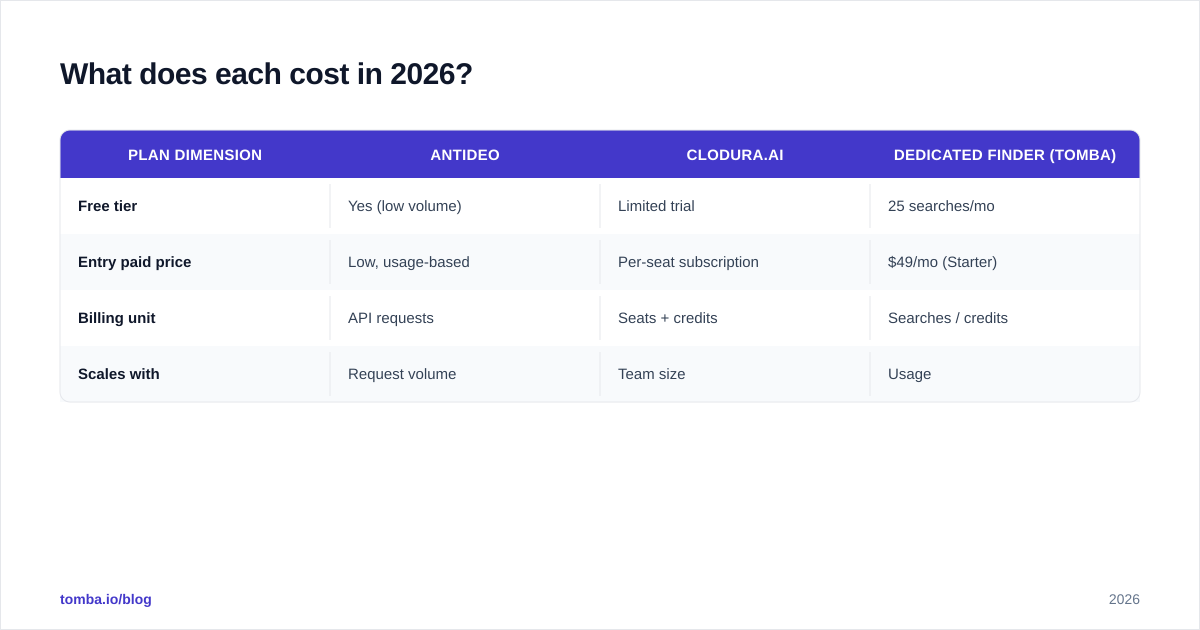
Pricing philosophy is where the gap is widest.
Antideo uses a freemium, usage-based model. There's a free tier suitable for hobby projects and low request volumes, with paid plans that scale by request volume. Because it is a single-purpose API, the per-call cost is low and predictable. You pay for checks, not seats.
Clodura.ai uses platform subscriptions, typically billed per user with credit allotments for contact reveals and exports. That is normal for sales-intelligence tools, but it means cost scales with your team size and your appetite for data, not just with usage. For a small team it can be reasonable; for a large org it becomes a line item you negotiate.
For context on how a usage-transparent finder prices, compare against published Tomba pricing: a free tier of 25 searches/month, Starter at $49/mo, Growth at $99/mo, and Pro at $249/mo. The point isn't that one is cheapest — it's that you should map price to the job. Paying platform rates for what is essentially validation, or paying per-call rates and still having no contacts, are both waste.
| Plan dimension | Antideo | Clodura.ai | Dedicated finder (Tomba) |
|---|---|---|---|
| Free tier | Yes (low volume) | Limited trial | 25 searches/mo |
| Entry paid price | Low, usage-based | Per-seat subscription | $49/mo (Starter) |
| Billing unit | API requests | Seats + credits | Searches / credits |
| Scales with | Request volume | Team size | Usage |
When should you choose Antideo?#
Choose Antideo when validation is the whole job:
- You run a signup or lead form and want to block disposable emails, bot IPs, and junk input in real time.
- You're a developer who wants a single endpoint, clean JSON, and no platform onboarding.
- Your contacts already exist — in your CRM, your product database, a bulk email finder export — and you just need a deliverability gate before sending.
- Budget is tight and you want pay-per-use rather than seats.
Antideo is a sharp tool for a specific cut. Don't ask it to source pipeline; that was never its design.
When should you choose Clodura.ai?#
Choose Clodura.ai when you need an outbound engine, not a checker:
- You have an SDR or growth team that needs a contact database to build target lists from scratch.
- You want intent signals and technographics to prioritize accounts.
- You prefer running discovery, enrichment, and sequencing inside one platform instead of stitching tools together.
- Per-seat pricing fits your headcount and you'll actually use the breadth.
The caveat: platforms reward heavy use. If two reps run a handful of searches a week, you're paying for a Swiss-army knife to open envelopes.
Is there a better-fit alternative to both?#
Often, yes — because most teams don't actually want "a validation API" or "a giant platform." They want accurate, verified B2B emails for the people they already know they want to reach, without overpaying.
That middle path is what a dedicated email-finding suite covers:
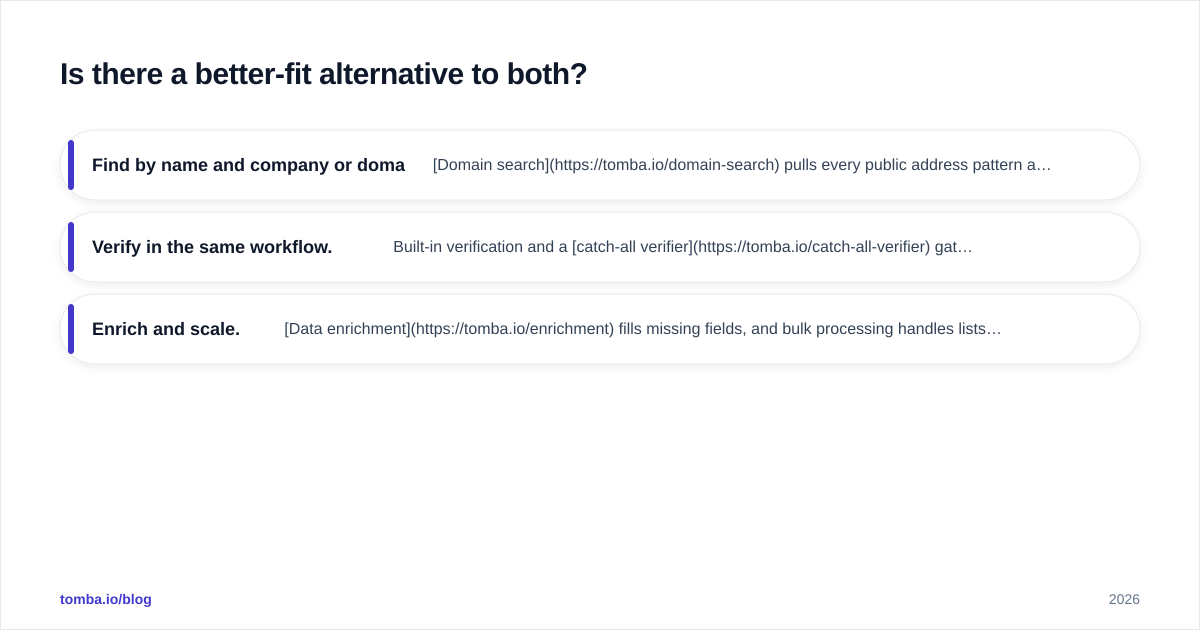
- Find by name and company or domain. Domain search pulls every public address pattern at a company, and the email finder resolves a specific person — the discovery Antideo lacks.
- Verify in the same workflow. Built-in verification and a catch-all verifier gate deliverability before you send — the protection Clodura.ai bundles, but as a focused, independently-trustworthy step.
- Enrich and scale. Data enrichment fills missing fields, and bulk processing handles lists without per-seat lock-in.
You can sanity-check any of these claims yourself on independent review sites like G2 and Capterra, and read each vendor's own scope on the Antideo and Clodura.ai homepages before committing. Neutral reviews beat vendor copy every time.
What's the verdict?#
There is no single winner, because Antideo and Clodura.ai aren't really competitors — they're neighbors.
- Antideo wins if you have data and need it validated cheaply and programmatically.
- Clodura.ai wins if you have no data and need a full platform to source and engage at the team level.
- Neither wins if your actual need is "find verified emails for known targets without buying a platform or stitching APIs" — that's a finder's job.
Map the tool to the job to be done, not to the longest feature list. The most expensive mistake in B2B data tooling is paying platform prices for a single function, or paying for raw data you never verify before it bounces.
If your bottleneck is getting accurate, ready-to-send email addresses for the people you want to reach, start with the Tomba Email Finder. Find contacts by name, company, or domain, verify them in the same flow, and pay for searches instead of seats — free for your first 25 searches a month, $49/mo when you scale. Validate what you have, source what you don't, and stop letting stale data eat your sender reputation.
Ready to find emails that actually work?
Join 150,000+ professionals who stopped guessing and started sending. Free credits on signup — no credit card required.
Get the Tomba newsletter
Practical outbound tactics and product updates — once every two weeks.
About the author