Antideo vs EasyLeadz 2026: Which B2B Data Tool Wins?
Antideo verifies emails, IPs and phone numbers; EasyLeadz finds direct-dial mobiles. Here's exactly which one fits your 2026 GTM stack — and where a dedicated finder beats both.
You typed "Antideo vs EasyLeadz" into a search bar expecting two versions of the same product. They are not. One cleans the data you already have; the other goes out and finds data you don't. Picking the wrong one wastes a budget cycle and leaves a hole in your pipeline.
This breakdown shows what each tool actually does, where they overlap (barely), what they cost, and the realistic workflow where you'd use one, the other, or neither.
TL;DR — Antideo vs EasyLeadz in 30 seconds#
- Antideo is a data validation and hygiene API: email verification, IP reputation, phone format checks, and disposable-domain detection. It improves data you already collected.
- EasyLeadz (and its "Mr. E" extension) is a contact discovery tool focused on B2B direct-dial mobile numbers, pulled mostly from a LinkedIn-driven workflow.
- They solve different problems. Antideo answers "is this contact real and safe?"; EasyLeadz answers "what's this person's phone number?"
- For pricing, Antideo leans toward free-tier-plus-API usage; EasyLeadz sells credit packs aimed at phone-number pulls.
- If your real need is finding and verifying business email addresses at scale, neither is a perfect fit — a dedicated email finder plus email verifier covers that lane better.
What is Antideo?#
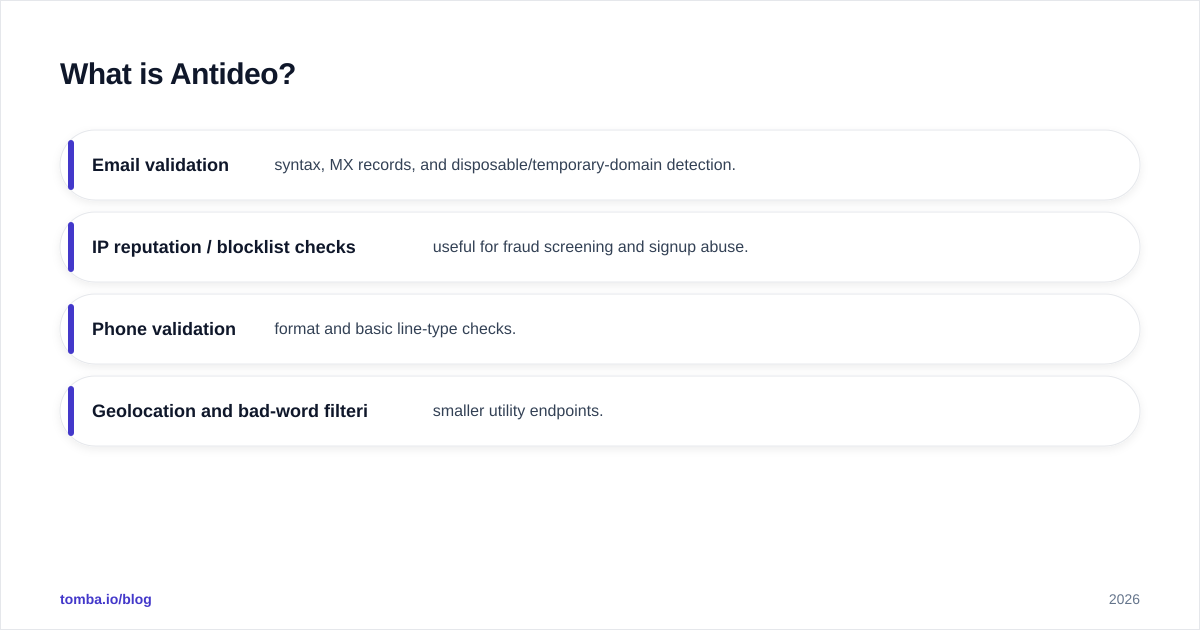
Antideo is a developer-facing data-quality service. Think of it as the bouncer at the door of your CRM: before a record gets in, Antideo checks its ID. It exposes a set of REST API endpoints (with a free tier) that handle:
- Email validation — syntax, MX records, and disposable/temporary-domain detection.
- IP reputation / blocklist checks — useful for fraud screening and signup abuse.
- Phone validation — format and basic line-type checks.
- Geolocation and bad-word filtering — smaller utility endpoints.
Antideo's center of gravity is fraud prevention and list hygiene, not lead generation. You point it at data you've already captured — a signup form submission, an imported list — and it tells you whether to trust the record. It does not hand you new contacts. You can read more on the official Antideo site.
What is EasyLeadz?#
EasyLeadz is a B2B prospecting tool built around one headline feature: finding direct-dial mobile numbers for decision-makers. Its browser extension, "Mr. E," sits on a LinkedIn profile and surfaces a phone number (and sometimes an email) for that person. The model is credit-based — you spend credits to reveal contact details.
Where Antideo cleans, EasyLeadz hunts. It's aimed at SDRs and cold-callers who live inside LinkedIn and want a phone number to dial today. You can see its positioning on the official EasyLeadz site and read user sentiment on G2.
The trade-off: phone-number databases are notoriously uneven by region. EasyLeadz tends to be strongest for India and parts of APAC and thinner in some Western European markets, so coverage depends heavily on where your prospects sit.
Antideo vs EasyLeadz: how do they compare head-to-head?#
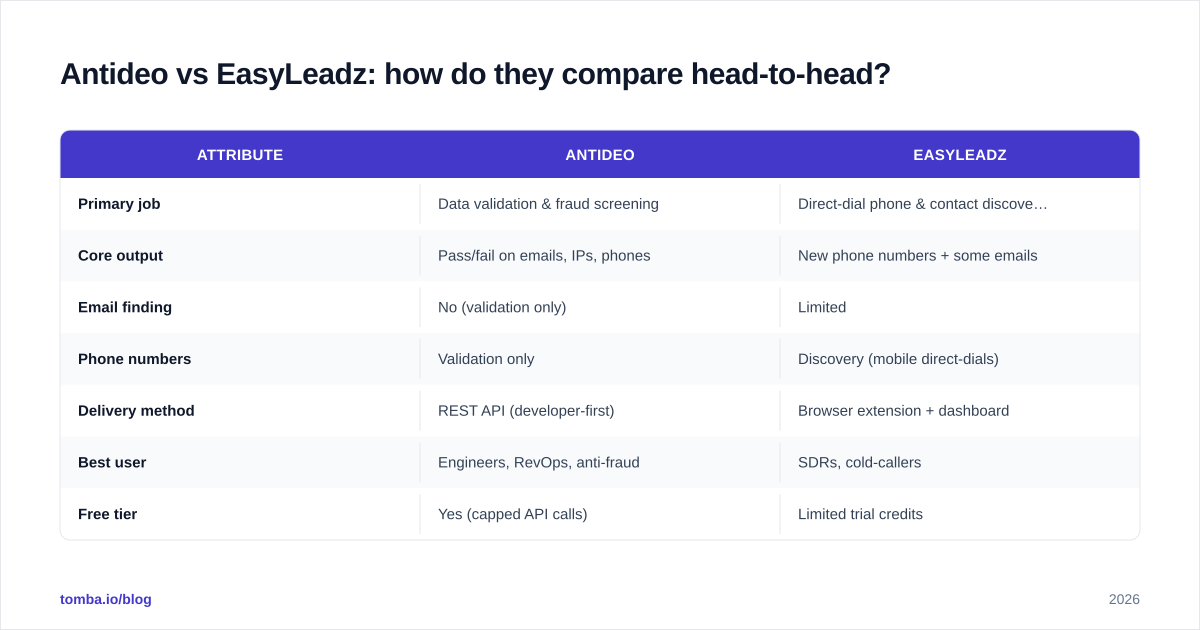
The honest answer is that comparing them feels like comparing a dishwasher to a delivery van. Here's the side-by-side anyway, because you came for it:
| Attribute | Antideo | EasyLeadz |
|---|---|---|
| Primary job | Data validation & fraud screening | Direct-dial phone & contact discovery |
| Core output | Pass/fail on emails, IPs, phones | New phone numbers + some emails |
| Email finding | No (validation only) | Limited |
| Phone numbers | Validation only | Discovery (mobile direct-dials) |
| Delivery method | REST API (developer-first) | Browser extension + dashboard |
| Best user | Engineers, RevOps, anti-fraud | SDRs, cold-callers |
| Free tier | Yes (capped API calls) | Limited trial credits |
| Pricing model | Free + paid API tiers | Credit packs / subscription |
| Data freshness risk | Low (checks live signals) | Medium (depends on DB coverage) |
| Geographic strength | Global (validation is universal) | Strong India/APAC, patchier EU/US |
Read that table once and the takeaway is clear: these tools are complementary, not competitive. A mature outbound team could plausibly run both — EasyLeadz to source numbers, Antideo to screen inbound form fills. What you should not do is buy one expecting the other's feature set.

Which tool should you choose for your use case?#
Match the tool to the job, not the brand name. Use this decision frame:
Choose Antideo if:
- You're a developer or RevOps lead who needs to validate emails or screen signups programmatically.
- Fraud, fake accounts, or disposable emails are eating your funnel.
- You already have contact data and need to clean it, not grow it.
Choose EasyLeadz if:
- You're an SDR whose primary motion is cold-calling.
- Your prospects are concentrated in regions where EasyLeadz's phone coverage is strong.
- You live in LinkedIn and want a number revealed on the profile you're already viewing.
Choose neither (and use a dedicated finder) if:
- Your core need is finding business email addresses by name or domain at scale — that's what an email finder and domain search are built for.
- You want finding and verification in one workflow without stitching two vendors together.
A useful mental model: data tooling splits into three layers — discovery (find new contacts), enrichment (add detail to known contacts), and hygiene (validate what you have). EasyLeadz plays in discovery, Antideo plays in hygiene, and most teams discover they need all three. Trying to force one tool to cover two layers is where stacks get expensive and data quality drops.
How accurate is the data from each?#
Accuracy means different things here, so judge each on its own terms.
For Antideo, "accuracy" is about correctly classifying a record — does it actually catch disposable domains, dead MX records, and flagged IPs? Validation is a more deterministic problem than discovery: an MX lookup either resolves or it doesn't. So Antideo's outputs are reasonably reliable for syntax-and-deliverability signals. The caveat is depth — a lightweight validation API will not catch catch-all domains or do the SMTP-level checks that a specialized catch-all verifier performs.
For EasyLeadz, "accuracy" is about whether the phone number it reveals is current and reaches the right person. This is a far harder problem, and it's where every phone-discovery vendor lives or dies. Numbers go stale, people change jobs, and coverage is wildly uneven by geography. Expect strong hit rates in EasyLeadz's core markets and noticeably weaker ones elsewhere. Always sample-test against your own target region before committing budget.
If verified email is your priority, this is the gap neither tool fully closes. Email verification is its own discipline — checking syntax, MX, SMTP response, and catch-all behavior. Tools built specifically for that, with transparent data sources, tend to outperform a general validation endpoint or a phone-first finder bolting email on as an afterthought.
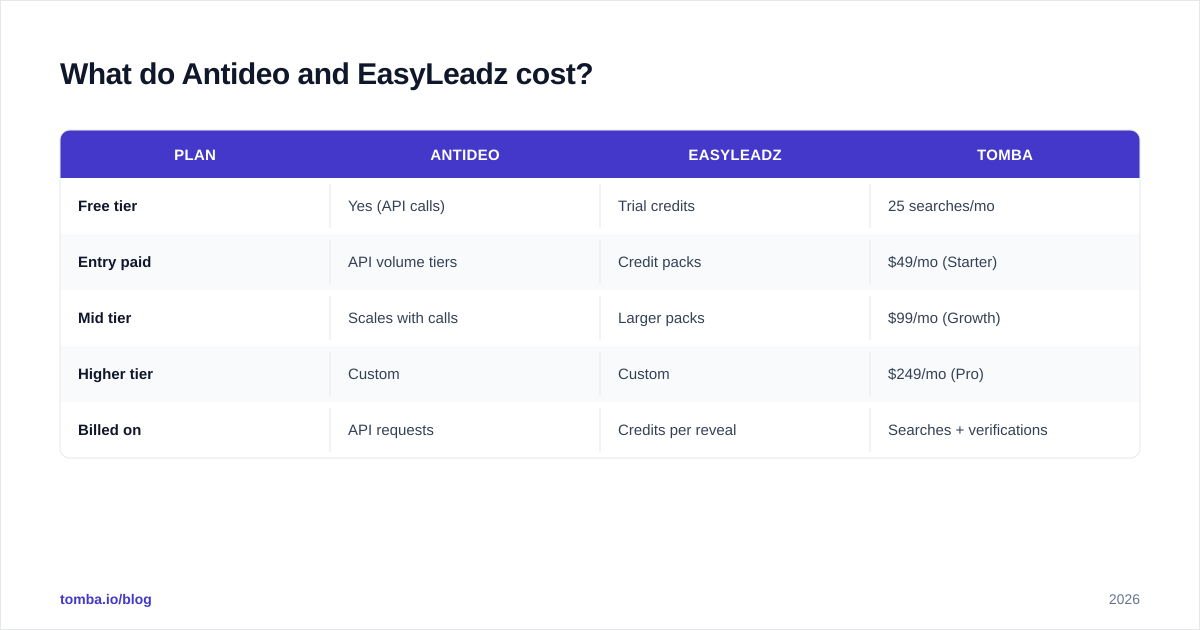
What do Antideo and EasyLeadz cost?#
Pricing structures reflect the different jobs.
Antideo follows the classic API playbook: a free tier with capped monthly calls, then paid tiers that scale with request volume. If you're a developer prototyping fraud checks, you can start at zero and only pay when you hit volume.
EasyLeadz uses a credit model — you buy a pack, and each contact reveal burns credits. That makes per-contact cost the number to watch. If your team reveals hundreds of numbers a week, credit burn adds up fast, and unused credits expiring is a common complaint with credit-based tools generally.
For context, here's how a finder-plus-verifier platform prices against them, since many readers comparing these two are really shopping for contact data overall:
| Plan | Antideo | EasyLeadz | Tomba |
|---|---|---|---|
| Free tier | Yes (API calls) | Trial credits | 25 searches/mo |
| Entry paid | API volume tiers | Credit packs | $49/mo (Starter) |
| Mid tier | Scales with calls | Larger packs | $99/mo (Growth) |
| Higher tier | Custom | Custom | $249/mo (Pro) |
| Billed on | API requests | Credits per reveal | Searches + verifications |
(See current Tomba pricing for exact credit allotments.) The point isn't that one is universally cheaper — it's that you should price against your dominant action. If you mostly validate, pay per API call. If you mostly reveal numbers, watch credit burn. If you mostly find-and-verify emails, a search-based plan is the cleanest fit.
Can you use both Antideo and EasyLeadz together?#
Yes, and for some teams that's the smartest play. A clean pipeline might look like:
- Source the contact — pull a direct-dial from EasyLeadz, or find a verified email with a dedicated finder.
- Validate it — run the email or IP through Antideo to screen junk and fraud before it touches your CRM.
- Enrich and route — append firmographics via data enrichment and push the clean record into your sequencing tool.
The friction is integration overhead: two vendors, two billing relationships, two sets of API keys, and data formats you have to reconcile. That's exactly why consolidated platforms exist — finding, verifying, enriching, and even bulk lead generation under one roof, with a single email finder API instead of a patchwork. Whether consolidation is worth it depends on your volume and your engineering bandwidth.
The verdict: which one wins?#
Neither "wins" outright, because they're not really competitors — and that's the most useful thing to know before you spend a dollar.
- Antideo wins if your problem is data quality, fraud, and hygiene, and you want a developer-friendly API to enforce it.
- EasyLeadz wins if your problem is getting a decision-maker's phone number from a LinkedIn profile, and your market matches its coverage.
- Neither is the right pick if what you actually need is to find and verify business email addresses at scale — the most common job people are quietly trying to solve when they compare data tools.
If that last case is you, start with a tool built for it. Tomba's Email Finder locates professional emails by name, domain, or company, validates them in the same flow, and ships with a free tier (25 searches/month) so you can test accuracy against your own target list before paying. Pair it with the built-in email verifier and you cover discovery and hygiene without stitching two vendors together. Try it on your next 25 prospects and compare the hit rate yourself — that's the only benchmark that matters.
// get started
Find, verify and enrich your first contacts today
Start on the free plan with 25 searches a month, then scale when your team is ready.
Free plan · No credit card required · GDPR & CCPA
// about the author