Antideo vs Exellius (2026): Email Data Tools Compared
Antideo is a self-serve validation API; Exellius is a done-for-you B2B data and outreach service. Here is how the two stack up in 2026 — pricing, accuracy, coverage, and which fits your workflow.
You typed "Antideo vs Exellius" into a search bar because you are trying to clean up a messy contact list — or stand up a lead pipeline — without setting fire to your sender reputation or your budget. The problem is that these two names get lumped together as "data tools," but they solve different problems and they don't compete head-to-head the way the query implies.
This guide cuts through that. We'll define what each one actually is, where they overlap, where they don't, and which one belongs in your stack in 2026.
TL;DR#
- Antideo is a self-serve validation and threat-data API: email validation, IP reputation, phone validation, and spam/abuse checks with a genuinely usable free tier.
- Exellius (Exellius Systems) is a done-for-you B2B lead generation and data service — closer to an agency/DaaS model than a developer tool you plug in yourself.
- They are not direct competitors. One is a build-it-yourself API; the other is a buy-the-outcome service.
- Choose Antideo if you have a dev team and want to verify data inside your own app. Choose Exellius if you want lists and appointments handed to you.
- If what you actually need is to find and verify business emails at scale yourself, a dedicated platform like Tomba sits in the gap between them.
What is Antideo?#
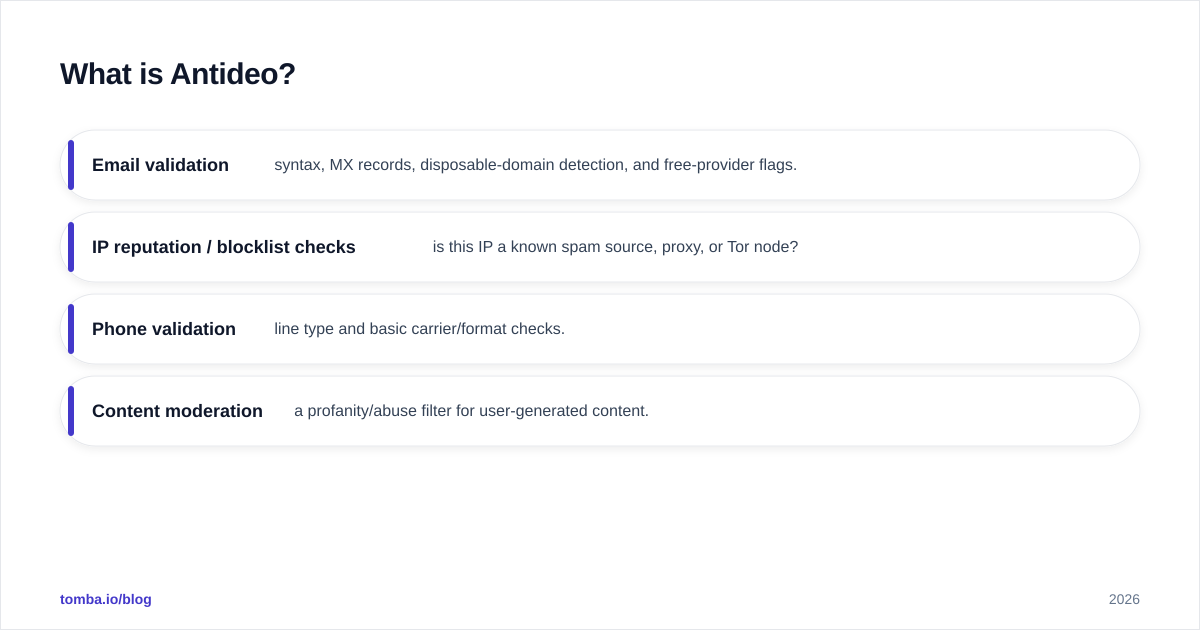
Antideo is an API-first data hygiene and threat-intelligence service. Instead of a dashboard you log into to run campaigns, it gives developers endpoints they call from their own code. The core modules are:
- Email validation — syntax, MX records, disposable-domain detection, and free-provider flags.
- IP reputation / blocklist checks — is this IP a known spam source, proxy, or Tor node?
- Phone validation — line type and basic carrier/format checks.
- Content moderation — a profanity/abuse filter for user-generated content.
The pitch is simple: bolt real-time validation onto your signup forms, checkout flows, or comment sections so junk never enters your database in the first place. Antideo offers a free tier (rate-limited, no card required for basic calls), which makes it popular with indie developers and early-stage products testing the waters. You can read its module list on the official site at antideo.com.
The trade-off: Antideo is a gatekeeper, not a prospecting engine. It tells you whether a record is clean. It does not go find new contacts for you.
What is Exellius?#
Exellius Systems operates at the opposite end of the spectrum. It is a B2B lead-generation and sales-development service: you brief them on your ideal customer profile, and they deliver targeted contact lists, data enrichment, and in many engagements full outbound outreach or appointment setting. Think managed service, not API key.
That model has real advantages. You don't need engineers. You don't manage credits or rate limits. You describe the outcome — "SaaS marketing directors in North America, 50–500 employees" — and a team builds and runs against it. For sales leaders who want pipeline without operational overhead, that's attractive.
The trade-offs are the usual ones for any done-for-you service: less transparency into where data comes from, slower iteration when your targeting changes, per-project or retainer pricing rather than predictable usage-based costs, and dependency on a vendor's process instead of your own data sources. You're buying an outcome and trusting the method.
)
Antideo vs Exellius: how do they actually differ?#
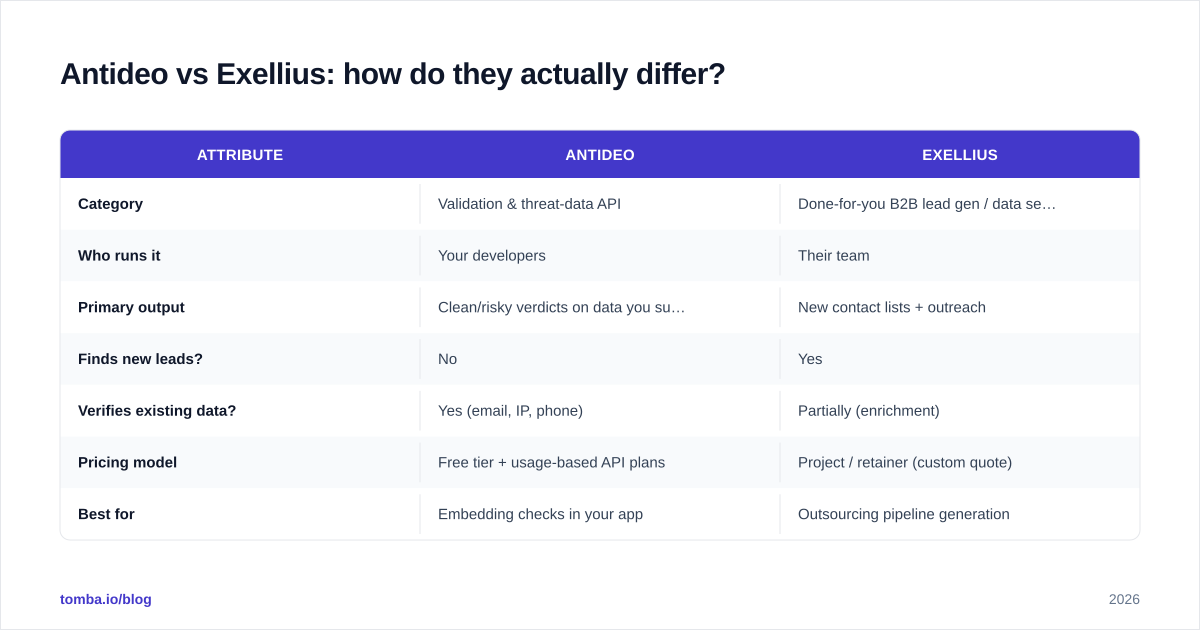
The cleanest way to see it: Antideo is a tool you operate; Exellius is a team that operates for you. One is infrastructure, the other is a service.
| Attribute | Antideo | Exellius |
|---|---|---|
| Category | Validation & threat-data API | Done-for-you B2B lead gen / data service |
| Who runs it | Your developers | Their team |
| Primary output | Clean/risky verdicts on data you supply | New contact lists + outreach |
| Finds new leads? | No | Yes |
| Verifies existing data? | Yes (email, IP, phone) | Partially (enrichment) |
| Pricing model | Free tier + usage-based API plans | Project / retainer (custom quote) |
| Best for | Embedding checks in your app | Outsourcing pipeline generation |
| Setup effort | API integration | Onboarding call + brief |
| Transparency | High (you see every call) | Lower (managed process) |
Notice what's missing from both columns: neither is a self-serve email finder you can sit down with and search by domain or name in minutes. Antideo validates what you already have; Exellius hands you a finished list. If you want to do the finding-and-verifying yourself, at your own pace, that's a third category — and we'll get to it.
Which one is more accurate?#
Accuracy means different things here, so compare like with like.
For email validation, Antideo does the standard checks well — syntax, MX, disposable detection, role-account flags. Where lightweight validation APIs tend to struggle is catch-all domains (servers that accept any address, so a simple SMTP probe returns "valid" for everything) and deep mailbox-level confidence. If your list is heavy on catch-all domains, a single validation call may overstate deliverability. That's a known limit across the lightweight-API category, not an Antideo-specific flaw — it's why dedicated tools layer on a catch-all verifier and risk scoring.
For Exellius, "accuracy" is about the quality of the lists they deliver — how current the contacts are and how well they match your brief. With any managed data service, freshness depends on the provider's sourcing cadence, and you typically can't audit each record's provenance the way you can with a transparent API or email verifier you run yourself. Ask for sample data and bounce-rate guarantees before committing.
Bottom line: Antideo gives you measurable, per-record verdicts you control. Exellius gives you delivered lists whose accuracy you largely take on trust. Neither is "more accurate" in the abstract — they're accurate about different things.
Which is better for cold email and deliverability?#
If your goal is protecting sender reputation on cold campaigns, the workflow matters more than the brand name.
Antideo fits the pre-send hygiene step: run addresses through validation before they hit your sequencer so you strip syntax errors, disposables, and obvious traps. That's necessary but not sufficient — it won't catch every risky catch-all, and it won't warm your domain or fix your SPF/DKIM setup.
Exellius, when it includes managed outreach, owns more of the funnel — but you're also trusting their infrastructure and their list hygiene to keep your domain safe. If their data is stale, your bounce rate (and your sender reputation) takes the hit, even though you didn't build the list.
Either way, deliverability is a system, not a single tool. Validation is one layer; authentication, warmup, and list freshness are others. For a primer on how those pieces connect, HubSpot's guide on email deliverability is a solid neutral reference, and you can compare options on G2 before you commit budget.

What do they cost in 2026?#
Pricing is where the two models diverge hardest.
Antideo uses the familiar API ladder: a free tier with rate limits for testing and low-volume use, then paid tiers that scale with request volume. This is predictable and self-serve — you know your cost per thousand calls, and you can start at zero. Good for budgeting, good for experimentation.
Exellius quotes per engagement. Because it's a managed service, pricing reflects scope — list size, targeting complexity, whether outreach is included, and contract length. That can deliver strong ROI when it replaces a headcount, but it's rarely a "swipe a card and start" number, and minimums often apply.
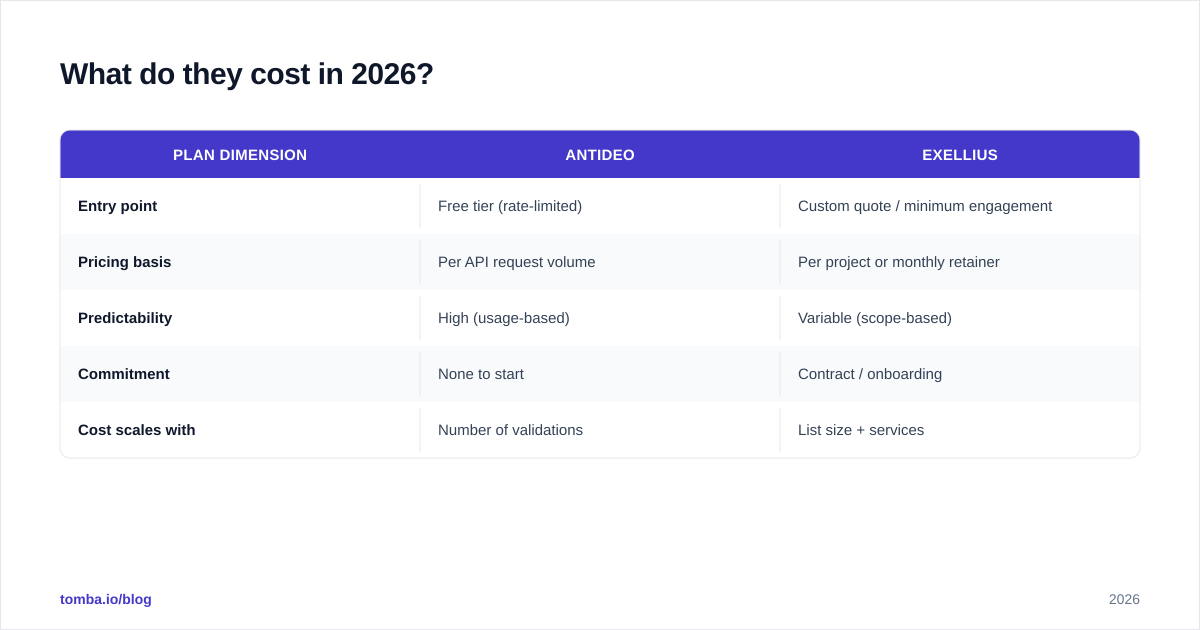
Here's a simplified shape (always confirm current numbers directly — service pricing especially moves):
| Plan dimension | Antideo | Exellius |
|---|---|---|
| Entry point | Free tier (rate-limited) | Custom quote / minimum engagement |
| Pricing basis | Per API request volume | Per project or monthly retainer |
| Predictability | High (usage-based) | Variable (scope-based) |
| Commitment | None to start | Contract / onboarding |
| Cost scales with | Number of validations | List size + services |
For comparison, a self-serve finder-plus-verifier platform like Tomba publishes flat tiers — Free (25 searches/mo), Starter $49/mo, Growth $99/mo, Pro $249/mo — so you can see the full Tomba pricing before committing. That predictability is exactly what API buyers like about Antideo and what service buyers give up with Exellius.
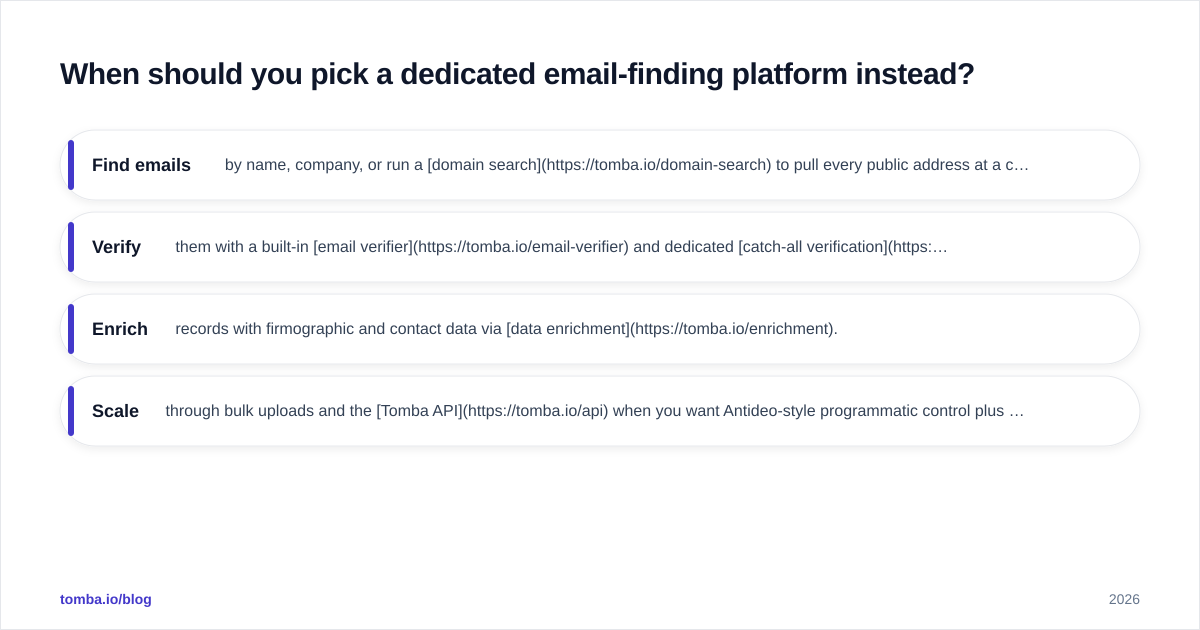
When should you pick a dedicated email-finding platform instead?#
Often — because most people searching "Antideo vs Exellius" actually want a third thing.
If your real job is: find the right contacts at target companies, get their verified business emails, and push them into your CRM or sequencer yourself, then neither a validation-only API nor a done-for-you agency is the tightest fit. Antideo won't find the contacts; Exellius finds them but takes the controls out of your hands.
That middle ground — self-serve, transparent, and built for both finding and verifying — is where a platform like Tomba lives. You can:
- Find emails by name, company, or run a domain search to pull every public address at a company.
- Verify them with a built-in email verifier and dedicated catch-all verification so risky domains don't slip through.
- Enrich records with firmographic and contact data via data enrichment.
- Scale through bulk uploads and the Tomba API when you want Antideo-style programmatic control plus actual lead discovery.
In other words, you get the developer-friendly, usage-clear model that makes Antideo appealing, combined with the lead-finding outcome that makes Exellius appealing — without choosing one or the other.
Antideo vs Exellius: quick decision guide#
| If you... | Pick |
|---|---|
| Have developers and want to validate data inside your app | Antideo |
| Want to block junk signups and abusive IPs in real time | Antideo |
| Want lists and outreach handled for you, no ops | Exellius |
| Are replacing an SDR/research headcount | Exellius |
| Want to find AND verify business emails yourself | Tomba (self-serve platform) |
| Need predictable flat pricing with a free tier | Antideo or Tomba |
Frequently asked questions#
Is Antideo a competitor to Exellius? Not really. Antideo is a self-serve validation/threat-data API; Exellius is a managed B2B lead-generation service. They sometimes appear in the same searches because both touch "B2B data," but one is infrastructure you operate and the other is an outcome you buy.
Can Antideo find new email addresses? No. Antideo validates and scores data you already have (emails, IPs, phone numbers). To discover new contacts you need an email finder or a lead-gen service.
Does Exellius publish pricing? Pricing is quoted per engagement based on scope, so expect a custom proposal rather than public tiers. Ask for sample data and bounce guarantees before signing.
What about catch-all domains? Lightweight validation APIs often mark catch-all addresses as "valid" by default, which can inflate confidence. A dedicated catch-all verifier adds the risk scoring those simple checks miss.
The verdict#
Stop framing it as "Antideo vs Exellius" — they're answers to different questions. Antideo is the right call when you want to embed transparent, usage-priced validation into your own product. Exellius makes sense when you'd rather outsource pipeline generation entirely and pay for the outcome. Most teams searching this comparison, though, are really after the thing in between: the ability to find verified business contacts themselves, fast, with predictable pricing.
If that's you, start with Tomba's Email Finder. Search by domain or name, verify on the spot, and export clean, deliverable contacts straight into your workflow — the find-it-yourself control of an API with the finished-list outcome of a service, on a free tier you can try today. Spin up a list, run it through verification, and see how much cleaner your next campaign sends.
Ready to find emails that actually work?
Join 150,000+ professionals who stopped guessing and started sending. Free credits on signup — no credit card required.
Get the Tomba newsletter
Practical outbound tactics and product updates — once every two weeks.
About the author