Antideo vs Generect 2026: Which B2B Data API Wins?
Antideo validates emails, phones, and IPs; Generect finds and enriches B2B leads. Here's an honest, side-by-side breakdown of which API fits your stack in 2026.
Antideo and Generect get mentioned in the same breath because both are API-first data tools, but they solve opposite problems. Antideo cleans and validates contact data you already have. Generect goes out and finds new B2B leads. Picking between them by feature list alone leads people to buy the wrong tool, so this comparison frames the decision around what you actually need to ship.
TL;DR#
- Antideo is a data-hygiene API: email verification, disposable-email detection, phone validation, IP reputation, and geolocation. It does not find new contacts.
- Generect is a B2B lead-generation API: it sources company and people data (heavily LinkedIn-anchored) and returns enriched leads with emails.
- They are complementary, not interchangeable — Generect finds, Antideo (or a verifier) confirms before you send.
- If you need both finding and verifying in one platform with predictable pricing, a dedicated email-data provider like Tomba covers the full loop.
- Decision rule: choose Antideo for cleaning lists, Generect for building them, and a unified finder+verifier when you want one bill and one API.
What is Antideo?#
Antideo is a lightweight data-validation API aimed at developers who need to keep junk out of their systems. Think of it as the bouncer at the door of your database: it does not bring guests in, it just checks IDs and turns away the fakes.
Its core endpoints cover email verification (syntax, MX records, disposable-domain flags), phone validation, and IP reputation/geolocation lookups. The free tier is generous for low-volume hobby and prototype use, and the API is simple to wire into a signup form to block throwaway addresses or score risky IPs at registration.
What Antideo does not do is discovery. You cannot ask it "give me the marketing directors at Acme Corp." It only operates on data you feed it. That single fact resolves most of the confusion in any antideo vs generect debate.
What is Generect?#
Generect is a B2B data and lead-generation API. If Antideo is the bouncer, Generect is the scout who goes out and brings back a list of people worth talking to.
Generect's pitch is fresh, LinkedIn-anchored company and people data delivered programmatically. You query by company, role, or filters and it returns leads with firmographic detail and contact data, including email addresses. It is built for teams automating outbound pipeline generation rather than one-off lookups, and it leans toward higher-volume API consumers who want to feed a sequencing tool or CRM directly.
The trade-off is that Generect is a sourcing engine first. Verification quality on returned emails varies by record, which is exactly why pairing it with a verifier matters — and why the two tools in this comparison often end up in the same workflow.
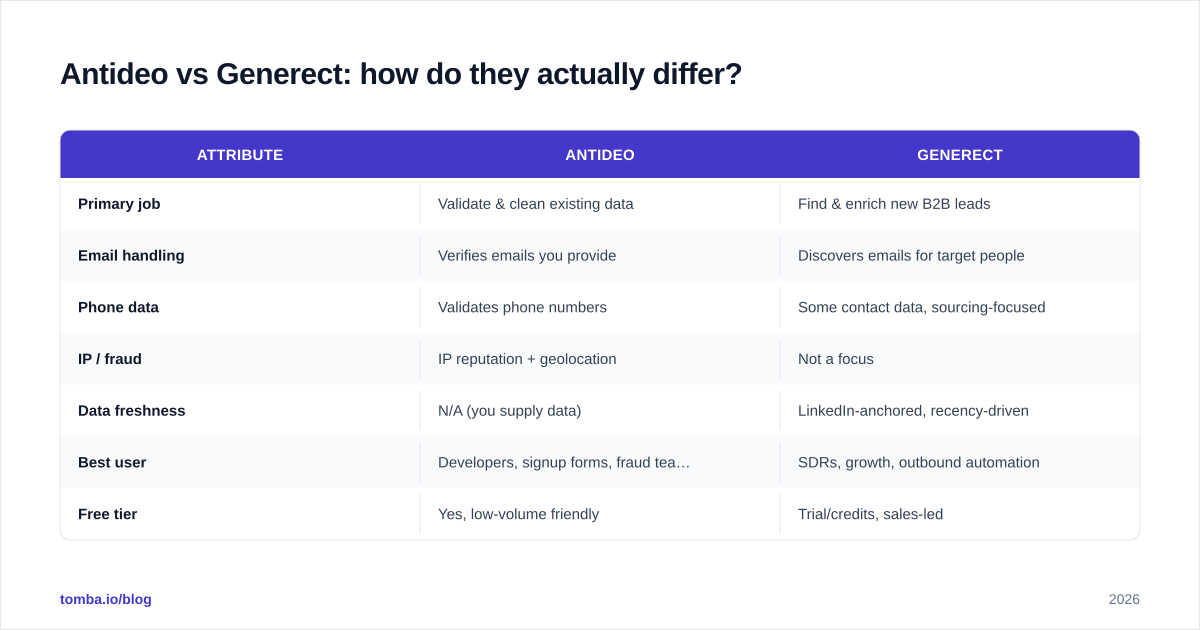
Antideo vs Generect: how do they actually differ?#
The cleanest way to see the gap is by job-to-be-done, not by feature checkboxes.
| Attribute | Antideo | Generect |
|---|---|---|
| Primary job | Validate & clean existing data | Find & enrich new B2B leads |
| Email handling | Verifies emails you provide | Discovers emails for target people |
| Phone data | Validates phone numbers | Some contact data, sourcing-focused |
| IP / fraud | IP reputation + geolocation | Not a focus |
| Data freshness | N/A (you supply data) | LinkedIn-anchored, recency-driven |
| Best user | Developers, signup forms, fraud teams | SDRs, growth, outbound automation |
| Free tier | Yes, low-volume friendly | Trial/credits, sales-led |
| Output | Pass/fail + risk signals | Lead records with firmographics |
Read the table and the answer to "which is better" becomes obvious: it depends entirely on whether your bottleneck is too much bad data (Antideo) or not enough leads (Generect).

Is Antideo better than Generect for email?#
Neither is better — they touch email at different stages. Antideo answers "is this address real and safe to send to?" Generect answers "what is the email of this specific person at this company?"
A realistic outbound flow uses both stages:
- Source — Generect (or another finder) returns target contacts and candidate emails.
- Verify — Antideo or a dedicated email verification step removes invalids, disposables, and risky catch-alls.
- Send — only confirmed addresses hit your sequencer, protecting your sender reputation.
Skipping step 2 is how teams torch their domain reputation. If you want to understand why that matters, the mechanics are covered well in deliverability primers like the one in the Tomba glossary on email deliverability and Google's own Postmaster Tools documentation. The short version: invalid sends raise bounce rates, bounce rates wreck sender reputation, and reputation drives the inbox-vs-spam decision.
Pricing: Antideo vs Generect vs a unified option#
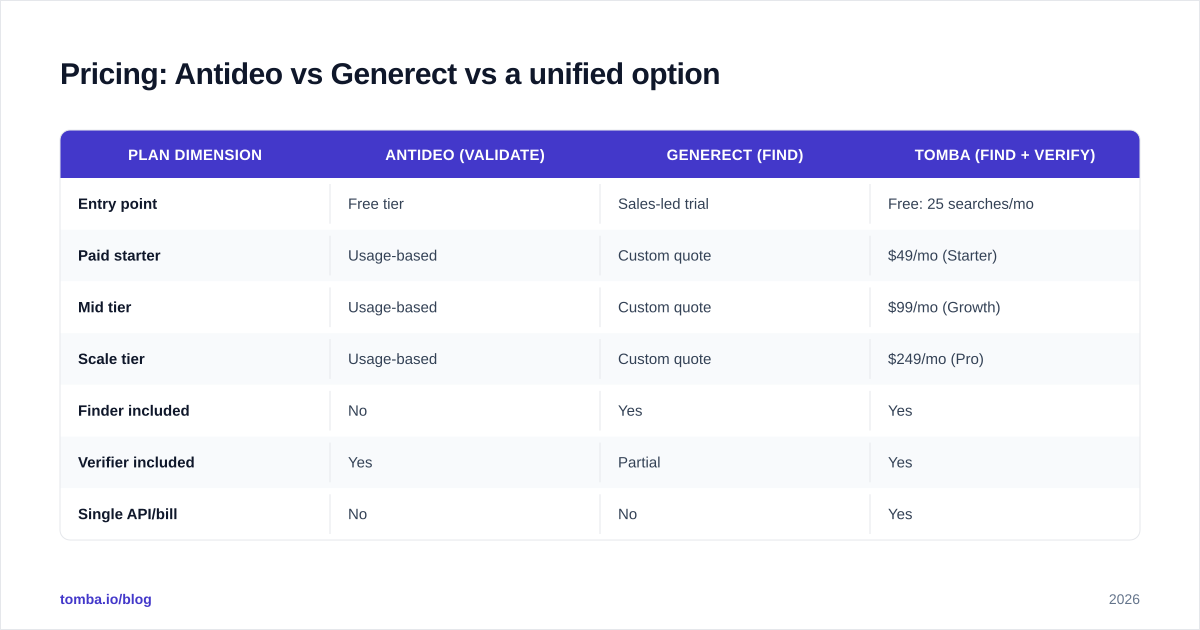
Antideo prices around API call volume with a free tier that suits prototypes and low-traffic forms. Generect is sales-led and priced for higher-volume lead sourcing, so the per-lead economics depend on your negotiated plan. Because they bill on different units (validations vs leads), a direct dollar-for-dollar match is misleading.
The more useful comparison is total cost when you need both capabilities. Here is how the standalone path stacks up against a single platform that finds and verifies:
| Plan dimension | Antideo (validate) | Generect (find) | Tomba (find + verify) |
|---|---|---|---|
| Entry point | Free tier | Sales-led trial | Free: 25 searches/mo |
| Paid starter | Usage-based | Custom quote | $49/mo (Starter) |
| Mid tier | Usage-based | Custom quote | $99/mo (Growth) |
| Scale tier | Usage-based | Custom quote | $249/mo (Pro) |
| Finder included | No | Yes | Yes |
| Verifier included | Yes | Partial | Yes |
| Single API/bill | No | No | Yes |
Two standalone tools mean two contracts, two SLAs, and glue code to keep them in sync. If that overhead outweighs best-of-breed depth for your team, consolidating is the rational move. You can sanity-check the numbers against published Tomba pricing rather than estimating.
When should you choose Antideo?#
Pick Antideo when your problem is incoming data quality, not lead volume. It shines in a few concrete scenarios:
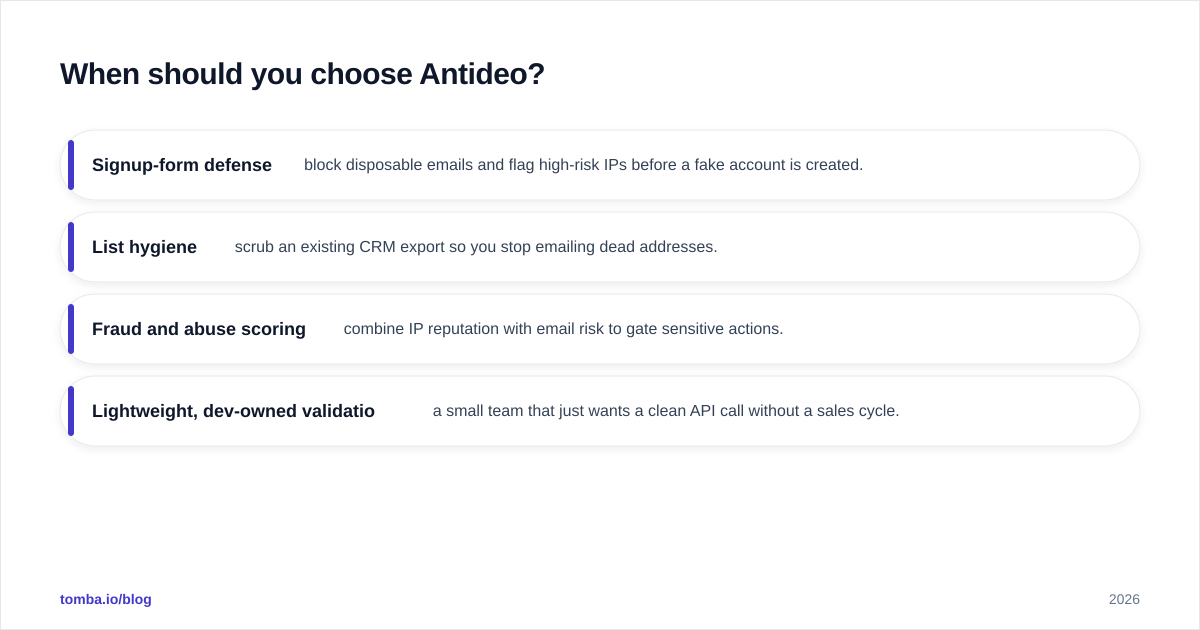
- Signup-form defense — block disposable emails and flag high-risk IPs before a fake account is created.
- List hygiene — scrub an existing CRM export so you stop emailing dead addresses.
- Fraud and abuse scoring — combine IP reputation with email risk to gate sensitive actions.
- Lightweight, dev-owned validation — a small team that just wants a clean API call without a sales cycle.
If you already have a strong source of leads (inbound, partnerships, an existing finder) and only need a gatekeeper, Antideo is a focused, affordable fit.
When should you choose Generect?#
Pick Generect when your bottleneck is pipeline volume and you want programmatic lead sourcing. It fits teams that:
- Run outbound at scale and need a steady feed of fresh, role-targeted contacts.
- Want LinkedIn-anchored firmographics piped straight into a CRM or sequencer.
- Have engineering resources to integrate a lead API and handle verification downstream.
Just budget for that downstream verification step. Sourcing tools optimize for coverage; they are not a substitute for a verifier, and treating them as one is the most common mistake in this category. For deeper prospecting context, our breakdown of how a domain search workflow complements a lead API is a useful companion read.
Antideo vs Generect: which should most teams pick?#
Most teams need both jobs done — and that is the real decision, not Antideo versus Generect in isolation.
You have three viable paths:
- Generect + Antideo, stitched together — best when you have strong engineering bandwidth and want best-of-breed at each stage. You own the integration and the two bills.
- Antideo only — best when leads already flow in and you just need hygiene.
- One platform that finds and verifies — best when you want a single API, one invoice, and a built-in finder→verifier loop without writing glue code.
For path three, Tomba is built around exactly that loop: the email finder discovers addresses by name, company, or domain search, the verifier confirms them, and bulk lead generation handles volume — all under one Tomba API. It is not the right call if you only need IP fraud scoring (Antideo's niche) or only raw LinkedIn lead volume at enterprise scale (Generect's niche), and it is fair to evaluate all three against neutral review data on G2 before committing.
How to evaluate any data API before you commit#
Whatever you shortlist, run the same five-point test instead of trusting marketing copy:
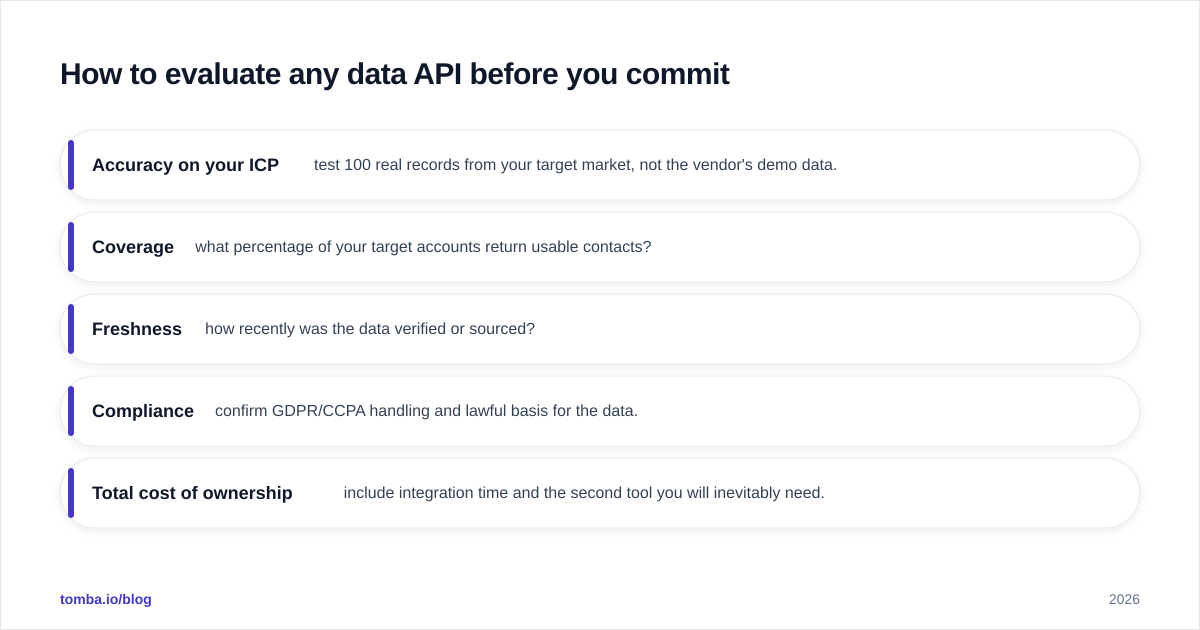
- Accuracy on your ICP — test 100 real records from your target market, not the vendor's demo data.
- Coverage — what percentage of your target accounts return usable contacts?
- Freshness — how recently was the data verified or sourced?
- Compliance — confirm GDPR/CCPA handling and lawful basis for the data.
- Total cost of ownership — include integration time and the second tool you will inevitably need.
Score each tool on these five dimensions with your own numbers. A tool that wins on price but fails the accuracy test on your ICP costs more in wasted sends and rep time than the sticker difference ever saves.
Frequently asked questions#
Is Antideo a lead-generation tool? No. Antideo validates and scores data you provide — emails, phones, and IPs. It does not discover new contacts.
Does Generect verify the emails it returns? Generect focuses on sourcing. Verification quality varies by record, so you should run a dedicated verifier before sending.
Can I use Antideo and Generect together? Yes, and many teams do — Generect finds, Antideo verifies. The trade-off is two integrations and two bills.
What is the simplest single-tool alternative? A platform that bundles finding and verifying, such as Tomba, removes the glue code and gives you one API and one invoice across the workflow.
The bottom line#
Antideo and Generect aren't really competitors — Antideo is a validation gatekeeper and Generect is a lead-sourcing engine, and the honest answer is that scaling outbound usually requires both jobs done well. If you'd rather not maintain two contracts and a sync layer, start with the Tomba Email Finder: find verified B2B emails by name, company, or domain, confirm them in the same platform, and scale with bulk lead generation when you're ready. Spin up the free tier (25 searches a month, no card) and test it against your own ICP before you decide.
Ready to find emails that actually work?
Join 150,000+ professionals who stopped guessing and started sending. Free credits on signup — no credit card required.
Get the Tomba newsletter
Practical outbound tactics and product updates — once every two weeks.
About the author