Antideo vs Leadzenai: Which B2B Data Tool Wins in 2026?
Antideo validates data; Leadzen.ai finds it. We break down what each tool actually does, where pricing bites, and which one belongs in your 2026 stack.
You typed "Antideo vs Leadzenai" into a search bar expecting a head-to-head between two competitors. Here's the twist most comparison posts won't tell you up front: these two tools barely compete. One cleans data you already have. The other goes out and finds data you don't. Picking between them as if they're interchangeable is how teams end up paying for the wrong thing.
This post sorts out what each platform actually does, where the overlap is real, where it's imaginary, and how to decide which one — or which combination — earns a slot in your 2026 go-to-market stack.
TL;DR#
- Antideo is a data validation and fraud-prevention API — email, phone, and IP checks, plus disposable-domain and profanity filters. It scores and cleans records; it does not source new leads.
- Leadzen.ai is a lead intelligence and prospecting platform — it discovers contacts, enriches profiles, and surfaces B2B and B2C data, with a heavier focus on the Indian market.
- They solve different problems: Antideo answers "is this record real?"; Leadzen answers "who should I contact next?"
- For most outbound teams, the practical question isn't Antideo or Leadzen — it's finder + verifier together, which is where a dedicated stack (or an all-in-one like Tomba) usually beats either single tool.
- If forced to choose one based on your stage: pick Leadzen when you have no pipeline data yet, Antideo when you have dirty data hurting deliverability.
What is Antideo?#
Antideo is an API-first data hygiene service. You send it an email address, phone number, or IP, and it returns a verdict: valid or invalid, disposable or legitimate, risky or safe. Its core modules cover email validation, phone validation, IP reputation and geolocation, plus utility filters like profanity detection and disposable-email blocking.
The audience is developers and product teams. Antideo lives inside signup forms, checkout flows, and backend pipelines — anywhere you need to stop fake or low-quality records before they pollute your database. It's a gatekeeper, not a prospector.
That framing matters. Antideo never tells you who to email. It only tells you whether the contact data you already collected is trustworthy. If your problem is bounce rates, fraudulent signups, or a CRM full of typo'd addresses, that's Antideo's lane.
What is Leadzen.ai?#
Leadzen.ai sits at the opposite end of the funnel. It's a lead generation and intelligence platform built to find contacts and companies, then enrich them with firmographic and contact details. Think prospecting search, contact discovery, and profile enrichment, with strong coverage of the Indian B2B and B2C market and a browser-extension workflow for pulling data while you browse.
Where Antideo is a quiet API endpoint, Leadzen is a destination you log into. You run searches, build lists, and export contacts into your outreach tooling. Its value is breadth of discovery — surfacing people and businesses you didn't already have.
The catch: discovery tools generate raw data, and raw data is rarely clean. Leadzen finds contacts, but the freshness and deliverability of those contacts still need checking before you hit send. That's exactly the gap a verifier fills — and why these two categories end up adjacent in real workflows.
Antideo vs Leadzenai: how do they actually compare?#
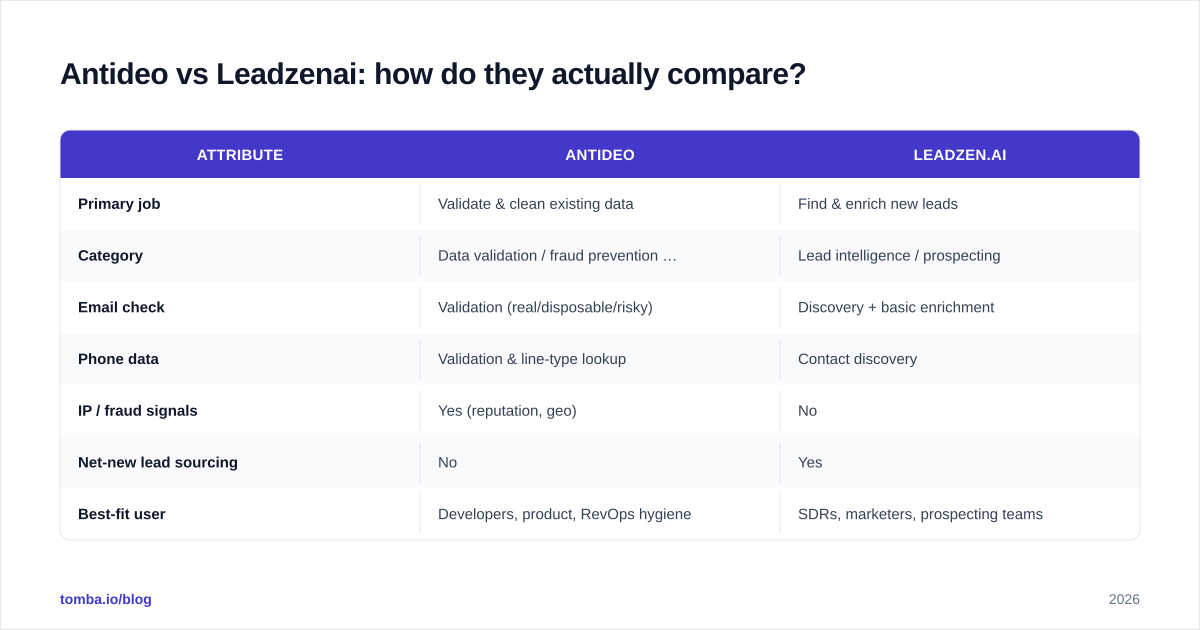
Here's the honest side-by-side. Notice how few rows are true head-to-head — most are "one does this, the other doesn't."
| Attribute | Antideo | Leadzen.ai |
|---|---|---|
| Primary job | Validate & clean existing data | Find & enrich new leads |
| Category | Data validation / fraud prevention API | Lead intelligence / prospecting |
| Email check | Validation (real/disposable/risky) | Discovery + basic enrichment |
| Phone data | Validation & line-type lookup | Contact discovery |
| IP / fraud signals | Yes (reputation, geo) | No |
| Net-new lead sourcing | No | Yes |
| Best-fit user | Developers, product, RevOps hygiene | SDRs, marketers, prospecting teams |
| Delivery model | API only | Web app + browser extension |
| Geographic strength | Global, validation-focused | India-heavy B2B/B2C |
| Free tier | Limited free API calls | Limited free credits |
Read that table top to bottom and the verdict writes itself: comparing them is like comparing a water filter to a well. One makes what you have safe to use; the other gets you the water in the first place.

Is one better than the other?#
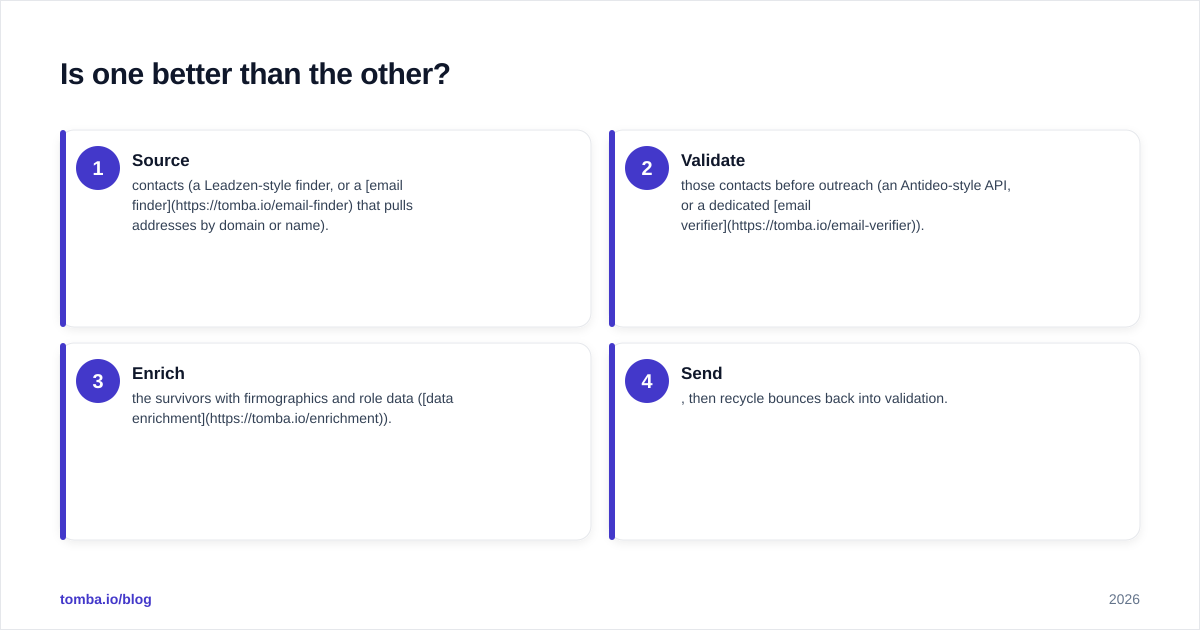
Neither is "better" — they're answers to different questions. The better framing is sequencing. In a healthy pipeline, discovery comes first and validation comes second:
- Source contacts (a Leadzen-style finder, or a email finder that pulls addresses by domain or name).
- Validate those contacts before outreach (an Antideo-style API, or a dedicated email verifier).
- Enrich the survivors with firmographics and role data (data enrichment).
- Send, then recycle bounces back into validation.
If you only buy the validator, you have nothing to validate. If you only buy the finder, you blast unverified data and torch your sender reputation. This is why mature teams rarely pick one of these tools in isolation — they assemble the chain, or buy a platform that bundles it.
For a deeper look at where contact data actually comes from and how it's kept fresh, Tomba documents its data sources openly, which is a useful benchmark when you're evaluating any provider's coverage claims.
What does each one cost?#
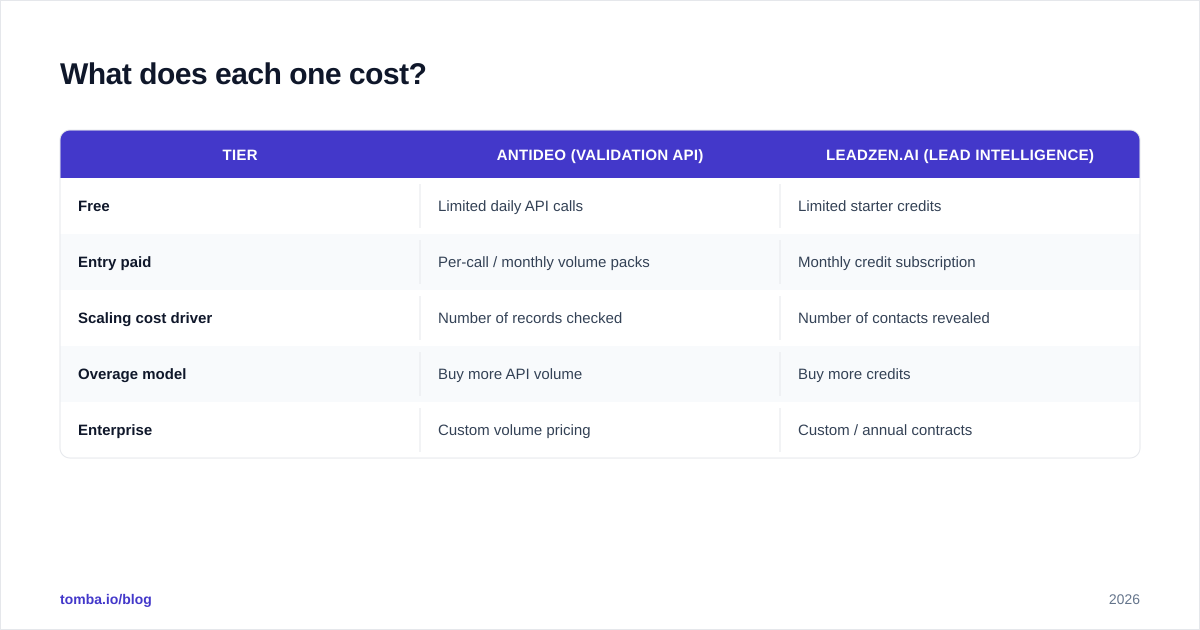
Pricing for both is usage-based and tier-gated, and both publish a free entry point. Exact numbers shift, so treat published vendor pricing as the source of truth — but the shape of the cost is what matters for budgeting:
| Tier | Antideo (validation API) | Leadzen.ai (lead intelligence) |
|---|---|---|
| Free | Limited daily API calls | Limited starter credits |
| Entry paid | Per-call / monthly volume packs | Monthly credit subscription |
| Scaling cost driver | Number of records checked | Number of contacts revealed |
| Overage model | Buy more API volume | Buy more credits |
| Enterprise | Custom volume pricing | Custom / annual contracts |
The cost trap is different for each. With Antideo, costs scale with how much data you push through — high-volume signup flows can rack up calls fast. With Leadzen, costs scale with how many contacts you reveal — aggressive prospecting burns credits quickly. Model your actual monthly volume against both before committing.
For comparison, Tomba's pricing is transparent and credit-based: a free tier with 25 searches/month, Starter at $49/month, Growth at $99/month, and Pro at $249/month, with enterprise custom. You can see the full breakdown on the Tomba pricing page. The reason that matters here: an all-in-one finder-plus-verifier can collapse two line items (one for discovery, one for validation) into a single predictable bill.
Which should you pick for your use case?#
Match the tool to the bottleneck, not the hype.
Pick Antideo if:
- Your problem is quality, not quantity — you have leads but they bounce.
- You need form-level or API-level fraud and disposable-email blocking.
- A developer owns the integration and wants a clean endpoint.
- You operate signup or checkout flows where fake records cost you money.
Pick Leadzen.ai if:
- Your problem is empty pipeline — you need net-new contacts.
- You sell into the Indian market, where its coverage is strongest.
- Your SDRs want a search-and-export workflow, not an API.
- You're earlier in GTM and discovery is the constraint.
Pick a combined finder + verifier stack if:
- You're running outbound at scale and need both discovery and deliverability.
- You want one bill, one workflow, and bounce rates under control.
- You'd rather not stitch two vendors together with glue code.
That third option is where most growing teams land. A platform that does domain search to find every address at a company, verifies them in the same flow, and supports bulk lead generation removes the seam between "find" and "validate" entirely.
How do accuracy and deliverability hold up?#
Accuracy means different things for each tool, and conflating them is a common mistake.
For Antideo, accuracy is about correct verdicts — does it catch disposable domains, flag risky addresses, and avoid false positives that block real customers? Its strength is breadth of signals (email + phone + IP), which gives a richer risk picture than email-only checkers.
For Leadzen, accuracy is about data freshness and match rate — are the contacts it surfaces real, current, and reachable? Discovery tools live and die on how recently their data was refreshed, because a finder that returns stale addresses just shifts the deliverability problem downstream.
The deliverability lesson holds either way: never send to unverified data. Even the best discovery tool returns some addresses that have churned or never existed. Running them through verification — catch-all handling included, via a catch-all verifier — is what protects your domain reputation. If you want third-party signal on any vendor's real-world performance, peer reviews on G2 are a better gut-check than vendor self-reporting.
You can confirm the categories yourself on the vendors' own sites — Antideo leads with validation and fraud APIs, while Leadzen.ai leads with lead discovery and intelligence. The positioning tells you everything: these are complements, not rivals.
What's the bottom line?#
Antideo and Leadzen.ai aren't really competitors — they're two stages of the same pipeline. Antideo keeps your data clean; Leadzen helps you get data in the first place. Choosing between them as if it's either/or usually means you've misdiagnosed your bottleneck.
If your real goal is fewer tools, less integration overhead, and clean contacts you can actually email, the smarter move is a single platform that finds and verifies in one place. Tomba's Email Finder sources professional email addresses by name, domain, or company, then pairs with built-in verification, domain search, and enrichment — so the "find it" and "is it real?" questions get answered in the same workflow. Start on the free tier with 25 searches, and only move up to the $49/month Starter plan once you've seen the match and verification quality for yourself. That's a faster path to clean pipeline than bolting two single-purpose tools together.
Ready to find emails that actually work?
Join 150,000+ professionals who stopped guessing and started sending. Free credits on signup — no credit card required.
Get the Tomba newsletter
Practical outbound tactics and product updates — once every two weeks.
About the author