Antideo vs Pubrio 2026: Email Validation & Lead Data Compared
Antideo guards your funnel with email and IP validation; Pubrio fills it with B2B leads. Here's which one your 2026 stack actually needs — and where a third option beats both.
Antideo and Pubrio get lumped together in "data tool" roundups, but they solve opposite halves of the same problem. One keeps junk out of your funnel. The other puts leads into it. Picking between them without knowing that is how teams end up paying for two products that don't overlap — or one product that doesn't do what they actually need.
This breakdown cuts through the positioning. You'll see what each tool is built for, where their feature sets touch, how pricing compares, and which workflows each one wins. If your real goal is finding and verifying B2B contacts in one place, there's a third option worth knowing about too.
TL;DR: Antideo vs Pubrio at a glance#
- Antideo is a validation and fraud-prevention API: email checks, IP reputation, phone validation, and disposable-domain detection. It cleans and scores data you already have.
- Pubrio is a B2B prospecting and lead-intelligence platform: company and contact search, intent signals, and enrichment. It generates data you don't have yet.
- They barely compete. Antideo defends the funnel; Pubrio fills it. Most teams need both jobs done, not one tool.
- On pricing, Antideo skews toward developers and low-volume API calls; Pubrio is a seat-based SaaS aimed at sales teams.
- If you want finding and verifying under one roof with a transparent API, Tomba covers both jobs at a lower combined cost than running these two side by side.
What is Antideo?#
Antideo is a data-quality and fraud-prevention API. Think of it as the bouncer at the door of your signup form: before a record gets into your CRM or mailing list, Antideo checks whether it's real, risky, or garbage.
Its core endpoints handle email validation (syntax, MX records, disposable-domain flags), IP address reputation (proxy, Tor, and blocklist checks), and phone number validation. It's developer-first — you wire it into a registration flow, a lead form, or a batch cleaning job, and it returns structured risk signals you act on programmatically.
What Antideo is not: a source of new contacts. It never tells you who works at a company or hands you an email address you didn't already collect. It only evaluates data you bring to it. That distinction is the whole ballgame in an Antideo vs Pubrio decision.
What is Pubrio?#
Pubrio is a B2B lead-generation and sales-intelligence platform. Where Antideo is a gatekeeper, Pubrio is a prospector — it surfaces companies and people who match your ideal customer profile, then enriches those records with firmographic and contact data.
Its toolkit centers on a searchable B2B database, contact and company lookups, buying-intent signals, and enrichment to fill gaps in your existing lists. The audience is account executives, SDRs, and growth marketers who need a steady supply of targeted prospects, not engineers cleaning a database.
Pubrio does include email finding and basic verification as part of its enrichment flow. That's the one place it overlaps with Antideo — both touch email validity — but they approach it from opposite ends. Pubrio verifies as a side effect of delivering a contact; Antideo verifies as its entire reason to exist.
Antideo vs Pubrio: how do they compare directly?#
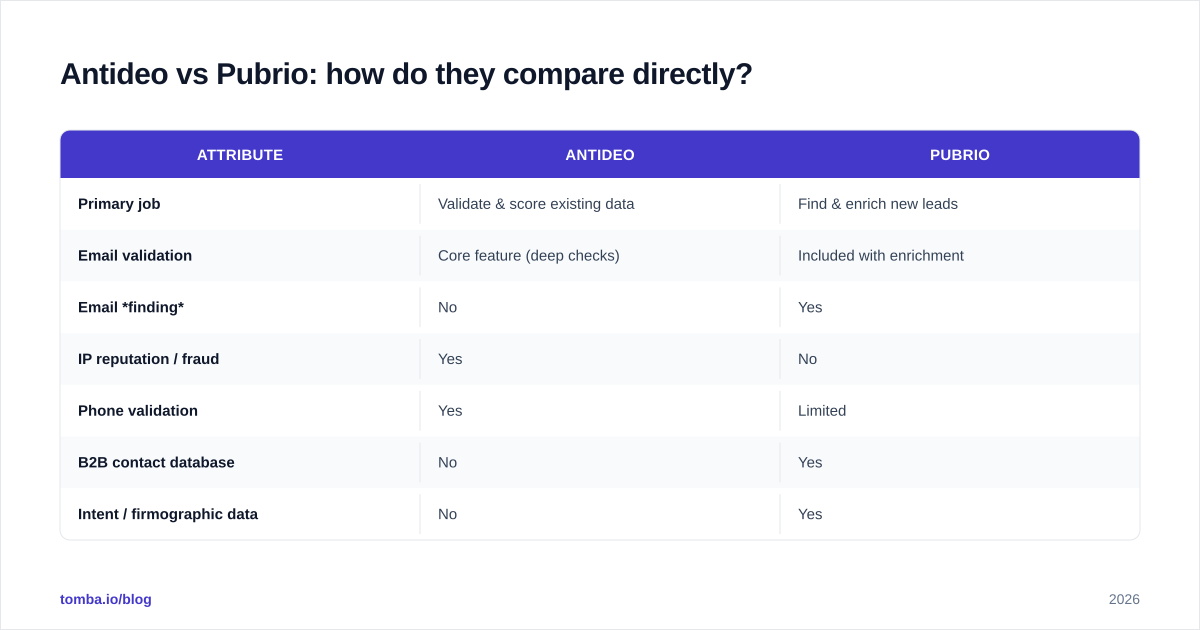
Here's the honest side-by-side. Note how few rows have a true head-to-head — that's the point.
| Attribute | Antideo | Pubrio |
|---|---|---|
| Primary job | Validate & score existing data | Find & enrich new leads |
| Email validation | Core feature (deep checks) | Included with enrichment |
| Email finding | No | Yes |
| IP reputation / fraud | Yes | No |
| Phone validation | Yes | Limited |
| B2B contact database | No | Yes |
| Intent / firmographic data | No | Yes |
| Built for | Developers, RevOps, fraud teams | SDRs, AEs, marketers |
| Delivery | API-first | Web app + API |
| Free tier | Yes (limited API calls) | Limited trial |
The takeaway: comparing these two is like comparing a smoke detector to a moving truck. Both useful, neither replaces the other. If a roundup told you to "pick one," it skipped the part where you figure out which job you're actually hiring for.

Is Antideo better than Pubrio for your use case?#
Antideo wins when your problem is data quality, not data quantity. Choose it if you:
- Run high-volume signup or lead forms and need to block disposable emails, bots, and fraudulent IPs in real time.
- Already have lists and need to scrub bounces before a send to protect your sender reputation.
- Want a lightweight, pay-for-what-you-call API rather than another seat-based SaaS subscription.
- Care about fraud signals (proxy/VPN detection, blocklists) that pure email tools ignore.
Antideo's weakness is obvious the moment you need a new contact. It has no database, no prospecting, no way to answer "who is the VP of Marketing at this account." For that, you're back to square one.
If protecting deliverability is your driver, pairing validation with a dedicated email verifier often gets you cleaner results than a general fraud API, because the verifier is tuned specifically for mailbox-level checks rather than broad risk scoring.
Is Pubrio better than Antideo for prospecting?#
Pubrio wins when your problem is an empty pipeline. Choose it if you:
- Need a repeatable source of net-new B2B contacts matched to an ICP.
- Want firmographic filters (industry, headcount, tech stack) and intent signals to prioritize accounts.
- Run an outbound team that lives in prospect search all day and needs a UI, not just an API.
- Value enrichment that fills missing fields on records you already own.
Pubrio's limits show up around data hygiene and fraud. Its built-in verification is convenience-grade — fine for a first pass, not a substitute for a dedicated validation layer. And it does nothing for IP reputation or signup fraud, because that was never its job. Teams that rely solely on Pubrio's verification often still see bounce rates creep up, which is exactly the gap Antideo-style tools were built to close.
That's why a surprising number of teams end up buying both — Pubrio to source, Antideo to clean — and then wonder why their data stack has two line items doing one workflow.
What does Antideo vs Pubrio pricing look like?#
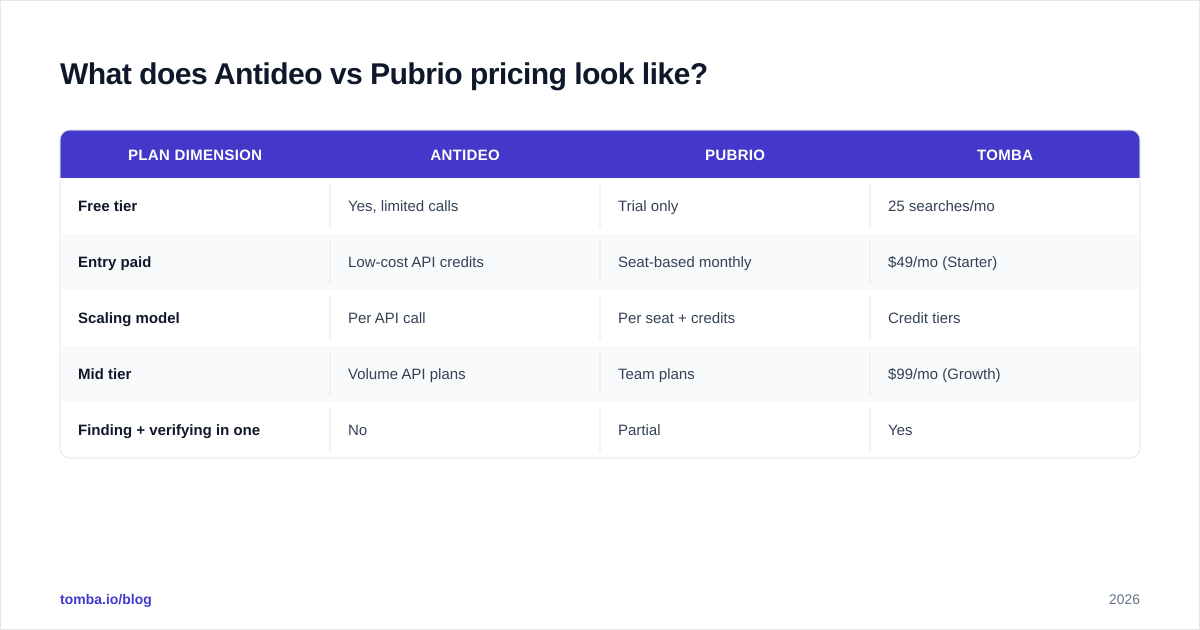
The pricing models reflect the different jobs. Antideo charges around API usage and is friendly to developers and low-volume needs. Pubrio is seat-and-credit SaaS pricing aimed at sales teams who consume contacts in bulk. Always confirm current numbers on each vendor's own page — Pubrio and Antideo both adjust tiers periodically — but the shape looks like this:
| Plan dimension | Antideo | Pubrio | Tomba |
|---|---|---|---|
| Free tier | Yes, limited calls | Trial only | 25 searches/mo |
| Entry paid | Low-cost API credits | Seat-based monthly | $49/mo (Starter) |
| Scaling model | Per API call | Per seat + credits | Credit tiers |
| Mid tier | Volume API plans | Team plans | $99/mo (Growth) |
| Finding + verifying in one | No | Partial | Yes |
The hidden cost in an Antideo + Pubrio combo isn't just two subscriptions — it's the integration glue, the duplicate billing, and the context-switching between a fraud API and a prospecting UI. For many B2B teams, a single platform that finds and verifies erases that overhead. You can compare the math against full Tomba pricing before committing to a two-tool setup.

How accurate is the data in each tool?#
Accuracy means different things here, which is why a single leaderboard doesn't capture it.
Antideo's accuracy is about correctly flagging bad data — catching disposable domains, dead mailboxes, and risky IPs without falsely killing good leads. Its strength is breadth of risk signals; its job is precision on the "reject" decision.
Pubrio's accuracy is about correctly sourcing data — does the email it hands you actually reach the person, and is the firmographic data current? B2B contact data decays fast (people change jobs constantly), so freshness matters as much as the initial match rate.

Neither vendor publishes independent third-party accuracy benchmarks the way some specialized finders do, so treat in-app confidence scores as directional, not gospel. The most reliable workflow is to source a contact, then run it through a dedicated verification step before you send — regardless of which tool surfaced it. That second pass is where most teams recover deliverability they'd otherwise lose to stale or guessed addresses. For a deeper look at where providers actually pull records from, Tomba documents its data sources openly.
Where does a combined tool beat both?#
The Antideo vs Pubrio framing assumes you must choose between finding and cleaning. You don't. A platform built to do both removes the integration tax entirely.
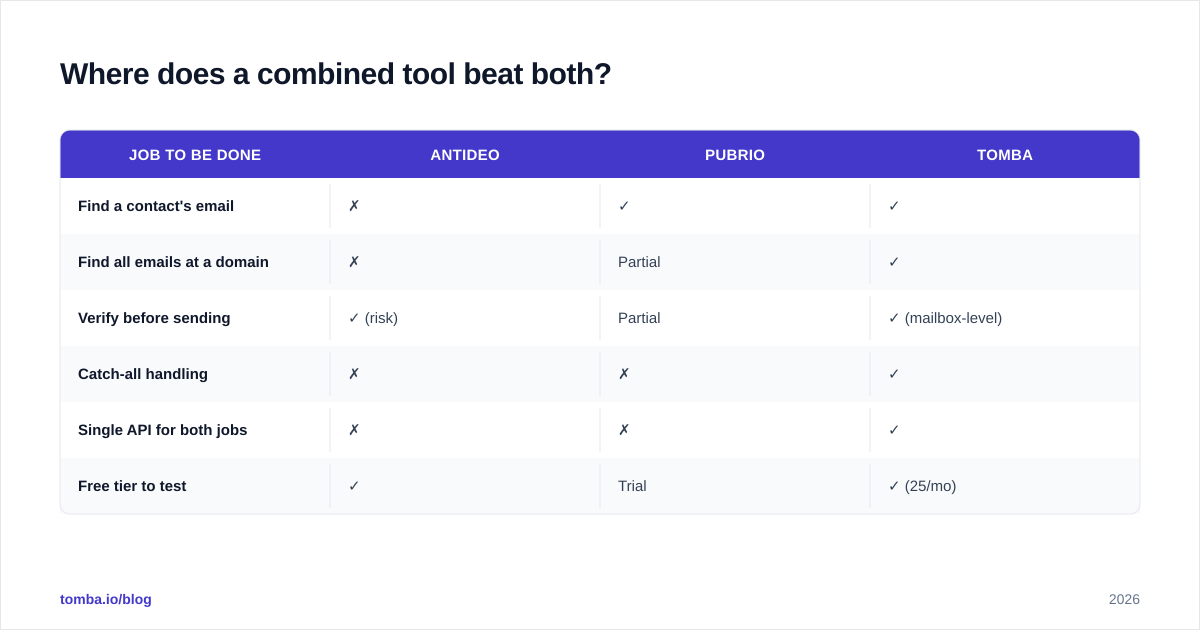
That's the case for Tomba. Instead of running Pubrio to source and Antideo to scrub, you get email finding, domain search for company-wide lookups, real-time verification, catch-all detection, and a developer-friendly email finder API under one account. Here's how the jobs map:
| Job to be done | Antideo | Pubrio | Tomba |
|---|---|---|---|
| Find a contact's email | ✗ | ✓ | ✓ |
| Find all emails at a domain | ✗ | Partial | ✓ |
| Verify before sending | ✓ (risk) | Partial | ✓ (mailbox-level) |
| Catch-all handling | ✗ | ✗ | ✓ |
| Single API for both jobs | ✗ | ✗ | ✓ |
| Free tier to test | ✓ | Trial | ✓ (25/mo) |
For a team standing up outbound from scratch, consolidating to one provider usually beats stitching a fraud API to a prospecting suite — fewer vendors, one billing line, one integration. Tools like HubSpot and Salesforce sit downstream of all of this; what they ingest is only as good as the find-and-verify layer feeding them.
Which should you actually pick?#
Decide by the job, not the brand:
- Pure fraud and data-hygiene problem, developer-led? Antideo is a clean, focused fit. Wire its validation and IP checks into your forms and move on.
- Empty pipeline, sales-team-led, need net-new prospects? Pubrio gives you a real prospecting UI and an ICP-filtered database.
- You need both finding and verifying, and don't want two subscriptions? That's where a consolidated platform wins on cost and simplicity.
Be honest about which of these you are. The most expensive mistake isn't picking the "wrong" tool — it's buying two tools to do one job because a comparison article never told you they don't overlap.
If finding accurate B2B emails and verifying them before you hit send is the core of your workflow, start with the Tomba Email Finder. The free tier gives you 25 searches a month to test match rates and verification quality against your own list — no card, no two-vendor setup — and the same account scales into bulk finding and API access when your outbound does. Source clean, verify in place, and skip the integration tax of running Antideo and Pubrio side by side.
Ready to find emails that actually work?
Join 150,000+ professionals who stopped guessing and started sending. Free credits on signup — no credit card required.
Get the Tomba newsletter
Practical outbound tactics and product updates — once every two weeks.
About the author