Antideo vs Seamless.AI 2026: Email Data Tools Compared
Antideo is a free validation API; Seamless.AI is a paid contact database. Here's which one fits your prospecting stack in 2026 — and where a third option wins.
TL;DR
- Antideo and Seamless.AI solve different problems. Antideo is a lightweight, free-to-start validation API (email, phone, IP reputation). Seamless.AI is a paid B2B contact database that surfaces emails and phone numbers for prospecting.
- Pick Antideo when you need to clean or score data you already have, cheaply, via API — not to source net-new contacts.
- Pick Seamless.AI when you need volume contact discovery with a CRM-friendly UI, and you can stomach annual contracts and credit-based pricing.
- Neither is a clean fit if you want accurate sourcing and verification in one predictable bill. That gap is where a finder-plus-verifier like Tomba lands.
- This guide breaks down accuracy, pricing, data scope, and the exact use cases each tool wins.
What are Antideo and Seamless.AI?#
Short version: Antideo is a data hygiene API, Seamless.AI is a data sourcing platform. They get lumped together in searches because both touch B2B email data, but they sit on opposite ends of the workflow.
Antideo is a developer-first API. You send it an email, phone number, or IP address, and it returns signals: is the email disposable, does the domain have valid MX records, is the IP flagged for spam or abuse. It has a genuinely free tier (rate-limited) and cheap paid plans. It does not find new contacts — it tells you whether the contacts you already have are worth keeping.
Seamless.AI is a sales intelligence platform. You search by company, title, or industry, and it returns contact records — work emails, mobile numbers, LinkedIn URLs — that you can push into your CRM or sequencer. It's built for SDRs and account executives who need to build lists fast. Pricing is credit-based and sold on annual contracts, and the UI is the product, not a raw API.
So the real question behind "antideo vs seamlessai" is usually: do I need to clean data, or do I need to find it? Once you answer that, the choice mostly makes itself.
How do they compare at a glance?#
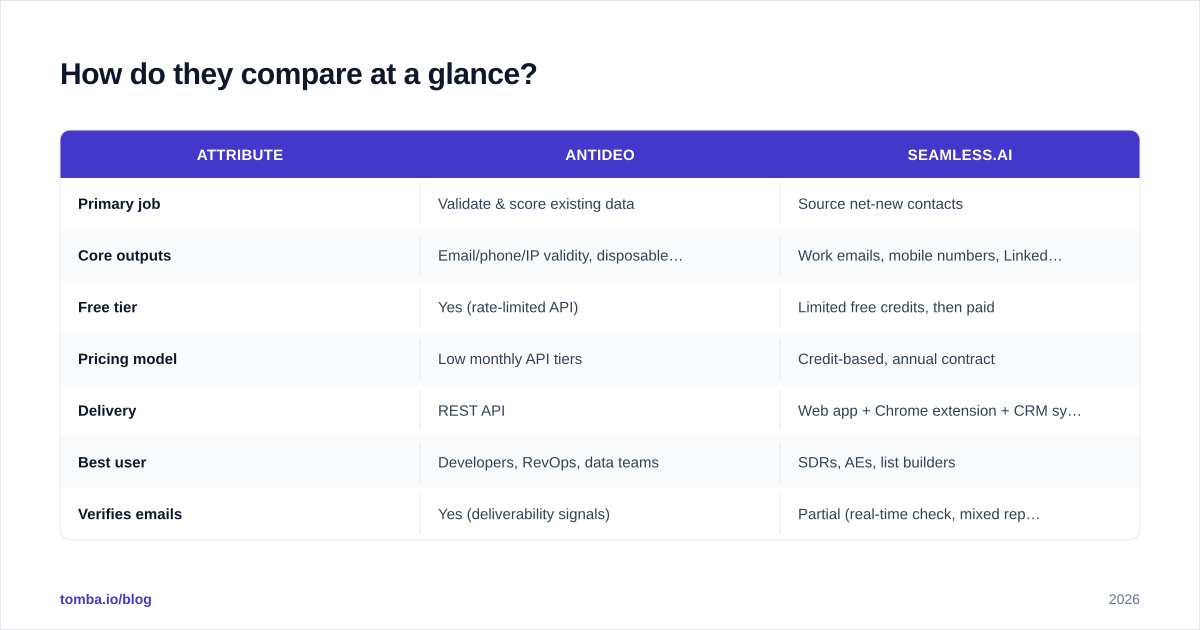
Here's the head-to-head on the attributes that actually change a buying decision.
| Attribute | Antideo | Seamless.AI |
|---|---|---|
| Primary job | Validate & score existing data | Source net-new contacts |
| Core outputs | Email/phone/IP validity, disposable & abuse flags | Work emails, mobile numbers, LinkedIn, firmographics |
| Free tier | Yes (rate-limited API) | Limited free credits, then paid |
| Pricing model | Low monthly API tiers | Credit-based, annual contract |
| Delivery | REST API | Web app + Chrome extension + CRM sync |
| Best user | Developers, RevOps, data teams | SDRs, AEs, list builders |
| Verifies emails | Yes (deliverability signals) | Partial (real-time check, mixed reports) |
| Finds new emails | No | Yes |
| Contract friction | None (pay as you go) | High (sales calls, lock-in) |
The table makes the split obvious: Antideo is the cheaper, narrower tool you bolt onto a pipeline, and Seamless.AI is the broader, pricier platform you build a prospecting motion around. If you try to force either into the other's job, you'll be disappointed.

Which one is more accurate?#
Accuracy means two different things here, so judge each tool on its own metric.
For Antideo, accuracy is about validation precision: does it correctly flag disposable domains, dead mailboxes, and risky IPs? In practice it's solid for the basics — syntax, MX records, known disposable lists, and abuse databases. Where any validation API struggles is catch-all domains, where the mail server accepts everything and reveals nothing about a specific mailbox. Antideo will tell you a catch-all is "accept-all," but it can't promise the individual address is live. That's a category limitation, not an Antideo flaw — every verifier hits the same wall, which is why a dedicated catch-all verifier exists as a separate discipline.
For Seamless.AI, accuracy is about whether the found email actually belongs to the person and still works. User reviews on G2 are mixed on this point: the database is large and the UI is fast, but bounce rates and outdated mobile numbers are a recurring complaint, especially in non-US markets. Seamless.AI generates and predicts some emails algorithmically, which boosts coverage but hurts precision — you get more addresses, and more of them bounce.
The uncomfortable truth: a sourcing tool that doesn't rigorously verify, plus a verifier that can't source, leaves you doing two jobs with two bills. If you run Seamless.AI exports through Antideo, you'll catch obvious junk, but you've now stitched together a pipeline that a single accurate finder-verifier handles in one pass.

How does pricing compare?#
This is where the two tools feel least alike.
Antideo is transparent and cheap. There's a free tier with daily limits that's genuinely usable for small jobs and testing, and paid API plans scale up request volume without a sales call. If you're a developer wiring validation into a signup form or a lead-import job, you can be live in an afternoon for a few dollars a month.
Seamless.AI is opaque and committed. Public pricing is hard to pin down because most plans run through a sales rep on an annual contract, and the credit system means "unlimited" rarely means unlimited. The Chrome extension and CRM integrations are strong, but you're buying seats and a yearly commitment, not metered usage. For a funded sales team that's fine; for a solo founder or a lean RevOps team, the contract friction is real.
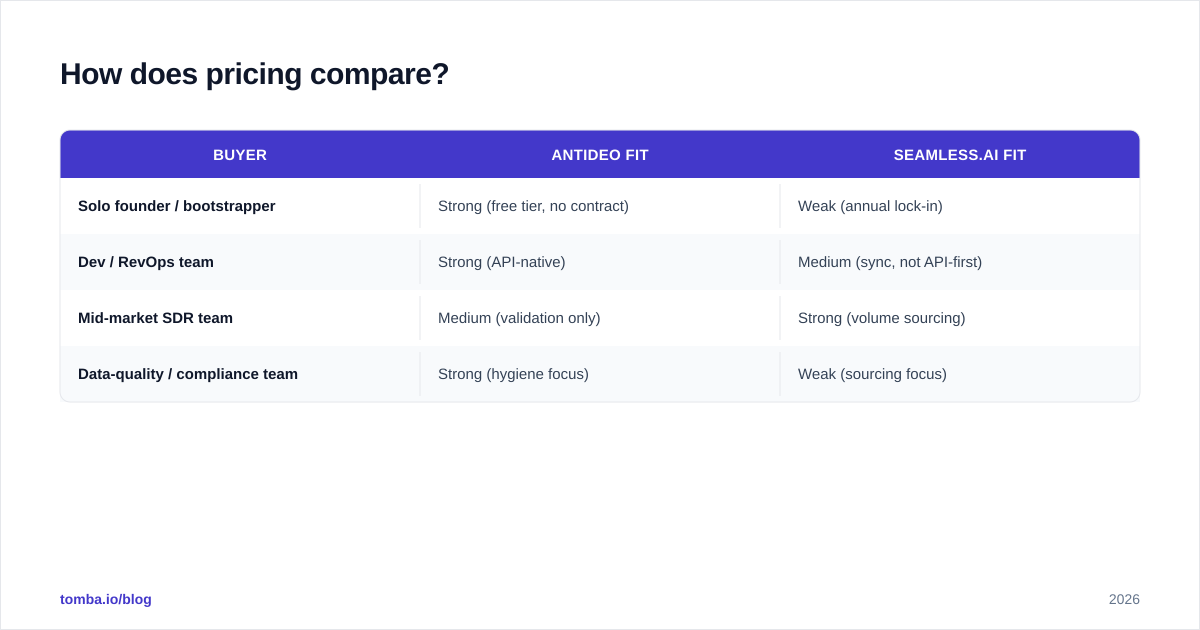
Here's a rough mapping of who each model suits:
| Buyer | Antideo fit | Seamless.AI fit |
|---|---|---|
| Solo founder / bootstrapper | Strong (free tier, no contract) | Weak (annual lock-in) |
| Dev / RevOps team | Strong (API-native) | Medium (sync, not API-first) |
| Mid-market SDR team | Medium (validation only) | Strong (volume sourcing) |
| Data-quality / compliance team | Strong (hygiene focus) | Weak (sourcing focus) |
If predictable, usage-based pricing matters to you, it's worth comparing both against Tomba pricing, which keeps a free tier (25 searches/month) and flat monthly plans — Starter at $49/mo, Growth at $99/mo — without annual lock-in.
)
When should you choose Antideo?#
Choose Antideo when validation is the whole job. Concrete scenarios:
- Form protection. Block disposable and abusive signups in real time at the point of entry. Antideo's IP reputation and disposable-domain checks are purpose-built for this.
- List hygiene before a send. You bought or inherited a list and need to strip dead and risky addresses before it touches your sending domain. Protecting sender reputation is exactly what this is for.
- Lightweight enrichment signals. You want a quick risk score on an inbound lead without standing up a heavy data contract.
Antideo will not help you build a prospecting list from scratch. If your problem statement starts with "I need 500 CMOs in fintech," Antideo is the wrong tool — it has no one to give you.
When should you choose Seamless.AI?#
Choose Seamless.AI when discovery at volume is the bottleneck and you have budget for it:
- High-velocity outbound. Your SDRs live in LinkedIn and need a one-click way to pull a work email and mobile while prospecting. The Chrome extension is the headline feature here.
- CRM-centric teams. You want contacts flowing into Salesforce or HubSpot with minimal manual export. Seamless.AI's native syncs are a genuine strength.
- US-heavy ICP. Coverage and accuracy skew best for US-based contacts; the value drops noticeably for EMEA and APAC targets.
Skip Seamless.AI if you're price-sensitive, allergic to annual contracts, or your deliverability can't absorb the bounce rate that comes with algorithmically predicted emails. In that case you'll want a finder with tighter verification baked in.
Is there a better-fit alternative for most teams?#
For teams that need both accurate sourcing and verification in one predictable tool, a dedicated finder-verifier closes the gap that splitting Antideo and Seamless.AI leaves open.
That's the niche Tomba fills. Instead of choosing between "validate what I have" and "find what I don't," you get:
- An email finder that sources addresses by name, company, or domain search, with the confidence score attached.
- A built-in email verifier so every address is checked before it leaves the platform — no second tool, no second bill.
- A bulk email finder for list building at volume, with the same verification pass applied.
- Flat, transparent pricing and a free tier to test against your own ICP before committing.
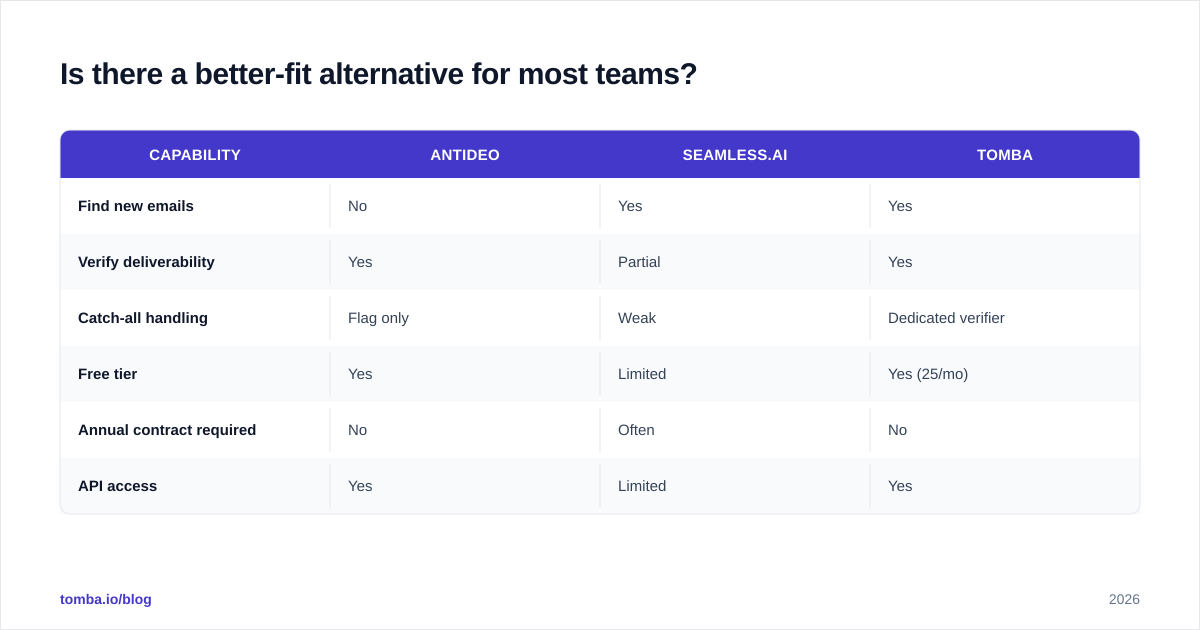
Here's how the three stack up on the dimensions that decide real outbound outcomes:
| Capability | Antideo | Seamless.AI | Tomba |
|---|---|---|---|
| Find new emails | No | Yes | Yes |
| Verify deliverability | Yes | Partial | Yes |
| Catch-all handling | Flag only | Weak | Dedicated verifier |
| Free tier | Yes | Limited | Yes (25/mo) |
| Annual contract required | No | Often | No |
| API access | Yes | Limited | Yes |
The point isn't that Antideo or Seamless.AI are bad — it's that they're half a workflow each. Antideo validates but can't source; Seamless.AI sources but verifies loosely. If your goal is a clean, low-bounce list that lands in inboxes, doing both jobs in one accurate pass is simpler and usually cheaper.
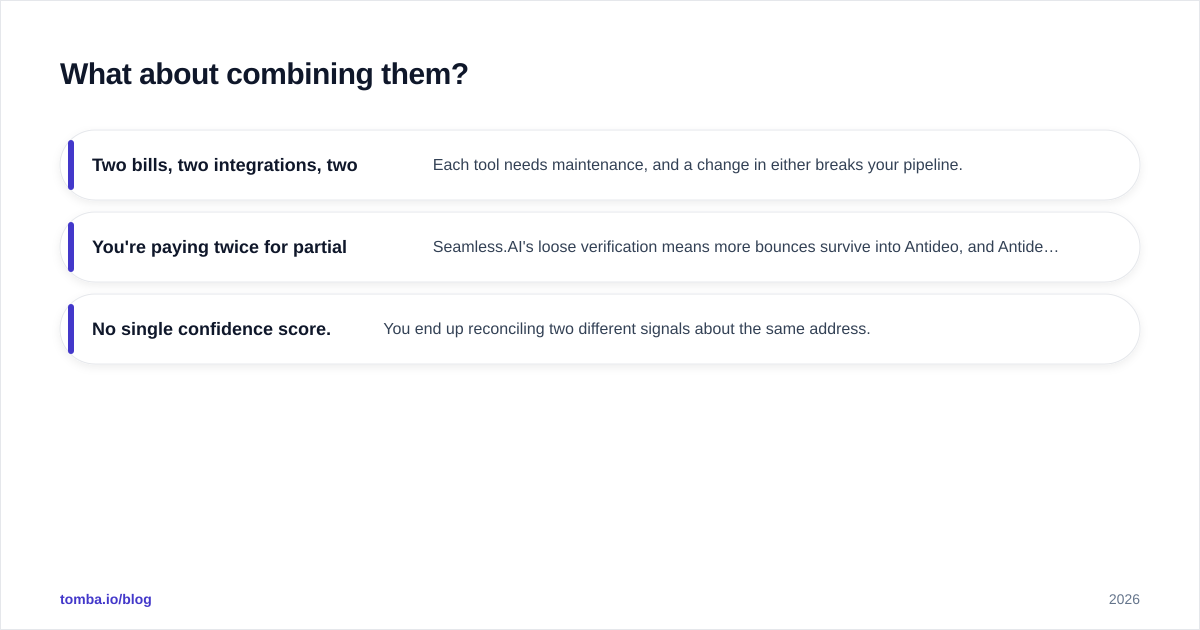
What about combining them?#
You can run a hybrid: use Seamless.AI to source, then pipe exports through Antideo to scrub the obvious junk before sending. Plenty of teams do exactly this.
The trade-offs to weigh:
- Two bills, two integrations, two failure points. Each tool needs maintenance, and a change in either breaks your pipeline.
- You're paying twice for partial accuracy. Seamless.AI's loose verification means more bounces survive into Antideo, and Antideo can only flag what it can see — catch-alls still slip through.
- No single confidence score. You end up reconciling two different signals about the same address.
For a data-engineering team that wants maximum control, the hybrid is defensible. For a sales team that just wants leads that don't bounce, it's overhead. The single-tool path wins on simplicity nearly every time, which is why "find and verify in one place" keeps showing up as the recommendation.
Frequently asked questions#
Is Antideo free? Yes — it has a real free tier with daily rate limits, plus cheap paid API plans. It's one of the more affordable validation options available.
Does Seamless.AI guarantee email accuracy? No. It surfaces a large volume of contacts, some algorithmically predicted, and bounce rates vary — especially outside the US. Always verify before sending.
Can Antideo find emails? No. Antideo validates and scores existing email, phone, and IP data. It does not source new contacts.
Which is cheaper, Antideo or Seamless.AI? Antideo, by a wide margin, because it's metered API pricing with a free tier versus Seamless.AI's annual credit contracts. But they do different jobs, so price alone shouldn't decide it.
The bottom line#
Antideo and Seamless.AI aren't really competitors — they're two halves of a pipeline. Antideo cleans data cheaply through an API; Seamless.AI sources data at volume through a polished but pricey platform. Choose based on which job is your actual bottleneck.
But if your real goal is a low-bounce list that reaches inboxes — sourced and verified without juggling two contracts — start with a finder that verifies as it goes. Spin up the Tomba Email Finder on the free tier, run it against your own target accounts, and compare the bounce rate to whatever you're using now. That single test will tell you more than any spec sheet.
// get started
Find, verify and enrich your first contacts today
Start on the free plan with 25 searches a month, then scale when your team is ready.
Free plan · No credit card required · GDPR & CCPA
// about the author