Antideo vs ZoomInfo 2026: Email Validation or B2B Data?
Antideo is a lean validation API; ZoomInfo is a heavyweight B2B database. Here's an honest 2026 breakdown of which one your team actually needs — and where a third option fits.
TL;DR
- Antideo and ZoomInfo solve different problems. Antideo is a lightweight email/IP/phone validation API. ZoomInfo is a full B2B intelligence platform with a contact database, intent data, and CRM sync. Comparing them is comparing a scalpel to a hospital.
- Pick Antideo if you need cheap, fast data-hygiene checks (spam-trap, disposable, IP reputation) bolted onto an app or signup form.
- Pick ZoomInfo if you need to source net-new contacts and accounts at scale and have a five-figure annual budget to match.
- Neither is a great fit if your real job is finding and verifying outbound prospecting emails affordably — that's where a focused email finder beats both.
- ZoomInfo locks you into annual contracts starting in the thousands; Antideo has a usable free tier but no prospecting database at all.
What is Antideo?#
Antideo is an API-first data-validation service. Think of it as a bouncer at the door of your database: it checks each email, IP address, or phone number before you let it in. It tells you whether an email is disposable (a throwaway like Mailinator), whether an IP sits on a spam blacklist, and whether a phone number is formatted and routable.
What Antideo is not: a place to find people. It has no searchable B2B contact database. You bring the data; Antideo grades it. That makes it popular with developers wiring up signup forms, fraud checks, and lightweight list hygiene where a heavy platform would be overkill. Its free tier (rate-limited API calls) is genuinely usable for small projects, and paid plans scale on request volume rather than per-seat licensing.
If your mental model of "email tools" is sourcing leads, Antideo will feel strangely empty. That's by design — it's plumbing, not a prospecting engine. You can see the scope on the Antideo homepage.
What is ZoomInfo?#
ZoomInfo is the opposite end of the spectrum: a sprawling B2B data intelligence platform built for revenue teams. It maintains a massive database of companies and professional contacts, layers on intent signals (who's researching what), org charts, technographics, and ships native CRM and sales-engagement integrations.
Where Antideo answers "is this data clean?", ZoomInfo answers "who should I be talking to, and are they in-market right now?" It's used by mid-market and enterprise sales orgs that need to build territory lists, route leads, and feed automated sequences. You can review capabilities and verified user feedback on ZoomInfo's G2 profile.
The catch is cost and commitment. ZoomInfo sells annual contracts, typically negotiated, frequently landing in the low-to-mid five figures per year once you add seats and data packages. There is no meaningful free tier — you get a trial and a sales call.
Antideo vs ZoomInfo: how do they actually compare?#
Because these tools overlap only at the edges (both touch contact data), a feature table makes the gap obvious.
| Attribute | Antideo | ZoomInfo |
|---|---|---|
| Primary job | Email / IP / phone validation | B2B contact & account database |
| Find net-new contacts | No | Yes (millions of records) |
| Email verification | Yes (disposable, syntax, MX) | Yes (within platform) |
| Intent / technographic data | No | Yes |
| Free tier | Yes (rate-limited API) | No (trial + demo only) |
| Entry price | Free → low monthly API tiers | Annual contract, typically 5 figures |
| Contract | Pay-as-you-go / monthly | Annual lock-in |
| Best for | Developers, signup hygiene, fraud checks | Enterprise sales & RevOps teams |
| Setup | API key, minutes | Onboarding + sales cycle |
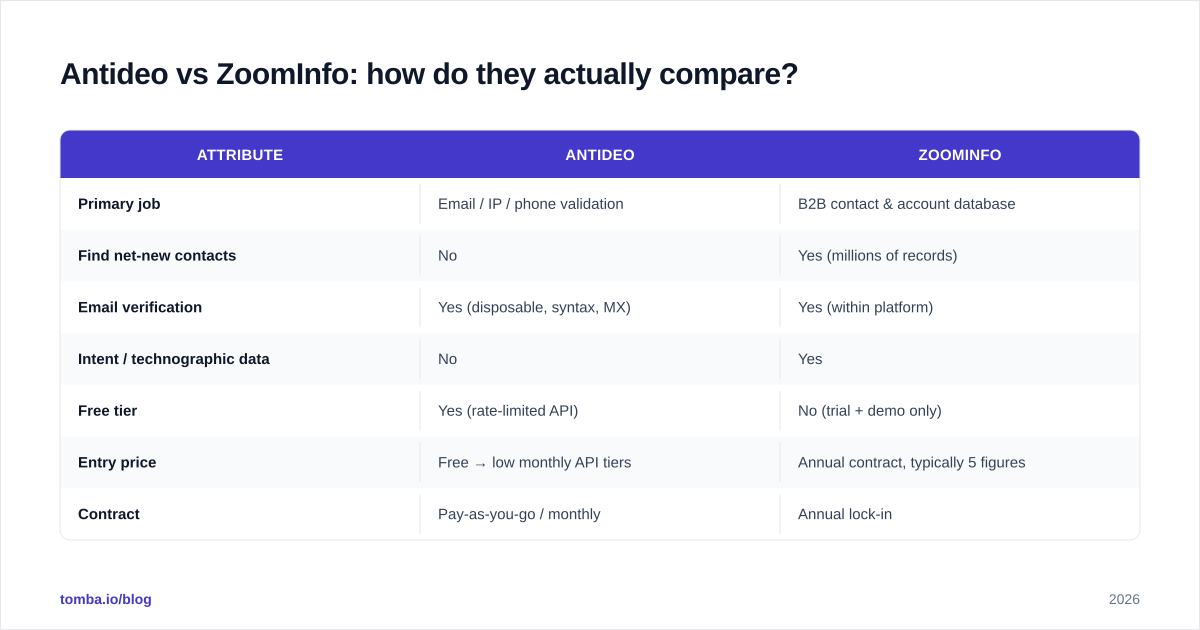
The honest read: these are not really competitors. They land in the same search results because both touch "email data," but a team choosing between them is usually asking the wrong question. The right question is what job am I hiring a tool to do — validate data I already have, or source data I don't?

Which one is more accurate?#
Accuracy means different things for each tool, so a head-to-head "who's more accurate" misses the point.
For Antideo, accuracy is about catch rate on bad data: does it correctly flag disposable domains, dead mailboxes, and blacklisted IPs? It's solid for the common cases — known disposable providers, obvious syntax failures, and major blacklists — but it doesn't deeply probe deliverability on catch-all domains, which is where most real-world verification gets hard.
For ZoomInfo, accuracy is about record freshness: is the contact still at that company, is the direct dial current, is the email still live? At enterprise scale this is the perennial complaint — B2B data decays roughly 2–3% per month as people change jobs, so any large database is fighting entropy constantly. ZoomInfo invests heavily here, but no static database is immune.

This is exactly why many teams separate sourcing from verification: pull contacts from one source, then re-verify every address at send time with a dedicated email verifier rather than trusting the database's last-known-good flag. Treating verification as a continuous step, not a one-time import, is the single biggest lever on bounce rates and sender reputation.
What does each one cost in 2026?#
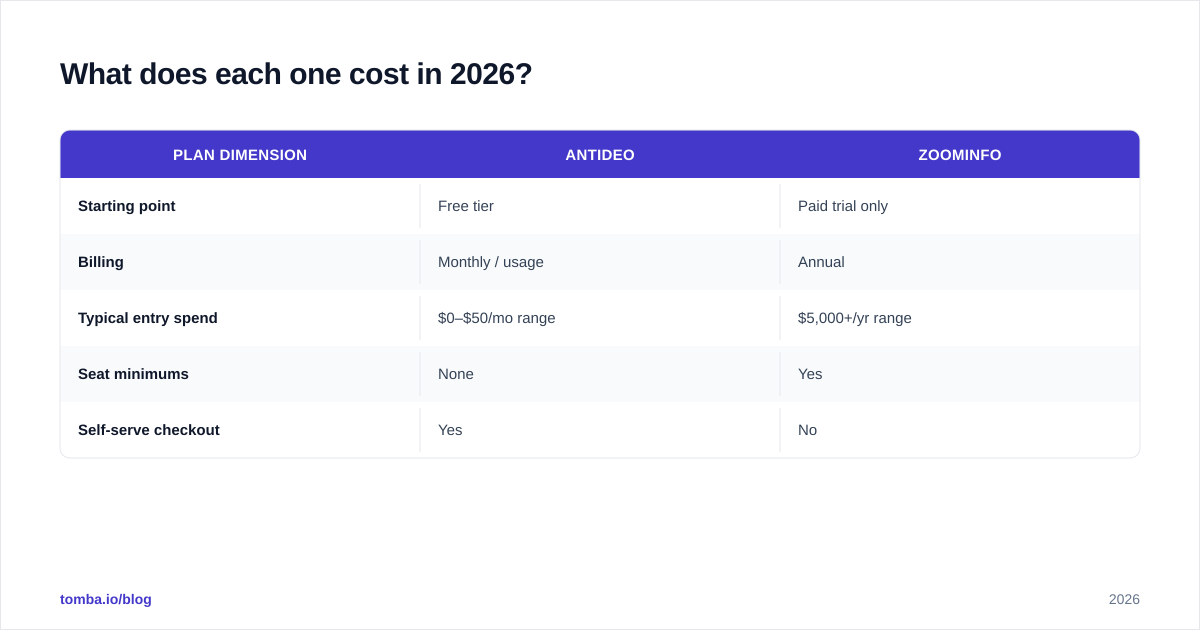
Pricing is where the two tools diverge most sharply, and it's usually the deciding factor.
Antideo follows a developer-friendly model. There's a free rate-limited tier for low-volume checks, then paid tiers that scale with API request volume. You can start in minutes with a credit card — or no card at all — and your cost tracks usage. For a startup adding email validation to a signup form, monthly spend can stay in the low double digits.
**
ZoomInfo** follows the enterprise SaaS model: annual contracts, per-seat licensing, and add-on data packages (intent, scoops, enrichment) that stack up. Public reporting and user reviews consistently put real-world annual spend in the thousands to tens of thousands of dollars, and there's typically a minimum seat count. You negotiate; you don't self-serve.
| Plan dimension | Antideo | ZoomInfo |
|---|---|---|
| Starting point | Free tier | Paid trial only |
| Billing | Monthly / usage | Annual |
| Typical entry spend | $0–$50/mo range | $5,000+/yr range |
| Seat minimums | None | Yes |
| Self-serve checkout | Yes | No |
If budget predictability matters and you don't need a contact database, Antideo wins on cost outright. If you need the database and have the budget, ZoomInfo's price buys breadth Antideo simply doesn't offer.
Is there a better fit for outbound prospecting?#
Yes — and this is the part most "Antideo vs
ZoomInfo" comparisons skip. If your actual goal is outbound prospecting — finding decision-maker emails by name or domain, verifying them, and pushing clean contacts into a sequence — neither tool is ideal. Antideo can't source contacts; ZoomInfo can, but you're paying enterprise prices and signing annual paper to do it.
A focused email finder splits the difference. With Tomba you can run a domain search to pull every public professional email at a company, use the email finder to locate a specific person by name and domain, and verify each result — all on transparent, self-serve pricing with a free tier to start. The data sourcing methodology is documented openly on Tomba's data sources page, and the underlying B2B database is queryable by API.

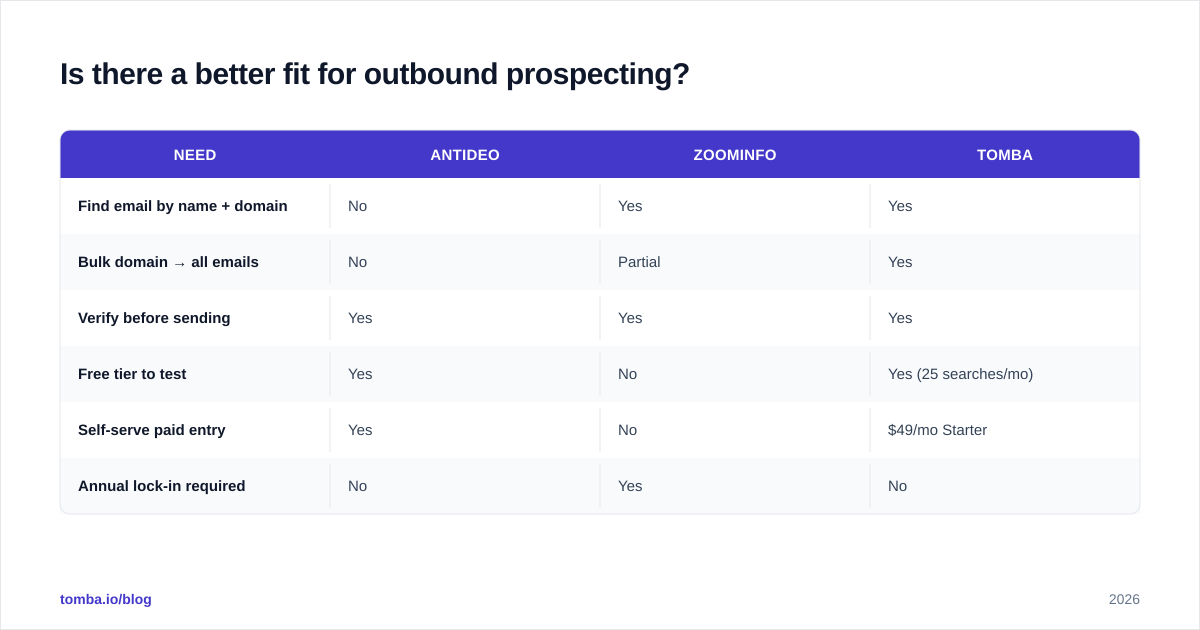
Here's how the three approaches stack up for a prospecting use case specifically:
| Need | Antideo | ZoomInfo | Tomba |
|---|---|---|---|
| Find email by name + domain | No | Yes | Yes |
| Bulk domain → all emails | No | Partial | Yes |
| Verify before sending | Yes | Yes | Yes |
| Free tier to test | Yes | No | Yes (25 searches/mo) |
| Self-serve paid entry | Yes | No | $49/mo Starter |
| Annual lock-in required | No | Yes | No |
For transparent, published rates rather than a sales call, see the full Tomba pricing — Starter is $49/mo, Growth $99/mo, and Pro $249/mo, all month-to-month.
How do I choose between Antideo and ZoomInfo?#
Match the tool to the job, not to the marketing.
Choose Antideo if:
- You're a developer adding validation to signup forms, checkout, or fraud screening.
- You already have the contacts and just need to keep the list clean.
- You want usage-based pricing and a free tier with no sales call.
- You don't need to discover new people or companies.
Choose ZoomInfo if:
- You're an enterprise or mid-market sales org building territory and account lists.
- You need intent data, org charts, and technographics, not just contact records.
- You have a five-figure annual budget and a team large enough to justify per-seat pricing.
- Deep CRM and sales-engagement integration is non-negotiable.
Choose a dedicated email finder if:
- Your core job is outbound: find, verify, and sequence decision-maker emails.
- You want ZoomInfo-style sourcing without the contract or the price tag.
- You need clean, verified data feeding your email deliverability strategy.
The trap to avoid is buying ZoomInfo for prospecting volume you'll never use, or expecting Antideo to do sourcing it was never built for. Most teams under 50 reps land somewhere in the middle — and that middle is exactly the gap a focused finder fills.
Frequently asked questions#
Is Antideo a ZoomInfo alternative? Not really. Antideo validates data you already have; it can't replace ZoomInfo's contact database. They serve different stages of the data lifecycle.
Does ZoomInfo verify emails? Yes, within its platform — but database records still decay, so re-verifying at send time with a standalone verifier is best practice regardless of source.
Can I use Antideo for free? Yes. Antideo offers a rate-limited free API tier suitable for low-volume validation. ZoomInfo offers only a trial and a demo.
What's the cheapest way to get verified prospecting emails? Start with a free tier on a dedicated email finder, verify results, and only upgrade when volume demands it — far cheaper than an enterprise data contract.
The bottom line#
Antideo and ZoomInfo aren't rivals so much as tools at opposite ends of the B2B data pipeline: one cleans, one sources. If you only need hygiene, Antideo's free, usage-based model is hard to beat. If you need an enterprise intelligence engine and can fund it, ZoomInfo earns its price. But if what you actually need is to find decision-maker emails, verify them, and start conversations without an annual contract, neither hits the sweet spot.
That's the gap Tomba was built for. Spin up a free account, run a domain search on your top target accounts, and let the Tomba Email Finder surface and verify the addresses you need — self-serve, transparent pricing, no sales call required.
Ready to find emails that actually work?
Join 150,000+ professionals who stopped guessing and started sending. Free credits on signup — no credit card required.
Get the Tomba newsletter
Practical outbound tactics and product updates — once every two weeks.
About the author