Anybizio Pricing & Reviews 2026: Pros, Cons & Alternatives
Is Anybizio worth it in 2026? An honest look at Anybizio pricing, real user reviews, the pros and cons, and the best alternatives for B2B teams.
TL;DR
- Anybizio is an all-in-one AI business and sales-automation platform aimed at small teams that want lead generation, outreach, and workflow tools bundled together.
- Pricing is tiered (a free or low-cost entry plan, a mid "growth" tier, and a higher "pro/agency" tier); the headline appeal is bundling, not best-in-class accuracy on any single feature.
- Reviews are mixed: users like the breadth and the price-to-feature ratio, but flag data accuracy, support response times, and a learning curve as recurring complaints.
- The biggest con for prospecting teams: bundled email and contact data rarely matches a dedicated email finder on accuracy or verification depth.
- If your bottleneck is finding and verifying accurate B2B emails, a specialist tool plus a lightweight outreach layer often beats one bundle that does everything at 70%.
What is Anybizio?#
Anybizio positions itself as an all-in-one platform for small businesses and lean sales teams: a single subscription that promises lead sourcing, contact data, outreach automation, and a handful of marketing utilities under one login. Think of it like a Swiss Army knife — convenient because every blade is attached to the same handle, but no single blade is the sharpest one you can buy.
That framing matters because the whole "pricing, reviews, pros and cons" question depends on what you compare it against. Against assembling five separate tools, a bundle looks cheap and simple. Against a category leader in any one function — email finding, verification, sequencing, or CRM — a bundle usually trades depth for breadth.
This review is written for B2B teams evaluating whether Anybizio belongs in their 2026 stack. We are not affiliated with Anybizio, and where Tomba is mentioned, it is because email data accuracy is the area where bundles most often fall short.
How much does Anybizio cost in 2026?#
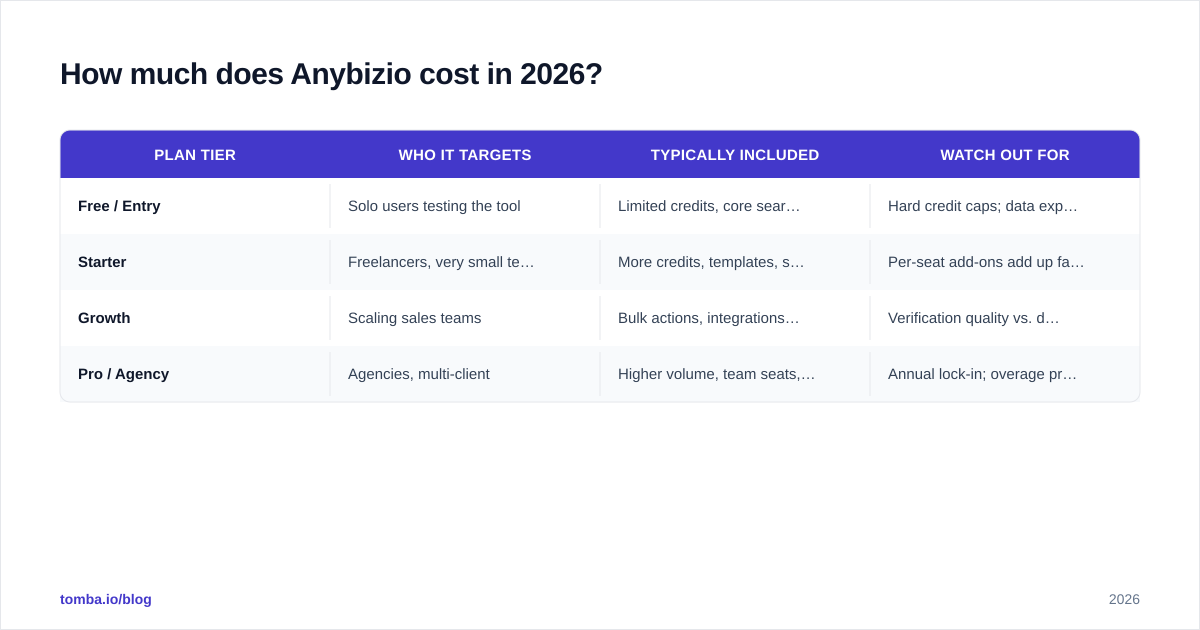
Anybizio uses the familiar good-better-best tier structure that most SaaS bundles adopt: a low-friction entry plan to get you in the door, a mid plan where most features unlock, and a top plan aimed at agencies or higher-volume users. Pricing on bundled platforms changes often, and credit allowances are usually the real cost driver — so always confirm the current numbers on the vendor's own page and on a directory like Capterra before committing.
Here is how the typical bundle tiering breaks down, and what to scrutinize at each level:
| Plan tier | Who it targets | Typically included | Watch out for |
|---|---|---|---|
| Free / Entry | Solo users testing the tool | Limited credits, core search, basic outreach | Hard credit caps; data exports often locked |
| Starter | Freelancers, very small teams | More credits, templates, single inbox | Per-seat add-ons add up fast |
| Growth | Scaling sales teams | Bulk actions, integrations, reporting | Verification quality vs. dedicated tools |
| Pro / Agency | Agencies, multi-client | Higher volume, team seats, white-label | Annual lock-in; overage pricing |
The strategic point: with bundles, you are rarely paying for one feature. You are paying for credits that get spent across every module. If you burn most of your allowance on low-accuracy contact lookups, the "cheap" plan stops looking cheap once you factor in the leads that bounce.
For contrast, a dedicated provider prices the data function transparently. Tomba's plans run from a free tier (25 searches/month) to Starter at $49/mo, Growth at $99/mo, and Pro at $249/mo — you can see the full Tomba pricing breakdown rather than guessing how many "credits" a verified email costs inside a bundle.
What do Anybizio reviews say — the pros?#
Across review directories and community threads, the positive themes are consistent. Treat individual star ratings on sites like G2 as directional rather than gospel, but the pattern of praise tells you who Anybizio fits.
Breadth for the price. The single most common compliment is value: you get lead sourcing, outreach, and basic marketing tools without paying for four subscriptions. For a solo founder or a two-person team, consolidating logins and invoices is a real, measurable win.
Fast time-to-first-campaign. Because the data and the sending sit in one place, new users report getting a campaign live quickly without wiring up integrations. There is no Zapier-glue project before you can send your first sequence.
Approachable for non-technical users. Reviewers who are not sales-ops specialists appreciate that the workflows are guided. You do not need to understand SPF records, list hygiene, or API keys to get started.
One bill, one vendor. Procurement and budgeting are simpler. For very small businesses, "one card charge instead of five" is a legitimate reason to choose a bundle.
If your situation is "I am one person, I have a small budget, and I want something working this afternoon," those pros are exactly the right ones to weigh heavily.
What are the cons and complaints?#
The criticisms are just as consistent, and they cluster around the predictable weak spots of any all-in-one tool.
Data accuracy and bounce rates. This is the recurring theme for prospecting teams. Bundled contact data is typically sourced and refreshed less aggressively than a specialist's, so emails go stale, and bounce rates climb. High bounces hurt your sender reputation, which then drags down every campaign you run — even the ones with perfect copy.
Verification depth. Finding an address is only half the job. Catch-all domains, role accounts, and recently-changed mailboxes need real verification. Bundles often ship a basic "valid/invalid" check rather than the layered logic a dedicated email verifier uses, so risky addresses slip through.
Support responsiveness. Several reviews mention slow support, especially on lower tiers. When one tool owns your data, sending, and reporting, a support gap stalls everything at once instead of just one function.
Learning curve and feature sprawl. Ironically, "all-in-one" can mean "lots to learn." Reviewers note that the dashboards try to do everything, and finding the one setting you need takes time.
Lock-in. Annual contracts and white-label tiers are sticky by design. If the data quality disappoints in month three, you may be paying through month twelve.
Is Anybizio better than a dedicated stack?#
It depends entirely on which job is your bottleneck. The honest answer is that bundles win on convenience and lose on depth — so the right question is "where do I need depth?"
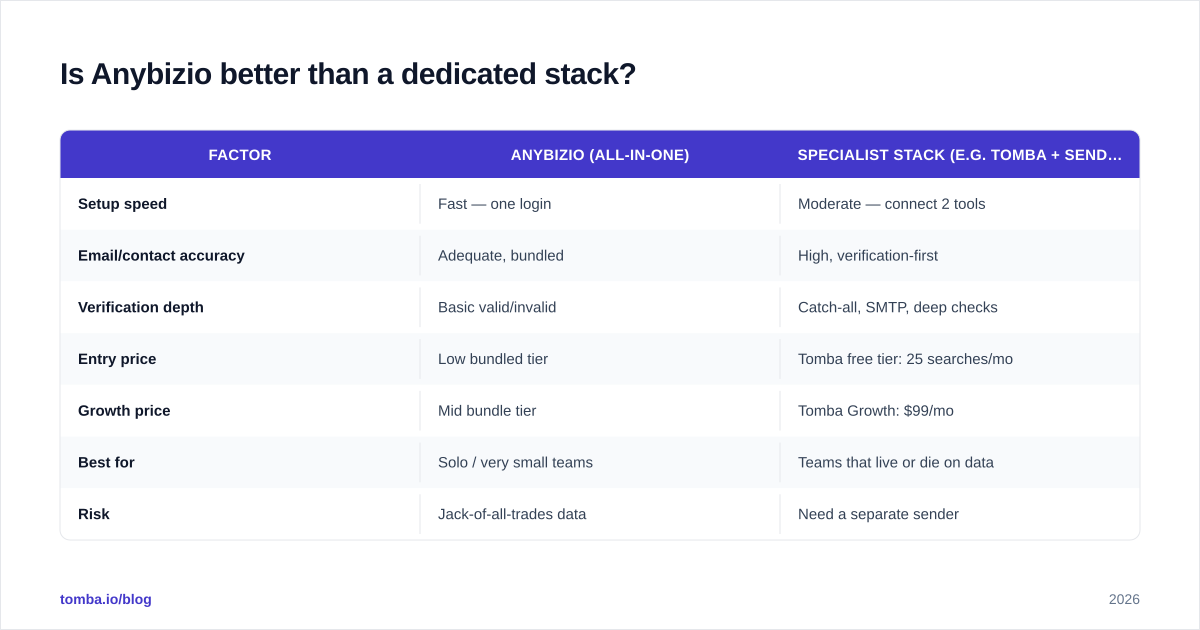
Here is a side-by-side of the two philosophies, using accurate Tomba figures for the specialist column:
| Factor | Anybizio (all-in-one) | Specialist stack (e.g. Tomba + sender) |
|---|---|---|
| Setup speed | Fast — one login | Moderate — connect 2 tools |
| Email/contact accuracy | Adequate, bundled | High, verification-first |
| Verification depth | Basic valid/invalid | Catch-all, SMTP, deep checks |
| Entry price | Low bundled tier | Tomba free tier: 25 searches/mo |
| Growth price | Mid bundle tier | Tomba Growth: $99/mo |
| Best for | Solo / very small teams | Teams that live or die on data |
| Risk | Jack-of-all-trades data | Need a separate sender |
A practical rule: if your pipeline depends on reaching the right person at the right address, do not let the cheapest part of a bundle decide your deliverability. You can keep an outreach or CRM bundle and still feed it clean, verified data from a data enrichment layer or a dedicated finder. The two approaches are not mutually exclusive — many teams run a specialist data source into whatever sending tool they already like.
For a structured way to decide, walk the workflow below before you sign anything.
Who should actually use Anybizio?#
Use this quick fit test instead of generic "it depends" advice.
Anybizio is a reasonable choice if:
- You are a solo operator or a team of two to three with a tight budget.
- You value one bill and one login over best-in-class accuracy.
- Your volume is low enough that occasional bounces are tolerable.
- You want to launch outreach this week without an integration project.
Look elsewhere if:
- Email accuracy and deliverability directly drive your revenue.
- You send at volume, where a few percent of bounces becomes hundreds of wasted sends and reputation damage.
- You already own a CRM or sending tool you like and only need better data.
- You need granular verification (catch-all handling, role-account filtering, SMTP checks).
If you landed in the second group, the smarter spend is a specialist data tool plus the outreach layer you already trust. Tools like HubSpot publish solid primers on building an outbound process if you want to design the sending side independently of your data source.
How do I evaluate Anybizio (or any bundle) before buying?#
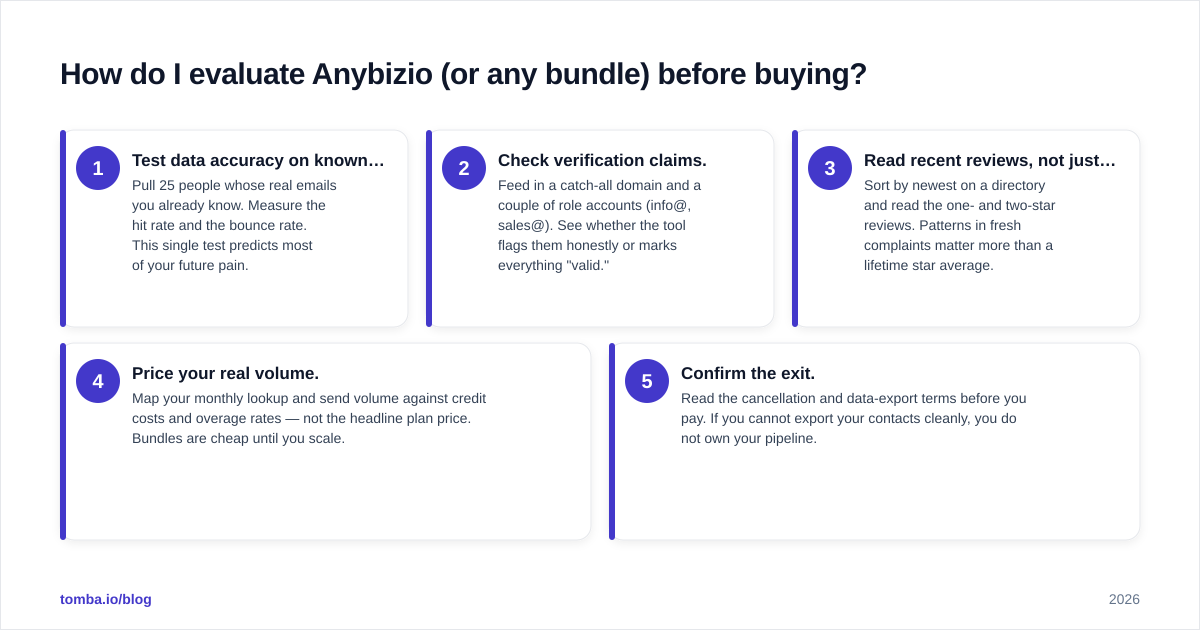
Run this five-step due-diligence checklist during the free trial. It takes an afternoon and saves months of lock-in regret.
- Test data accuracy on known contacts. Pull 25 people whose real emails you already know. Measure the hit rate and the bounce rate. This single test predicts most of your future pain.
- Check verification claims. Feed in a catch-all domain and a couple of role accounts (info@, sales@). See whether the tool flags them honestly or marks everything "valid."
- Read recent reviews, not just the average. Sort by newest on a directory and read the one- and two-star reviews. Patterns in fresh complaints matter more than a lifetime star average.
- Price your real volume. Map your monthly lookup and send volume against credit costs and overage rates — not the headline plan price. Bundles are cheap until you scale.
- Confirm the exit. Read the cancellation and data-export terms before you pay. If you cannot export your contacts cleanly, you do not own your pipeline.
If step one disappoints, that is your answer regardless of how attractive the bundle looks elsewhere. You can plug a verification-first tool into your existing workflow in minutes — a bulk email finder and verifier will tell you exactly how clean (or dirty) a sample list really is.
The bottom line on Anybizio pricing, reviews, pros and cons#
Anybizio is a defensible pick for solo users and very small teams who value consolidation and price over depth. Its pros — breadth, speed, one bill — are real. Its cons — data accuracy, verification depth, support, and lock-in — are also real, and they hit prospecting teams hardest, because every other tactic in cold outreach assumes you reached an actual, working inbox.
The decision is not "bundle versus no bundle." It is "which job in my pipeline cannot afford to be done at 70%." For most B2B teams, that job is data. Get the contact right first, then layer whatever outreach tool fits your style on top.
If accurate, verified B2B emails are your real bottleneck, start with the Tomba Email Finder. The free tier gives you 25 searches a month to benchmark accuracy against whatever bundle you are weighing — find professional addresses by domain, name, or company, verify them before you send, and keep your sender reputation intact. Prove the data quality on your own list first, then decide where the rest of your budget should go.
// get started
Find, verify and enrich your first contacts today
Start on the free plan with 25 searches a month, then scale when your team is ready.
Free plan · No credit card required · GDPR & CCPA
// about the author