Anymail Finder vs Cognism 2026: Which Email Tool Wins?
Anymail Finder vs Cognism compared on data accuracy, coverage, pricing, and compliance — plus where each one actually fits your 2026 outbound stack.
TL;DR
- Anymail Finder is a lean, pay-for-what-you-verify email finder. You only get charged for emails it can confirm, pricing is transparent, and it's built for speed and bulk lookups.
- Cognism is a premium B2B sales-intelligence platform — verified mobile numbers (Diamond Data), intent signals, and GDPR/CCPA-checked records — sold on annual contracts, not self-serve credits.
- They overlap on "find a work email," but they are not the same category: one is a tool, the other is a database subscription.
- Budget is the fastest filter. Anymail Finder starts in the tens of dollars per month; Cognism typically lands in the low-to-mid five figures per year.
- If you want email accuracy without a sales call or an annual commitment, a credit-based finder like Anymail Finder — or Tomba's email finder — fits better. If you need phone-verified mobiles and intent across EMEA, Cognism earns its price.
Choosing between Anymail Finder vs Cognism usually isn't about which tool is "better." It's about whether you're buying a finder or a data platform — and those are two different purchases. This guide breaks down accuracy, coverage, compliance, workflow, and price so you can match the tool to how your team actually prospects.
What is Anymail Finder?#
Anymail Finder is a focused email-finding tool. You give it a name and a company (or a domain), and it returns a business email address with a verification status. Its defining commercial idea is simple: you only pay for emails it marks as "verified." Guessed or unverifiable results don't burn credits.
That billing model is the whole personality of the product. It pushes you toward clean, deliverable lists instead of bloated exports full of catch-all guesses. The feature set stays deliberately narrow:
- Single lookups by name + domain or name + company
- Bulk CSV upload for list building
- A REST API for embedding lookups into your own apps
- Integrations through Zapier and common outreach tools
There's no intent data, no org charts, no phone dialer. It does one job and bills you honestly for it. Think of it like a vending machine that only charges you when the snack actually drops — no payment for jams.
What is Cognism?#
Cognism is a sales-intelligence platform, not a single-purpose finder. Its pitch is a compliant, enriched B2B contact database you search and export from — emails, firmographics, technographics, intent (via Bombora), and its headline feature, Diamond Data: mobile numbers that have been phone-verified by a human team.
Cognism's strongest reputation is in two areas: EMEA mobile coverage and compliance. It markets notification against DNC lists across regions and positions itself for teams that worry about GDPR and CCPA exposure. You typically work through a Chrome extension (Prospector) that overlays LinkedIn and company sites, plus a web app for list building and CRM sync.
The trade-off is the commercial model. Cognism is sold on annual contracts negotiated with sales, usually with seat-based and credit-based limits. There is no published self-serve price and no "swipe a card for $49" path. You're buying a data subscription, complete with onboarding.
How do Anymail Finder and Cognism compare on data accuracy?#
Accuracy is where these two diverge in method, not just outcome.
Anymail Finder verifies emails in real time through SMTP-style checks and only charges when it can confirm deliverability. That keeps bounce rates low on the records it bills you for — but it also means coverage is "whatever it can verify right now." For obscure contacts or strict catch-all domains, you may simply get fewer results.
Cognism leans on a large, continuously re-verified database plus its human-verified phone layer. Its email accuracy is solid, but the headline accuracy story is really about mobile numbers — the Diamond Data verification is what justifies the premium. For pure email, the gap between a good finder and Cognism narrows considerably.
A practical reality for both: no provider is 100% accurate, and catch-all domains break naive verification. That's why teams pair any finder with a dedicated email verifier and a catch-all verifier before launching a campaign, regardless of which platform sourced the address.


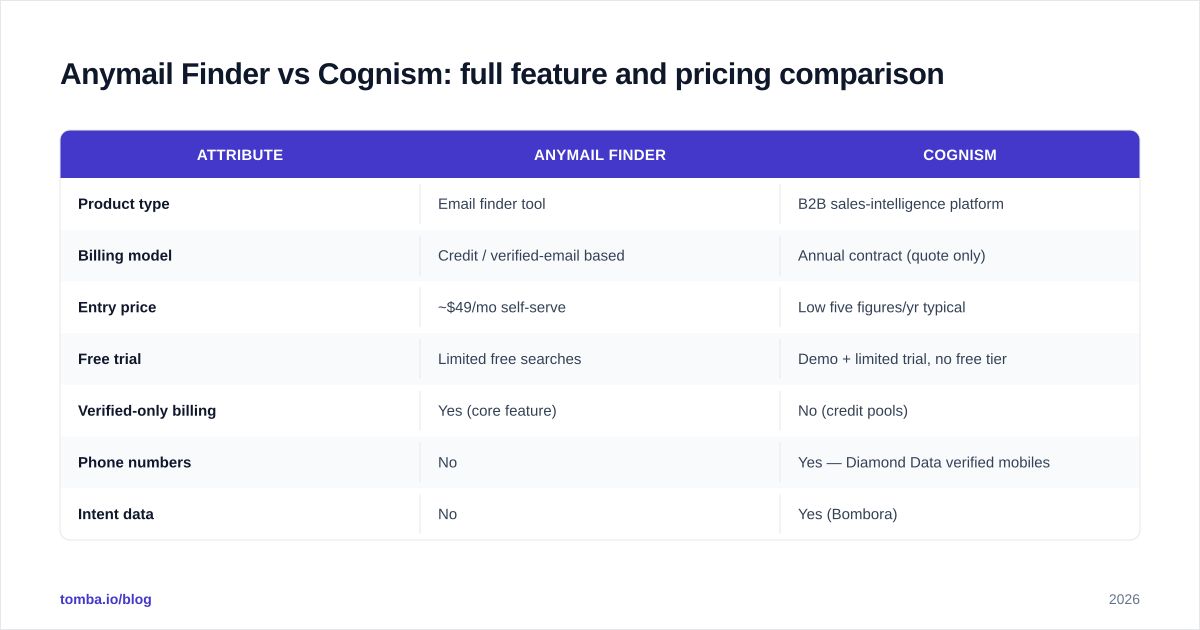
Anymail Finder vs Cognism: full feature and pricing comparison#
Here's the side-by-side. Treat Cognism's pricing as directional — it's quote-based, so exact numbers depend on region, seats, and credit volume.
| Attribute | Anymail Finder | Cognism |
|---|---|---|
| Product type | Email finder tool | B2B sales-intelligence platform |
| Billing model | Credit / verified-email based | Annual contract (quote only) |
| Entry price | ~$49/mo self-serve | Low five figures/yr typical |
| Free trial | Limited free searches | Demo + limited trial, no free tier |
| Verified-only billing | Yes (core feature) | No (credit pools) |
| Phone numbers | No | Yes — Diamond Data verified mobiles |
| Intent data | No | Yes (Bombora) |
| Chrome extension | Basic | Prospector (LinkedIn overlay) |
| Bulk list building | Yes (CSV) | Yes (in-app) |
| API access | Yes | Yes (enterprise) |
| Compliance positioning | Standard | GDPR/CCPA + DNC checks |
| Best region | Global, US-strong | Strong EMEA + US |
| Onboarding | Self-serve, instant | Sales-led |
The pattern is clear: Anymail Finder competes on price, transparency, and speed-to-value. Cognism competes on breadth, phone data, and compliance assurance. You're not comparing two finders; you're comparing a screwdriver to a toolbox.
For reference, here's how a broader set of email-finding tools stacks up on the metrics that matter for outbound:

Which one is better for cold outreach and list building?#
It depends on what your outbound motion needs.
Choose Anymail Finder if:
- You run email-first campaigns and want deliverable addresses without overpaying.
- You value transparent, usage-based pricing over annual commitments.
- You're a startup, solo founder, agency, or lean SDR team.
- You already have a sequencer and just need a reliable email source feeding it.
Choose Cognism if:
- Phone is a core channel — cold calling and multi-threading by mobile.
- You sell into EMEA and need strong regional mobile coverage.
- Compliance sign-off (GDPR, DNC) is a hard requirement from legal.
- You want intent signals to prioritize accounts, not just contacts.
- You have the budget and a team large enough to amortize the contract.
A useful gut check: count how many of your replies actually start on the phone. If the honest answer is "almost none," you're paying for Diamond Data you won't use, and a credit-based finder covers you for a fraction of the cost. If half your pipeline is built on connect rates, Cognism's mobile layer may pay for itself.
For teams that do need numbers but balk at an annual platform contract, a standalone phone finder can bolt verified mobiles onto a cheaper email stack without the five-figure commitment.
How do they handle compliance and data sourcing?#
This is Cognism's home turf. It invests heavily in compliance messaging — notifying against do-not-call registries across regions and positioning its database as GDPR- and CCPA-aware. For regulated industries or EMEA-heavy teams whose legal department reviews vendors, that documentation is a real, billable feature.
Anymail Finder takes the lighter-weight tool approach: it finds and verifies public business emails on demand. It doesn't market the same depth of compliance tooling because it isn't selling a standing database of personal contact records — it's resolving a specific lookup when you ask for it.
Neither approach removes your own responsibility. Wherever you source contacts, you still own lawful basis, suppression, and opt-out handling on your side. If you want to understand how providers assemble records in the first place, it's worth reading any vendor's data-sourcing page — including where Tomba gets its data — before you commit. Treat compliance claims as a starting point for your own diligence, not a substitute for it.
What do real users say on review sites?#
Patterns from public reviews on platforms like G2 are consistent with the positioning above.
Anymail Finder users praise the verified-only billing and simplicity — the "I never pay for junk" sentiment shows up repeatedly. The most common complaint is coverage: for hard-to-find contacts it returns fewer results than a giant database would, because it refuses to bill for guesses.
Cognism users praise mobile accuracy and EMEA coverage above all, plus responsive support and the Chrome extension workflow. The recurring criticisms are price and contract rigidity — credits that expire, annual lock-in, and the need to forecast volume accurately up front to avoid overpaying.
You can validate both yourself: Cognism's site leads with phone-verified data and compliance, while Anymail Finder's site leads with verified-only pricing. Each homepage tells you exactly who it's built for.
Is there a middle-ground alternative to both?#
Yes — and for many teams it's the most sensible answer to Anymail Finder vs Cognism.
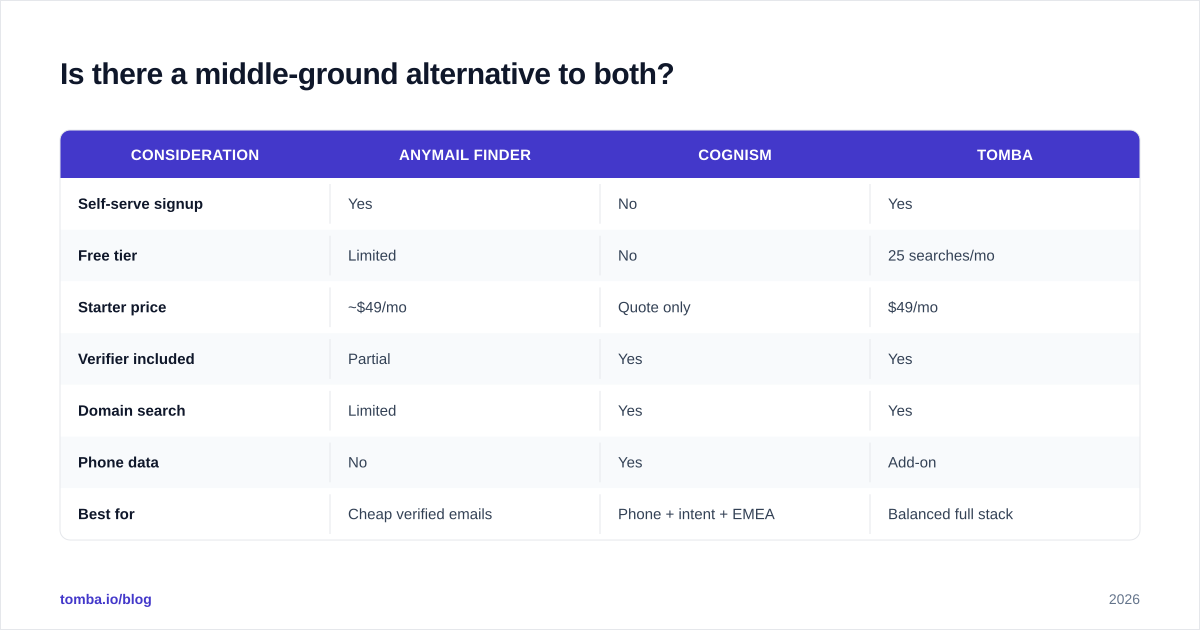
The honest summary: Anymail Finder can feel too narrow once you also need verification, domain-level discovery, and enrichment, while Cognism can feel too heavy (and too expensive) if you mostly need accurate emails at scale. The gap between them is exactly where a full-stack-but-affordable finder lives.
That's the slot tools like Tomba aim for. You get an email finder, domain search, a built-in email verifier, a bulk email finder for list building, and data enrichment — under transparent, self-serve Tomba pricing instead of an annual negotiation.
| Consideration | Anymail Finder | Cognism | Tomba |
|---|---|---|---|
| Self-serve signup | Yes | No | Yes |
| Free tier | Limited | No | 25 searches/mo |
| Starter price | ~$49/mo | Quote only | $49/mo |
| Verifier included | Partial | Yes | Yes |
| Domain search | Limited | Yes | Yes |
| Phone data | No | Yes | Add-on |
| Best for | Cheap verified emails | Phone + intent + EMEA | Balanced full stack |
The point isn't that one tool wins every row — it's that you should buy for your row. A two-person agency and a 40-rep EMEA sales org should not land on the same product.
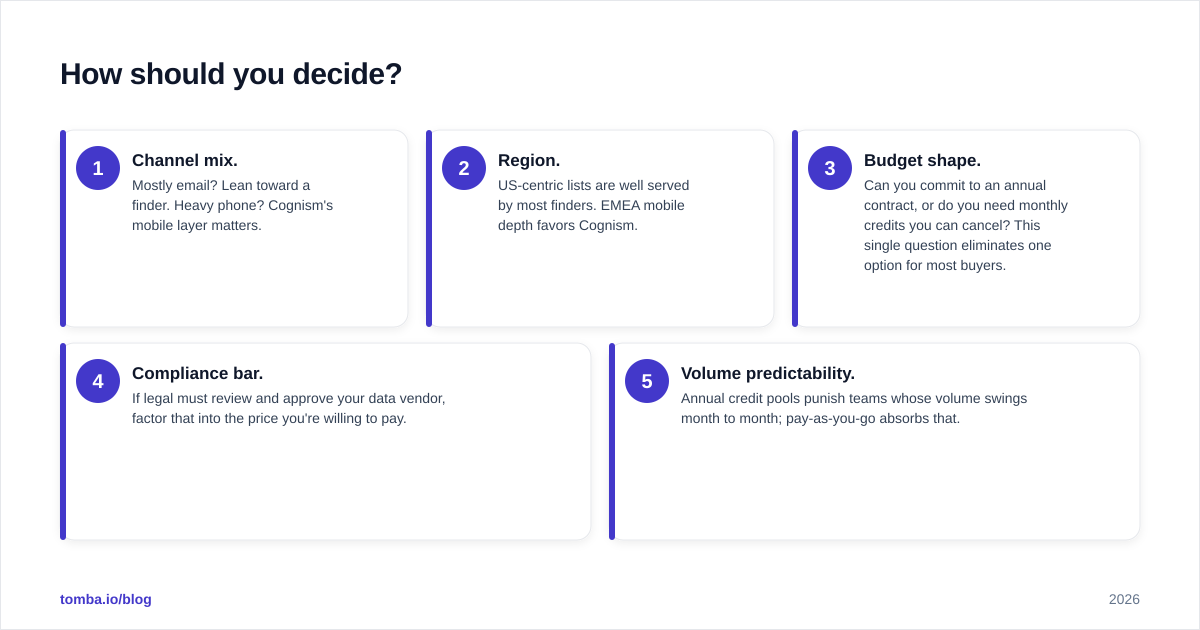
How should you decide?#
Run this short test before you sign anything:
- Channel mix. Mostly email? Lean toward a finder. Heavy phone? Cognism's mobile layer matters.
- Region. US-centric lists are well served by most finders. EMEA mobile depth favors Cognism.
- Budget shape. Can you commit to an annual contract, or do you need monthly credits you can cancel? This single question eliminates one option for most buyers.
- Compliance bar. If legal must review and approve your data vendor, factor that into the price you're willing to pay.
- Volume predictability. Annual credit pools punish teams whose volume swings month to month; pay-as-you-go absorbs that.
Most small and mid-market teams will find that a transparent, credit-based finder covers 80% of their need at 10% of the cost — and they layer in phone data only where it's proven to move pipeline.
The bottom line#
Anymail Finder vs Cognism comes down to tool vs platform. Anymail Finder is the disciplined, pay-for-verified email finder that respects a small budget. Cognism is the premium intelligence engine for teams that live on the phone, sell into EMEA, and need compliance documentation to match. Neither is wrong; they're built for different buyers.
If you want the accuracy and verified-only discipline of Anymail Finder, the domain search and enrichment reach that nudges toward Cognism territory, and pricing you can start today without a sales call — try the Tomba Email Finder. Start free with 25 searches a month, find emails by name, domain, or company, verify them in the same workflow, and only scale up to the $49/mo Starter plan when your pipeline does. It's the middle path most outbound teams are actually looking for.
// get started
Find, verify and enrich your first contacts today
Start on the free plan with 25 searches a month, then scale when your team is ready.
Free plan · No credit card required · GDPR & CCPA
// about the author