Anymail Finder vs DealSignal: 2026 B2B Data Comparison
Anymail Finder bills only for verified emails; DealSignal sells managed, multi-source B2B records. Here is which one fits your prospecting motion in 2026.
Choosing between Anymail Finder and DealSignal is really a choice between two philosophies of B2B contact data. One is a lean, verify-first email finder that charges you only when it is confident. The other is a managed, multi-source data platform that sells depth, firmographics, and human-verified records at a higher price point. They overlap just enough to land on the same shortlist, and differ enough that picking wrong wastes a quarter of budget.
This guide breaks down how the two compare on accuracy, pricing, data coverage, integrations, and the workflows each one actually serves best.
TL;DR — Anymail Finder vs DealSignal#
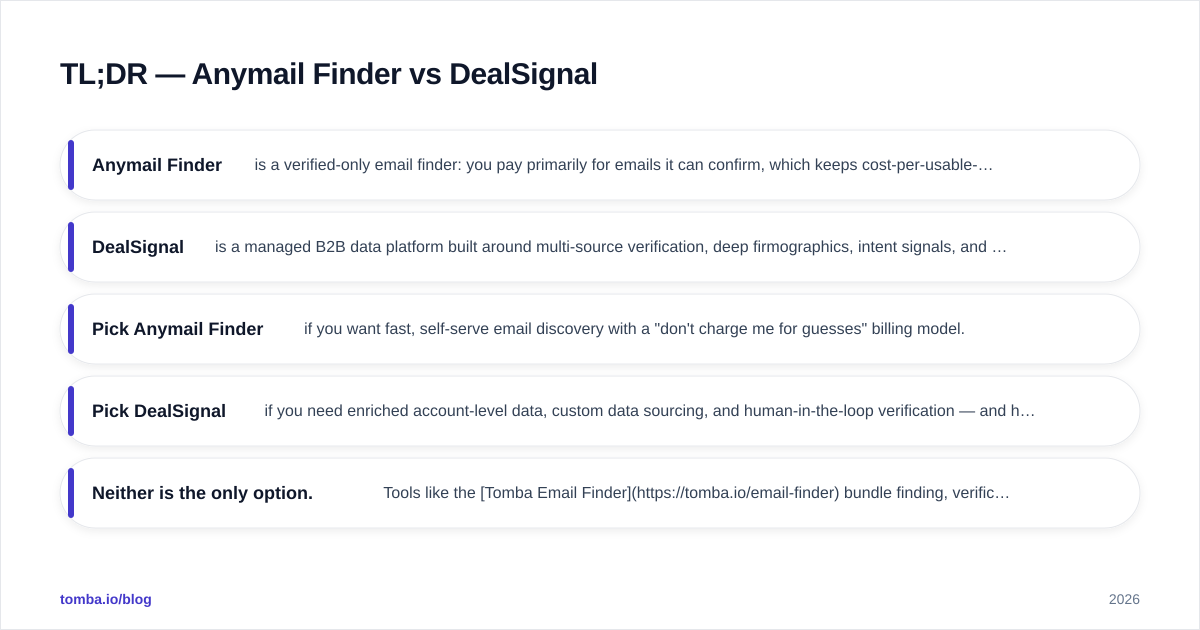
- Anymail Finder is a verified-only email finder: you pay primarily for emails it can confirm, which keeps cost-per-usable-lead predictable for outbound teams.
- DealSignal is a managed B2B data platform built around multi-source verification, deep firmographics, intent signals, and on-demand list building for larger GTM teams.
- Pick Anymail Finder if you want fast, self-serve email discovery with a "don't charge me for guesses" billing model.
- Pick DealSignal if you need enriched account-level data, custom data sourcing, and human-in-the-loop verification — and have the budget for it.
- Neither is the only option. Tools like the Tomba Email Finder bundle finding, verification, and enrichment under one credit system, often at a lower entry price.
What is Anymail Finder?#
Anymail Finder is a straightforward email-finding tool. You give it a full name plus a company domain, or upload a list, and it returns a business email address with a confidence label. Its signature feature is the billing model: in most plans, you are charged only for emails returned as verified. Guesses and unverified results do not burn credits the same way.
That design solves a real frustration. With many finders, you pay per lookup regardless of whether the result is usable, so a list full of hard-to-find contacts quietly drains your quota. Anymail Finder flips that — your spend tracks closely to deliverable results.
The trade-off is scope. Anymail Finder is focused on the email itself. It is not trying to be your firmographic database, your intent platform, or your account-research suite. It finds and verifies emails, does bulk processing, and exposes an API. That focus is a feature for teams who already know who they want to reach and just need the address.
What is DealSignal?#
DealSignal is a B2B data platform, not just an email tool. It positions itself around fresh, multi-sourced, verified contact and account data. Instead of returning a single field, it builds enriched records: job title, seniority, department, company size, industry, technologies, and in many cases direct dials and intent signals.
A core part of DealSignal's pitch is the managed, on-demand model. You can specify an ideal customer profile and have data built or refreshed to match, with human verification layered on top of automated checks. That makes it closer in spirit to providers like ZoomInfo or Clearbit than to a self-serve email finder. You can read DealSignal's own positioning on its official site and cross-check user reviews on G2.
The implication: DealSignal aims at revenue operations and demand-gen teams who need to power CRM enrichment, account-based marketing, and large segmented campaigns — workflows where the email is just one attribute among twenty.
How do Anymail Finder and DealSignal compare on accuracy?#
Accuracy means two different things here, so compare carefully.
Anymail Finder's accuracy claim is about email deliverability — when it labels an email "verified," that address should accept mail and not bounce. Because billing is tied to verification, the incentive structure pushes toward precision over volume. You may get fewer results on obscure contacts, but the ones you get are usable. That keeps your bounce rate low, which protects sender reputation and downstream email deliverability.
DealSignal's accuracy claim is broader: it is about the whole record staying fresh and correct — title changes, company moves, phone validity, not just the email. Multi-source cross-referencing plus human verification is designed to catch records that have decayed. For teams enriching a database of tens of thousands of accounts, that record-level freshness matters more than any single email lookup.
So the honest answer is: for raw "will this one email bounce?" precision, a verify-first finder is excellent. For "is this entire contact record still true six months later?", a managed multi-source platform has the edge — at a cost.


Anymail Finder vs DealSignal: feature and pricing comparison#
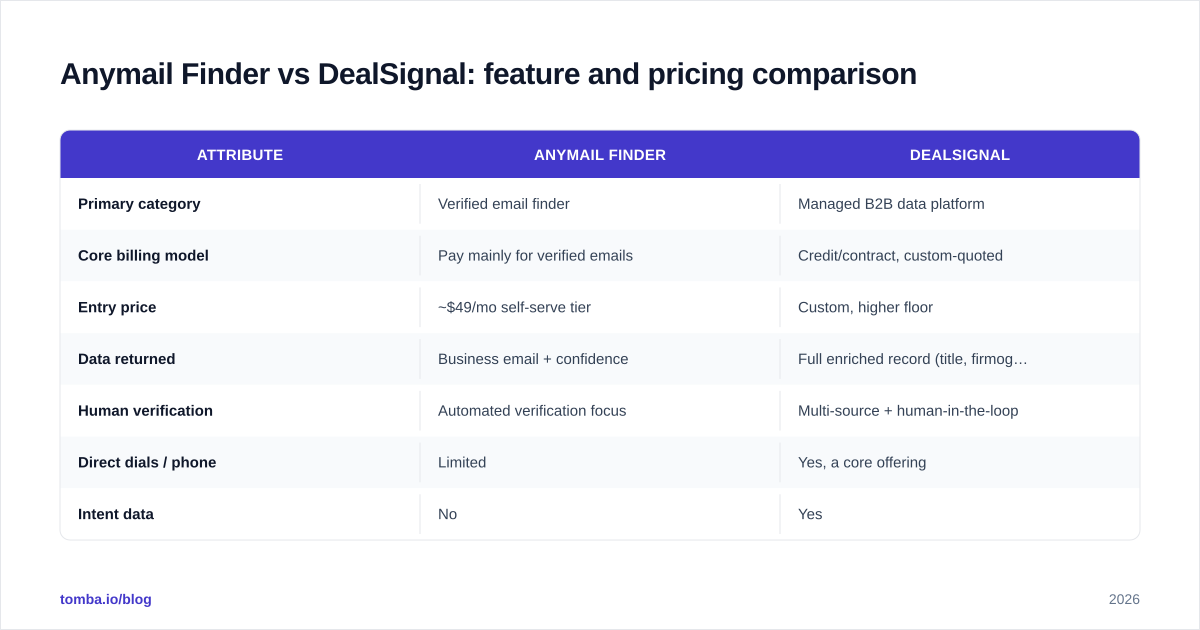
The clearest way to see the gap is side by side. Pricing for self-serve email finders is published; managed-data platforms like DealSignal typically quote based on volume and data scope, so treat those cells as directional.
| Attribute | Anymail Finder | DealSignal |
|---|---|---|
| Primary category | Verified email finder | Managed B2B data platform |
| Core billing model | Pay mainly for verified emails | Credit/contract, custom-quoted |
| Entry price | ~$49/mo self-serve tier | Custom, higher floor |
| Data returned | Business email + confidence | Full enriched record (title, firmographics, intent, phone) |
| Human verification | Automated verification focus | Multi-source + human-in-the-loop |
| Direct dials / phone | Limited | Yes, a core offering |
| Intent data | No | Yes |
| Bulk list building | Upload + bulk find | On-demand custom list builds |
| Best for | SDRs, founders, lean outbound | RevOps, demand gen, ABM at scale |
| API | Yes | Yes |
The pattern is consistent: Anymail Finder competes on simplicity and cost-per-verified-email, DealSignal competes on data depth and managed freshness. Neither is "better" in the abstract — they are priced for different buyers.
Which tool fits your workflow?#
Match the tool to the motion, not the feature list.
Choose Anymail Finder if you are running focused outbound. You have a list of named prospects or target domains, you know your messaging, and you need clean, deliverable addresses without paying for misses. The verify-first model means your response rate math stays clean because you are not emailing dead inboxes. Founders, solo SDRs, and small teams get the most leverage here.
Choose DealSignal if data is your bottleneck, not just emails. You are enriching a CRM, scoring accounts, feeding an ABM program, or building segmented lists from scratch against a defined ICP. You need direct dials, intent, and records that stay fresh across thousands of accounts. The price reflects a managed service, and for the right team it replaces several point tools.
Choose a unified finder-plus-enrichment tool if you want both without the enterprise contract. This is the gap many teams fall into: too much volume for a pure finder, not enough budget for a managed platform. That middle is where consolidated tools live.

Where does Tomba fit between them?#
Tomba sits deliberately in that middle lane. It is built as an email finder first — domain, name, or company lookups — but bundles verification, domain search, data enrichment, phone finder, and catch-all handling under one credit system. So you get Anymail Finder's "find me the email" simplicity plus a slice of DealSignal's record depth, without jumping to a custom enterprise quote.
The pricing is transparent and self-serve, which is the practical difference for most buyers comparing these two. Tomba's published Tomba pricing runs from a Free tier (25 searches/month) to Starter at $49/mo, Growth at $99/mo, and Pro at $249/mo, with Enterprise quoted for high volume. That gives you a clear floor to test against before committing — unlike a managed contract that requires a sales conversation to even price.
A few honest caveats. If your single most important need is large-scale intent data and a fully managed, human-built list operation, a dedicated platform in DealSignal's class will go deeper than Tomba or Anymail Finder. And if you genuinely only ever need one verified email at a time, a pure finder is all you need. Tomba's argument is for the common case in between: real prospecting volume, multiple data fields, and a budget that doesn't stretch to enterprise data contracts.
How do the data sources differ?#
Data provenance is where these tools quietly diverge, and it drives both accuracy and compliance posture.
Anymail Finder leans on pattern detection plus live verification — it works out likely addresses from public signals and confirms them before charging you. That is efficient and keeps the dataset lean, but it is fundamentally email-centric.
DealSignal aggregates from many third-party sources and partners, then reconciles and human-verifies. That breadth is what powers the firmographic and intent layers, but it also means you are buying into a larger sourcing pipeline whose freshness you should audit. When you evaluate any multi-source provider, ask how often records refresh and how decayed data is purged — guidance echoed by analyst firms like Gartner when assessing B2B data vendors.
Tomba publishes its own approach to data sources and pairs every find with an email verifier step, so you can validate before sending rather than trusting a label blindly. Whichever tool you pick, run a sample list through verification first — never load an unverified vendor export straight into a sending tool.

What about integrations and scale?#
Both tools expose an API and handle bulk work, but the integration philosophy differs.
Anymail Finder's API is built for the email-finding job: send identifiers, get verified emails back, wire it into your sequencer. It is the kind of endpoint you drop into a sales automation flow to enrich leads at the point of capture.
DealSignal integrates at the platform level — CRM sync, marketing automation, and data-warehouse feeds — because the whole point is keeping your systems of record continuously enriched. That is more setup, but it is the right shape for a revenue operations function.
If you want finder-grade simplicity with platform-style reach, Tomba's bulk email finder, native CRM connectors, and a documented email finder API cover both ends. The decision again comes down to whether you need a single capability done cleanly or an enterprise data backbone.
The bottom line#
Anymail Finder and DealSignal are not really competitors so much as neighbors. Anymail Finder is the disciplined, verify-first email finder that protects your budget and your deliverability. DealSignal is the managed, multi-source data engine for teams whose problem is records, not just addresses. Decide which problem you actually have — single deliverable emails, or a continuously enriched account database — and the choice makes itself.
If your answer is "both, but priced like a finder," start with Tomba. The Tomba Email Finder gives you verified emails, verification, enrichment, and phone data on transparent, self-serve pricing, with a free tier to test before you spend a dollar. Run your hardest 25 prospects through it, check the bounce rate, and let the results pick the tool.
// get started
Find, verify and enrich your first contacts today
Start on the free plan with 25 searches a month, then scale when your team is ready.
Free plan · No credit card required · GDPR & CCPA
// about the author