Anymail Finder vs Oceanio (2026): Accuracy, Pricing & Verdict
Anymail Finder vs Oceanio compared on accuracy, pricing, data depth, and billing model. See which email finder fits prospecting in 2026 — and where a third option wins.
TL;DR
- Anymail Finder is a focused email-finding tool with a "pay only for verified emails" billing model and strong bulk CSV workflows. Ocean.io is a company-data and lookalike-targeting platform that finds emails as one feature inside a broader account-based stack.
- Pick Anymail Finder if your job is "I have names and domains, get me deliverable emails cheaply." Pick Ocean.io if your job is "build me a list of similar companies, then enrich the people inside them."
- On raw email accuracy and cost-per-verified-contact, Anymail Finder is the tighter tool. On market mapping and total addressable market discovery, Ocean.io does more.
- Neither is the cheapest path to high-accuracy emails at scale. A dedicated finder-plus-verifier like Tomba often beats both on cost-per-valid-email.
- This guide compares them on accuracy, pricing, data depth, billing model, and integrations — then tells you which to choose by use case.
What are Anymail Finder and Ocean.io?#
Short answer: they solve two different halves of the same prospecting problem.
Anymail Finder is a single-purpose email finder. You give it a full name plus a company domain (or upload a CSV of them), and it returns a business email address with a confidence label — "verified," "guessed," or not found. Its headline promise is that you are billed only when it returns a verified address, which removes the usual fear of paying for guesses. Think of it like a locksmith who only charges you if the key actually opens the door.
Ocean.io is a B2B company-intelligence and lookalike-targeting platform. Its core trick is taking a list of your best customers and finding thousands of statistically similar companies, then giving you the firmographics and contacts inside them. Email finding is a feature, not the whole product. Think of it less like a locksmith and more like a real-estate scout who hands you the neighborhoods, the houses, and the doorbells.
That framing matters because most "X vs Y" searches assume the two tools are interchangeable. They are not. One is a precision instrument; the other is a discovery engine that happens to include contact data.

How do you choose between an email finder and a data platform?#
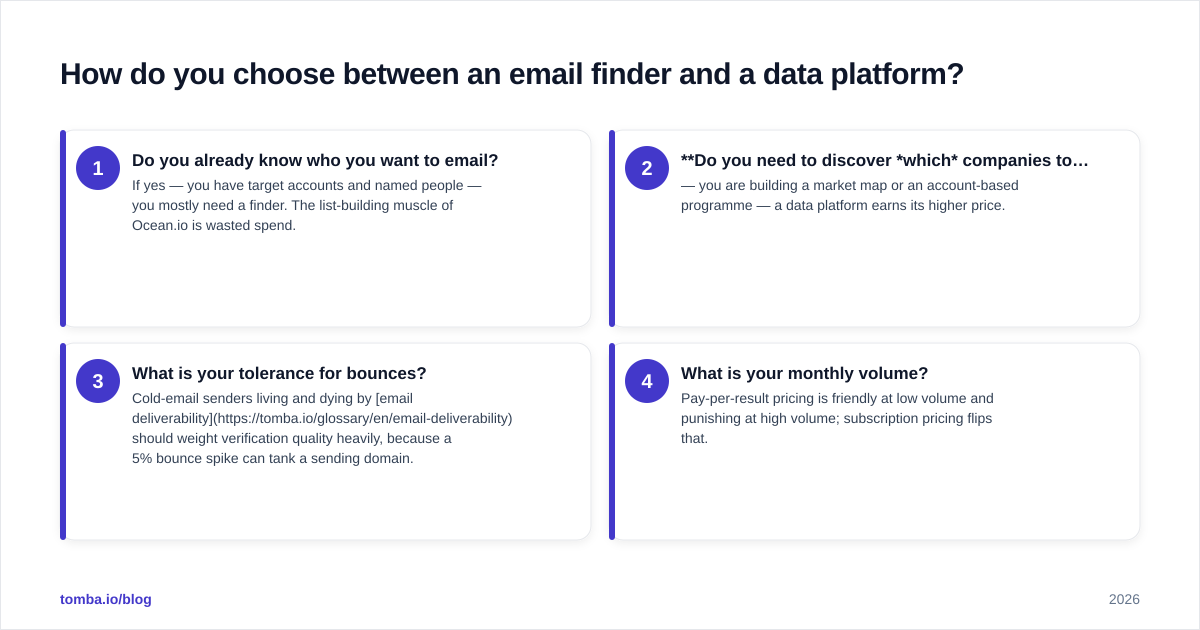
Before pricing, settle the category question. Use this decision framework when you are weighing a focused finder against a broader data platform.
The logic is simple:
- Do you already know who you want to email? If yes — you have target accounts and named people — you mostly need a finder. The list-building muscle of Ocean.io is wasted spend.
- Do you need to discover which companies to target? If yes — you are building a market map or an account-based programme — a data platform earns its higher price.
- What is your tolerance for bounces? Cold-email senders living and dying by email deliverability should weight verification quality heavily, because a 5% bounce spike can tank a sending domain.
- What is your monthly volume? Pay-per-result pricing is friendly at low volume and punishing at high volume; subscription pricing flips that.
If your answers cluster around "I know my targets, I send cold email, I care about bounces," Anymail Finder is the natural fit. If they cluster around "I need to find new markets and enrich whole org charts," Ocean.io is the natural fit.
How accurate is each tool at finding emails?#
Anymail Finder wins on cost-controlled accuracy; Ocean.io wins on coverage breadth inside its database.
Anymail Finder's verification-first model means the addresses it charges you for clear an SMTP-level check, so the deliverable rate on billed results tends to be high. Its weak spot is the same as every finder's: catch-all domains, where the mail server accepts everything and verification can't confirm a single mailbox. On those, you either get a "guessed" label or nothing.
Ocean.io's email data is pulled from its company graph rather than verified live per request in the same pay-per-verified way. Coverage is strong for companies inside its database — particularly in Europe, where Ocean.io has historically been deep — but accuracy varies more by region and seniority, and you are paying via subscription regardless of how many bounce.
No third-party benchmark covers every vendor identically, so treat published accuracy claims with skepticism and run your own seed-list test. For context on how email-finder accuracy is measured across the category, this comparison is a useful baseline:

The practical takeaway: whichever you trial, upload the same 100 known-good contacts to both and measure deliverable rate yourself. Vendor-reported numbers are marketing; your seed list is evidence. You can run the verification step with any standalone email verifier to keep the test neutral.
What does Anymail Finder vs Oceanio pricing look like?#
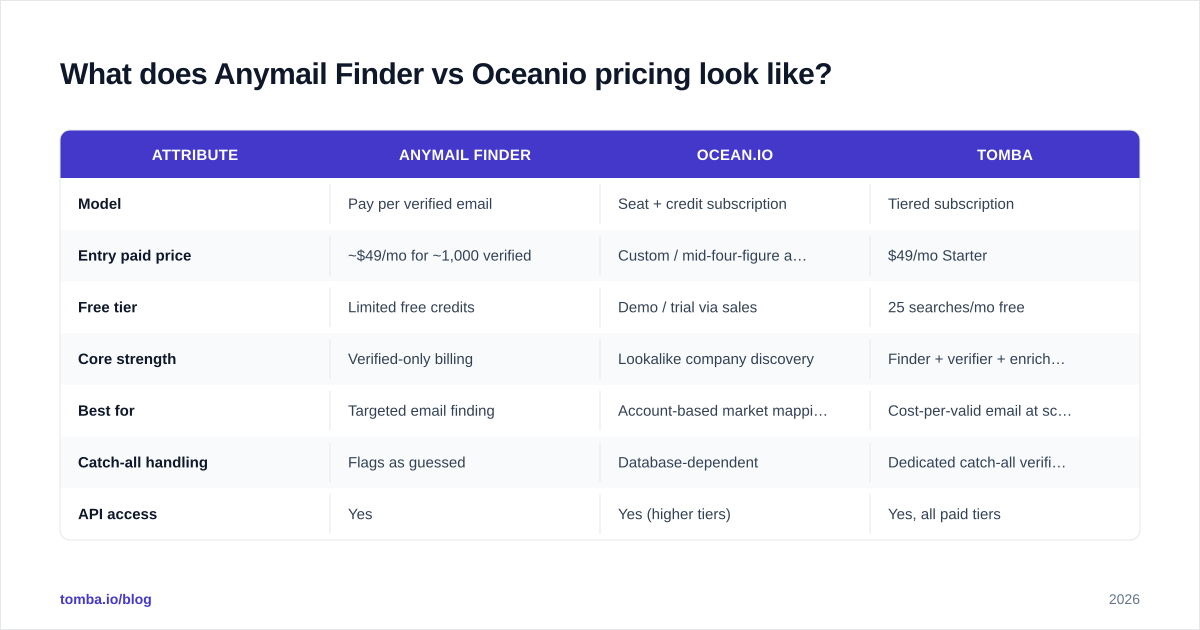
Anymail Finder bills per verified email; Ocean.io bills as a seat-and-credit subscription. They are hard to compare on a single axis — so here is both.
Pricing changes often, so confirm current numbers on each vendor's page before you buy. As of early 2026, the shape looks like this:
| Attribute | Anymail Finder | Ocean.io | Tomba |
|---|---|---|---|
| Model | Pay per verified email | Seat + credit subscription | Tiered subscription |
| Entry paid price | ~$49/mo for ~1,000 verified | Custom / mid-four-figure annual typical | $49/mo Starter |
| Free tier | Limited free credits | Demo / trial via sales | 25 searches/mo free |
| Core strength | Verified-only billing | Lookalike company discovery | Finder + verifier + enrichment |
| Best for | Targeted email finding | Account-based market mapping | Cost-per-valid email at scale |
| Catch-all handling | Flags as guessed | Database-dependent | Dedicated catch-all verifier |
| API access | Yes | Yes (higher tiers) | Yes, all paid tiers |
A few honest notes:
- Anymail Finder's "only pay for verified" is genuinely good for low-to-mid volume targeted work. The risk is that catch-all-heavy lists return many "guessed" results you still can't use.
- Ocean.io's pricing is sales-led, which usually signals annual commitments and a higher floor. That is fine if you are buying the lookalike engine; it is overkill if you only want emails.
- Tomba's tiered model (see Tomba pricing) lands between them: predictable monthly cost with finder, verifier, and enrichment bundled, which tends to win on cost-per-valid-email once volume climbs.
Anymail Finder vs Oceanio: which has better data depth?#
Ocean.io is deeper on company-level intelligence; Anymail Finder is deeper on the one thing it does.
Ocean.io gives you firmographics, technographics-adjacent signals, employee counts, and the lookalike modelling that is its real differentiator. If you want to answer "show me 500 mid-market SaaS companies in DACH that look like my top 10 customers," Ocean.io is built for exactly that and Anymail Finder simply isn't.
Anymail Finder gives you emails and the metadata needed to find them — name, domain, role pattern. It does not pretend to be a market-mapping tool, and that focus is a feature, not a gap, if email is all you need.
Where both leave a hole is full-contact enrichment: phone numbers, social profiles, and ongoing data freshness across a record. That is where a data enrichment layer or a dedicated B2B database becomes relevant, especially if you sync into a CRM and need records to stay current.
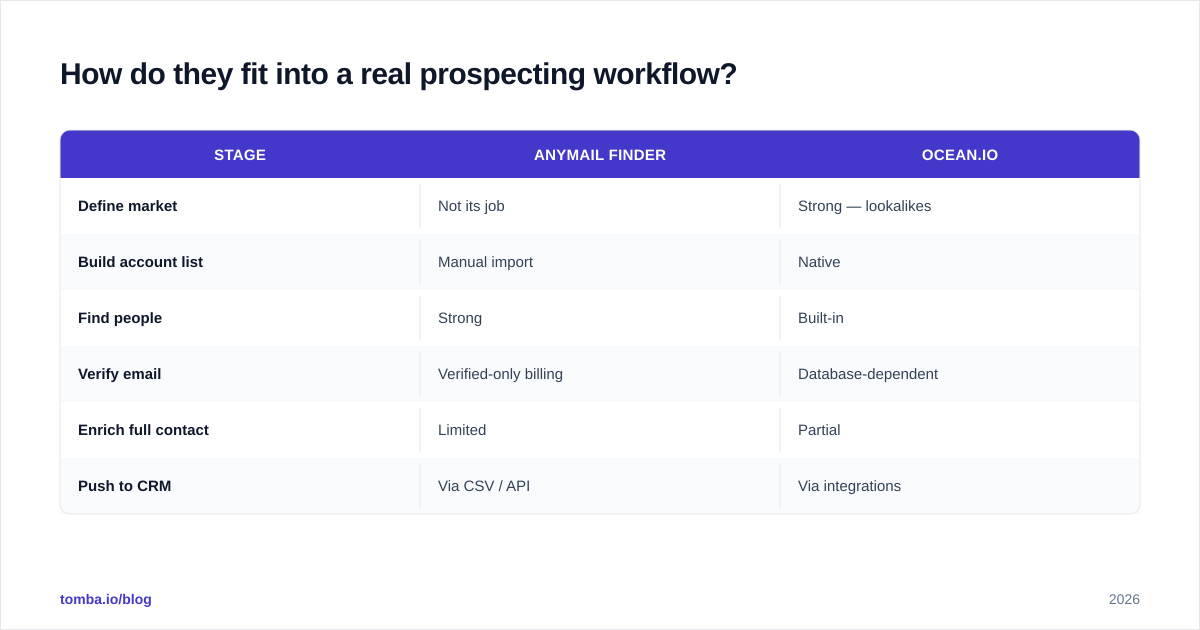
How do they fit into a real prospecting workflow?#
Map each tool to where it actually sits in the funnel.
| Stage | Anymail Finder | Ocean.io |
|---|---|---|
| Define market | Not its job | Strong — lookalikes |
| Build account list | Manual import | Native |
| Find people | Strong | Built-in |
| Verify email | Verified-only billing | Database-dependent |
| Enrich full contact | Limited | Partial |
| Push to CRM | Via CSV / API | Via integrations |
In a typical outbound motion you might run Ocean.io to discover and shortlist accounts, then hand named contacts to a finder for clean, verified emails before they enter a sequence. The two can be complementary rather than either/or — which is exactly why "vs" framing oversimplifies. If your stack already includes a CRM, check that whichever tool you choose offers a clean path in; both expose APIs, and finders like Tomba ship native HubSpot integration and Salesforce integration-style connectors plus a documented email finder API.
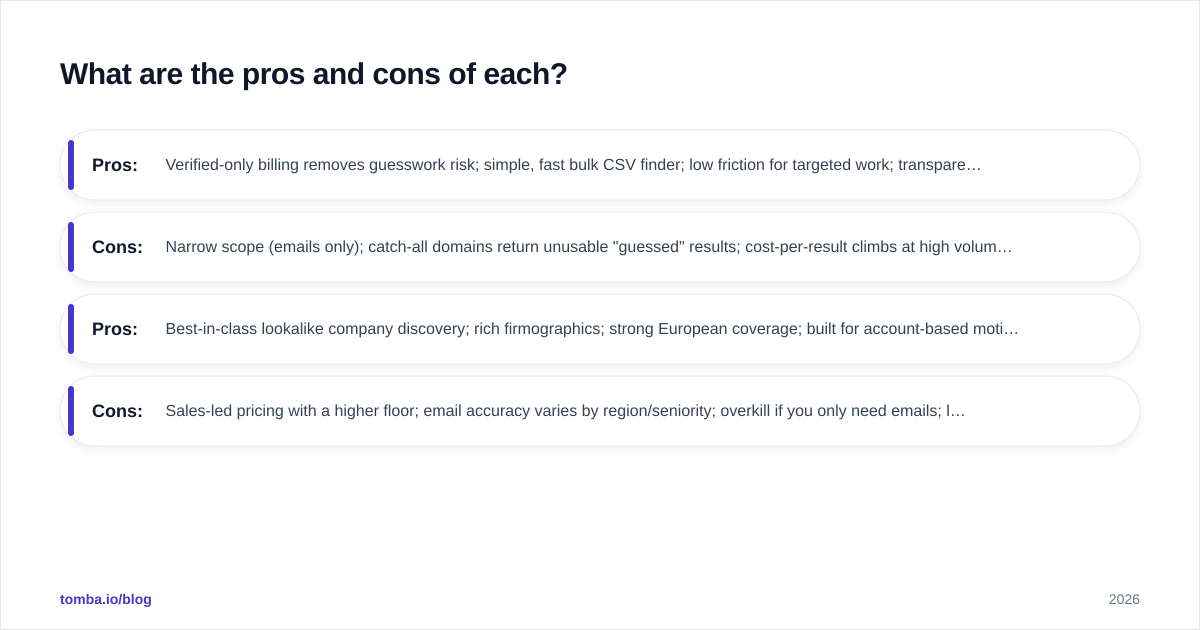
What are the pros and cons of each?#
Anymail Finder
- Pros: Verified-only billing removes guesswork risk; simple, fast bulk CSV finder; low friction for targeted work; transparent confidence labels.
- Cons: Narrow scope (emails only); catch-all domains return unusable "guessed" results; cost-per-result climbs at high volume; no market-discovery features.
Ocean.io
- Pros: Best-in-class lookalike company discovery; rich firmographics; strong European coverage; built for account-based motions.
- Cons: Sales-led pricing with a higher floor; email accuracy varies by region/seniority; overkill if you only need emails; less transparent per-email verification.
For category context on how the wider field stacks up on features and price, this overview helps:

When should you consider a third option?#
When your real need is "the most deliverable emails per dollar at scale" — neither tool is optimized for that.
Anymail Finder is optimized for verified-only billing at modest volume. Ocean.io is optimized for discovery, with emails as a side benefit. If your dominant cost is bounced sends and wasted SDR time, you want a tool that bundles finding and verification and catch-all handling without a sales call.
That is the gap Tomba targets. The email finder returns business emails by name or domain search, every result can run through the built-in verifier and catch-all verifier, and pricing is public and tiered rather than quote-based. Independent reviews on G2 are a sensible neutral place to sanity-check any of these claims before you commit budget.
It is not that Tomba beats Ocean.io at lookalike discovery — it doesn't try to. It is that for the specific job most people running this comparison actually have ("get me clean, verified B2B emails without overpaying"), a finder-plus-verifier stack is usually the better-value answer than either contender here.
Anymail Finder vs Oceanio: the verdict#
- Choose Anymail Finder if you have named targets, send cold email, care about bounces, and want pay-only-for-verified billing at low-to-mid volume.
- Choose Ocean.io if your bottleneck is finding which companies to target and you want lookalike modelling plus firmographics, and you can absorb subscription pricing.
- Choose a dedicated finder-plus-verifier like Tomba if your priority is the lowest cost-per-deliverable-email at scale with finding, verification, and enrichment in one transparent plan.
Run the same 100-contact seed list through whichever two you shortlist, measure deliverable rate and true cost-per-valid-email, and let your own numbers decide. Marketing pages won't bounce — your campaigns will.
Ready to test cleaner email data?#
If the job is simply getting verified, deliverable B2B emails without a sales call or a guessing-tax, start with the Tomba Email Finder. Search by name, company, or domain, verify every result before it hits your sequence, and keep your sender reputation intact. The free tier gives you 25 searches a month to benchmark it against Anymail Finder and Ocean.io on your own list — no commitment, just evidence.
// get started
Find, verify and enrich your first contacts today
Start on the free plan with 25 searches a month, then scale when your team is ready.
Free plan · No credit card required · GDPR & CCPA
// about the author