Anymail Finder vs RocketReach 2026: Which Email Tool Wins?
Anymail Finder vs RocketReach compared on accuracy, pricing, data depth, and verification. See which email-finding tool fits your 2026 outbound stack — and where a third option beats both.
Choosing between Anymail Finder and RocketReach usually comes down to one question: do you want a focused, verification-first email finder, or a broad contact database that bundles emails with phone numbers and social profiles? Both tools find work addresses. They go about it very differently, and the wrong pick can cost you bounce rate, budget, or both.
This guide breaks down accuracy, pricing, data coverage, verification, integrations, and the use cases where each tool earns its keep — plus where a third option quietly outperforms both.
TL;DR#
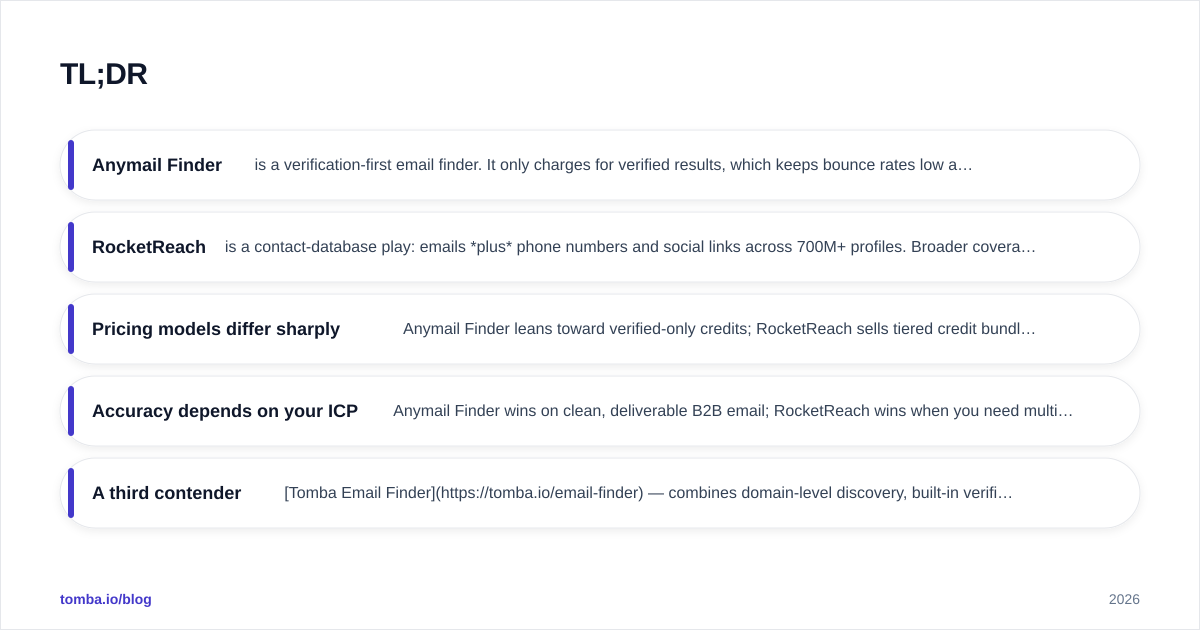
- Anymail Finder is a verification-first email finder. It only charges for verified results, which keeps bounce rates low and billing predictable — but its dataset is narrower than a full sales-intelligence platform.
- RocketReach is a contact-database play: emails plus phone numbers and social links across 700M+ profiles. Broader coverage, but credits are consumed even on lower-confidence guesses.
- Pricing models differ sharply: Anymail Finder leans toward verified-only credits; RocketReach sells tiered credit bundles that mix email and phone lookups.
- Accuracy depends on your ICP: Anymail Finder wins on clean, deliverable B2B email; RocketReach wins when you need multichannel contact data in one record.
- A third contender — Tomba Email Finder — combines domain-level discovery, built-in verification, and flat predictable plans starting at $49/mo, often closing the gap both tools leave open.
What is Anymail Finder?#
Anymail Finder is a B2B email finder built around a single promise: you only pay for emails it can verify. Feed it a full name and a company domain, and it returns either a "verified" address or nothing — no half-confident guesses billed to your account.
That model is its whole personality. Sales teams that have been burned by high bounce rates like it because deliverability is baked into the pricing. If the address can't be confirmed, you aren't charged, and your sender reputation stays intact. For anyone running cold outreach where a 5% bounce rate can trip spam filters, that's a real feature, not a marketing line.
The trade-off is scope. Anymail Finder is an email tool, not a contact-intelligence suite. You won't get phone numbers, org charts, intent signals, or social profiles in the same record. It does one job and tries to do it cleanly.
What is RocketReach?#
RocketReach is a contact-data platform. Its pitch is breadth: more than 700 million professional profiles and 100 million companies, with emails, direct dials, and social links attached. You can read more about its scope on the official RocketReach site.
Where Anymail Finder hands you a verified email, RocketReach hands you a person record — work email, personal email (sometimes), phone, LinkedIn, and current role. For multichannel sequences that mix email, calls, and LinkedIn touches, that consolidation saves real time.
The cost of breadth is precision. RocketReach surfaces emails at varying confidence levels, and credits get consumed whether the address is rock-solid or a pattern-based guess. You'll want to run results through an email verifier before launching a campaign, which adds a step Anymail Finder folds into its core flow.
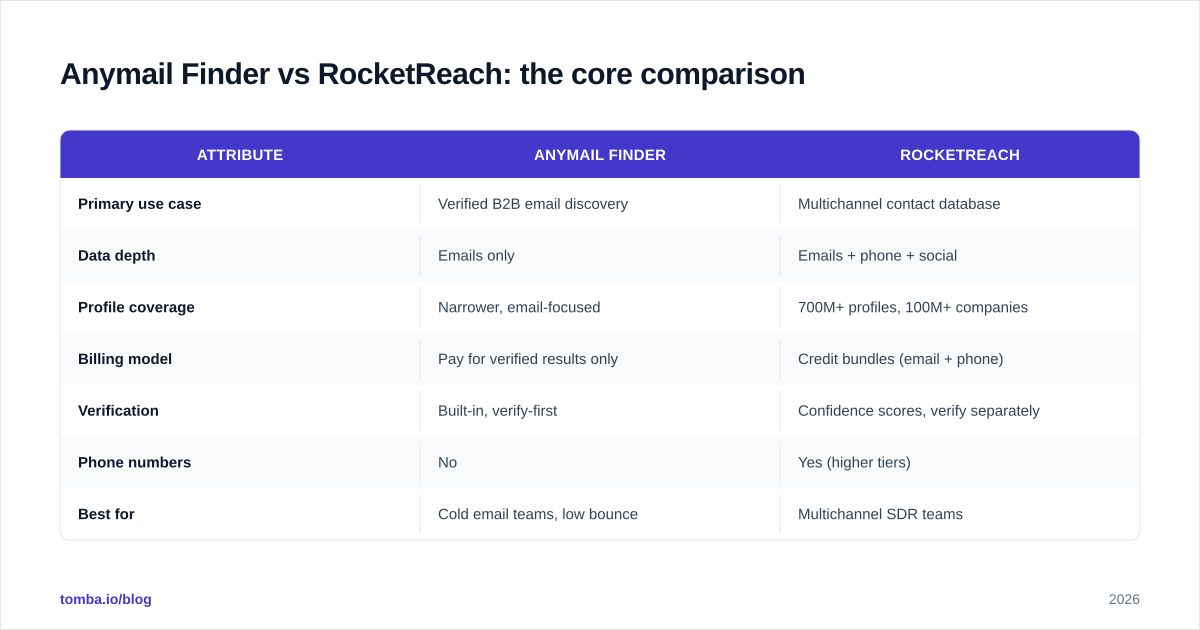
Anymail Finder vs RocketReach: the core comparison#
Here's the head-to-head on the attributes that actually change your results.
| Attribute | Anymail Finder | RocketReach |
|---|---|---|
| Primary use case | Verified B2B email discovery | Multichannel contact database |
| Data depth | Emails only | Emails + phone + social |
| Profile coverage | Narrower, email-focused | 700M+ profiles, 100M+ companies |
| Billing model | Pay for verified results only | Credit bundles (email + phone) |
| Verification | Built-in, verify-first | Confidence scores, verify separately |
| Phone numbers | No | Yes (higher tiers) |
| Best for | Cold email teams, low bounce | Multichannel SDR teams |
| Entry pricing | Mid-tier credit plans | Tiered credit bundles |
The pattern is clear: Anymail Finder optimizes for deliverability per dollar, RocketReach optimizes for data per record. Neither is "better" in the abstract — they're built for different motions.
Which tool is more accurate?#
Accuracy splits along the same line as everything else: Anymail Finder is more accurate per email it returns, because it withholds anything it can't verify. RocketReach is more complete, because it returns more records — including some it isn't certain about.
This distinction matters for your bounce rate. A tool that returns 100 emails at 98% deliverability is doing a different job than one that returns 300 emails at 85% deliverability. The first protects your domain; the second fills your pipeline faster but demands a verification pass before send.

If you care about sender reputation, the verify-first model is the safer default. If you'd rather cast a wide net and clean it later, the database model gets you more raw volume. Just budget for the cleanup — sending to unverified addresses is the fastest way to land in spam.
A practical middle path: use a broad tool for discovery, then run every address through a dedicated email verification step. That decouples coverage from deliverability so you don't have to choose.
How does pricing compare?#
This is where buyers get tripped up, because the two tools don't price the same unit.
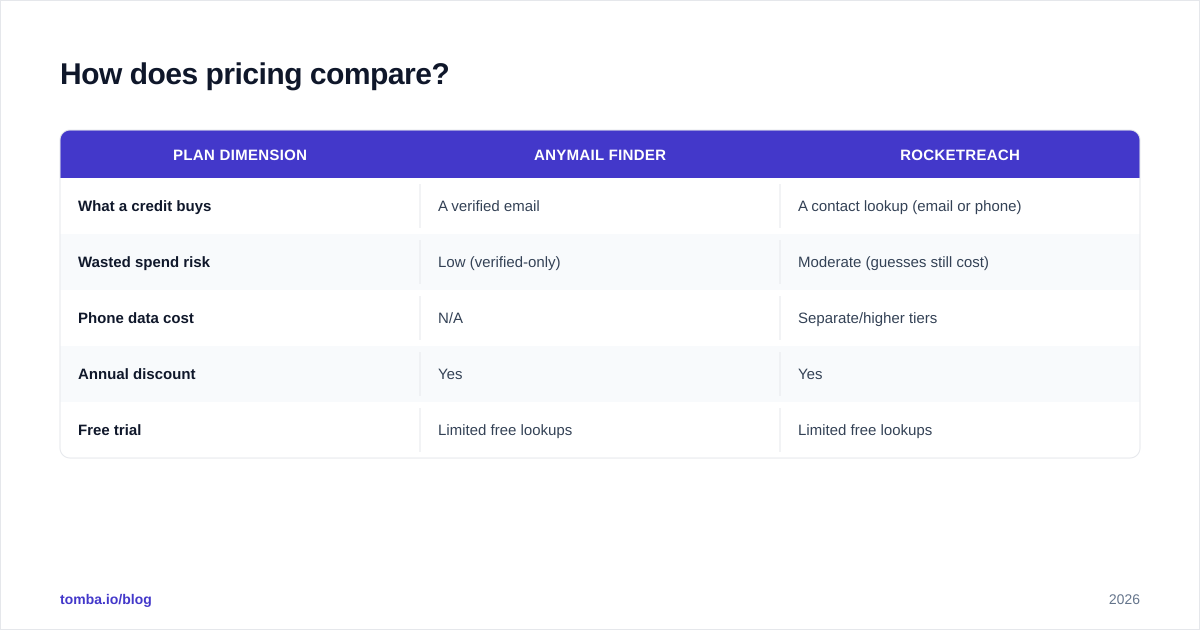
Anymail Finder charges for verified results. You're paying for outcomes, so a credit roughly equals a usable email. That makes forecasting easy — 1,000 credits is close to 1,000 deliverable contacts.
RocketReach sells credit bundles where a credit unlocks a contact's data. Email lookups and phone lookups can draw from different pools depending on your plan, and a credit spent on a low-confidence email is still a credit spent. Power users on annual plans get better rates, but the unit economics are harder to predict.
| Plan dimension | Anymail Finder | RocketReach |
|---|---|---|
| What a credit buys | A verified email | A contact lookup (email or phone) |
| Wasted spend risk | Low (verified-only) | Moderate (guesses still cost) |
| Phone data cost | N/A | Separate/higher tiers |
| Annual discount | Yes | Yes |
| Free trial | Limited free lookups | Limited free lookups |
The honest takeaway: if your KPI is cost per deliverable email, Anymail Finder's model is friendlier. If your KPI is cost per fully-enriched multichannel contact, RocketReach can justify its credits — provided you actually use the phone and social data.
Integrations and workflow fit#
Both tools plug into the usual outbound stack. RocketReach leans on its Chrome extension and a broad set of CRM connectors; Anymail Finder offers an API and bulk upload for teams that work in spreadsheets.
If your workflow lives in a CRM, check native support before committing. A clean HubSpot integration or Salesforce integration saves hours of CSV juggling, and the quality of that connector varies more than the marketing pages admit. For spreadsheet-driven teams, a bulk email finder that handles thousands of rows in one pass often matters more than any single-lookup feature.

When should you choose each tool?#
Choose Anymail Finder if:
- Cold email is your primary channel and bounce rate is a KPI.
- You want predictable, outcome-based billing.
- You don't need phone numbers or social profiles in the same record.
- Your team values deliverability over raw volume.
Choose RocketReach if:
- You run multichannel sequences (email + call + LinkedIn).
- You need phone numbers and social links alongside email.
- Coverage breadth matters more than per-email precision.
- You have a verification step downstream to clean results.
Neither is a mistake for the right team. The error is buying a contact database when you only needed verified email, or buying a lean email finder when your reps live on the phone.
Where does Tomba fit in this comparison?#
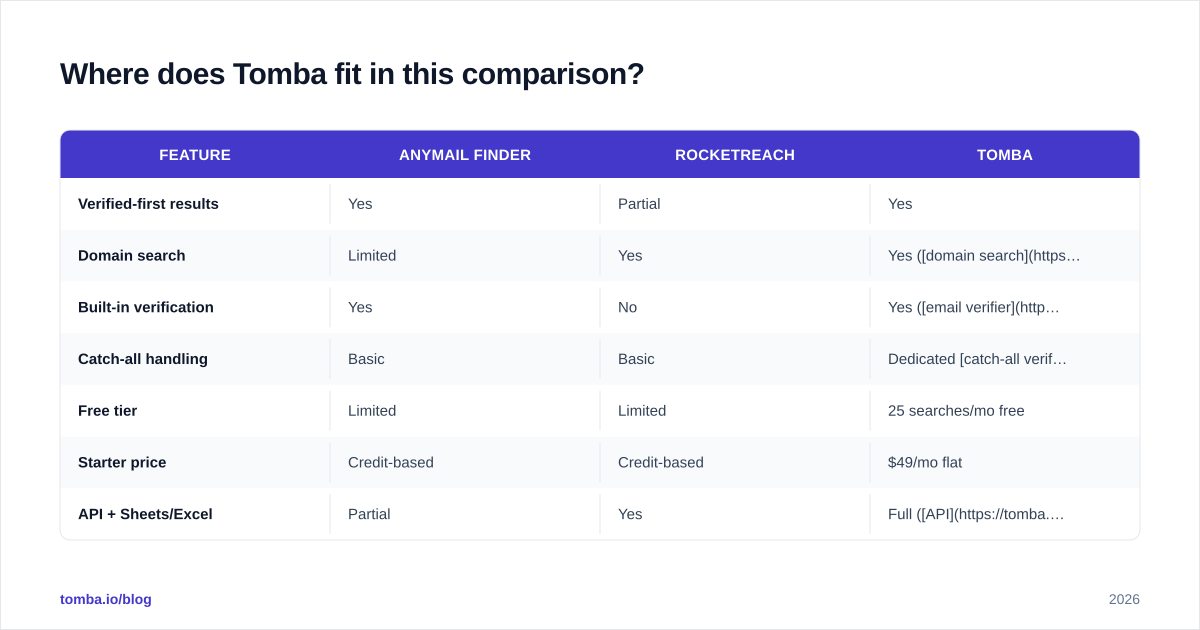
Here's the gap both tools leave: Anymail Finder is verification-strong but data-narrow, while RocketReach is data-broad but verification-light. Tomba Email Finder was built to close that gap — domain-level discovery plus built-in verification, on flat, predictable plans.
| Feature | Anymail Finder | RocketReach | Tomba |
|---|---|---|---|
| Verified-first results | Yes | Partial | Yes |
| Domain search | Limited | Yes | Yes (domain search) |
| Built-in verification | Yes | No | Yes (email verifier) |
| Catch-all handling | Basic | Basic | Dedicated catch-all verifier |
| Free tier | Limited | Limited | 25 searches/mo free |
| Starter price | Credit-based | Credit-based | $49/mo flat |
| API + Sheets/Excel | Partial | Yes | Full (API, Sheets) |
Tomba's pricing is flat and easy to plan around: a free tier with 25 searches a month, Starter at $49/mo, Growth at $99/mo, and Pro at $249/mo. You can see the full breakdown on the Tomba pricing page. Independent reviews on G2 are a useful sanity check before you commit to any of the three.
The practical advantage is workflow consolidation. Instead of finding emails in one tool and verifying in another, you find by domain search, verify in the same pass, and handle catch-all domains with a dedicated checker — without juggling two credit systems.

How to test before you commit#
Don't take any vendor's accuracy claim at face value — including this one. Run a controlled test:
- Pull a sample list of 50 known contacts (people whose real email you can confirm).
- Run the same list through each tool's free tier.
- Measure two things: hit rate (how many it found) and deliverability (how many actually verify clean).
- Multiply by your real pricing to get cost per deliverable email.
That single spreadsheet will tell you more than any comparison post, because it reflects your ICP and your target domains. A tool that crushes it on US tech companies might stumble on EU mid-market manufacturers, and vice versa.
The verdict#
Anymail Finder and RocketReach solve adjacent problems. Pick Anymail Finder when verified email deliverability is the goal and you want billing you can forecast. Pick RocketReach when you need a multichannel contact record — email, phone, and social — in one lookup and you have a verification step ready downstream.
If you'd rather not compromise between coverage and verification, Tomba Email Finder is worth a head-to-head test. Start with the free tier — 25 searches a month, no card — find emails by name or domain search, and let the built-in email verifier keep your bounce rate down from the first send. Run the 50-contact test above against all three, and let your own deliverability numbers pick the winner.
// get started
Find, verify and enrich your first contacts today
Start on the free plan with 25 searches a month, then scale when your team is ready.
Free plan · No credit card required · GDPR & CCPA
// about the author