Anymail Finder vs SalesIntel: 2026 Email Tool Showdown
Anymail Finder vs SalesIntel compared on accuracy, pricing, data depth, and bulk workflows — plus where a credit-light alternative beats both in 2026.
Choosing between Anymail Finder and SalesIntel comes down to one question: do you need clean email discovery at a predictable price, or human-verified records with firmographics baked in? They look like competitors, but they solve different halves of the prospecting problem.
This breakdown compares both on accuracy, pricing, data depth, verification, and the workflows that actually matter when you are filling a pipeline — then shows where a leaner option fits.
TL;DR#
- Anymail Finder is a focused email-finder. It charges only for verified emails, which keeps cost predictable for pure email discovery.
- SalesIntel is a full B2B data platform with human-verified contacts, intent data, and technographics — heavier, pricier, and built for enterprise RevOps.
- Accuracy is close on common business domains; SalesIntel wins on hard-to-find direct dials and senior-contact coverage in the US.
- Pricing model is the real fork: Anymail bills per verified hit, SalesIntel sells annual credit packages that scale into four and five figures.
- If you want email-finder accuracy without an enterprise contract, Tomba's email finder covers the same job from a free tier up to $49/mo.
What is Anymail Finder?#
Anymail Finder is a single-purpose tool: give it a name and a company (or just a domain), and it returns a business email address. Its signature policy is that you only pay for emails it can verify — guessed or unverifiable results do not burn credits.
That makes it popular with solo founders, recruiters, and small outbound teams who want one job done well. It does domain search, single lookups, and bulk CSV uploads. What it does not do is give you a deep contact profile, phone numbers at scale, or firmographic filters to build a list from scratch.
What is SalesIntel?#
SalesIntel is a B2B data provider, not just an email tool. Its pitch is "human-verified" data: a research team re-checks records on a cycle so contact details stay current. Alongside emails you get direct-dial phone numbers, job titles, company firmographics, technographics (what software a company runs), and buyer-intent signals.
That puts SalesIntel in the same arena as ZoomInfo and Cognism. You are buying a database and a platform, billed on annual credit allotments, usually with a sales-led contract. It is built for mid-market and enterprise teams who need to build territories and segment by industry, headcount, or tech stack — not just enrich a name you already have.
)
Anymail Finder vs SalesIntel: the core difference#
Here is the cleanest way to frame it: Anymail Finder answers "what is this person's email?" SalesIntel answers "who should I be emailing, and how do I reach them?"
The diagram below maps where each tool sits in a typical outbound workflow — discovery, enrichment, and verification.
If you already have target names, an email finder is enough. If you are starting from a blank territory and need to assemble accounts and contacts with filters, you need a data platform. Many teams end up running both — or replacing both with a single tool that does discovery plus email verification without the enterprise overhead.
How do Anymail Finder and SalesIntel compare on features and price?#
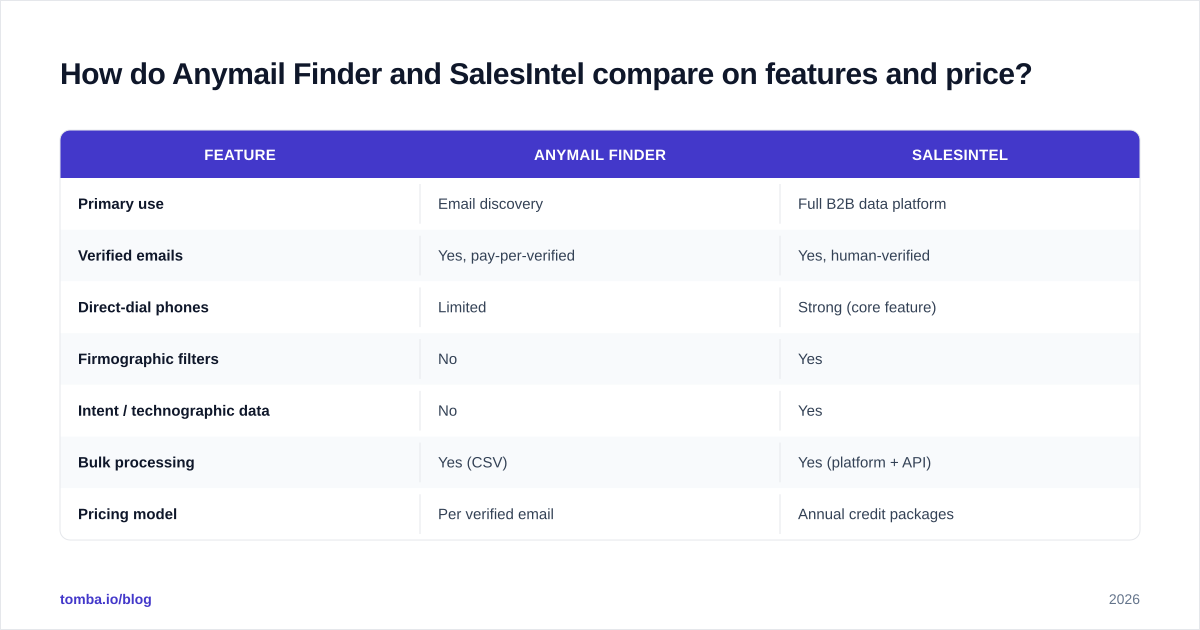
| Feature | Anymail Finder | SalesIntel |
|---|---|---|
| Primary use | Email discovery | Full B2B data platform |
| Verified emails | Yes, pay-per-verified | Yes, human-verified |
| Direct-dial phones | Limited | Strong (core feature) |
| Firmographic filters | No | Yes |
| Intent / technographic data | No | Yes |
| Bulk processing | Yes (CSV) | Yes (platform + API) |
| Pricing model | Per verified email | Annual credit packages |
| Entry price | ~$49/mo range | Quote-based, typically $$$$ /yr |
| Free tier | Limited trial | Demo / sample only |
| Best for | SMB, recruiters, founders | Mid-market & enterprise RevOps |
The takeaway: Anymail competes on simplicity and cost control; SalesIntel competes on data breadth and verification depth. You are rarely choosing between equals — you are choosing what problem to spend money on.
Which is more accurate?#
Accuracy depends on the segment. On standard corporate domains with a discoverable email pattern, both tools land in a similar range, and a good company email pattern check will confirm the format either returns.
Where they diverge:
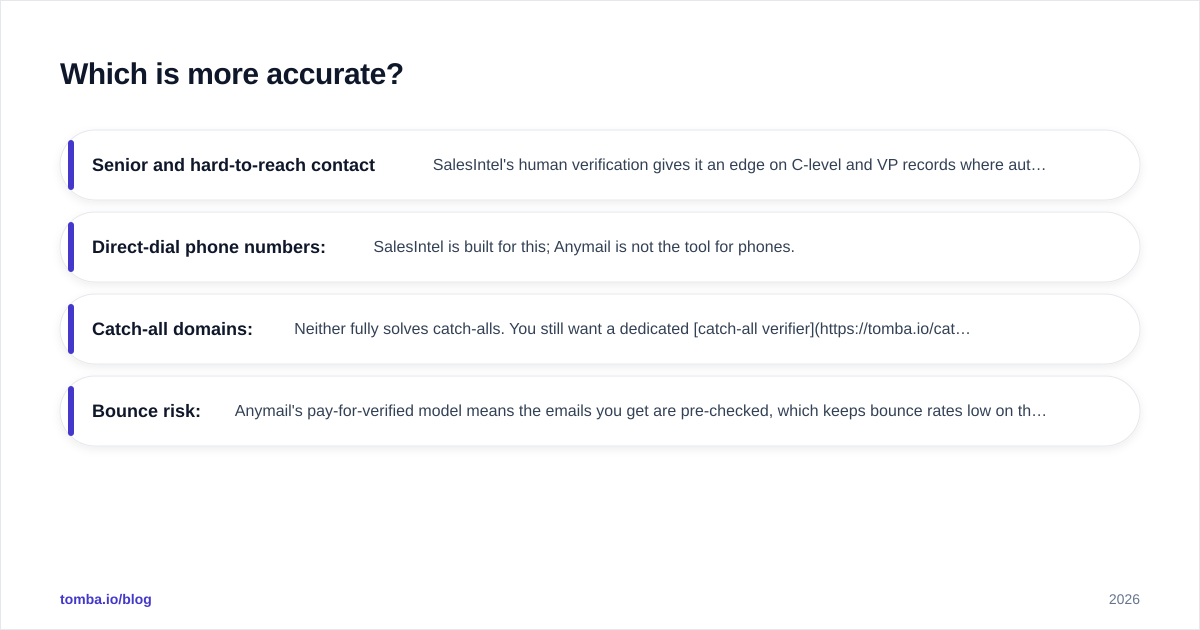
- Senior and hard-to-reach contacts: SalesIntel's human verification gives it an edge on C-level and VP records where automated guessing struggles.
- Direct-dial phone numbers: SalesIntel is built for this; Anymail is not the tool for phones.
- Catch-all domains: Neither fully solves catch-alls. You still want a dedicated catch-all verifier to avoid sending into a black hole.
- Bounce risk: Anymail's pay-for-verified model means the emails you get are pre-checked, which keeps bounce rates low on the addresses it does return.

No vendor hits 100%. Treat every list — from either tool — as something to re-verify before a campaign. Bounces above 2-3% drag your sender reputation down fast, and no amount of "verified" labeling on a vendor sheet protects you if the data is three months stale.
How does pricing really work?#
This is where the two part ways hardest.
Anymail Finder bills on a credit-per-verified-email basis with monthly tiers. Because unverifiable lookups do not cost you, your effective cost per usable email is more predictable. For a team finding a few thousand emails a month, the monthly bill is small and easy to forecast.
SalesIntel sells annual contracts with credit allotments, and pricing is quote-based. You are paying for the database, the verification service, intent data, and platform access — so the floor is much higher, typically landing in the thousands per year for a small team and climbing into five figures for full seats and intent.
If your only need is email discovery, paying SalesIntel's data-platform premium is overkill. If you genuinely need intent signals and a research team keeping records fresh, Anymail simply does not offer that.

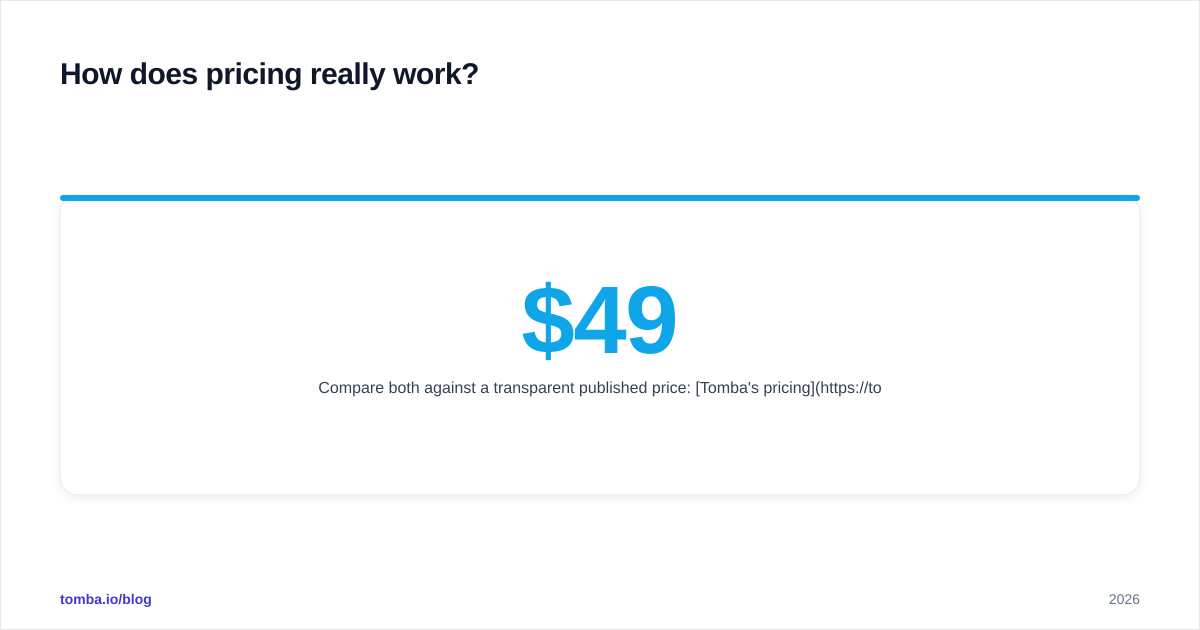
Compare both against a transparent published price: Tomba's pricing runs a Free tier (25 searches/mo), Starter at $49/mo, Growth at $99/mo, and Pro at $249/mo — no annual lock-in required to start.
Where does Tomba fit between them?#
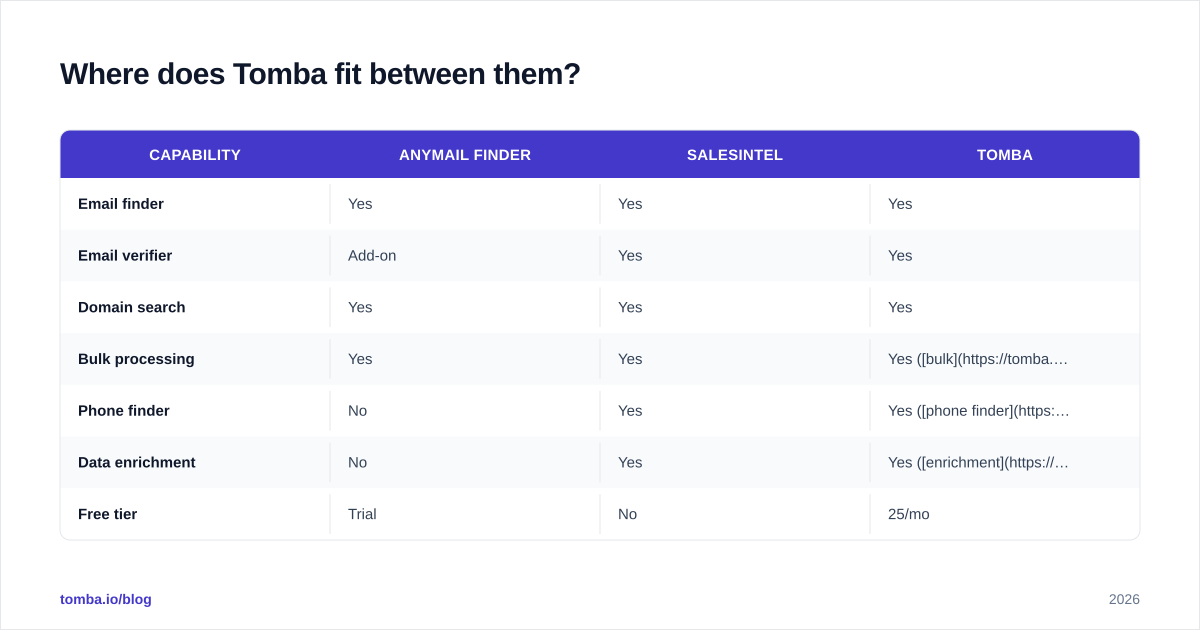
Tomba sits in the gap: email-finder accuracy and verification, plus enough enrichment to be useful, without an enterprise contract or a pay-per-hit ceiling.
| Capability | Anymail Finder | SalesIntel | Tomba |
|---|---|---|---|
| Email finder | Yes | Yes | Yes |
| Email verifier | Add-on | Yes | Yes |
| Domain search | Yes | Yes | Yes |
| Bulk processing | Yes | Yes | Yes (bulk) |
| Phone finder | No | Yes | Yes (phone finder) |
| Data enrichment | No | Yes | Yes (enrichment) |
| Free tier | Trial | No | 25/mo |
| Starter price | ~$49/mo | $$$$ /yr | $49/mo |
| API access | Yes | Yes | Yes (API) |
For a team that wants Anymail's simplicity but more contact types — and SalesIntel-style enrichment without the annual spend — Tomba covers the middle. You get the email finder, built-in verification, domain search, and enrichment under one predictable plan.

Which should you choose?#
Match the tool to the job, not the brand:
- Choose Anymail Finder if email discovery is your only need, you want to pay strictly for verified results, and you are a solo operator or small team that values a simple bill.
- Choose SalesIntel if you are a mid-market or enterprise RevOps team that needs to build territories from scratch, wants human-verified direct dials, and will actually use intent and technographic data — and can justify a four-to-five-figure annual contract.
- Choose Tomba if you want email-finder accuracy with built-in verification, optional phone and enrichment data, a real free tier, and published pricing that does not require a sales call.
A useful gut check: if you find yourself wanting SalesIntel "mostly for the emails," you are overpaying for the platform. If you find yourself wanting Anymail "but also phones and enrichment," you have outgrown a single-purpose finder. Tomba is built for the people stuck between those two sentences.
How to validate any of these tools before committing#
Do not take a vendor's accuracy claim at face value. Run the same test on each:
- Pull a sample of 50 known contacts from accounts you already work with.
- Run them through each tool's finder.
- Verify the returned emails with an independent email verifier — do not trust the source tool to grade its own homework.
- Send a small warm-up batch and measure real bounce rate against the tool's claim.
- Compare cost per usable, deliverable email — not cost per credit.
This five-minute discipline beats any comparison table, including this one, because it measures the tools against your target market. For the data-quality background behind why fresh verification matters, vendor-neutral review sites like G2 and Capterra collect real-user accuracy feedback worth scanning before you sign anything. HubSpot's research on email deliverability is a solid baseline for the bounce thresholds your list needs to clear.
Final verdict#
Anymail Finder and SalesIntel are not really rivals — one is a scalpel, the other is a surgical suite. Anymail wins on simplicity and predictable cost for pure email discovery. SalesIntel wins on data depth, human verification, and enterprise-grade reach, at enterprise-grade prices.
If you want the accuracy of a focused email finder, the safety net of built-in verification, and the option to add phones and enrichment — all without a credit-per-hit meter or an annual contract — start with Tomba's Email Finder. The free tier gives you 25 searches a month to test it against your own contact list before you spend a dollar, and the $49/mo Starter plan competes directly with Anymail while reaching into territory SalesIntel charges thousands for.
// get started
Find, verify and enrich your first contacts today
Start on the free plan with 25 searches a month, then scale when your team is ready.
Free plan · No credit card required · GDPR & CCPA
// about the author