Apexverify vs Arounddeal: B2B Data Tools Compared 2026
Apexverify cleans your list; Arounddeal builds it. Here's a head-to-head on data, accuracy, pricing, and which one your pipeline actually needs in 2026.
TL;DR
- Apexverify and Arounddeal solve different halves of the same problem. Apexverify cleans and validates email lists; Arounddeal sources B2B contacts and company intelligence. Comparing them is really comparing find vs verify.
- Arounddeal wins on contact discovery — a sizeable B2B database, a LinkedIn Chrome extension, and intent signals make it a prospecting tool first.
- Apexverify wins on list hygiene — bulk verification, syntax and SMTP checks, and bounce reduction for teams that already have lists.
- Neither is a complete stack. Most teams pair a finder with a verifier — which is why a single platform like Tomba that does both often beats running two subscriptions.
- Pricing favors Arounddeal for volume sourcing; Apexverify for cheap cleanup. Budget and workflow, not brand, should decide.
Who are Apexverify and Arounddeal, really?#
Apexverify is an email verification service. You feed it a list — exports from a webinar, a scraped CSV, an old CRM segment — and it tells you which addresses are deliverable, which will bounce, and which are risky catch-alls. Its job starts after you already have email addresses.
Arounddeal is a B2B contact and company data platform. It maintains a database of professional profiles, surfaces emails and phone numbers through a LinkedIn extension, and layers on company firmographics and buying-intent signals. Its job starts before you have anyone to email.
That distinction matters more than any feature table, so say it plainly: one finds contacts, the other confirms they're safe to email. If you go in expecting Apexverify to build a prospect list or Arounddeal to scrub a million-row file to inbox-grade cleanliness, you'll be disappointed by the wrong tool.

What does each tool actually do?#
Here's the honest division of labor. Treat the two products as stages in a pipeline rather than rivals fighting for the same checkout.
Arounddeal's core jobs:
- Search a B2B database by title, company, industry, and geography
- Reveal emails and direct dials from a LinkedIn profile via a browser extension
- Enrich existing records with firmographic and technographic fields
- Flag accounts showing intent or hiring signals
Apexverify's core jobs:
- Validate email syntax and domain MX records
- Run SMTP handshakes to confirm a mailbox exists
- Detect catch-all domains, role accounts, and disposable addresses
- Process bulk lists and return a deliverability score per row
You can see why a serious outbound team usually needs both capabilities. Arounddeal gives you names and addresses; those addresses still decay roughly 2–3% per month as people change jobs, so a verification pass before you send protects your sender reputation. Skipping that step is how good lists quietly wreck good domains.
Apexverify vs Arounddeal: the side-by-side#
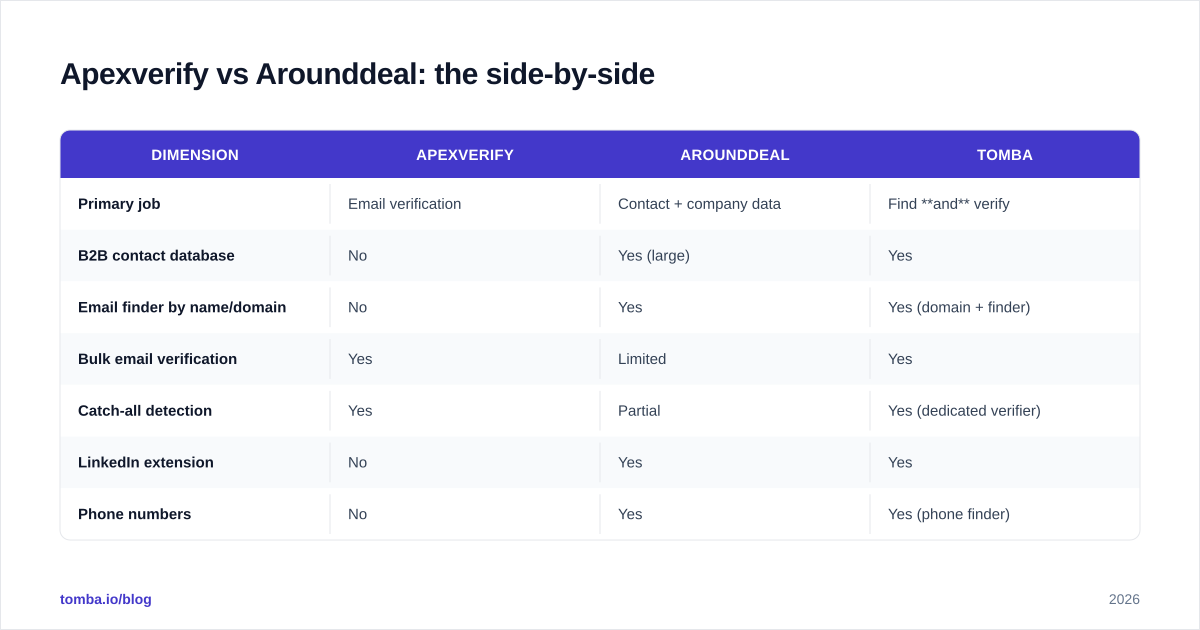
The table below maps both tools against the dimensions that actually change your buying decision. Where a capability is partial or secondary, it's marked accordingly rather than given a misleading checkmark.
| Dimension | Apexverify | Arounddeal | Tomba |
|---|---|---|---|
| Primary job | Email verification | Contact + company data | Find and verify |
| B2B contact database | No | Yes (large) | Yes |
| Email finder by name/domain | No | Yes | Yes (domain + finder) |
| Bulk email verification | Yes | Limited | Yes |
| Catch-all detection | Yes | Partial | Yes (dedicated verifier) |
| LinkedIn extension | No | Yes | Yes |
| Phone numbers | No | Yes | Yes (phone finder) |
| Intent / firmographic signals | No | Yes | Enrichment |
| API access | Yes | Yes | Yes |
| Free tier | Trial credits | Limited free credits | 25 searches/mo |
| Best for | Cleaning existing lists | Building new lists | Doing both in one place |
Read the table as a Venn diagram, not a scoreboard. Apexverify's column is deep on the right side of the funnel; Arounddeal's is deep on the left. The third column exists because most teams eventually want the whole row.
Is Arounddeal better than Apexverify for prospecting?#
Yes — for finding net-new contacts, Arounddeal is the stronger tool, because that's the only one of the two that actually has a database. Apexverify has no contact-discovery function at all, so comparing them on prospecting is lopsided by design.
Where Arounddeal earns its keep:
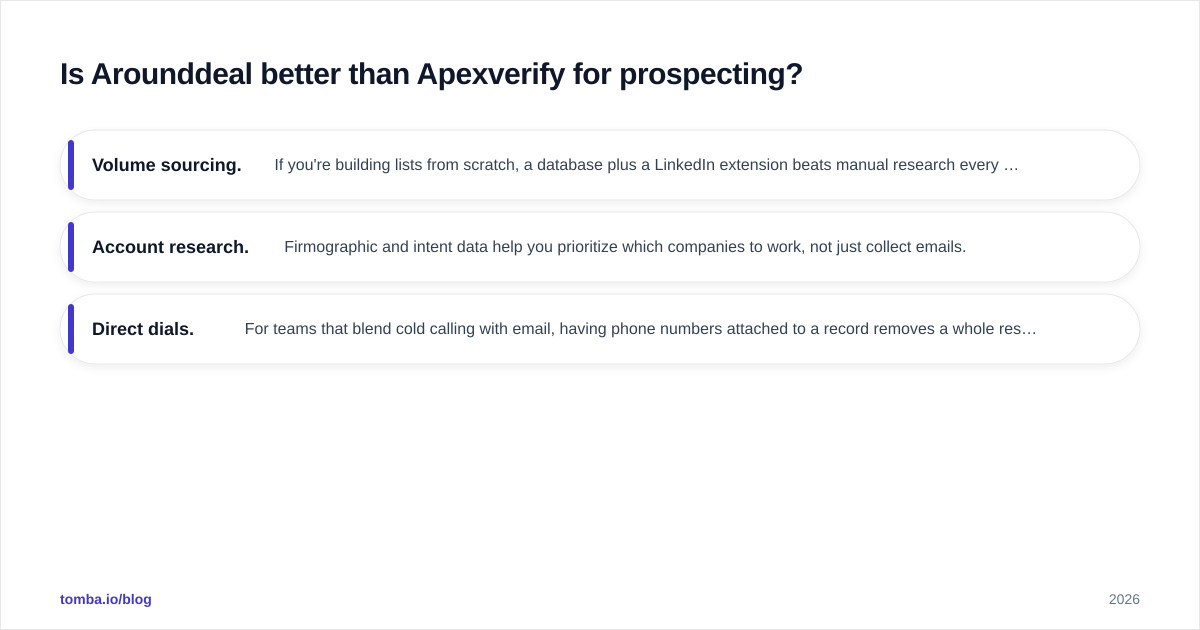
- Volume sourcing. If you're building lists from scratch, a database plus a LinkedIn extension beats manual research every time.
- Account research. Firmographic and intent data help you prioritize which companies to work, not just collect emails.
- Direct dials. For teams that blend cold calling with email, having phone numbers attached to a record removes a whole research step. If phone coverage matters to you, also look at dedicated options like a phone finder to benchmark fill rates.
The caveat — and it's a real one — is that database tools vary wildly in accuracy by region and seniority. US mid-market data tends to be strong; EMEA, APAC, and very senior or very junior titles are thinner across nearly every vendor, Arounddeal included. Don't trust a single vendor's self-reported accuracy number. Test on your actual ICP before committing budget.

That accuracy gap is exactly why verification exists as a separate discipline — which brings us back to Apexverify's lane.
Is Apexverify better than Arounddeal for list hygiene?#
Yes — if your problem is bounces, Apexverify is built for it and Arounddeal is not. Verification is Apexverify's entire reason for existing, so it goes deeper than the light validation bundled into most data platforms.
A purpose-built verifier matters when:
- You're importing a list you didn't generate (purchased, scraped, or inherited)
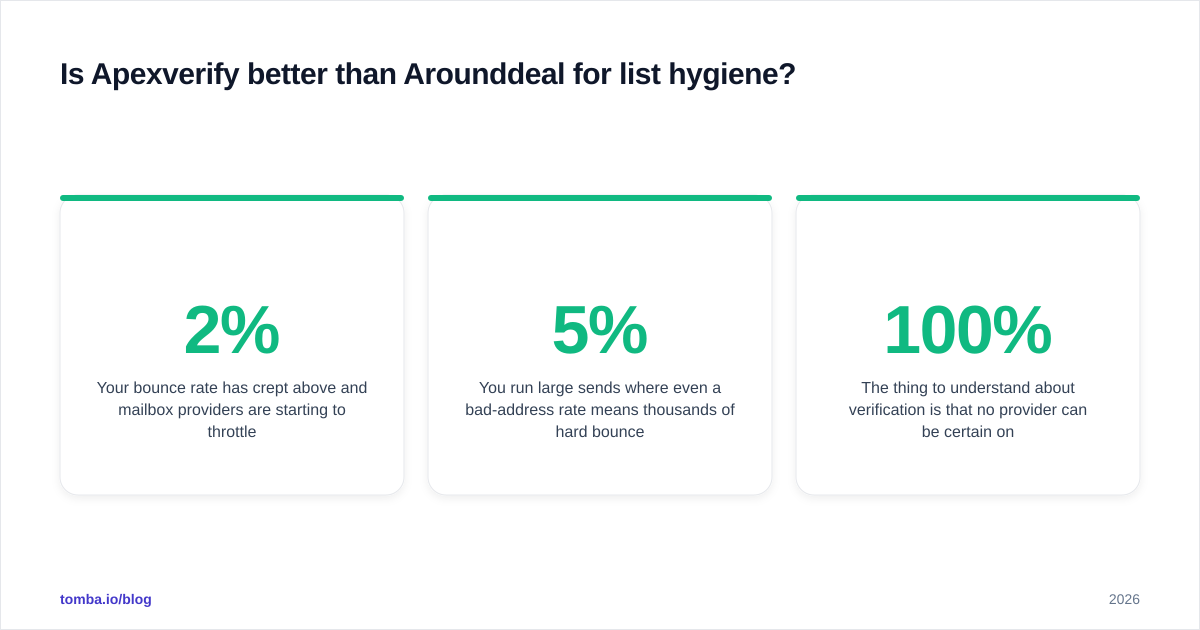
- Your bounce rate has crept above 2% and mailbox providers are starting to throttle you
- You run large sends where even a 5% bad-address rate means thousands of hard bounces
- You need catch-all verification, which generic data tools usually punt on
The thing to understand about verification is that no provider can be 100% certain on catch-all domains. When a domain accepts mail for every address, an SMTP check can't distinguish a real mailbox from a fake one. Honest verifiers — Apexverify included — return a "risky" or "unknown" status here rather than a false "valid." If a tool claims perfect catch-all accuracy, that's a marketing claim, not a technical one.
So Apexverify is the right shape for cleanup. What it can't do is hand you a single new prospect. That's the trade.
How much do Apexverify and Arounddeal cost?#
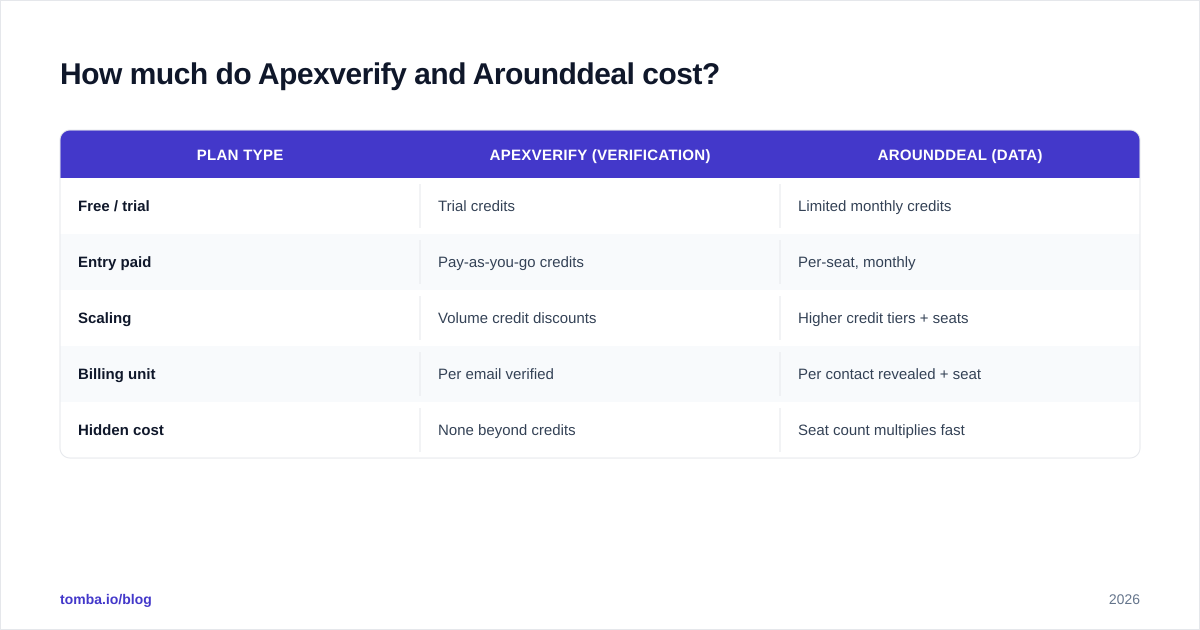
Pricing models differ because the products differ. Verification is typically priced per email checked (credits), while contact data is priced per seat plus credits. That makes a flat dollar comparison misleading, so compare on cost-per-outcome instead.
| Plan type | Apexverify (verification) | Arounddeal (data) |
|---|---|---|
| Free / trial | Trial credits | Limited monthly credits |
| Entry paid | Pay-as-you-go credits | Per-seat, monthly |
| Scaling | Volume credit discounts | Higher credit tiers + seats |
| Billing unit | Per email verified | Per contact revealed + seat |
| Hidden cost | None beyond credits | Seat count multiplies fast |
Two budgeting traps to avoid:
- Arounddeal's seat math. Per-seat pricing scales with team size, not just usage. A five-rep team pays five times the base regardless of how many credits each rep burns.
- Apexverify's volume cliff. Verification is cheap per email but adds up on million-row lists. Verify at the point of send, not your entire historical database every month.
If you're running both a finder and a verifier, total the two bills before deciding. Two mid-tier subscriptions frequently cost more than one consolidated plan — for reference, Tomba pricing starts with a free tier of 25 searches/mo, then Starter at $49/mo, Growth at $99/mo, and Pro at $249/mo, with finding and verifying under one meter.
When should you use a combined tool instead?#
Use a combined find-and-verify platform when your workflow crosses the boundary between sourcing and sending — which, for most outbound teams, is always.
Walk through a normal prospecting day:
- You identify target accounts (data tool territory — Arounddeal).
- You pull contacts and their emails (still the data tool).
- You verify those emails before adding them to a sequence (verifier territory — Apexverify).
- You enrich records with extra fields for personalization (back to the data tool).
Running steps 1–2 and 4 in Arounddeal and step 3 in Apexverify means two logins, two bills, two API integrations, and manual CSV shuffling between them. Every export-import handoff is a place for data to get stale or mangled.

This is the structural case for a single platform. A tool that runs domain search, email finding, and verification on the same data layer skips the handoffs entirely. You're not stitching two vendors' definitions of "valid" together and hoping they agree.
That doesn't make Apexverify or Arounddeal bad tools — it makes them specialist tools. If you genuinely only ever clean lists, a standalone verifier is fine. If you genuinely only ever source and hand emails to someone else to send, a standalone data tool is fine. The middle — which is where most reps live — is where consolidation pays off.
Which one should you choose?#
Decide by your actual bottleneck, not by which brand you saw first. Independent reviews on sites like G2 are useful for sanity-checking vendor claims, but your own ICP test matters more than any aggregate score.
Choose Apexverify if:
- You already have lists and your only problem is bounce rate
- You don't need to discover new contacts
- You want pay-as-you-go verification without a seat commitment
Choose Arounddeal if:
- Your bottleneck is finding contacts, not cleaning them
- You want a LinkedIn-driven workflow with phone numbers and intent data
- You can absorb per-seat pricing across your team
Choose a combined platform if:
- You do both sourcing and sending and want one bill, one API, one data layer
- You're tired of CSV handoffs between a finder and a verifier
- You want verification baked into the find step rather than bolted on after
For most outbound and demand-gen teams, the honest answer is the third one. You can compare Arounddeal head-to-head on data coverage at the vendor's own site (arounddeal.com) and weigh it against a consolidated approach before you commit budget. The tools aren't enemies — they're two stages you'll end up paying for either way.
The bottom line#
Apexverify and Arounddeal aren't really competitors; they're neighbors. Apexverify keeps your sends clean, Arounddeal keeps your pipeline full, and a serious outbound motion needs both jobs done well. The only question is whether you want to do them in two tools or one.
If you'd rather not run a finder and a verifier as separate subscriptions, start with the Tomba Email Finder. It finds professional emails by name, domain, or company, verifies them in the same workflow, and enriches the record — so the find-then-verify handoff that costs you time with two specialist tools simply disappears. Spin up the free tier with 25 searches a month, test it against your real ICP, and see whether one meter beats two.
// get started
Find, verify and enrich your first contacts today
Start on the free plan with 25 searches a month, then scale when your team is ready.
Free plan · No credit card required · GDPR & CCPA
// about the author