Apexverify vs Cloduraai: Which B2B Data Tool Wins in 2026?
Apexverify vs Cloduraai compared head-to-head on accuracy, pricing, and features — plus where a focused email finder beats both for cold outreach in 2026.
Choosing between Apexverify and Cloduraai comes down to one question most comparison posts dodge: do you need a focused data-quality layer, or a full sales-intelligence platform? They are not the same kind of tool, and picking the wrong one means paying for seats you never use — or bolting three subscriptions together to cover one gap.
This guide breaks down both tools on accuracy, pricing, data coverage, and real outreach use cases, then shows where a dedicated email finder fits when neither one quite lands.
TL;DR#
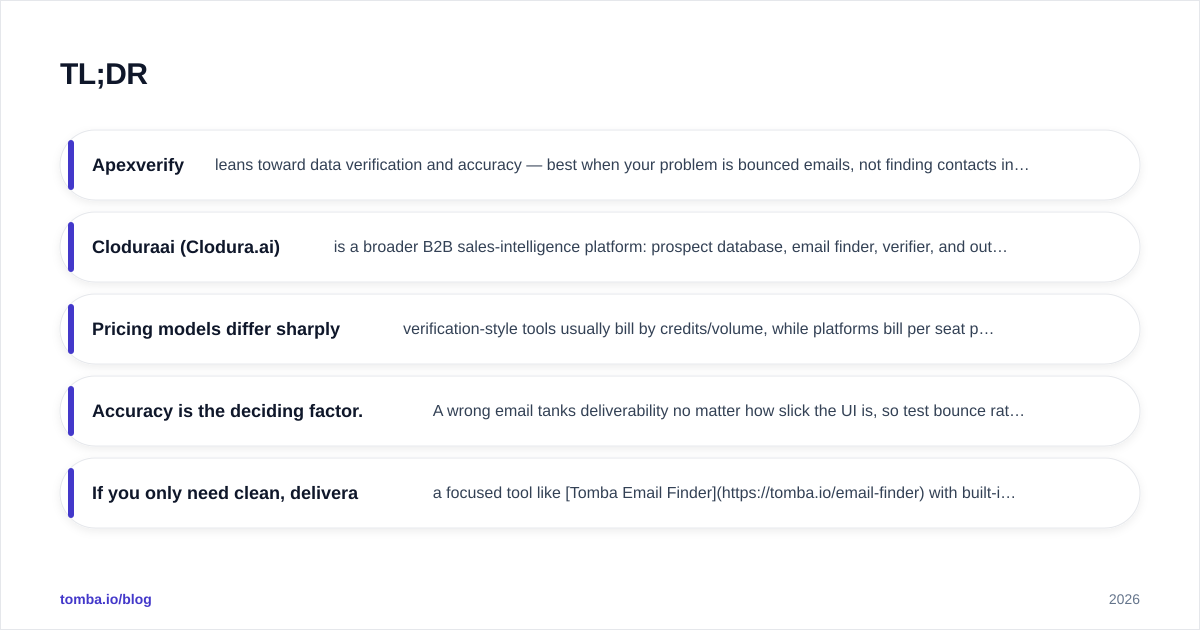
- Apexverify leans toward data verification and accuracy — best when your problem is bounced emails, not finding contacts in the first place.
- Cloduraai (Clodura.ai) is a broader B2B sales-intelligence platform: prospect database, email finder, verifier, and outreach sequences in one login.
- Pricing models differ sharply — verification-style tools usually bill by credits/volume, while platforms bill per seat plus database access. Your cost depends on whether you prospect daily or in bursts.
- Accuracy is the deciding factor. A wrong email tanks deliverability no matter how slick the UI is, so test bounce rates on a sample list before committing.
- If you only need clean, deliverable emails at the point of finding them, a focused tool like Tomba Email Finder with built-in verification often beats paying for a platform you'll half-use.
What is Apexverify?#
Apexverify positions itself around data verification — confirming that the contact records you already have, or are about to send to, are valid and deliverable. Tools in this category focus on the quality side of the funnel: catching invalid syntax, dead mailboxes, role-based addresses (like info@ or sales@), and risky catch-all domains before you hit send.
The value is straightforward. Every bounced email chips away at your sender reputation, and once mailbox providers start routing you to spam, even your good messages suffer. A verification-first tool exists to keep your bounce rate low and your domain healthy.
Where verification tools tend to be weak is sourcing. They clean what you bring them, but they don't always help you discover net-new contacts at scale. If your pipeline depends on constantly finding fresh prospects, a pure verifier is one piece of a larger stack rather than the whole thing.
What is Cloduraai?#
Cloudura.ai (commonly written Clodura.ai) is a B2B sales-intelligence platform. Instead of doing one job, it bundles several: a prospect database with company and contact records, an email finder, an email verifier, direct-dial discovery, buyer-intent signals, and built-in sequencing so you can prospect and send from the same place. You can read more on its official site.
The pitch is consolidation. Rather than stitching together a data provider, a verifier, and a sequencer, you get an all-in-one workspace. For teams that want a single dashboard and a single invoice, that's appealing.
The trade-offs are the usual platform trade-offs. All-in-one tools spread their engineering across many features, so any single feature — verification accuracy, for instance — may not match a specialist that does only that. You also pay for the breadth whether or not you use every module, and per-seat pricing scales with headcount fast.
Apexverify vs Cloduraai: how do they compare?#
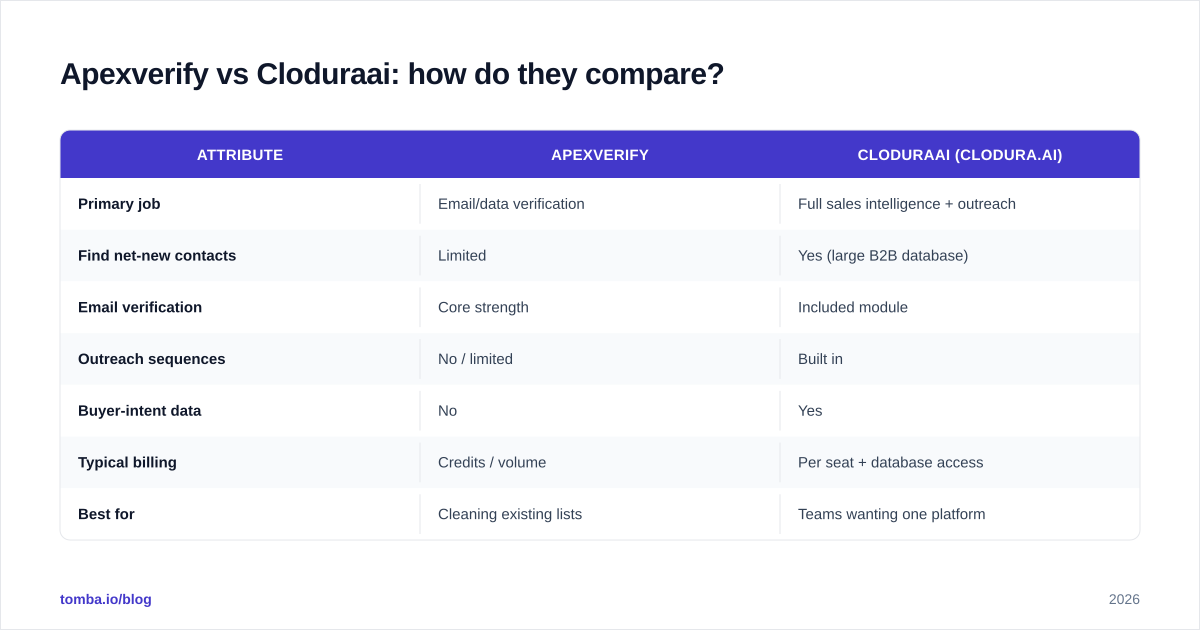
Here's the core distinction: Apexverify is a data-quality layer; Cloduraai is a prospecting platform. That changes who each one is for.
| Attribute | Apexverify | Cloduraai (Clodura.ai) |
|---|---|---|
| Primary job | Email/data verification | Full sales intelligence + outreach |
| Find net-new contacts | Limited | Yes (large B2B database) |
| Email verification | Core strength | Included module |
| Outreach sequences | No / limited | Built in |
| Buyer-intent data | No | Yes |
| Typical billing | Credits / volume | Per seat + database access |
| Best for | Cleaning existing lists | Teams wanting one platform |
| Learning curve | Low | Moderate to high |
If your bottleneck is deliverability, Apexverify-style tooling solves the immediate pain cheaply. If your bottleneck is not enough qualified pipeline, Cloduraai's database and sequencing do more — at a higher price and with more to learn.
A useful gut check: count how many tools you'd be replacing. Replacing just a verifier? The specialist wins on cost and accuracy. Replacing a database, a finder, a verifier, and a sequencer all at once? The platform's bundling starts to pay off.

Which tool is more accurate?#
Accuracy is where these tools live or die, because a verified-but-wrong email is worse than no email — it costs you a send, a bounce, and a dent in your domain reputation.
When email-finding and verification tools are benchmarked head to head, accuracy varies more than the marketing pages suggest. Coverage (how many contacts a tool can return) and accuracy (how many of those are actually deliverable) often trade off against each other.

Two things matter when you evaluate either tool's accuracy:
- Catch-all handling. Many corporate domains accept every address at the SMTP layer, so a naive verifier marks them "valid" when they may not be. A serious verifier flags these as risky rather than green-lighting them. If you send to a lot of enterprise domains, test how each tool labels catch-alls — a dedicated catch-all verifier exists precisely because this case is hard.
- Real bounce rate, not claimed accuracy. Vendor accuracy numbers are measured on their own test sets. Pull 100 contacts through each tool, send a real (warmed) campaign, and measure the bounce rate yourself. That's the only number that matters.
Don't take a percentage on a landing page as gospel. Run your own sample and compare the actual deliverability — it takes an hour and saves you a quarter of bad sends.
Which one is better for cold outreach?#
For cold outreach specifically, the workflow is: find the right contact → verify the email → send a sequence → follow up. Where each tool sits on that chain determines its fit.
Cloduraai covers the whole chain inside one product, which reduces tab-switching and keeps your data in one place. That's genuinely convenient for a team running daily outbound. The risk is lock-in and the "jack of all trades" problem — if its verification or its database depth lags a specialist, your whole funnel inherits that weakness.
Apexverify covers the verification step well but leaves finding and sequencing to other tools. That's fine if you already have a contact source and a sender (say, you pull contacts from LinkedIn and send through your existing sequencer) and just need a quality gate in the middle.
For most lean teams, the highest-leverage move is getting the find + verify steps right, because that's what protects deliverability. You can always add a sequencer later; you can't un-burn a domain. Tools like Instantly handle sending, but they assume your list is already clean.
Apexverify vs Cloduraai pricing: which is cheaper?#
Pricing comparisons between these two are apples-to-oranges, so map cost to your actual usage pattern rather than the sticker price.
- Verification-style tools (Apexverify's category) usually bill by credits or monthly volume. If you verify in bursts — clean a list, send, repeat — you pay only for what you process. Light users come out ahead.
- Platforms (Cloduraai's category) usually bill per seat plus database/credit tiers. The per-user cost is predictable but adds up across a team, and you're paying for modules even in months you only use one.
A simple framework: estimate your monthly verification volume and your number of active prospectors. High volume + few users favors a credit-based verifier. Moderate volume + a full sales team that needs database access favors a platform.
Always check what counts as a "credit" — some tools charge for a search that returns nothing, others only charge on a successful, verified result. That single policy difference can double or halve your effective cost.
Is there a better alternative to both?#
Often, yes — if your real need is clean, deliverable B2B emails at the moment you find them, a focused email finder with verification baked in gives you the accuracy of a specialist without the bloat of a platform.
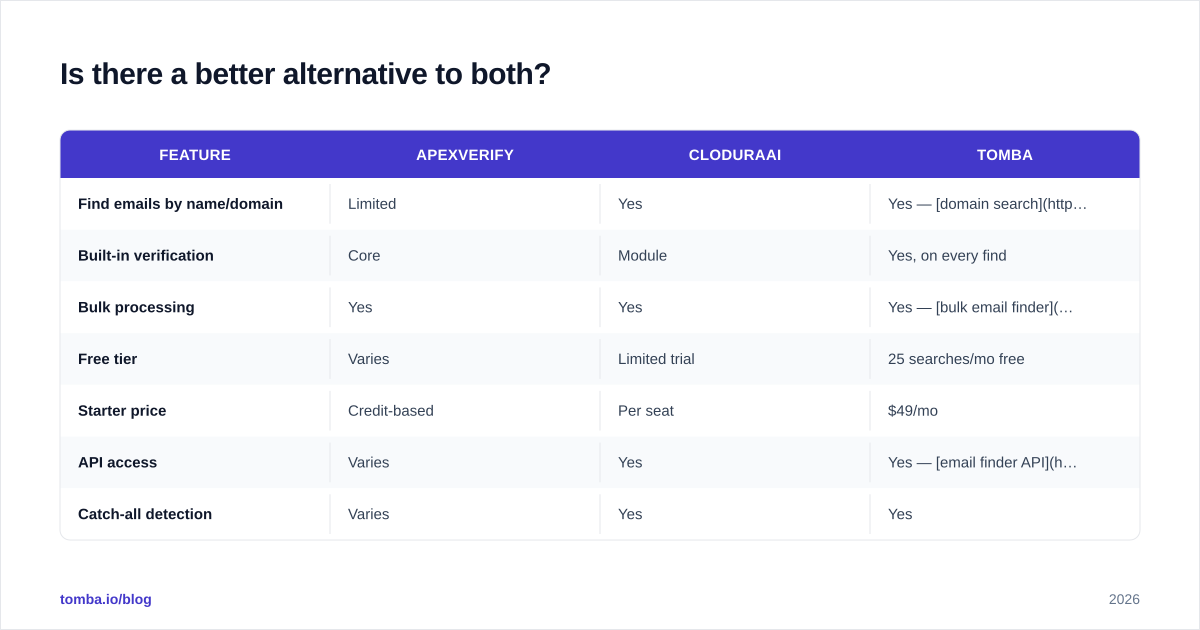
That's the gap Tomba fills. Instead of bolting a separate verifier onto a separate finder, every result runs through verification as it's found, so what lands in your CRM is already deliverable. Here's how the three approaches stack up:
| Feature | Apexverify | Cloduraai | Tomba |
|---|---|---|---|
| Find emails by name/domain | Limited | Yes | Yes — domain search |
| Built-in verification | Core | Module | Yes, on every find |
| Bulk processing | Yes | Yes | Yes — bulk email finder |
| Free tier | Varies | Limited trial | 25 searches/mo free |
| Starter price | Credit-based | Per seat | $49/mo |
| API access | Varies | Yes | Yes — email finder API |
| Catch-all detection | Varies | Yes | Yes |
Tomba's plans run from a free tier (25 searches/month) to Starter at $49/mo, Growth at $99/mo, and Pro at $249/mo — full Tomba pricing is public, with no per-seat surprise. The free tier alone is enough to run the head-to-head accuracy test described above before you spend anything.

Beyond the finder, Tomba layers in an email verifier, phone discovery, and contact enrichment — so you can expand coverage without forcing the all-in-one tax of a full platform. You add the pieces you need, when you need them.
How should you choose between them?#
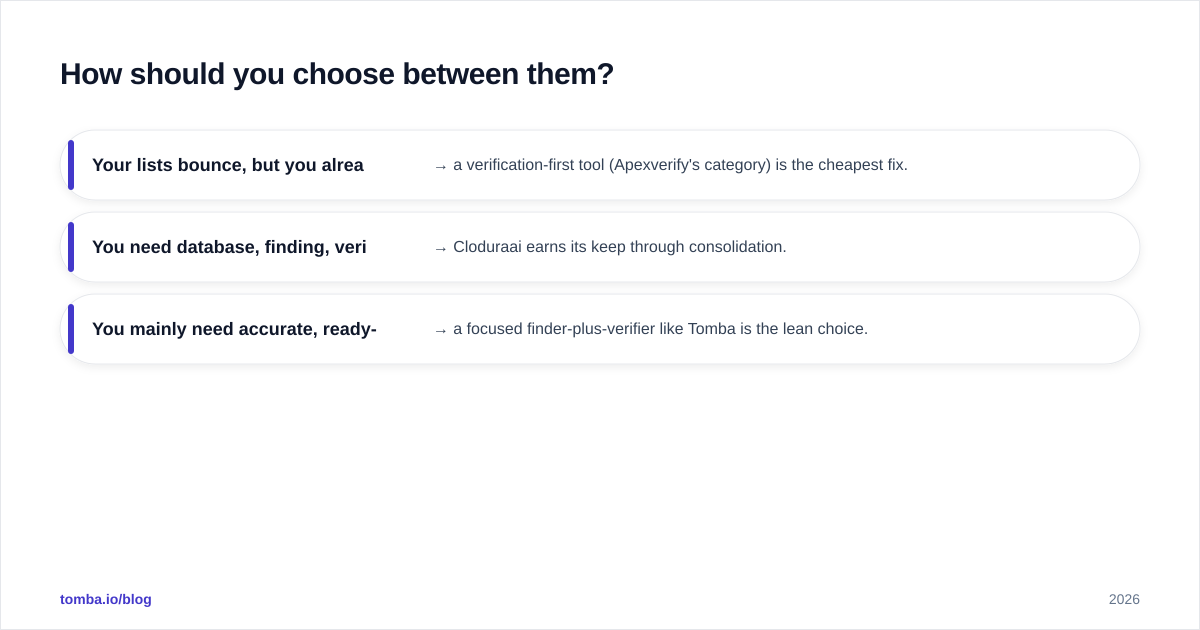
Decide based on your actual bottleneck, not the longest feature list:
- Your lists bounce, but you already have a contact source → a verification-first tool (Apexverify's category) is the cheapest fix.
- You need database, finding, verification, and sequencing in one place and have the budget per seat → Cloduraai earns its keep through consolidation.
- You mainly need accurate, ready-to-send emails and want to avoid paying for unused modules → a focused finder-plus-verifier like Tomba is the lean choice.
Whatever you pick, validate it with a real sample. Run the same 100 prospects through each tool, send a warmed test campaign, and compare bounce rates and reply rates. The winner on your data is the only winner that counts — and reputable review sites like G2 and Capterra are useful for surfacing recurring complaints (support, billing, data freshness) before you commit.
The bottom line#
Apexverify and Cloduraai solve different problems: one guards data quality, the other runs your whole prospecting motion. If you genuinely need a full platform and can fund per-seat pricing, Cloduraai's breadth is real. If you mostly need to stop bounces, a focused verifier is cheaper. But if your day-to-day is finding decision-makers and reaching them without torching your domain, neither extreme is ideal.
Start with the part that protects every campaign: accurate, verified contact data. Try the Tomba Email Finder free — 25 searches a month, verification built into every result, and no seat minimums. Run your own accuracy test against both tools, then scale only the capability you actually use. Your deliverability, and your budget, will thank you.
Ready to find emails that actually work?
Join 150,000+ professionals who stopped guessing and started sending. Free credits on signup — no credit card required.
Get the Tomba newsletter
Practical outbound tactics and product updates — once every two weeks.
About the author