Apexverify vs DealSignal 2026: Which B2B Data Tool Wins?
Apexverify vs DealSignal compared on data accuracy, coverage, pricing, and workflow fit — plus where a leaner email finder beats both for most outbound teams.
Picking between Apexverify and DealSignal usually comes down to one question you rarely see answered straight: are you buying data or buying trust in data you already have? They sit on opposite ends of that line, and choosing the wrong one means you either pay for coverage you don't use or scrub a list that was never that dirty.
This guide breaks down both tools on the things that actually move pipeline — accuracy, coverage, pricing model, and how they slot into a real outbound workflow — then shows where a focused email finder beats both for most teams.
TL;DR — Apexverify vs DealSignal at a glance#
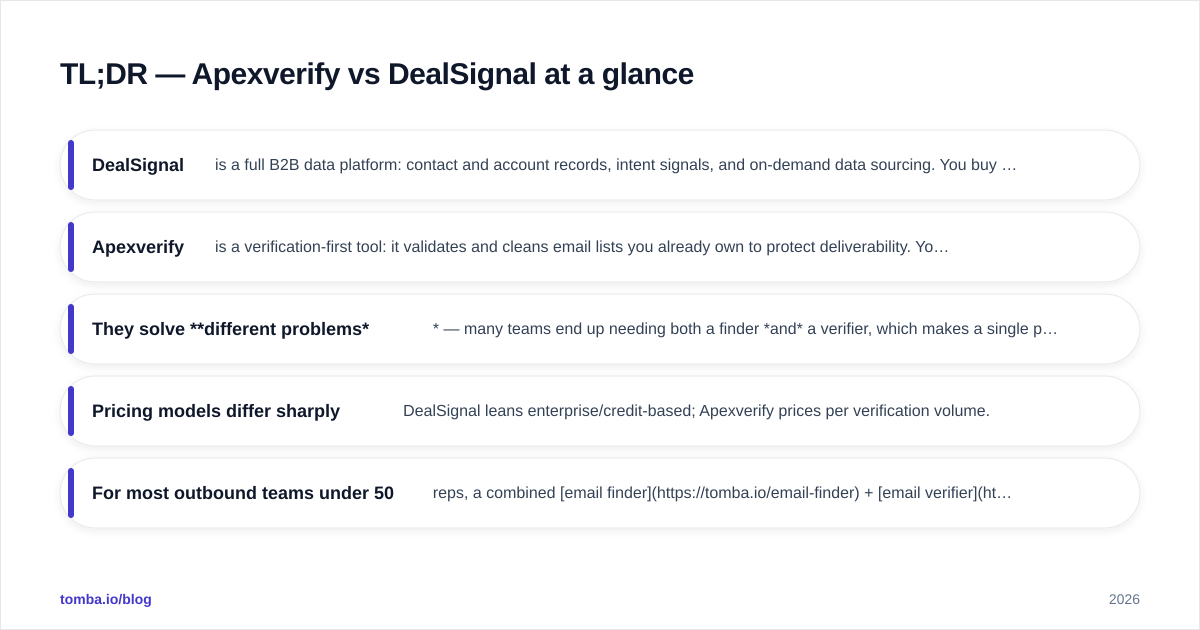
- DealSignal is a full B2B data platform: contact and account records, intent signals, and on-demand data sourcing. You buy coverage and enrichment depth.
- Apexverify is a verification-first tool: it validates and cleans email lists you already own to protect deliverability. You buy trust, not records.
- They solve different problems — many teams end up needing both a finder and a verifier, which makes a single platform that does both more cost-effective.
- Pricing models differ sharply: DealSignal leans enterprise/credit-based; Apexverify prices per verification volume.
- For most outbound teams under 50 reps, a combined email finder + email verifier like Tomba covers 80% of both use cases starting at $49/mo.
What is Apexverify and what does it actually do?#
Apexverify is an email verification and list-hygiene tool. Its core job is to take a list of addresses — from a form, a CRM export, a scraped list — and tell you which ones are safe to send to.
A good verifier runs layered checks: syntax validation, domain and MX-record lookups, SMTP handshake probing, and catch-all detection. The output is a status per address (valid, invalid, risky, catch-all) so you can suppress the junk before it ever hits your sending domain.
Why this matters: bounce rate is one of the loudest signals mailbox providers use to judge your sender reputation. A list with 8% invalid addresses can tank your inbox placement for weeks. Verification is the cheap insurance policy that keeps your domain out of the spam folder.
What Apexverify does not do well is find new contacts. It assumes you already have the addresses. If your problem is "I have 200 target accounts and no emails," a verifier is the wrong tool.
What is DealSignal and who is it built for?#
DealSignal is a B2B data provider. Think of it less as a single tool and more as a data warehouse you rent access to: company firmographics, contact records with verified emails and direct dials, technographic and intent data, and a service layer that can custom-source records on demand.
The pitch is coverage and freshness. DealSignal re-verifies records on a schedule and markets accuracy guarantees, which appeals to enterprise demand-gen and RevOps teams running large, multi-channel campaigns where stale data quietly burns budget.
The tradeoff is that you're buying a platform. Pricing is built around credits and annual commitments, onboarding is heavier, and the value only shows up at scale. A two-person startup buying DealSignal is like renting a forklift to move one box.
Apexverify vs DealSignal: the core difference in one line#
Apexverify cleans data you have. DealSignal sells data you don't.
That's the whole comparison in a sentence, and it's why pitting them directly against each other is slightly unfair — they're adjacent, not identical. But teams evaluate them together because both promise "better data," and both show up in the same budget conversation. The real decision is which gap you're solving: a coverage gap or a quality gap.
How do they compare on features and pricing?#
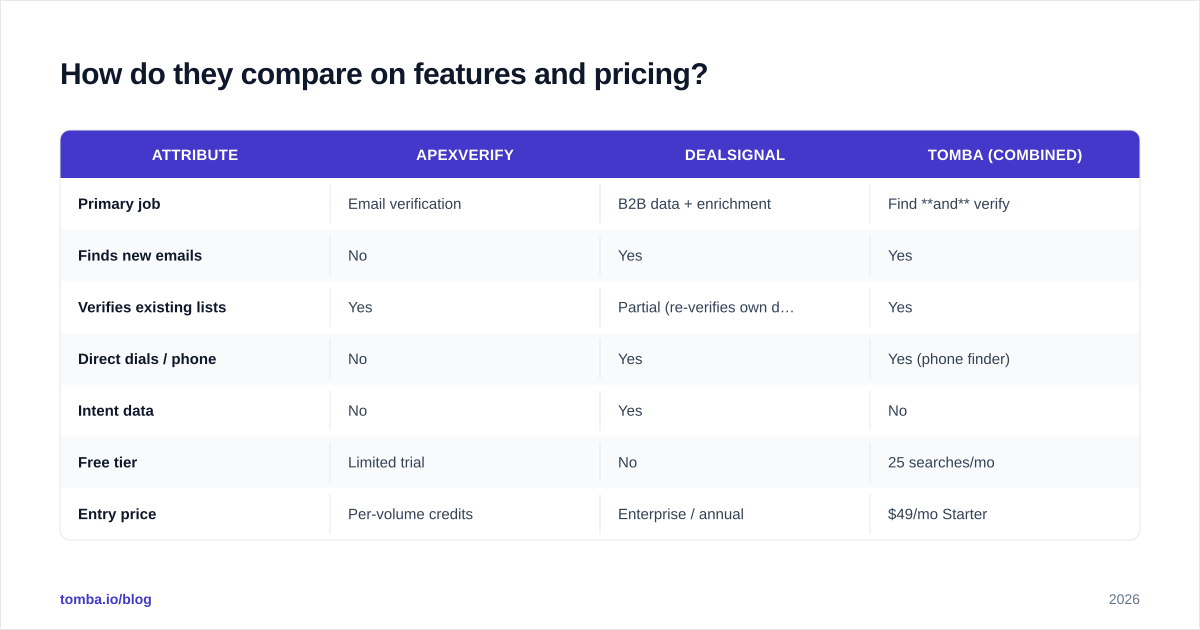
Here's the head-to-head on the attributes that decide most purchases. Pricing reflects each vendor's published model and typical market positioning as of 2026; always confirm current numbers directly.
| Attribute | Apexverify | DealSignal | Tomba (combined) |
|---|---|---|---|
| Primary job | Email verification | B2B data + enrichment | Find and verify |
| Finds new emails | No | Yes | Yes |
| Verifies existing lists | Yes | Partial (re-verifies own data) | Yes |
| Direct dials / phone | No | Yes | Yes (phone finder) |
| Intent data | No | Yes | No |
| Free tier | Limited trial | No | 25 searches/mo |
| Entry price | Per-volume credits | Enterprise / annual | $49/mo Starter |
| Best for | List hygiene | Enterprise demand gen | SMB–mid-market outbound |
| API access | Yes | Yes | Yes |
| Catch-all handling | Yes | Within dataset | Catch-all verifier |
The pattern is clear: DealSignal wins on breadth, Apexverify wins on focused list hygiene, and a combined finder-plus-verifier wins on cost-per-outcome for teams that need both jobs done without two contracts.
Where DealSignal pulls ahead#
- Coverage depth — direct dials, intent signals, and account-level firmographics in one place.
- Re-verification cadence — data is refreshed on a schedule rather than at point of use.
- On-demand sourcing — if a record doesn't exist, their team can go build it.
Where Apexverify pulls ahead#
- Deliverability protection — purpose-built to drop your bounce rate fast.
- Simplicity — upload, verify, export. No onboarding marathon.
- Cost for a single job — if all you need is clean lists, you're not paying for a data warehouse.
Is DealSignal worth the enterprise price?#
Yes — if you're running large-scale, multi-channel demand generation and stale data is measurably costing you. The math works when you have enough reps and enough volume that a few percentage points of accuracy improvement translates into real revenue.
It's overkill if you're a small team buying it for email coverage alone. At that point you're paying enterprise rates for a fraction of the platform. Independent reviews on G2 and Capterra consistently flag the same thing across enterprise data vendors: the value is real but the floor price excludes smaller buyers.
A practical filter: if you can't name three distinct workflows (enrichment, intent routing, account scoring) that will use the data weekly, you don't need a full data platform yet.
Is Apexverify enough on its own?#
Only if finding contacts isn't your bottleneck. Verification is a downstream fix — it makes a list safer, but it can't create coverage. If your reps spend hours hunting for emails before they even have a list to clean, a standalone verifier leaves the expensive part of the problem untouched.
This is the trap teams fall into: they buy a verifier to fix deliverability, then realize they still need a separate tool to source contacts, then a third to enrich them. Three subscriptions, three logins, three invoices — to do what one platform handles. That fragmentation is exactly the friction the "data stack consolidation" trend in RevOps is reacting to.
When does a combined email finder beat both?#
When you're under roughly 50 reps and your real job is build a clean prospect list fast — not run enterprise intent routing.
Most outbound teams have a simpler loop than the enterprise pitch assumes:
- Identify target companies.
- Find the right people and their emails.
- Verify those emails before sending.
- Push to CRM and sequence.
Steps 2 and 3 are where Apexverify (verify) and DealSignal (find) each only own half. A tool that does both in one pass removes the handoff entirely. With Tomba you can run a domain search to pull every email pattern at a target company, verify each result inline, and export — one workflow, one bill. For list-level work, the bulk email finder handles thousands of rows and dedupes as it goes.
The honest caveat: Tomba is not an intent-data platform. If buyer-intent signals and account scoring are central to your motion, DealSignal does something Tomba doesn't, and you should weigh that directly. For pure find-and-verify outbound, though, the combined approach is cheaper and faster.
How do their accuracy claims hold up?#
Every data vendor advertises a high accuracy number. The number that matters is your bounce rate after using the tool, on your segment — not the headline percentage on a pricing page.
DealSignal's accuracy story rests on re-verification frequency; Apexverify's rests on multi-layer SMTP checking. Both are legitimate approaches, but they measure different moments: DealSignal certifies a record when it's sourced, Apexverify certifies an address when you check it. For time-sensitive outbound, point-of-use verification (checking right before you send) tends to catch more recent churn — people change jobs, and a record verified three months ago may already be dead.
The practical move regardless of vendor: verify at send time, not at purchase time. Run a small seed test, measure actual bounces, and let that number — not the marketing claim — drive your choice. You can sanity-check any single address for free with a free email checker before committing budget.
How should you actually decide?#
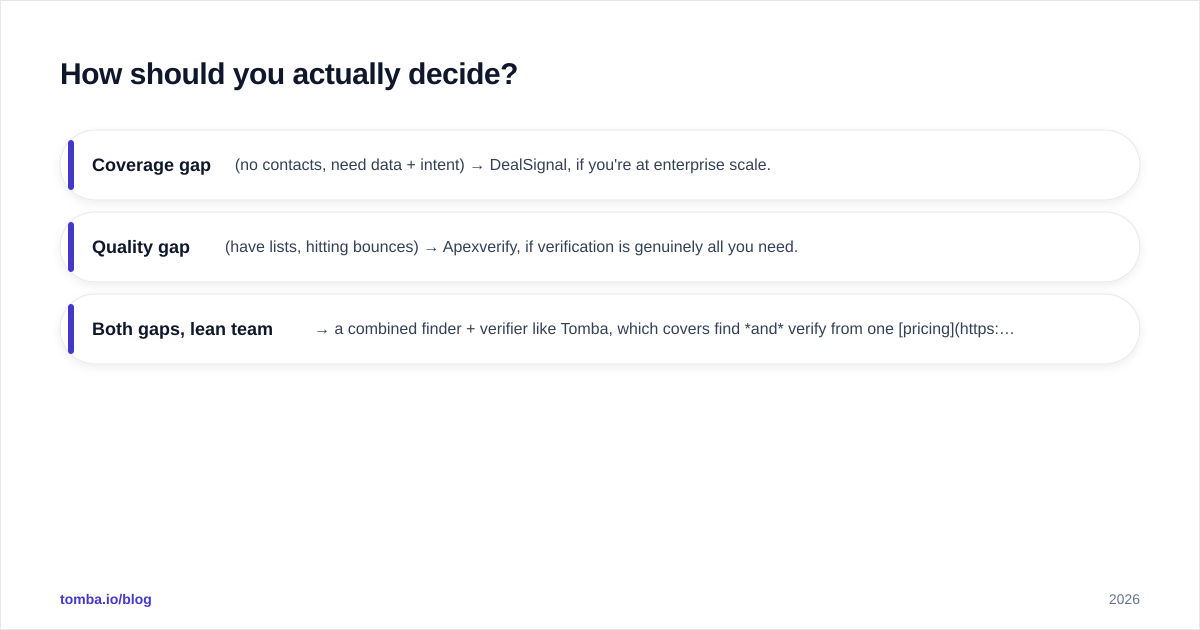
Map the tool to the gap, not the brand:
- Coverage gap (no contacts, need data + intent) → DealSignal, if you're at enterprise scale.
- Quality gap (have lists, hitting bounces) → Apexverify, if verification is genuinely all you need.
- Both gaps, lean team → a combined finder + verifier like Tomba, which covers find and verify from one pricing tier without an annual enterprise commitment.
Run the test before you sign anything: export 100 of your real target rows, run them through a trial of each option, and compare hit rate, accuracy, and cost-per-usable-record. The winner on your data is the only benchmark that pays your salary. Industry analysts at Gartner make the same point about data vendors generally — vendor-reported accuracy rarely survives contact with your specific ICP.
The bottom line#
Apexverify and DealSignal are both good at what they do — they're just good at different things. DealSignal sells you reach; Apexverify sells you reliability. Choosing between them means deciding which problem is actually blocking your pipeline this quarter.
For enterprise demand-gen with intent-based motions, DealSignal earns its price. For teams whose real job is finding verified emails and getting them into sequences without juggling three subscriptions, you don't need either at full cost. Tomba's email finder finds the addresses, verifies them in the same workflow, and starts at $49/mo with a free tier of 25 searches to test against your own list first. Find, verify, export — then let your reps spend their time selling instead of cleaning spreadsheets.
// get started
Find, verify and enrich your first contacts today
Start on the free plan with 25 searches a month, then scale when your team is ready.
Free plan · No credit card required · GDPR & CCPA
// about the author