Apexverify vs Generect: B2B Email Data Tools Compared (2026)
A neutral, head-to-head breakdown of Apexverify vs Generect in 2026 — accuracy, pricing, data coverage, and which lead-data tool fits your outbound stack.
Choosing between Apexverify and Generect usually comes down to one question: do you need a tool that finds new contacts, or one that proves the contacts you already have are real? Both names get thrown into the same "lead data" bucket, but they solve different ends of the same pipeline. This breakdown keeps the marketing out of it and looks at what each does, what it costs, and where each one quietly falls short.
TL;DR#
- Apexverify leans toward email verification and data hygiene — confirming deliverability, catching catch-alls, and cleaning lists before you send.
- Generect leans toward lead generation and discovery — building targeted B2B lists from LinkedIn-style filters and company data.
- The two overlap in the middle (both touch emails), but they are not direct substitutes for most teams.
- Pricing favors smaller teams on verification-first workflows; discovery-heavy teams pay more per seat for list-building tools.
- If you want one platform that finds and verifies in the same place, a combined tool like Tomba Email Finder is worth benchmarking against both.
What is Apexverify and what is Generect?#
Think of your outbound pipeline like cooking for a dinner party. Generect is grocery shopping — it goes out and brings back the raw ingredients (companies, roles, contacts) that match your recipe. Apexverify is the quality check — it makes sure none of the ingredients are spoiled before they hit the pan. You can technically shop without inspecting, or inspect an empty fridge, but neither gets dinner on the table alone.
In concrete terms:
- Apexverify is positioned as an email verification and validation layer. Its core job is taking a list of addresses and returning a status — valid, invalid, risky, catch-all, role-based — so your sender reputation does not get torched by bounces.
- Generect is positioned as a B2B lead generation and data platform. Its core job is surfacing new contacts and companies that fit a defined ICP, then handing you their emails and firmographic details.
That distinction matters because a lot of "X vs Y" searches assume the two tools are interchangeable. They mostly are not. The real decision is usually which problem you have first — empty pipeline or dirty pipeline.
How do Apexverify and Generect compare at a glance?#
Here is the head-to-head on the attributes that actually change your buying decision. Treat the pricing rows as directional — both vendors adjust tiers, and you should confirm live numbers before committing.
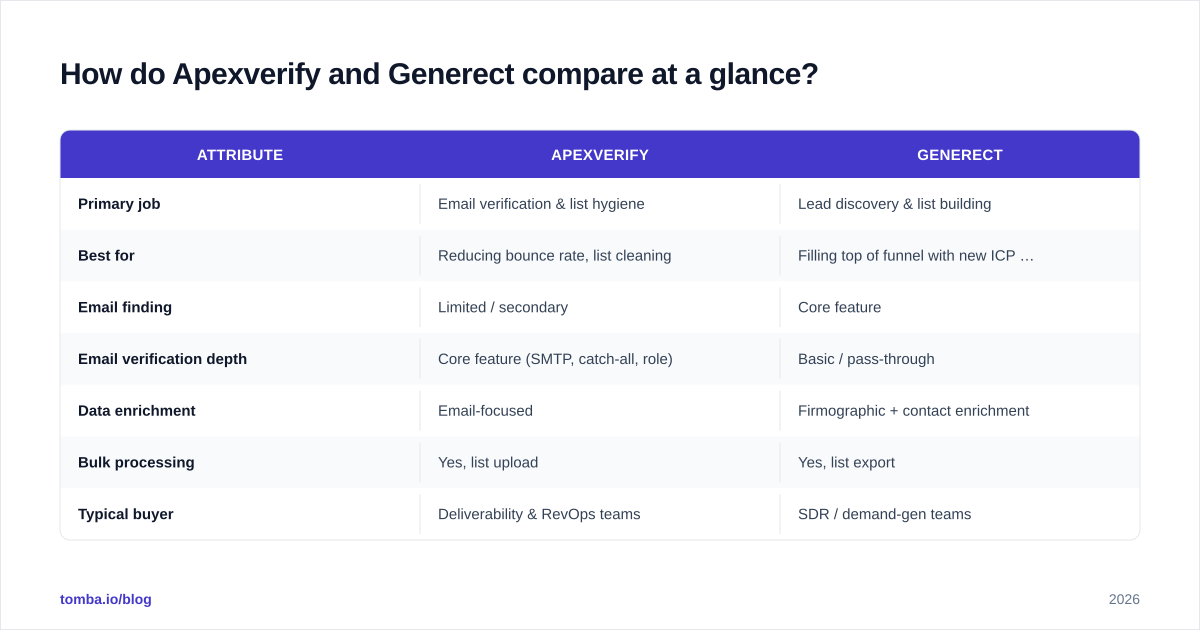
| Attribute | Apexverify | Generect |
|---|---|---|
| Primary job | Email verification & list hygiene | Lead discovery & list building |
| Best for | Reducing bounce rate, list cleaning | Filling top of funnel with new ICP contacts |
| Email finding | Limited / secondary | Core feature |
| Email verification depth | Core feature (SMTP, catch-all, role) | Basic / pass-through |
| Data enrichment | Email-focused | Firmographic + contact enrichment |
| Bulk processing | Yes, list upload | Yes, list export |
| Typical buyer | Deliverability & RevOps teams | SDR / demand-gen teams |
| Free trial | Usually limited credits | Usually limited credits |
The pattern is clear: these tools are strong on opposite halves of the funnel. A team that already has thousands of scraped contacts and a rising bounce rate wants the left column. A team staring at an empty CRM wants the right column.
Which tool is more accurate?#
Accuracy means two different things here, so compare them on the right axis.
For verification accuracy, the question is: when the tool says an email is valid, does it actually deliver? Verification-first tools live or die on this. Good verifiers run real SMTP checks, detect catch-all domains instead of guessing, and flag role-based addresses (info@, sales@) that tank engagement rates. Apexverify is built around this job, so it should be judged on bounce reduction in a real send.
For discovery accuracy, the question is: of the contacts the tool surfaces, how many emails are correct and currently employed there? This is where discovery tools like Generect get measured — and where most lead databases show their age, because people change jobs constantly and stale records pile up fast.

The trap is judging a discovery tool by verification standards or vice versa. A list-builder that returns 100 contacts at 85% deliverability is doing its job; a verifier that "only" cleans your existing list is doing a different job. If you care about both numbers — and most outbound teams should — you either run two tools in sequence or pick a platform that does both. That second option is why a lot of buyers end up comparing both Apexverify and Generect against a single combined tool rather than just against each other.

Apexverify vs Generect: pricing and value#
Neither tool is the cheapest option in its lane, and both use credit-based models that make true cost hard to eyeball. A few principles to price this honestly:
- Verification tools are usually cheaper per credit because a verification check is computationally lighter than a discovery query. If your main spend is cleaning large lists, a verification-first tool tends to win on raw cost.
- Discovery tools charge more per credit because you are paying for the underlying database, refresh cycles, and enrichment. You also burn credits faster, since not every search returns a usable contact.
- Watch the credit-expiry and rollover terms. A "cheap" plan that expires unused credits monthly can cost more than a pricier plan with rollover if your volume is spiky.
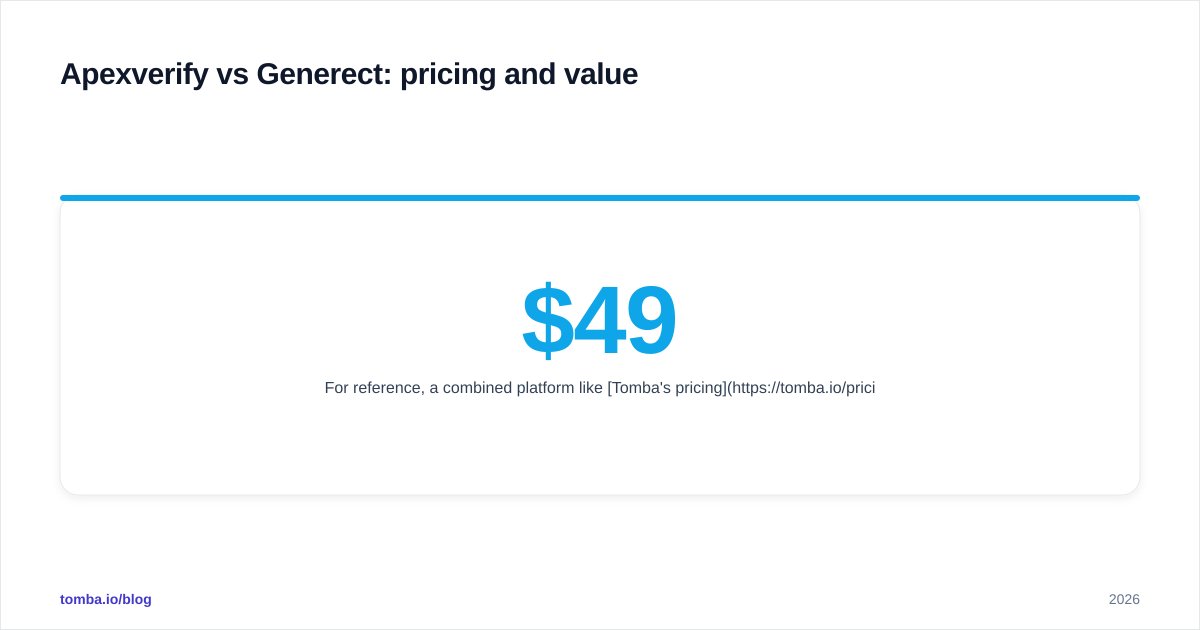
For reference, a combined platform like Tomba's pricing runs a Free tier (25 searches/mo), Starter at $49/mo, Growth at $99/mo, and Pro at $249/mo — covering both finding and verifying under one credit pool, which removes the two-subscription math entirely. When you compare Apexverify and Generect, add up both a verification subscription and a discovery subscription if you genuinely need both halves, then compare that total against a single combined tool. The two-tool stack is often more expensive than buyers expect.
You can sanity-check any vendor's real-world reputation on neutral review sites like G2 and Capterra before you trust the marketing page.
When should you choose Apexverify?#
Pick a verification-first tool like Apexverify when your dominant pain is deliverability, not discovery. Signals that you are in this camp:
- Your bounce rate is creeping above 3-4% and your sender reputation is at risk.
- You already buy or scrape contacts and just need them cleaned before sending.
- You run a data enrichment or RevOps function where hygiene is the mandate.
- You send high volume and a single bad list can get your domain flagged.
In these cases, discovery features are noise. You want fast, accurate, bulk verification with clear status codes you can route on. Verification is also the cheaper habit to build — cleaning before you send protects the sender reputation you spent months earning, and that asset is far more expensive to rebuild than to maintain.
When should you choose Generect?#
Pick a discovery-first tool like Generect when your dominant pain is an empty or stale pipeline. Signals:
- Your SDRs spend hours manually hunting contacts on LinkedIn.
- You need to build targeted lists by industry, headcount, role, or geography.
- You are entering new markets and have no existing contact base to clean.
- Top-of-funnel volume is your bottleneck, not deliverability.
Here the verification step is secondary — you will clean the list later, but first you need a list to clean. Discovery tools justify their higher per-credit cost by saving the manual research hours that would otherwise eat an SDR's week.
Can one tool do both finding and verifying?#
Yes — and this is the option most "Apexverify vs Generect" comparisons leave out. Running two separate subscriptions creates three recurring costs people underestimate: two bills, two credit pools that never line up, and the manual export-import handoff between them.
A consolidated platform collapses that. With one tool you can:
- Find contacts by company or role using a domain search or name lookup.
- Verify each address with an email verifier before it enters your sequence.
- Enrich and export the cleaned, confirmed list straight into your CRM.
That is the model Tomba runs on. Alongside the core email finder sit an email verifier, domain search, catch-all verifier, phone finder, and data enrichment — all drawing from one credit pool. The benefit is not just price; it is that the find-then-verify handoff happens inside one system instead of across two vendors with two export formats.

For teams that genuinely only have one of the two problems, a specialist tool can still be the right call. Specialists sometimes go deeper on their single job. But for the common case — a team that needs to both build and clean lists — the combined approach usually wins on total cost and operational simplicity.
What do most teams get wrong in this comparison?#
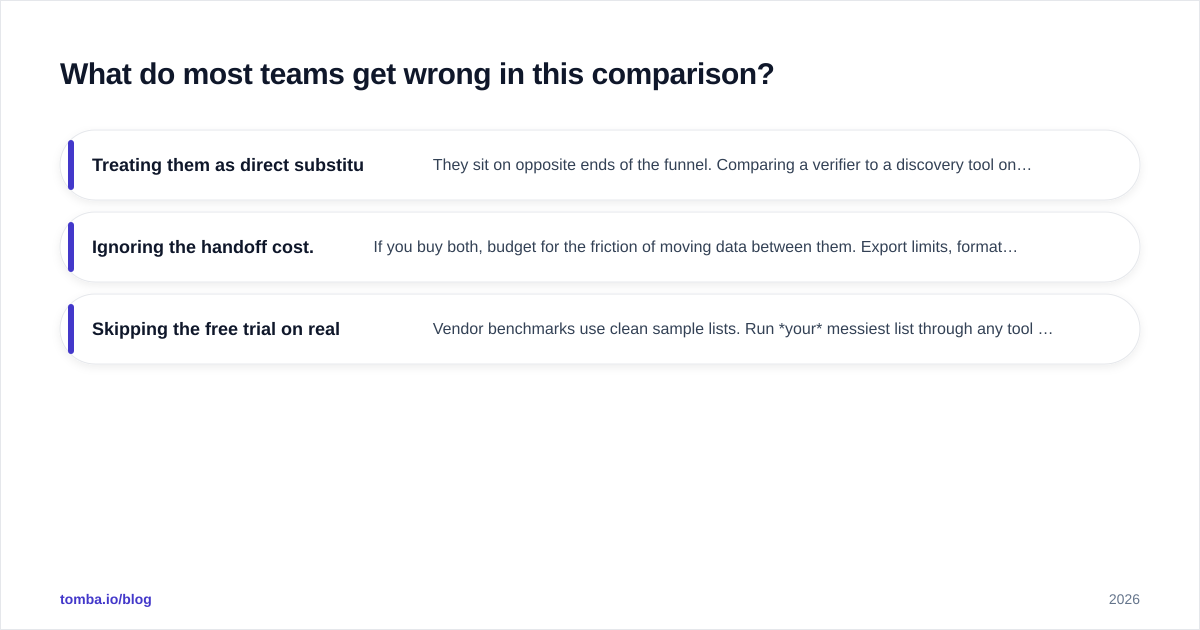
Three recurring mistakes show up when buyers evaluate Apexverify against Generect:
- Treating them as direct substitutes. They sit on opposite ends of the funnel. Comparing a verifier to a discovery tool on "accuracy" without specifying which kind of accuracy leads to bad conclusions.
- Ignoring the handoff cost. If you buy both, budget for the friction of moving data between them. Export limits, format mismatches, and credit-pool fragmentation are real recurring tax.
- Skipping the free trial on real data. Vendor benchmarks use clean sample lists. Run your messiest list through any tool before you commit. The only accuracy number that matters is the one on your data. If you want a fast gut-check first, a free email checker will validate a single address in seconds with no signup.
The honest summary: Apexverify and Generect are both competent at their respective jobs, but they are answering different questions. Decide which problem you have first — empty pipeline or dirty pipeline — and the choice gets a lot less confusing.
How should you make the final call?#
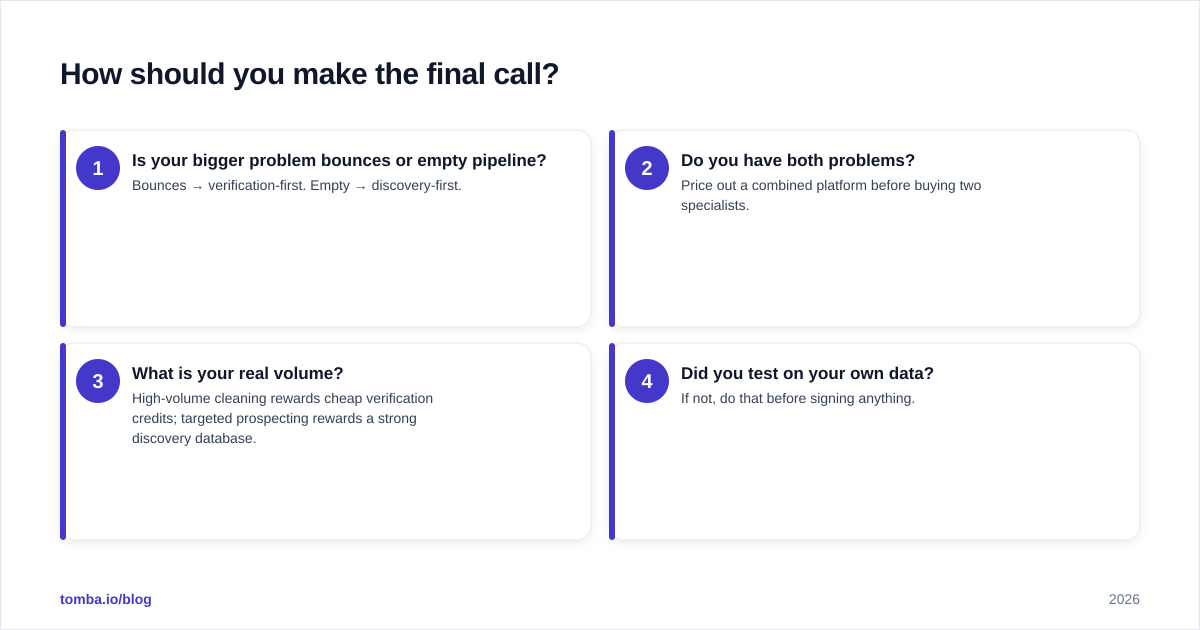
Run this quick decision filter:
- Is your bigger problem bounces or empty pipeline? Bounces → verification-first. Empty → discovery-first.
- Do you have both problems? Price out a combined platform before buying two specialists.
- What is your real volume? High-volume cleaning rewards cheap verification credits; targeted prospecting rewards a strong discovery database.
- Did you test on your own data? If not, do that before signing anything.
Outbound success is rarely about owning the single "best" tool — it is about matching the tool to the bottleneck that is actually slowing you down this quarter.
Final recommendation#
If your team needs to both find and verify B2B contacts without juggling two subscriptions and two credit pools, start with a combined platform. Tomba's Email Finder lets you find professional emails by domain, name, or company and verify them in the same workflow — Free tier included (25 searches/mo), then $49/mo Starter when you scale. Run your own list through it alongside Apexverify and Generect, compare the deliverability numbers on your data, and let the results pick the winner. That is the only benchmark that pays your salary.
// get started
Find, verify and enrich your first contacts today
Start on the free plan with 25 searches a month, then scale when your team is ready.
Free plan · No credit card required · GDPR & CCPA
// about the author