Apexverify vs Lead411: B2B Data & Email Accuracy Compared (2026)
Apexverify verifies emails; Lead411 is a full sales-intelligence database. Here's which one fits your pipeline in 2026 — and where a dedicated finder beats both.
Apexverify vs Lead411 is a slightly unfair fight on paper — one is an email-verification utility, the other is a full B2B sales-intelligence platform — but buyers compare them constantly because both promise the same outcome: contact data you can actually email. This guide cuts through the category confusion and tells you which one belongs in your stack, and when neither is the right answer.
TL;DR#
- Apexverify is built for one job: confirming whether an email address is deliverable before you send. It's narrow, fast, and cheap per check.
- Lead411 is a contact-and-company database with emails, direct dials, intent data, and CRM-style enrichment. It's broader and far more expensive.
- They overlap only at the edges. Apexverify cleans lists you already have; Lead411 builds lists from scratch.
- If your real need is finding verified work emails by name or domain — not buying a 200-field intelligence suite — a focused email finder plus a verifier covers 90% of the job at a fraction of Lead411's price.
- Pick by workflow, not branding: list hygiene → Apexverify; net-new prospecting + intent → Lead411; finding accurate emails on demand → a dedicated finder/verifier like Tomba.
What is Apexverify?#
Apexverify is an email-verification service. You feed it a single address or a bulk list, and it returns a deliverability status: valid, invalid, risky, catch-all, or unknown. Under the hood, verifiers like this run MX-record lookups, SMTP handshakes, syntax checks, and disposable/role-account detection to predict whether a message will land in an inbox or bounce.
That's the entire value proposition, and it's a real one. Bounce rates above 2–3% damage your sender reputation, and mailbox providers throttle senders with sloppy hygiene. Cleaning a list before a campaign is non-negotiable.
What Apexverify does not do is find contacts. It can't tell you the CMO of a target account or surface a phone number. It assumes you already have the addresses and just need them validated.
What is Lead411?#
Lead411 is a B2B sales-intelligence platform that has been around since 2001. It sells access to a database of company and contact records — verified emails, direct-dial mobile numbers, org charts, technographics, and Bombora-powered intent data that flags accounts actively researching your category. You can build lists by industry, headcount, revenue, location, and trigger events like funding rounds or hiring spikes.
In other words, Lead411 competes with ZoomInfo, Apollo, and Cognism — full-funnel prospecting platforms — not with single-purpose verifiers. Its pricing reflects that: Lead411 is sold as an annual seat-based subscription, typically several thousand dollars per user per year once you include unlimited-view tiers and intent add-ons. You can confirm current packaging on Lead411's site and read hands-on reviews on G2.

Apexverify vs Lead411: how do they actually compare?#
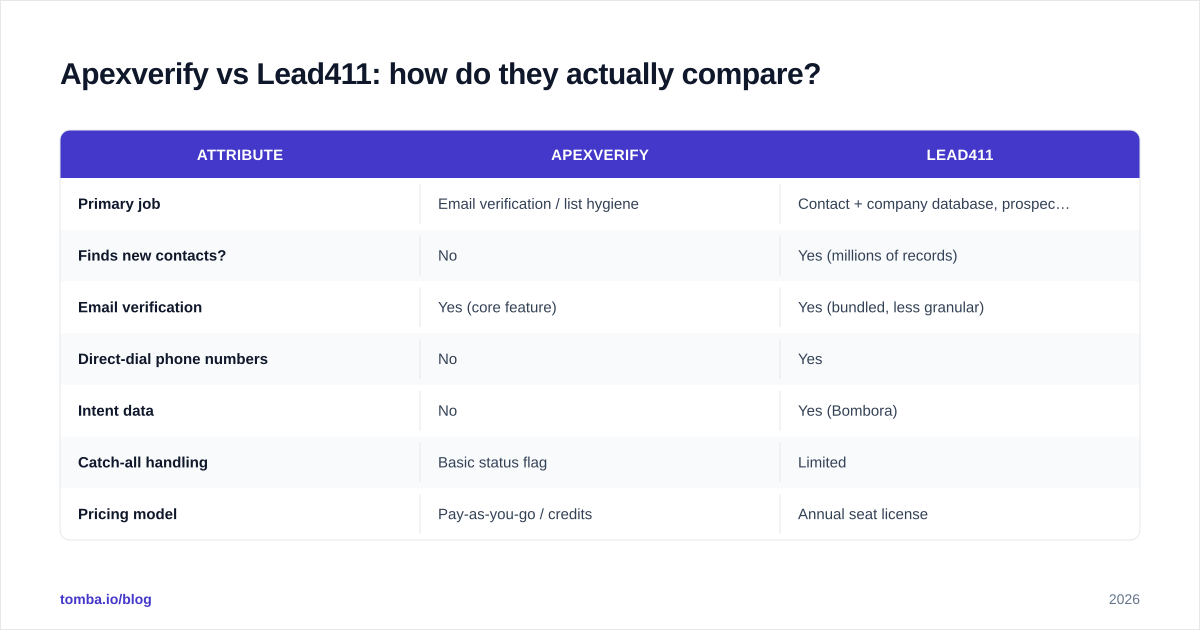
Because these tools sit in different categories, the honest comparison is about fit, not a feature-by-feature winner. Here's the side-by-side.
| Attribute | Apexverify | Lead411 |
|---|---|---|
| Primary job | Email verification / list hygiene | Contact + company database, prospecting |
| Finds new contacts? | No | Yes (millions of records) |
| Email verification | Yes (core feature) | Yes (bundled, less granular) |
| Direct-dial phone numbers | No | Yes |
| Intent data | No | Yes (Bombora) |
| Catch-all handling | Basic status flag | Limited |
| Pricing model | Pay-as-you-go / credits | Annual seat license |
| Typical entry cost | Low (per-verification) | High (thousands/user/yr) |
| Best for | Cleaning lists you own | Building lists from zero |
| Learning curve | Minutes | Days (CRM-style platform) |
The pattern is clear: Apexverify is a scalpel, Lead411 is a surgical theater. You don't choose between a scalpel and an operating room — you choose based on the procedure.
Which one is more accurate?#
Accuracy means different things for each tool. For Apexverify, accuracy is verification precision — how reliably it predicts a bounce. For Lead411, accuracy is data freshness — how many of its stored emails and phone numbers are still correct when you export them.
Here's the catch most buyers miss: a bundled verifier inside a big database is rarely as rigorous as a dedicated one. Sales-intelligence platforms optimize for coverage (more records = more value), and stale records slip through. A focused verifier optimizes for not sending you a bad address. That's why high-volume senders often run database exports back through a separate email verifier before launching.

The other accuracy trap is catch-all domains. Many corporate mail servers accept every address at the domain, so a basic verifier returns "unknown" or a misleading "valid." Tools with a dedicated catch-all verifier resolve a chunk of those into real yes/no answers — something neither Apexverify's basic flag nor Lead411's bundled check handles deeply.
When should you choose Apexverify?#
Pick Apexverify when you already have the contacts and the bottleneck is hygiene:
- You exported a list from a webinar, a conference, or an old CRM and need to scrub it before emailing.
- You run high-volume cold campaigns and want to protect email deliverability by keeping bounce rates under 2%.
- You want pay-as-you-go pricing without an annual commitment.
- You don't need phone numbers, firmographics, or intent signals.
Apexverify is the wrong call if your pipeline is empty. A verifier with nothing to verify is a hammer with no nails.
When should you choose Lead411?#
Pick Lead411 when you need to build pipeline from scratch and have budget for a platform:
- Your reps prospect into net-new accounts daily and need fresh firmographics and direct dials.
- Intent data matters to your motion — you want to reach accounts already in-market.
- You're consolidating tools and want database + verification + intent in one seat.
- You can justify a multi-thousand-dollar annual contract per rep with closed-won revenue.
Lead411 is overkill if you just need to validate a list once a quarter. You'd be paying enterprise prices for a feature a $20 verifier handles.
What's the smarter middle path?#
Most teams comparing these two are actually asking a different question: "How do I get accurate, verified emails for the people I want to reach — without overpaying?"
That's a finder-plus-verifier problem, not a buy-the-whole-suite problem. The modern stack looks like this:
- Find the email by name + company domain, or pull every address on a domain with domain search.
- Verify each one before it touches your sequence.
- Enrich the keepers with role and company context using data enrichment.
- Scale with bulk verify when you're working from a CSV.
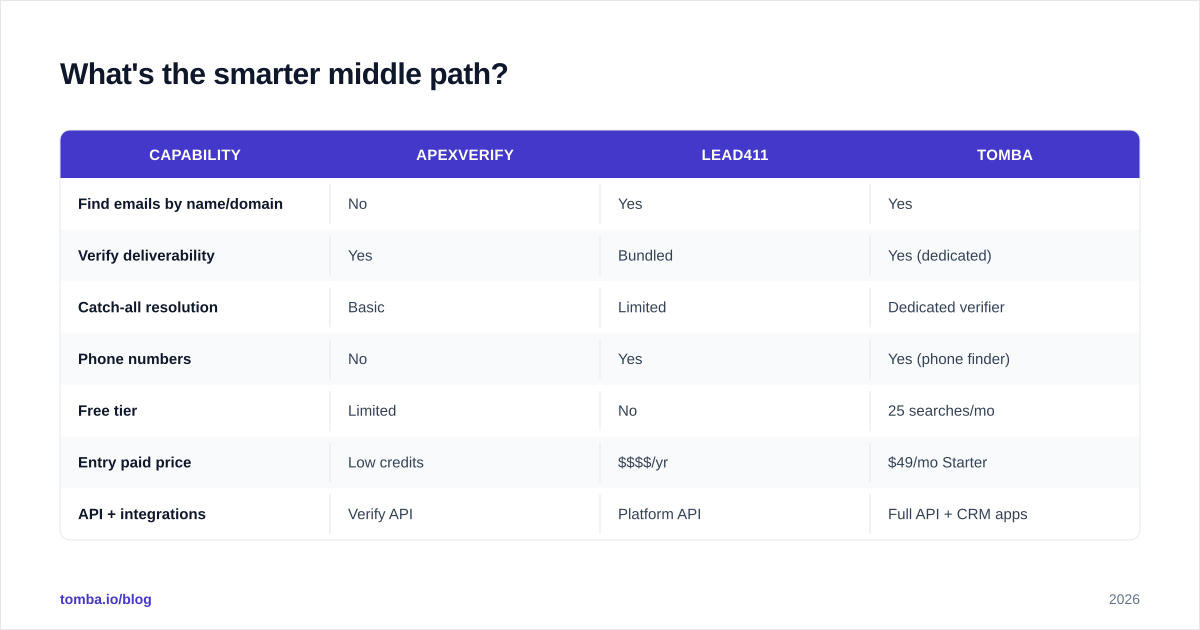
This is where Tomba fits between the two extremes. It finds emails like a prospecting tool and verifies them like Apexverify — without the Lead411 price tag. Here's how the three approaches stack up.

| Capability | Apexverify | Lead411 | Tomba |
|---|---|---|---|
| Find emails by name/domain | No | Yes | Yes |
| Verify deliverability | Yes | Bundled | Yes (dedicated) |
| Catch-all resolution | Basic | Limited | Dedicated verifier |
| Phone numbers | No | Yes | Yes (phone finder) |
| Free tier | Limited | No | 25 searches/mo |
| Entry paid price | Low credits | $$$$/yr | $49/mo Starter |
| API + integrations | Verify API | Platform API | Full API + CRM apps |
For exact tiers and credit limits, see the full Tomba pricing — Free (25 searches/mo), Starter $49/mo, Growth $99/mo, Pro $249/mo, and Enterprise. You can validate platform-category claims independently on review sites like Capterra before committing to any annual seat.
Does pricing actually favor one of them?#
For most SMB and mid-market teams, yes — and it usually favors not buying Lead411 unless you need intent data. A dedicated verifier plus an on-demand finder runs a few hundred dollars a month at most; Lead411 commits you to a year of platform fees per seat. The break-even point only tips toward Lead411 when intent signals and direct dials drive enough extra revenue to cover the contract.
A simple rule of thumb:
- < 2 reps, occasional prospecting → finder + verifier (cheapest, flexible).
- Pure list cleaning → Apexverify or a standalone verifier.
- Full SDR team, intent-led ABM → Lead411 (or a
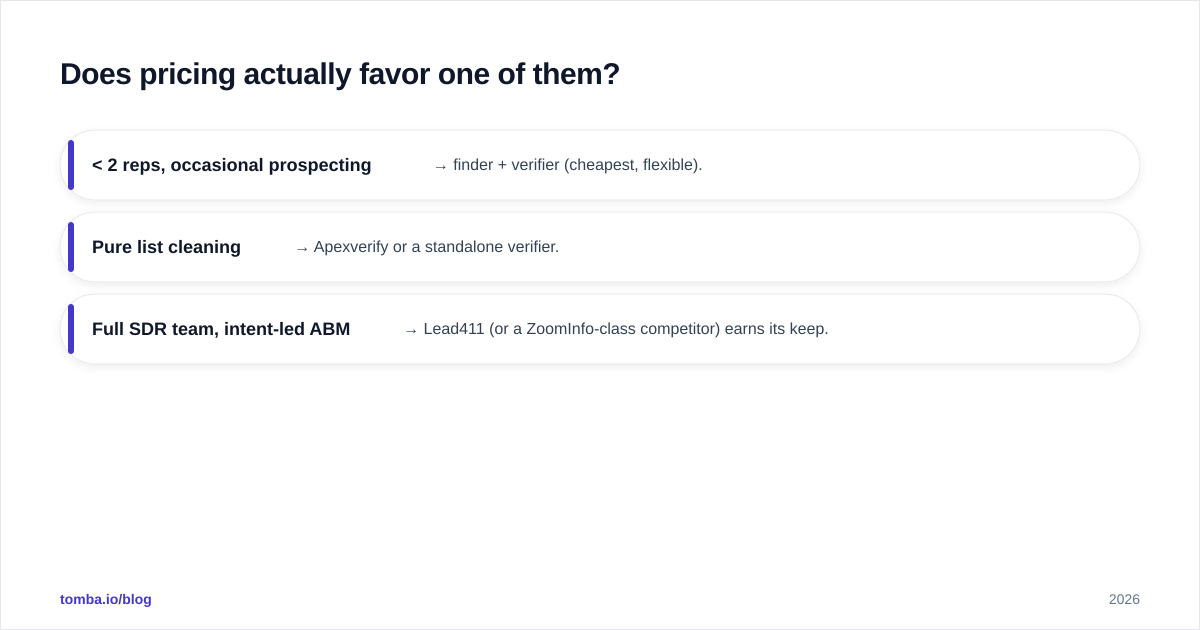
ZoomInfo-class competitor) earns its keep.
Don't pay for an operating room when you need a scalpel — and don't try to build pipeline with a tool that only validates what you already have.
Frequently asked questions#
Is Apexverify a Lead411 competitor? Not really. Apexverify verifies emails; Lead411 is a full sales-intelligence database. They overlap only on the verification step, and Lead411's bundled verification is less granular than a dedicated tool's.
Can I use both together? Yes — and many teams do something similar: pull contacts from a database, then run them through a standalone verifier before sending. That's exactly why a dedicated verification layer exists.
What about catch-all domains? Neither tool handles catch-alls deeply. If a large share of your targets sit on catch-all servers, prioritize a tool with a dedicated catch-all verifier.
The bottom line#
Apexverify and Lead411 aren't rivals — they're tools for different stages. Apexverify cleans the contacts you have; Lead411 finds the contacts you don't, at enterprise prices. The gap most teams fall into is paying for a full intelligence suite when all they really needed was accurate, verified emails on demand.
If that's you, start with the Tomba Email Finder. Find professional emails by name, domain, or company, verify them before they hit your sequence, and scale with the same API and integrations the big platforms charge a yearly seat for — beginning on a free tier of 25 searches a month. Build the list, verify the list, send with confidence, and skip the contract you don't need yet.
// get started
Find, verify and enrich your first contacts today
Start on the free plan with 25 searches a month, then scale when your team is ready.
Free plan · No credit card required · GDPR & CCPA
// about the author