Apexverify vs Oceanio: Email Verification Compared (2026)
Apexverify vs Oceanio, broken down by accuracy, catch-all handling, pricing, and API speed — plus where a third option quietly beats both in 2026.
Apexverify vs Oceanio: Which Email Verification Tool Wins in 2026?
Picking between Apexverify and Oceanio comes down to four numbers: how many bad addresses each one catches, how it treats catch-all domains, what you pay per verification, and how fast the API returns a verdict. Everything else is marketing.
This breakdown puts both tools side by side on exactly those axes, then shows where a third option — Tomba — quietly undercuts both on price and accuracy. No fluff, no vendor cheerleading.
TL;DR#
- Apexverify leans toward raw speed and a clean dashboard, but its catch-all handling is conservative — you'll see more "unknown" verdicts that you still have to gamble on.
- Oceanio is more aggressive on catch-all resolution and bulk throughput, but its per-credit pricing climbs fast once you pass the entry tier.
- On a straight accuracy-per-dollar basis, neither is the cheapest path: a flat-rate verifier like Tomba's email verifier lands more verified results for less at mid-volume.
- If you also need to find addresses (not just check them), Apexverify and Oceanio force you into a second tool — Tomba bundles finding and verification under one pricing plan.
- Your real decision rule: match the tool to whether you're verifying lists you already own, or building lists from scratch.
What do Apexverify and Oceanio actually do?#
Both are email verification platforms. You hand them an address — or a list of a million — and they tell you whether sending to it will bounce, hit a spam trap, or land in an inbox.
A verifier runs a stack of checks: syntax validation, MX-record lookup, SMTP handshake, disposable-domain detection, role-account flagging (think info@, sales@), and catch-all detection. The difference between a good verifier and a mediocre one isn't whether it runs these checks — they all do — it's how honestly it reports the gray areas, and how few "unknown" results it leaves you holding.
That honesty matters because every undeliverable address you send to chips away at your sender reputation. Mailbox providers watch your bounce rate. Cross 2-3% and your inbox placement craters for every recipient, including the good ones.
How accurate is each tool?#
Accuracy is the whole ballgame, so start here.
Apexverify markets a 98%+ accuracy figure on standard mailboxes. In practice that number holds up well on corporate domains with a real SMTP server that answers honestly. Where it gets cautious is catch-all domains — servers configured to accept any address at the domain. Apexverify tends to return these as "accept-all" or "unknown" rather than guessing, which is safe but leaves you with a bucket of addresses you still can't trust.
Oceanio takes the opposite posture. It applies additional signals — historical send data, pattern matching, and engagement heuristics — to push more catch-all addresses into a definite "valid" or "invalid" call. When those heuristics are right, you get a cleaner usable list. When they're wrong, you eat a bounce you didn't expect. It's a higher-variance approach.
Neither is universally "more accurate." They optimize for different errors:
- Apexverify minimizes false positives (rarely calls a bad address good) at the cost of more unknowns.
- Oceanio minimizes unknowns (resolves more catch-alls) at the cost of occasional false positives.
If your downstream cost of a bounce is high — you're warming a fresh domain, or your ESP is strict — Apexverify's caution is the safer bet. If you'd rather maximize the count of sendable addresses and can absorb a slightly higher bounce rate, Oceanio's aggression pays off.
For context on what a verifier is genuinely catching, this accuracy benchmark across tools is a useful reference point:

The takeaway from cross-tool testing: published accuracy numbers cluster in the high 90s for easy mailboxes, and the real spread only shows up on catch-all and greylisted domains. That's the segment to test before you commit.
How do they handle catch-all domains?#
This deserves its own section because it's where most verification budgets quietly leak.
A catch-all (or "accept-all") domain accepts mail to every address, so an SMTP handshake can't distinguish a real inbox from a typo. Roughly 15-25% of B2B domains are configured this way, so how a tool treats them directly determines how much of your list is usable.
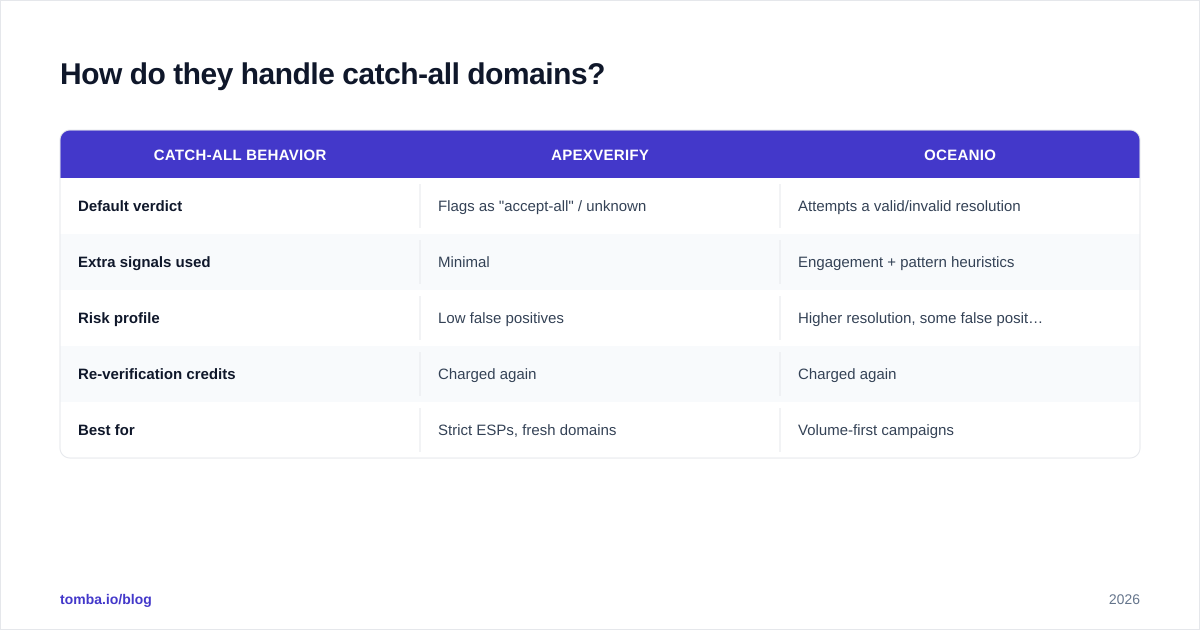
| Catch-all behavior | Apexverify | Oceanio |
|---|---|---|
| Default verdict | Flags as "accept-all" / unknown | Attempts a valid/invalid resolution |
| Extra signals used | Minimal | Engagement + pattern heuristics |
| Risk profile | Low false positives | Higher resolution, some false positives |
| Re-verification credits | Charged again | Charged again |
| Best for | Strict ESPs, fresh domains | Volume-first campaigns |
If catch-all coverage is your bottleneck, it's worth running the same sample through a dedicated catch-all verifier to see how many "unknowns" actually resolve. The gap between tools on this single category is usually wider than their headline accuracy difference.
Apexverify vs Oceanio: side-by-side comparison#
Here's the consolidated view across the attributes that drive a real buying decision.
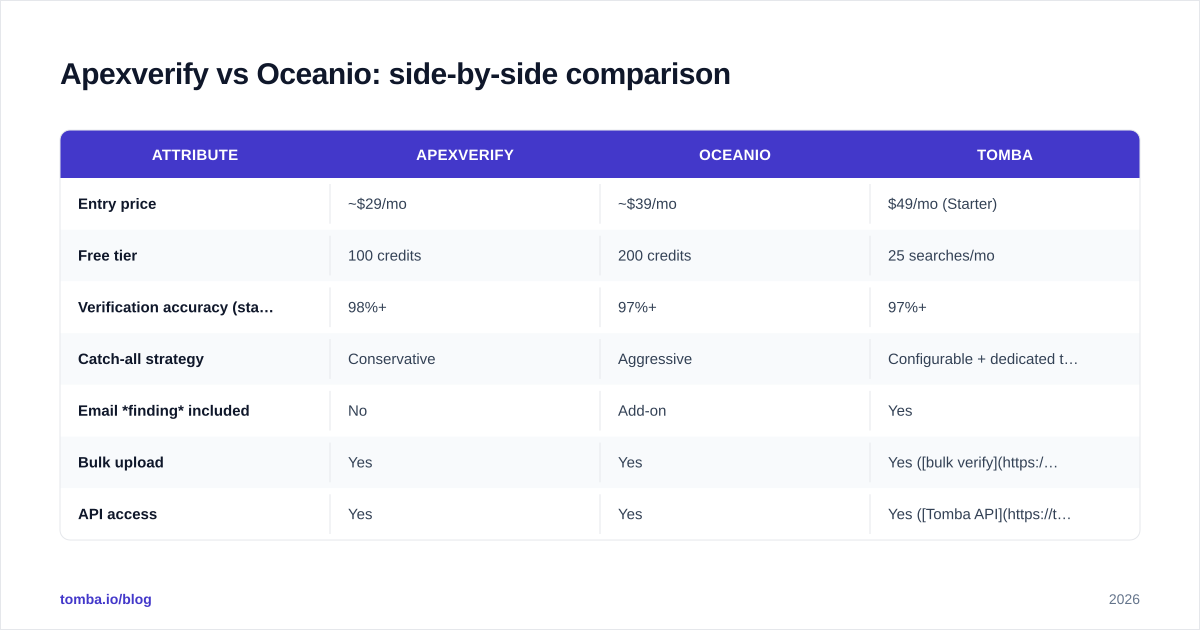
| Attribute | Apexverify | Oceanio | Tomba |
|---|---|---|---|
| Entry price | ~$29/mo | ~$39/mo | $49/mo (Starter) |
| Free tier | 100 credits | 200 credits | 25 searches/mo |
| Verification accuracy (standard) | 98%+ | 97%+ | 97%+ |
| Catch-all strategy | Conservative | Aggressive | Configurable + dedicated tool |
| Email finding included | No | Add-on | Yes |
| Bulk upload | Yes | Yes | Yes (bulk verify) |
| API access | Yes | Yes | Yes (Tomba API) |
| Domain search | No | Limited | Yes |
| Best fit | Clean known lists | High-volume bulk | Find + verify in one |
Two things jump out. First, both Apexverify and Oceanio are verification-only at their core — if your workflow includes discovering addresses, you're buying a second product. Second, their entry prices look cheaper than Tomba's $49 Starter, but that comparison is misleading once you account for the credits you burn re-verifying catch-alls and the separate finder subscription you'll need.
Which one is cheaper at real volume?#
Headline prices lie because verification isn't a flat product — it's priced per credit, and credit consumption is lumpy.
Say you verify 50,000 addresses a month. On a per-credit model, catch-all domains often get re-checked, disposable addresses still consume a credit, and bulk jobs that fail mid-run can double-charge. Apexverify's lower entry price erodes as you scale into higher credit tiers; Oceanio's per-credit cost is competitive at the bottom but steepens past the mid tier.
A flat-rate model changes the math. With Tomba, your pricing plan covers a defined volume regardless of how many catch-alls you hit, and finding is bundled in. At 50k/month, the all-in cost — finder plus verifier — typically lands below running Apexverify or Oceanio plus a separate email finder.
The rule of thumb: per-credit pricing wins for low, spiky volume; flat-rate wins the moment verification becomes a routine, predictable line item.
How fast and developer-friendly are the APIs?#
If you're wiring verification into a signup flow or an enrichment pipeline, latency and docs matter as much as accuracy.
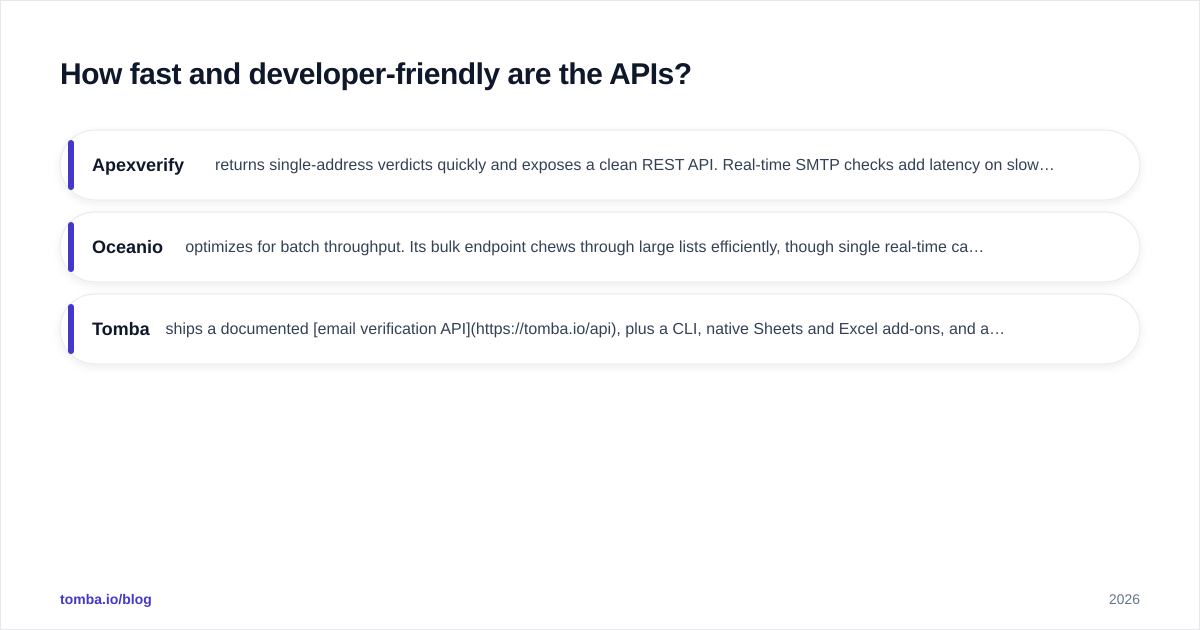
- Apexverify returns single-address verdicts quickly and exposes a clean REST API. Real-time SMTP checks add latency on slow-responding mail servers — unavoidable for any verifier, but Apexverify times out gracefully rather than hanging.
- Oceanio optimizes for batch throughput. Its bulk endpoint chews through large lists efficiently, though single real-time calls can be marginally slower because of the extra heuristic layer.
- Tomba ships a documented email verification API, plus a CLI, native Sheets and Excel add-ons, and a Chrome extension — so the same verification logic works whether you're a developer or a rep working out of a spreadsheet.
For a developer integrating once and forgetting about it, all three are adequate. For a non-technical team that wants verification inside the tools they already use, breadth of integrations is the tiebreaker — and that's where bundled platforms pull ahead of single-purpose verifiers.
When should you pick Apexverify?#
Choose Apexverify if:
- You're verifying lists you already own and don't need to find new addresses.
- You send from a fresh or sensitive domain where a single unexpected bounce is costly, and you'd rather have "unknown" than a wrong "valid."
- You want a simple, fast dashboard and don't need domain search or enrichment.
- Your volume is low-to-moderate and spiky, so per-credit pricing actually saves money.
Apexverify is a sharp, focused verifier. Its limitation is exactly that focus: it does one job and assumes you've solved address discovery elsewhere.
When should you pick Oceanio?#
Choose Oceanio if:
- You run high-volume bulk verification and care most about maximizing the count of sendable addresses.
- A meaningful share of your list sits on catch-all domains and you want them resolved, not flagged.
- You can tolerate a slightly higher bounce rate in exchange for fewer unknowns.
- You want batch throughput over single-call latency.
Oceanio's aggressive catch-all resolution is its real differentiator. Just validate it on your own data first — heuristic resolution is only as good as the patterns behind it, and results vary by industry and region.
Is there a better-value alternative to both?#
For most B2B teams, yes — because most teams don't just verify, they also need to find.
Apexverify and Oceanio both assume the addresses already exist in your CRM or export. The moment you need to build a list — say, every decision-maker at 500 target accounts — you're back to a separate email finder and a separate bill. That's two tools, two integrations, two credit pools to reconcile.
Tomba collapses that into one platform: find addresses by name or company, run domain search to pull every public address at a company, then verify the results before you export. The finder and verifier share the same data foundation, so you're not paying one vendor to guess an address and a second to check the first vendor's guess.
Here's how the consolidated comparison shakes out across the email-finding-and-verification category:

On accuracy Tomba sits in the same high-90s band as both verifiers. On scope it does more. On price it's flat and predictable. If you genuinely only ever verify pre-owned lists, a single-purpose tool is fine — but that's a narrower use case than most teams admit.
Independent reviews on G2 and the broader category context on Wikipedia's email verification overview are worth skimming before you commit to any single vendor — and HubSpot's own deliverability guidance is a solid neutral primer on why list hygiene moves revenue, not just bounce rates.
What does this mean for your workflow?#
Map it to your actual job:
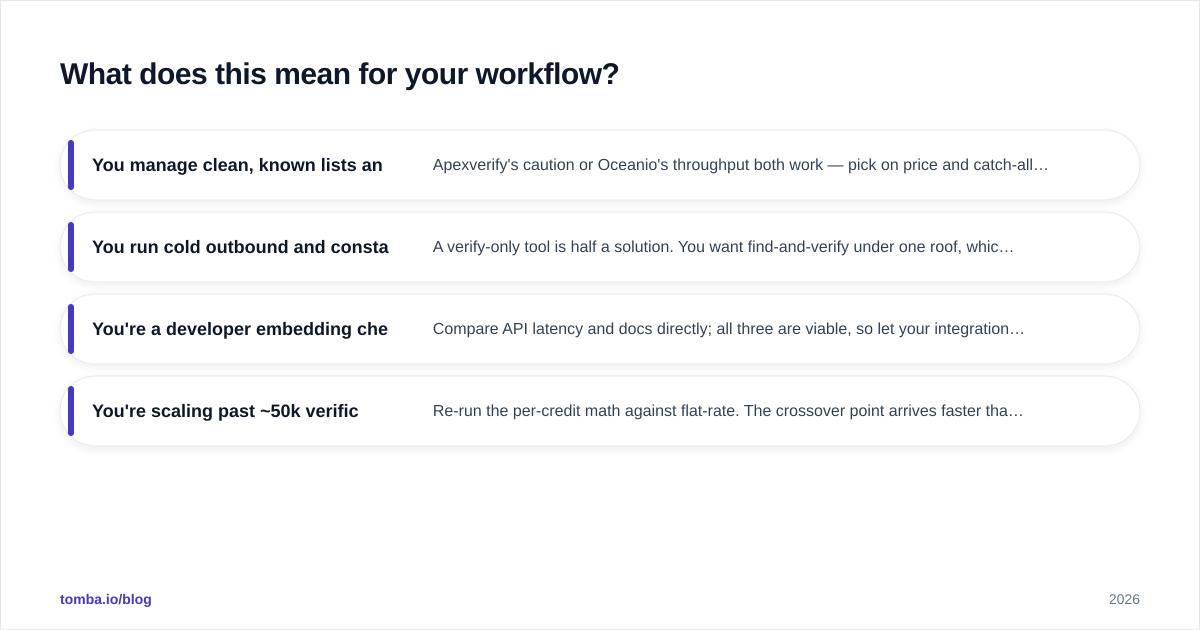
- You manage clean, known lists and never source new contacts. Apexverify's caution or Oceanio's throughput both work — pick on price and catch-all preference.
- You run cold outbound and constantly build new lists. A verify-only tool is half a solution. You want find-and-verify under one roof, which points to a bundled platform.
- You're a developer embedding checks in a product. Compare API latency and docs directly; all three are viable, so let your integration surface decide.
- You're scaling past ~50k verifications a month. Re-run the per-credit math against flat-rate. The crossover point arrives faster than the entry prices suggest.
The honest summary: Apexverify and Oceanio are both competent verifiers that optimize for opposite errors, and the "right" one depends entirely on whether you fear false positives or unknowns more. But if your real workflow includes finding addresses — and for most outbound teams it does — paying two vendors to do one job is the expensive habit hiding in plain sight.
Start finding and verifying in one place#
If you'd rather not stitch a finder and a verifier together, start with the Tomba Email Finder. Find professional addresses by domain, name, or company, verify them in the same workflow before you export, and keep your bounce rate — and your sender reputation — where it belongs. The free tier gives you 25 searches a month to test it against your own list before you pay a cent, and the Starter plan at $49/mo bundles finding and verification that Apexverify and Oceanio split across two subscriptions.
Run the same 100 addresses through all three. Count the verified results, count the unknowns, and check the bill. The tool that gives you the most usable addresses per dollar is the one that wins — not the one with the loudest accuracy claim.
// get started
Find, verify and enrich your first contacts today
Start on the free plan with 25 searches a month, then scale when your team is ready.
Free plan · No credit card required · GDPR & CCPA
// about the author