Apexverify vs Salesbot 2026: Which Email Finder Wins?
Apexverify vs Salesbot compared on accuracy, pricing, verification, and integrations — plus where a neutral third option quietly beats both in 2026.
Choosing between Apexverify and Salesbot usually comes down to one question your spreadsheet can't answer: which tool actually returns deliverable emails instead of plausible-looking guesses? Both promise high match rates and "verified" contacts. Only one of them should be the backbone of your outbound, and the right pick depends on volume, budget, and how much manual verification you're willing to tolerate.
This is a neutral, attribute-by-attribute breakdown — pricing, accuracy, verification depth, integrations, and the real-world workflow each tool forces on you.
TL;DR#
- Apexverify leans on a verification-first engine: fewer raw matches, but the emails it does return bounce less often. Best for teams that protect sender reputation above all.
- Salesbot maximizes coverage and automation: more matches, more integrations, but you'll catch more catch-alls and risky addresses you have to re-verify yourself.
- Pricing is close on paper but diverges at scale — Salesbot's per-seat model gets expensive for 3+ reps; Apexverify's credit model punishes bulk discovery.
- Neither is the only option. A third tool with a transparent verification pipeline and credit-based pricing (covered below) often beats both on cost-per-valid-email.
- If deliverability is the metric you're judged on, verification depth matters more than headline match rate. Pick accordingly.
What is the core difference between Apexverify and Salesbot?#
The fastest way to understand these tools is to look at what they optimize for. Apexverify is built around a "verify before you deliver" philosophy — every email passes through SMTP and MX checks before it's handed back, so the match count you see is already filtered. Salesbot optimizes for pipeline velocity: it surfaces as many contacts as possible and bolts automation (sequences, triggers, CRM sync) on top, leaving deeper verification as an optional step.
That single design choice ripples through everything: pricing, bounce rates, how much cleanup your RevOps team does, and whether your domain reputation survives a 5,000-email campaign.
Think of it like buying produce. Apexverify is the grocer who pre-inspects every apple and only puts the good ones on the shelf — a smaller pile, but you trust it. Salesbot is the wholesale market: a huge pile, lower price per unit, and it's on you to throw out the bruised ones before serving guests.

Accuracy is where this distinction stops being philosophical and starts costing money. A 95% "match rate" means nothing if 20% of those matches are unverified catch-all addresses that silently bounce. When you compare tools, separate discovery rate (did it find an address?) from validity rate (is that address real and deliverable?). Apexverify reports a lower discovery rate but a higher validity rate; Salesbot inverts that. Your cost-per-valid-email — not cost-per-match — is the number that matters.
How do Apexverify and Salesbot compare on features and pricing?#
Here's the head-to-head on the attributes that drive a buying decision. Figures reflect publicly listed plans and standard self-serve tiers as of 2026; enterprise contracts vary.
| Attribute | Apexverify | Salesbot | Tomba |
|---|---|---|---|
| Entry paid price | $59/mo | $69/mo (per seat) | $49/mo |
| Free tier | 30 credits/mo | 14-day trial only | 25 searches/mo |
| Pricing model | Credit-based | Per-seat + credits | Credit-based |
| Built-in verification | SMTP + MX, every result | Optional add-on step | Email verifier included |
| Catch-all handling | Flags + scores | Returns as "valid" | Dedicated catch-all verifier |
| Bulk discovery | Capped on low tiers | Unlimited (seat-gated) | Bulk finder + bulk verify |
| Native integrations | ~12 | 30+ (CRM-heavy) | HubSpot, Salesforce, Pipedrive,Zapier, Sheets |
| API access | Pro tier and up | All paid tiers | All paid tiers |
| Phone/data enrichment | No | Limited | Phone finder + enrichment |
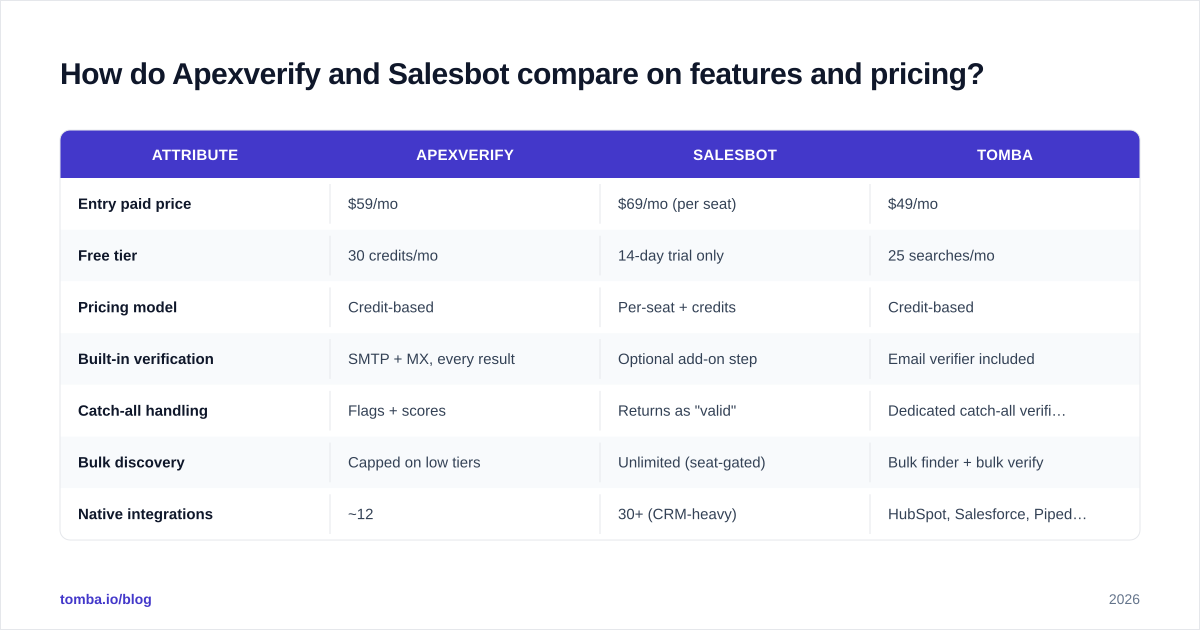
A few takeaways the table makes obvious:
- Salesbot's per-seat model is the hidden cost. A three-rep team on Salesbot pays for three seats before touching credit overages. Credit-based tools (Apexverify, Tomba) let a whole team share one pool.
- Apexverify gates bulk discovery on its cheaper plans, which frustrates anyone building large lists. You'll upgrade faster than the sticker price suggests.
- Catch-all handling is the sleeper feature. Salesbot returning catch-alls as plain "valid" is exactly how clean-looking lists generate surprise bounces. Tools that score or separately verify catch-alls — see how a dedicated catch-all verifier works — save you from that trap.
For a fuller sense of how credit-based pricing scales versus per-seat, compare against transparent Tomba pricing before you commit to an annual contract with either incumbent.
Which tool is more accurate for finding B2B emails?#
Accuracy is the whole ballgame, so let's frame it with a simple decision model rather than vendor marketing numbers.
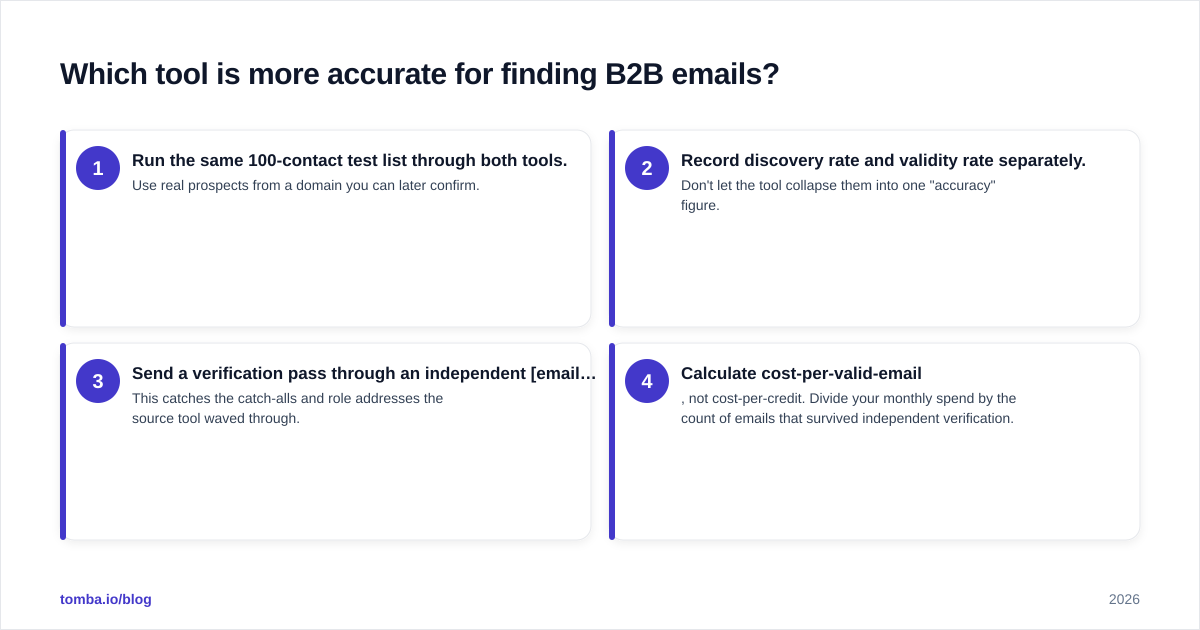
Use this framework when you evaluate any email finder, not just these two:
- Run the same 100-contact test list through both tools. Use real prospects from a domain you can later confirm.
- Record discovery rate and validity rate separately. Don't let the tool collapse them into one "accuracy" figure.
- Send a verification pass through an independent email verifier. This catches the catch-alls and role addresses the source tool waved through.
- Calculate cost-per-valid-email, not cost-per-credit. Divide your monthly spend by the count of emails that survived independent verification.
In practice, Apexverify tends to win the validity column and lose the discovery column. Salesbot does the reverse. If your SDRs are judged on volume of touches, Salesbot's wider net feels productive — until your bounce rate climbs past 3% and your domain gets throttled. If you're protecting a warmed sender domain, Apexverify's stricter filter is worth the lower yield.
The neutral truth: neither tool's self-reported accuracy should be trusted without your own test. Vendors measure accuracy on the subset of contacts they can find, which inflates the number. Independent benchmarks tell a different story — third-party reviews on G2 consistently show real-world validity rates trailing marketing claims by 10–20 points across the category.

How do they fit into an outbound workflow?#
A tool isn't just its match rate — it's how cleanly it slots into the way you already work.
Salesbot's strength is automation gravity. It wants to be your sequencer too: find the contact, drop them into a cadence, fire CRM triggers. If you have no outreach tooling yet, that all-in-one pull is genuinely convenient. The risk is lock-in — your data and your sequences live in one vendor, and migrating later is painful. Its 30+ integrations are real, but most are CRM sync rather than data sources.
Apexverify stays in its lane as a discovery-and-verification utility. It expects you to bring your own sequencer (Instantly, Smartlead, your CRM's native cadences). For teams with an existing stack, that separation of concerns is a feature, not a gap — you swap the data layer without ripping out outreach.
Where both tools leave a gap is the enrichment and routing layer between discovery and send. If you find an email but can't confirm the format across the company, you're guessing. A domain search that returns every known address and the company's email pattern closes that gap — and pairing discovery with a bulk email finder lets you process a 2,000-row list in one job instead of seat-limited drips.
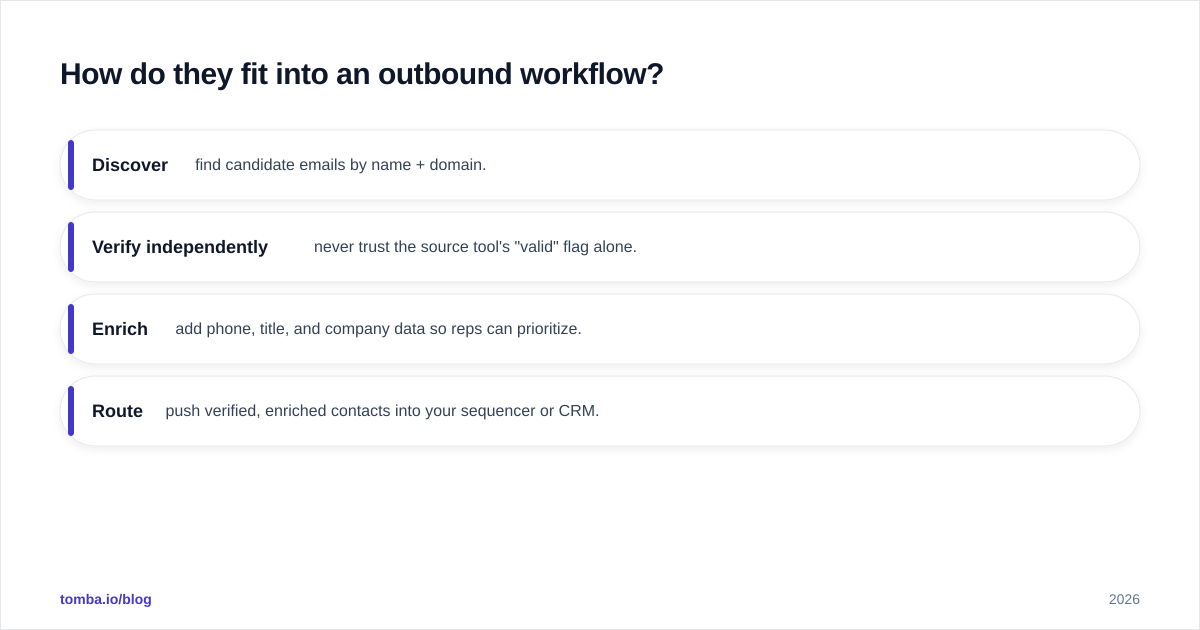
A clean outbound workflow, regardless of which finder you pick, looks like this:
- Discover — find candidate emails by name + domain.
- Verify independently — never trust the source tool's "valid" flag alone.
- Enrich — add phone, title, and company data so reps can prioritize.
- Route — push verified, enriched contacts into your sequencer or CRM.
Salesbot tries to own all four steps; Apexverify owns the first two well. Knowing which steps each tool actually covers — versus markets — keeps you from paying twice for the same capability.
What are the pros and cons of each tool?#
A blunt summary, because comparison posts that refuse to take a position waste your time.
Apexverify — pros:
- Verification-first means lower bounce rates out of the box.
- Catch-all scoring instead of false "valid" labels.
- Credit pool shared across the team.
Apexverify — cons:
- Lower raw discovery rate; you'll miss some findable contacts.
- Bulk discovery is gated behind higher tiers.
- No phone or meaningful enrichment data.
Salesbot — pros:
- High discovery rate and unlimited bulk on paid seats.
- Deep CRM and sequencer integrations — close to all-in-one.
- Automation triggers reduce manual list handoffs.
Salesbot — cons:
- Per-seat pricing punishes growing teams.
- Returns catch-alls as "valid," inflating apparent quality.
- Verification is an optional, sometimes paid, extra step.
The honest verdict: pick Apexverify if deliverability is your KPI and your team is small; pick Salesbot if coverage and built-in automation matter more and budget per seat isn't a constraint. But before you sign either contract, run a third option through the same test — because the category has moved, and the incumbents aren't automatically the value leaders.
Is there a better alternative to both?#
Often, yes — and not because of brand loyalty, but because the cost-per-valid-email math favors tools that bundle verification without per-seat penalties.
Tomba sits in exactly the gap these two leave. It combines an email finder with a built-in verifier, dedicated catch-all checking, domain search, phone finder, and bulk processing under one credit pool — starting at $49/mo, below both Apexverify and Salesbot's entry tiers. You get Salesbot-style coverage with Apexverify-style verification discipline, without the per-seat math or the catch-all blind spot. Native connections to HubSpot, Salesforce, Pipedrive, Zapier, and Google Sheets mean it drops into an existing stack rather than demanding you adopt a whole platform.
That's not a claim to take on faith. Run the 100-contact test from the framework above across all three. Measure validity rate and cost-per-valid-email. The tool with the lowest cost-per-valid-email — whichever it turns out to be — is the correct answer for your specific list and domain. Email finding is, at its core, a data accuracy problem, and data quality is measured by independent verification, not vendor confidence.
How should you make the final decision?#
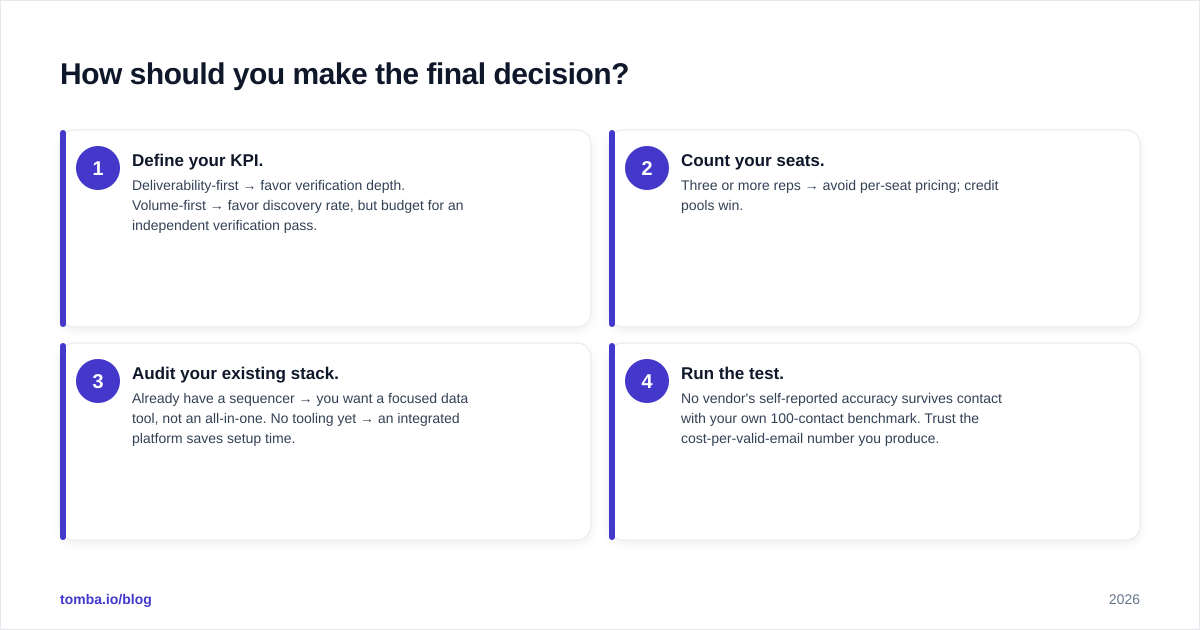
Decide in this order, and you won't over-buy:
- Define your KPI. Deliverability-first → favor verification depth. Volume-first → favor discovery rate, but budget for an independent verification pass.
- Count your seats. Three or more reps → avoid per-seat pricing; credit pools win.
- Audit your existing stack. Already have a sequencer → you want a focused data tool, not an all-in-one. No tooling yet → an integrated platform saves setup time.
- Run the test. No vendor's self-reported accuracy survives contact with your own 100-contact benchmark. Trust the cost-per-valid-email number you produce.
Apexverify and Salesbot are both competent — they simply optimize for opposite ends of the discovery-versus-validity spectrum, and their pricing models reward different team shapes. There's no universal winner, only the right fit for your KPI, headcount, and stack.
Start with verified emails, not guesses#
If your real goal is deliverable emails at a predictable cost per valid contact, start by testing a finder that verifies in the same pass instead of charging you twice. The Tomba Email Finder finds professional emails by name, domain, or company, runs every result through built-in verification, and shares credits across your whole team from $49/mo — with a free tier of 25 searches so you can benchmark it against Apexverify and Salesbot before you spend a dollar. Run all three on the same list, compare cost-per-valid-email, and let the data pick the winner.
// get started
Find, verify and enrich your first contacts today
Start on the free plan with 25 searches a month, then scale when your team is ready.
Free plan · No credit card required · GDPR & CCPA
// about the author