Apexverify vs Sparklane: B2B Data Tools Compared (2026)
Apexverify and Sparklane solve different halves of the same problem: clean contact data and smart lead intelligence. Here's which one your GTM team actually needs in 2026.
Choosing between Apexverify and Sparklane feels like a head-to-head, but it usually isn't. One cleans and confirms the contacts you already have. The other tells you which accounts deserve your attention in the first place. Picking wrong means you either spray verified emails at the wrong companies, or chase perfect-fit accounts with bounce-prone data.
This guide breaks down what each tool actually does, where they overlap, and how to decide — with pricing, accuracy, and workflow fit laid out side by side.
TL;DR#
- Apexverify is built around contact-data hygiene: email verification, deliverability checks, and list cleaning before you send.
- Sparklane is a predictive lead-intelligence platform: it scores and surfaces accounts using signals, intent, and firmographics.
- They are complements more often than rivals — verification protects deliverability, intelligence protects targeting.
- If you only buy one, choose based on your bottleneck: bouncing emails point to Apexverify; weak pipeline targeting points to Sparklane.
- Most lean teams skip both and start with an email finder plus verifier combo (like Tomba) that covers discovery and validation in one stack.
What is Apexverify?#
Apexverify positions itself as a contact-data accuracy layer. Its core job is to take a list of email addresses — exported from your CRM, a scraper, or a prospecting tool — and tell you which ones are safe to send to.
That means syntax checks, domain and MX record validation, mailbox-level pinging, catch-all detection, and flagging of risky records like role-based addresses (info@, sales@) and known spam traps. The output is a cleaner list and a lower bounce rate, which protects your sender reputation over time.
If your cold-email campaigns are getting throttled or your domain reputation is sliding, verification is the unglamorous fix. A 2-3% bounce rate is the rough line most inbox providers tolerate; cross it repeatedly and your deliverability collapses regardless of how good your copy is.
What Apexverify does not do well is tell you who to contact. It assumes you already have the list. That's the gap Sparklane fills.
What is Sparklane?#
Sparklane is a predictive lead-generation and account-intelligence platform, originally strong in European B2B markets. Instead of cleaning a list you bring, it builds the list for you based on fit and timing.
It ingests firmographic data, company news, hiring signals, funding events, and other "buying signals," then scores accounts so your reps spend time on companies most likely to convert. Think of it less as a data scrubber and more as a targeting engine — it answers "which 200 accounts should we work this quarter?" rather than "is this one email valid?"
You can read more about Sparklane's positioning on its official site and user reviews on G2. The trade-off: intelligence platforms are heavier, pricier, and aimed at structured outbound or ABM motions, not quick list hygiene.
Apexverify vs Sparklane: how do they actually differ?#
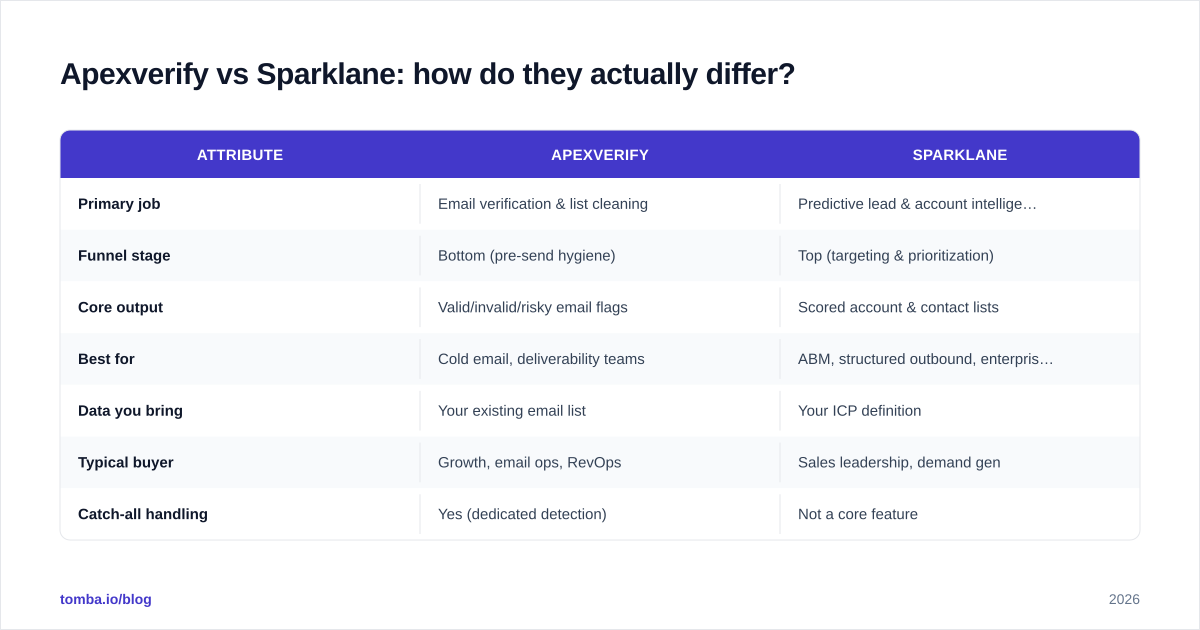
The cleanest way to see the difference is to map each tool to a stage in the outbound funnel. Verification sits at the bottom (protecting sends); intelligence sits at the top (choosing targets).
Here's the side-by-side:
| Attribute | Apexverify | Sparklane |
|---|---|---|
| Primary job | Email verification & list cleaning | Predictive lead & account intelligence |
| Funnel stage | Bottom (pre-send hygiene) | Top (targeting & prioritization) |
| Core output | Valid/invalid/risky email flags | Scored account & contact lists |
| Best for | Cold email, deliverability teams | ABM, structured outbound, enterprise SDR |
| Data you bring | Your existing email list | Your ICP definition |
| Typical buyer | Growth, email ops, RevOps | Sales leadership, demand gen |
| Catch-all handling | Yes (dedicated detection) | Not a core feature |
| Learning curve | Low | Medium-high |
The pattern is obvious once you see it: they rarely compete for the same line item in your budget. One is a scalpel for data quality, the other is a map for where to aim.

Which one is more accurate?#
Accuracy means different things for each tool, so a single number won't settle it.
For Apexverify, accuracy is measured by verification precision: how reliably it labels a valid mailbox as valid and a dead one as dead. Good verification engines land in the 95-99% range on deliverable detection, with the hardest cases being catch-all domains — servers that accept every address whether the mailbox exists or not. If a large share of your list lives on catch-all domains, you'll want a dedicated catch-all verifier layer regardless of which platform you choose.
For Sparklane, accuracy means signal relevance: how often a high-scored account actually turns into a real opportunity. That's harder to benchmark because it depends on your ICP, your market, and how fresh the underlying firmographic and intent data is. Intelligence data decays fast — a funding round from 18 months ago is noise, not a signal.
The honest takeaway: Apexverify's accuracy is measurable and comparable; Sparklane's is contextual and only provable in your own pipeline. Run a 30-day trial against closed-won data before trusting the scores.
How does pricing compare?#
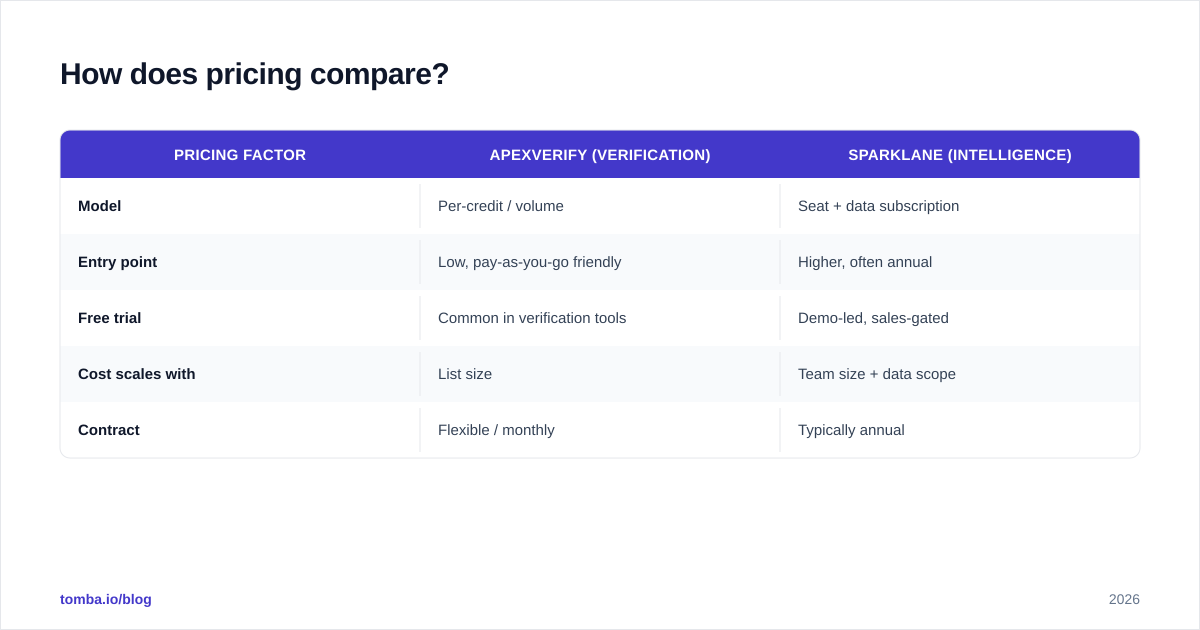
Neither vendor publishes fully transparent, self-serve pricing across all tiers, which is common in this category. Verification tools usually price per credit or per verified email; intelligence platforms price per seat plus a data subscription, often with an annual commitment.
| Pricing factor | Apexverify (verification) | Sparklane (intelligence) |
|---|---|---|
| Model | Per-credit / volume | Seat + data subscription |
| Entry point | Low, pay-as-you-go friendly | Higher, often annual |
| Free trial | Common in verification tools | Demo-led, sales-gated |
| Cost scales with | List size | Team size + data scope |
| Contract | Flexible / monthly | Typically annual |
As a rule, verification is a variable cost you can throttle, while intelligence platforms are a fixed investment you justify with pipeline. If budget is tight and you need quick wins, the verification side of the equation is far easier to expense and prove. For a transparent reference point on what bundled finding-plus-verification costs, see Tomba pricing — the Free tier covers 25 searches/month and Starter runs $49/mo.
Do you actually need both?#
Sometimes. But many teams over-buy here. Ask three questions:
- Are emails bouncing? If yes, you have a verification problem. Sparklane won't fix it.
- Is the pipeline full of bad-fit accounts? If yes, you have a targeting problem. Apexverify won't fix it.
- Do you even have contacts yet? If you're starting from a blank ICP, neither tool finds the emails — you'll still need a discovery step.
That third question trips up a lot of buyers. Verification assumes you have a list. Intelligence assumes you have contacts at the accounts it surfaces. Neither is a finder. You still need a way to turn "Company X looks great" into "here is the VP of Marketing's verified email."
That's where a discovery-first stack changes the math. Tools that combine an email finder, data enrichment, and an email verifier in one place collapse three line items into one and remove the handoff friction between targeting and sending.
Apexverify vs Sparklane: pros and cons#
A quick gut-check on the trade-offs each tool forces.
| Pros | Cons | |
|---|---|---|
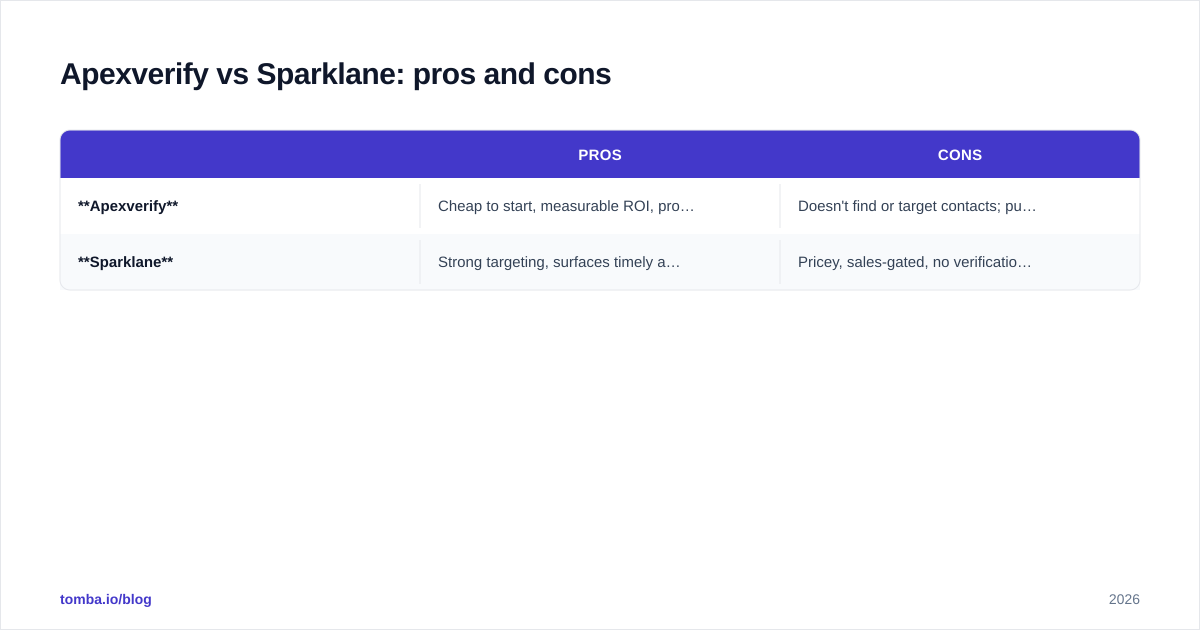
| Apexverify | Cheap to start, measurable ROI, protects deliverability, fast to deploy | Doesn't find or target contacts; pure hygiene layer |
| Sparklane | Strong targeting, surfaces timely accounts, good for ABM | Pricey, sales-gated, no verification, slower to value |
Apexverify wins on simplicity and immediate, provable impact. Sparklane wins when your problem is strategic — too many reps working too many wrong accounts. Neither replaces a contact-discovery engine.
What's the best workflow for each scenario?#
Map the tool to the motion. Here's how the pieces fit together in practice:
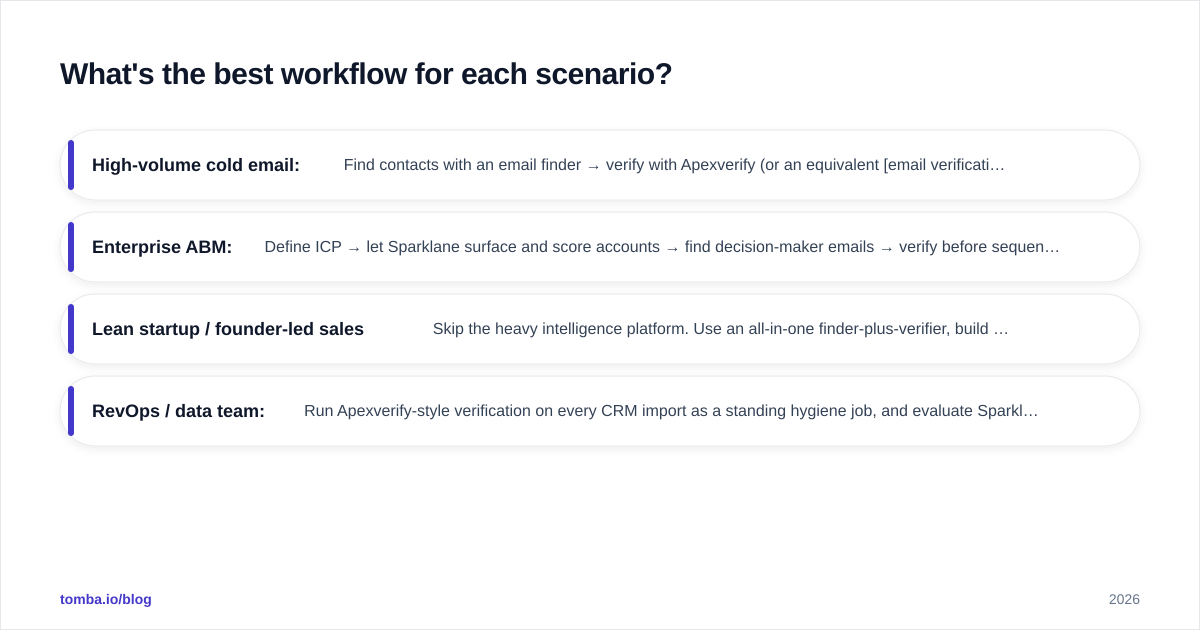
- High-volume cold email: Find contacts with an email finder → verify with Apexverify (or an equivalent email verification layer) → send. Targeting matters less than clean data and volume.
- Enterprise ABM: Define ICP → let Sparklane surface and score accounts → find decision-maker emails → verify before sequencing. Here intelligence earns its keep.
- Lean startup / founder-led sales: Skip the heavy intelligence platform. Use an all-in-one finder-plus-verifier, build a tight account list manually, and reinvest the saved budget into more outreach.
- RevOps / data team: Run Apexverify-style verification on every CRM import as a standing hygiene job, and evaluate Sparklane only if pipeline quality is the documented bottleneck.
The mistake to avoid is buying an intelligence platform to solve a deliverability problem, or buying a verifier and wondering why your targeting didn't improve. Diagnose the bottleneck first.
How does Tomba fit into this comparison?#
Tomba sits a step earlier than both tools — and quietly covers part of each. Apexverify cleans lists you already have; Sparklane tells you which accounts to chase. Tomba's job is the bridge: turning a company or a name into a verified, ready-to-send contact.
With domain search you pull every public email pattern at a target company. The built-in email verifier validates each address — including catch-all domains — so you don't need a separate hygiene tool for most use cases. And data enrichment fills in the firmographic and role context that makes targeting decisions easier, without a full intelligence-platform commitment.
It won't replace a deep ABM scoring engine like Sparklane for a 50-rep enterprise org. But for the large majority of teams, "find the right contact and confirm it's real" is the whole job — and bundling discovery, enrichment, and verification removes two vendors from the stack.
You can compare third-party reviews of all three categories on Capterra to sanity-check vendor claims before committing.
The verdict: which should you choose?#
Choose Apexverify if your single biggest pain is deliverability — bounces, blocklists, throttled sends — and you already have lists to clean. It's cheap, fast, and the ROI is obvious within a week.
Choose Sparklane if you run structured outbound or ABM at scale, your reps are drowning in undifferentiated accounts, and you can justify an annual data subscription with pipeline impact.
Choose neither yet if you're still finding contacts manually or starting from scratch. A combined finder-and-verifier covers discovery and hygiene in one move, and you can layer intelligence on later once your motion is proven.
The framing that matters: this is rarely "Apexverify vs Sparklane." It's "verification or intelligence — and what finds the contact in between."
Start with the contact, not the tool#
Before you weigh a verification subscription against an intelligence platform, make sure you can actually find the people you want to reach. The Tomba Email Finder turns a name, company, or domain into a verified professional email — with catch-all detection and enrichment built in — so you cover discovery, validation, and context in a single step. Start free with 25 searches a month, then scale on the $49/mo Starter plan when your outbound proves out. Find the right contact first; layer verification and intelligence only where they earn their keep.
// get started
Find, verify and enrich your first contacts today
Start on the free plan with 25 searches a month, then scale when your team is ready.
Free plan · No credit card required · GDPR & CCPA
// about the author