Apexverify vs Warpleads: B2B Lead Data Showdown for 2026
Apexverify verifies emails; Warpleads exports them in bulk. Here's the honest 2026 breakdown of where each wins, what each costs, and which one your pipeline actually needs.
You typed "Apexverify vs Warpleads" into a search bar because you are trying to fix the same problem every outbound team hits: your lead list looks great in a spreadsheet and falls apart the moment you hit send. Bounces climb, your domain reputation slips, and the "10,000 leads" you exported turn into maybe 4,000 people who can actually receive your email.
The fast answer: these two tools solve different halves of the same problem. Warpleads is built to source and export volume — large B2B lead lists, fast. Apexverify is built to clean and validate — confirm that the addresses you already have are real before you mail them. Comparing them head-to-head only makes sense once you understand that, so this post does both: where each tool wins on its own turf, and what happens when you try to use one to do the other's job.
TL;DR#
- Warpleads is a volume-first lead generation and export platform — its pitch is unlimited or high-volume exports for outbound campaigns. Best when you need raw quantity of B2B contacts quickly.
- Apexverify is an email verification tool — its job is reducing bounces by validating addresses before you send. Best when you already have lists and need them clean.
- They are complementary, not interchangeable: sourcing without verification burns your domain; verification without sourcing leaves you with nothing to send.
- On a pure cost-per-usable-contact basis, a combined finder-plus-verifier workflow (like Tomba Email Finder with built-in verification) often beats running two single-purpose tools.
- Pick by your bottleneck: no leads → sourcing tool; dirty leads → verifier; both → an integrated platform.
What is Apexverify and what does it actually do?#
Apexverify is positioned as an email verification and validation service. The core job is simple to describe and hard to do well: take an email address, decide whether sending to it is safe, and tell you why.
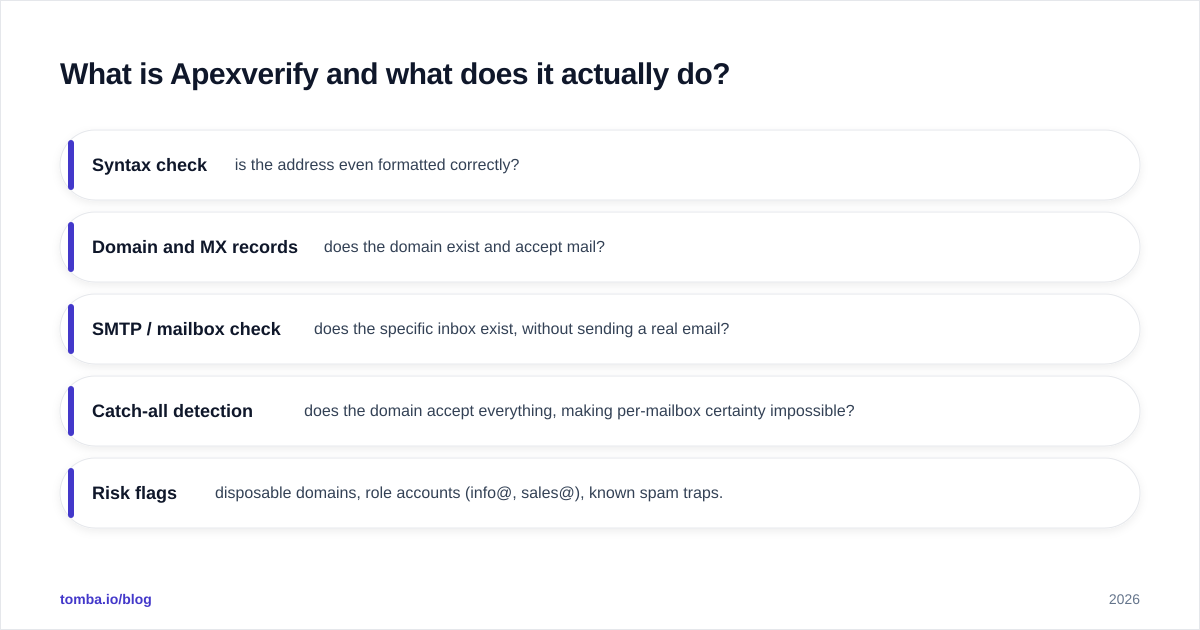
A real verifier runs a chain of checks, not a single lookup:
- Syntax check — is the address even formatted correctly?
- Domain and MX records — does the domain exist and accept mail?
- SMTP / mailbox check — does the specific inbox exist, without sending a real email?
- Catch-all detection — does the domain accept everything, making per-mailbox certainty impossible?
- Risk flags — disposable domains, role accounts (info@, sales@), known spam traps.
The output you care about is a status: valid, invalid, risky/catch-all, or unknown. The quality of a verifier is measured by how few "valid" addresses still bounce and how few good addresses it wrongly kills. If you want the textbook definition of the category, email verification on Wikipedia covers the SMTP mechanics in neutral terms.
Where Apexverify fits: you have a list — exported from LinkedIn, scraped, bought, or aged in your CRM — and you need to know what's safe to send before it touches your sending domain.
What is Warpleads and what does it actually do?#
Warpleads is a lead generation platform built around export volume. Its appeal is straightforward: get large quantities of B2B contact records (company, role, email) out of a database and into your sequencer without per-lead pricing strangling your campaigns.
For high-volume outbound — agencies running many client campaigns, SDR teams testing wide ICPs, founders who want to spray-and-measure before they niche down — the constraint is almost always "how many qualified contacts can I get out of this thing this month." Warpleads is designed to answer that with a big number.
But volume has a tax. Bulk B2B databases drift. People change jobs, companies fold, addresses go stale. Industry consensus from data vendors puts B2B contact decay at roughly 22–30% per year. So a fresh 10,000-record export is never 10,000 deliverable addresses on day one. That gap is exactly where a verifier — Apexverify, or a built-in one — earns its keep.
Apexverify vs Warpleads: how do they compare directly?#
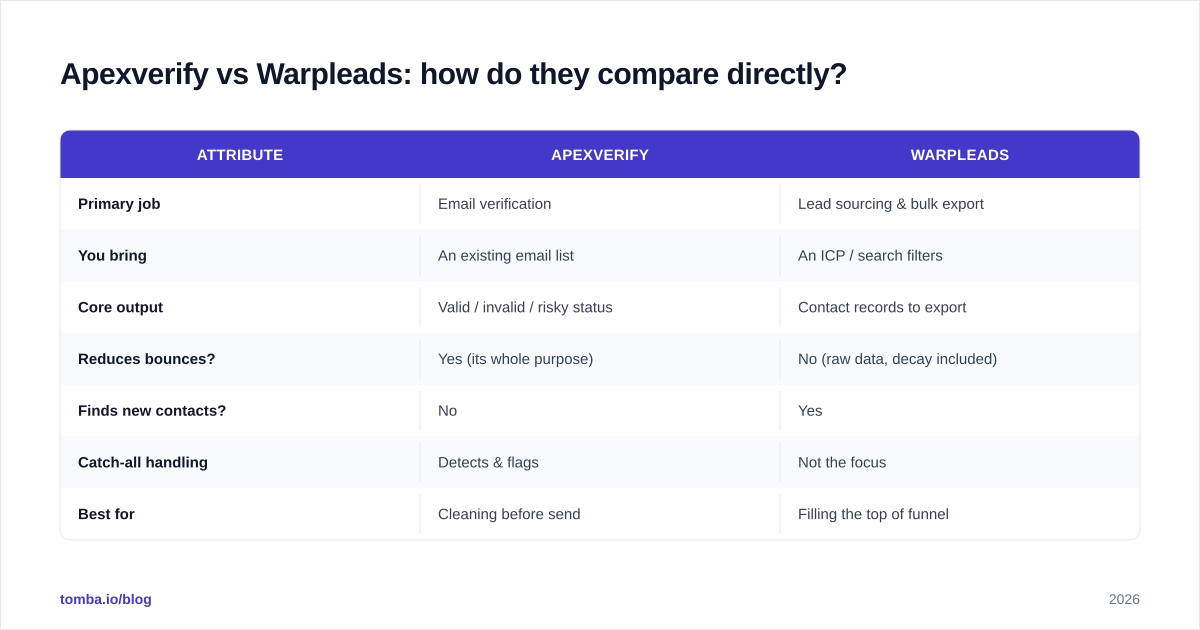
Here's the honest part — they're not really competitors, they're sequential steps. But you came for a table, so here's the head-to-head on the attributes that matter when you're choosing where to spend.
| Attribute | Apexverify | Warpleads |
|---|---|---|
| Primary job | Email verification | Lead sourcing & bulk export |
| You bring | An existing email list | An ICP / search filters |
| Core output | Valid / invalid / risky status | Contact records to export |
| Reduces bounces? | Yes (its whole purpose) | No (raw data, decay included) |
| Finds new contacts? | No | Yes |
| Catch-all handling | Detects & flags | Not the focus |
| Best for | Cleaning before send | Filling the top of funnel |
| Risk if used alone | Nothing to send | High bounce, domain damage |
The takeaway from the table: a column-by-column read shows almost no overlap. Warpleads has no row where it beats Apexverify on data quality, and Apexverify has no row where it produces leads. Choosing "one or the other" is the wrong frame for most teams. The right question is which gap is bigger in your funnel right now.
Which one is more accurate?#
Accuracy means two different things here, so don't let a single number fool you.
For Warpleads, accuracy = how many exported records are still real and deliverable. This is a freshness-and-coverage question, and no pure sourcing tool escapes contact decay. A big export with no verification layer will always include a meaningful slice of dead addresses.
For Apexverify, accuracy = how well it separates deliverable from undeliverable without false positives (good addresses marked bad) or false negatives (bad addresses marked good). The hard case for every verifier is the catch-all domain, where the server accepts all mail and a standard SMTP probe can't confirm a specific mailbox. This is where verifiers genuinely differ, and it's worth testing with a catch-all-heavy sample before you commit.

The practical move: run a known-good test list of ~500 addresses (people you've successfully emailed) through any verifier and measure how many it wrongly flags. A verifier that kills your good contacts is more expensive than one that occasionally passes a dud. If catch-all domains dominate your market, lean on a dedicated catch-all verifier rather than trusting a generic valid/invalid flag.
How do they price out for real campaigns?#
Pricing models differ in kind, not just amount, which makes raw sticker comparison misleading.
- Warpleads sells on export volume — the value is high or "unlimited" exports for a flat fee, so cost-per-lead trends toward zero at scale. The hidden cost is the verification you still have to add.
- Apexverify sells on verification credits — you pay per address checked. Cost scales with list size, and you only pay for cleaning, not finding.
- Tomba bundles finding and verifying together: a Free tier (25 searches/mo), Starter at $49/mo, Growth at $99/mo, Pro at $249/mo, and custom Enterprise. See full Tomba pricing for credit allocations per tier.
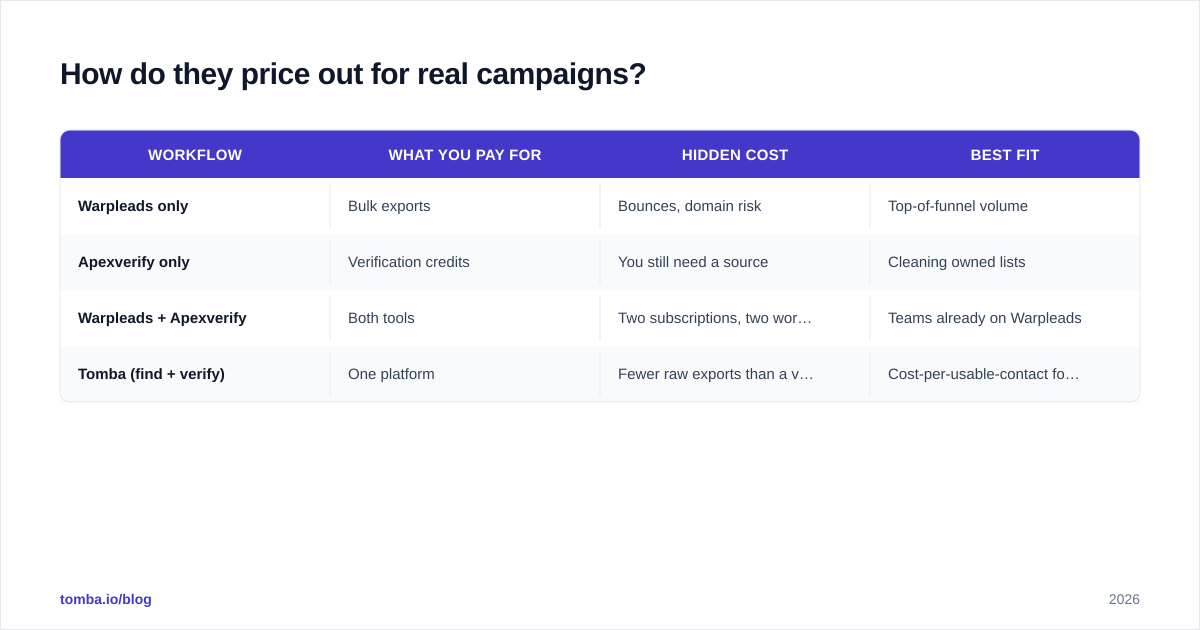
Here's the part most "vs" posts skip: the metric that matters is cost per usable contact, not cost per export or cost per check. Stack the workflow and the math changes.
| Workflow | What you pay for | Hidden cost | Best fit |
|---|---|---|---|
| Warpleads only | Bulk exports | Bounces, domain risk | Top-of-funnel volume |
| Apexverify only | Verification credits | You still need a source | Cleaning owned lists |
| Warpleads + Apexverify | Both tools | Two subscriptions, two workflows | Teams already on Warpleads |
| Tomba (find + verify) | One platform | Fewer raw exports than a volume tool | Cost-per-usable-contact focus |
If you're already running Warpleads and just need cleaner sends, adding a verifier is the cheap fix. If you're building the stack from scratch, an integrated finder-verifier usually wins on total cost and on workflow simplicity — one tool, one credit pool, one export.
What's the right way to combine sourcing and verification?#
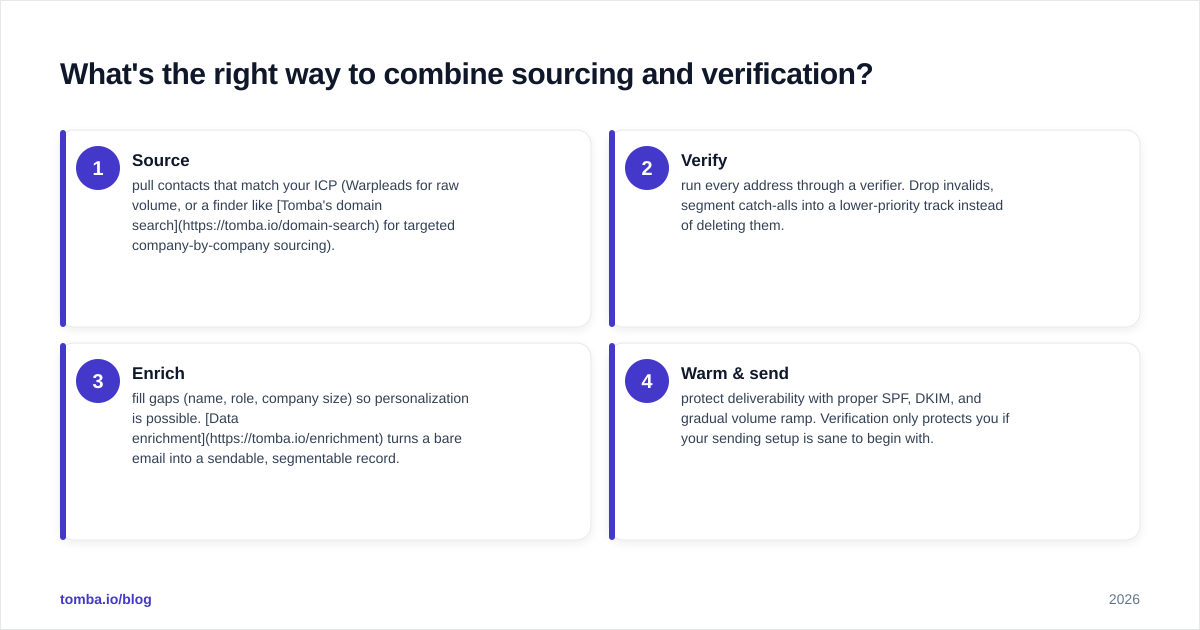
Conclusion first: never send to an unverified bulk export. Treat sourcing and verification as one pipeline, not two purchases. Here's the framework that keeps your domain healthy.
- Source — pull contacts that match your ICP (Warpleads for raw volume, or a finder like Tomba's domain search for targeted company-by-company sourcing).
- Verify — run every address through a verifier. Drop invalids, segment catch-alls into a lower-priority track instead of deleting them.
- Enrich — fill gaps (name, role, company size) so personalization is possible. Data enrichment turns a bare email into a sendable, segmentable record.
- Warm & send — protect deliverability with proper SPF, DKIM, and gradual volume ramp. Verification only protects you if your sending setup is sane to begin with.
This is the sequence that separates teams who get replies from teams who get blacklisted. The order is not optional: sourcing without step 2 is how you torch a domain in a week.

For deeper context on why step 4 matters as much as the data itself, HubSpot's research on email deliverability and peer reviews on G2 are useful neutral references when you're evaluating any tool in this category.
When should you pick Apexverify over Warpleads (and vice versa)?#
Decide by your current bottleneck, not by which brand markets harder.
Pick Warpleads when:
- Your problem is "not enough leads." You have a sequencer and a verification step ready, and the empty top of the funnel is what's hurting you.
- You run high-volume, multi-client outbound where per-lead pricing would bankrupt the model.
- You're comfortable adding a separate verification layer on top.
Pick Apexverify when:
- Your problem is "dirty leads." You already have lists — CRM exports, old purchases, scraped data — and your bounce rate is the bleeding wound.
- You want a focused, single-purpose verifier and don't need it to find anything.
- You verify in bursts and prefer pay-per-check credits over a volume subscription.
Pick an integrated platform (like Tomba) when:
- You want sourcing and verification in one workflow, one credit pool, and one export.
- You care about cost-per-usable-contact more than cost-per-raw-export.
- You also need adjacent jobs — bulk email finding, reverse email lookup, or API access for your own tooling — without bolting on a third vendor.
Frequently asked questions#
Is Apexverify a Warpleads alternative? Not really. Apexverify verifies; Warpleads sources. They sit in different stages of the same pipeline. A true alternative to either is a tool that does both — an integrated finder-verifier.
Can I use Warpleads without a verifier? You can, but you shouldn't. Raw bulk exports carry contact decay and catch-alls that will spike your bounce rate and damage sender reputation. Always verify before you send.
Does verification guarantee deliverability? No. Verification removes bad addresses; it doesn't fix bad sending infrastructure. You still need SPF/DKIM, a warmed domain, and reasonable volume ramps. Verification is necessary, not sufficient.
What about catch-all domains? Standard verification can't confirm individual mailboxes on a catch-all domain. Segment those into a lower-priority track and use a dedicated catch-all tool rather than guessing.
The bottom line#
Apexverify and Warpleads aren't rivals — they're two steps in the workflow that turns a search filter into a delivered email. Warpleads fills the top of the funnel with volume; Apexverify keeps that volume from wrecking your domain. Run one without the other and you've only solved half the problem.
If you'd rather not stitch two subscriptions and two workflows together, that's exactly what an integrated platform is for. Tomba Email Finder finds professional addresses by domain, name, or company and verifies them in the same pass — so the list you export is the list you can actually send to. Start free with 25 searches a month, and scale to Starter at $49/mo when your pipeline grows. One tool, verified leads, no second vendor to babysit.
// get started
Find, verify and enrich your first contacts today
Start on the free plan with 25 searches a month, then scale when your team is ready.
Free plan · No credit card required · GDPR & CCPA
// about the author