Apexverify vs ZoomInfo 2026: B2B Data Tools Compared
Apexverify vs ZoomInfo, head to head on accuracy, pricing, coverage, and contracts, so you can pick the B2B data tool that actually fits your outbound motion in 2026.
You are weighing Apexverify vs ZoomInfo because one promises clean, verified emails and the other promises an entire sales-intelligence database, and your budget can't pretend they're the same purchase. They aren't. This breakdown shows where each tool earns its keep, where it overcharges, and which one belongs in your 2026 stack.
TL;DR#
- Apexverify is a focused email-verification and finder tool: cheap, fast, month-to-month, best when you already have a list of names or domains and need clean, deliverable addresses.
- ZoomInfo is a heavyweight sales-intelligence platform: company firmographics, intent data, org charts, and phone numbers, sold on annual contracts that routinely start in the five figures.
- If your bottleneck is deliverability and verified contacts, Apexverify (or a leaner finder) wins on cost per usable email.
- If your bottleneck is discovering net-new accounts and buying signals, ZoomInfo's database depth is hard to match, but you pay for all of it whether you use it or not.
- Most teams overspend by buying ZoomInfo for a job a $49/month finder-verifier does better. Match the tool to the bottleneck, not the brand name.
What is Apexverify and who is it for?#
Apexverify positions itself as an email-verification and lookup tool. The core jobs are simple and narrow: take an email and tell you whether it's deliverable, or take a name plus a company domain and return the likely address. It checks syntax, MX records, SMTP response, catch-all status, and known-bounce patterns, then hands back a confidence signal.
That narrowness is the point. You're not paying for intent scores, org charts, or a 100-million-record database. You're paying to stop sending mail into the void. For a lean SDR team, a recruiter, or a founder running outbound personally, that's often the only data problem that actually matters week to week.
Where Apexverify struggles is discovery. It validates and finds against inputs you already have. If you don't yet know which companies or people to target, a verifier can't manufacture a market map for you. That's ZoomInfo's territory.
What is ZoomInfo and who is it for?#
ZoomInfo is a sales-intelligence platform, not a verification utility. Its value is breadth: contact records, company firmographics, technographics, org hierarchies, scoops (sales-trigger news), and intent data signaling which accounts are researching topics like yours. Enterprise GTM teams use it to build territories, route leads, and feed CRM enrichment at scale.
That breadth comes with enterprise commercial terms. ZoomInfo is sold via annual contracts, typically with seat minimums and credit caps, and pricing is famously opaque, frequently landing well into five figures per year. You can confirm the platform scope on the official ZoomInfo site, and you'll find candid reviews of both the data quality and the contract experience on G2.
The catch every buyer eventually meets: ZoomInfo's contact data still needs verification before you send. Database records decay roughly 2–3% per month as people change jobs, so even a premium platform doesn't free you from a verification step. You're buying discovery, not a guarantee of deliverability.

Apexverify vs ZoomInfo: the core difference#
The mistake is treating these as competitors. They solve different halves of the pipeline.
- Apexverify answers: "Is this address real, and what is it?" — a quality gate.
- ZoomInfo answers: "Who should I be talking to, and why now?" — a discovery engine.
If you put them on the same axis, you'll either overpay (buying ZoomInfo to clean a list) or under-equip (expecting a verifier to build your TAM). The right question isn't "which is better," it's "which problem is currently costing me the most pipeline."
How do Apexverify and ZoomInfo compare on features and price?#
| Attribute | Apexverify | ZoomInfo | Tomba |
|---|---|---|---|
| Primary job | Email verify + find | Sales intelligence DB | Email find + verify |
| Net-new account discovery | No | Yes (deep) | Domain search, limited |
| Email verification | Yes (core) | Add-on / partial | Yes (core) |
| Phone numbers | No | Yes | Yes (phone finder) |
| Intent data | No | Yes | No |
| Contract | Month-to-month | Annual, seat minimums | Month-to-month |
| Free tier | Limited | No | 25 searches/mo |
| Entry price | Low monthly | Often $15K+/yr | $49/mo Starter |
| Best for | List hygiene | Enterprise GTM | SMB outbound + enrichment |
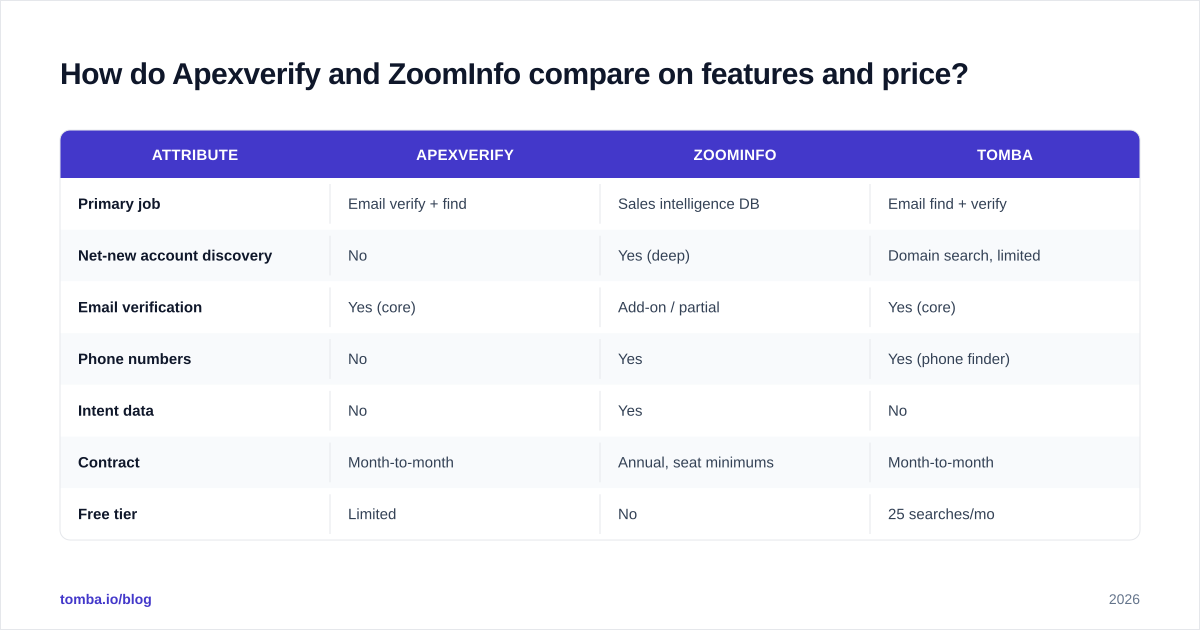
The pattern is clear: Apexverify and Tomba compete on cost per verified contact, while ZoomInfo competes on database breadth and signals. If you only need the former, paying for the latter is a budget leak.

Which tool has better data accuracy?#
Accuracy splits into two questions, and each tool wins a different one.
Deliverability accuracy — will the address bounce? Here a dedicated verifier wins because that's the entire product. Apexverify's SMTP-level checks, catch-all detection, and bounce-pattern matching are tuned for exactly this. ZoomInfo gives you a record, but a record pulled six weeks ago isn't a live deliverability check.
Coverage accuracy — do they have the contact at all? ZoomInfo's scale wins here for obscure mid-market and enterprise roles, simply because the database is enormous.
The honest takeaway: no single vendor is "most accurate" across both axes. That's why mature teams layer a discovery source with a verification source rather than betting everything on one platform. A verified email is worth more than a found email, and a found-and-verified email is worth most of all. If you want to see how independent finders stack up on deliverable-rate, the comparison below is a useful reference point.

You can pressure-test any record yourself with a free email checker before committing budget to a platform that claims its data is already clean.
When does ZoomInfo justify its price?#
ZoomInfo earns its premium in specific conditions:
- You run account-based marketing at scale and need intent signals to time outreach.
- Your TAM is genuinely unknown and you need to build territories from firmographic filters.
- You have a RevOps team to operationalize enrichment, routing, and CRM sync, so the platform's depth gets used instead of shelved.
- Your average deal size makes a five-figure data spend a rounding error.
If three or more of those describe you, ZoomInfo's breadth is a real advantage, and a verifier alone won't replace it. Check current scope and terms on Capterra before signing, because the contract is the part buyers regret most.

When is Apexverify (or a lean finder) the smarter buy?#
Flip the conditions and the math inverts:
- You already know your target accounts and just need clean, deliverable addresses.
- You send cold email and live or die by bounce rate and sender reputation.
- You want month-to-month flexibility, not an annual lock-in.
- Your volume is hundreds to low-thousands of contacts a month, not millions.
In that world, paying enterprise prices for intent data you'll never open is pure waste. A focused verifier — or a finder-verifier combo — gets you the same usable inbox hits at a fraction of the spend. Run your candidates through a proper email verifier and you protect deliverability without the contract.
Where does Tomba fit in the Apexverify vs ZoomInfo decision?#
Tomba sits deliberately between the two. It's not a heavyweight intelligence suite, and it's not verification-only. You get an email finder that locates addresses by name, company, or domain, plus built-in verification, domain search to map every public address at a company, a phone finder, and data enrichment to fill in the gaps on records you already hold.
The commercial model is the part most teams care about. Tomba pricing runs on simple monthly tiers:
| Plan | Price | Best for |
|---|---|---|
| Free | $0 (25 searches/mo) | Testing the data |
| Starter | $49/mo | Solo founders, small SDR teams |
| Growth | $99/mo | Scaling outbound |
| Pro | $249/mo | High-volume teams |
| Enterprise | Custom | Large GTM orgs |
No annual lock-in, a real free tier to validate the data before you pay, and find-plus-verify in one place. For the teams who'd otherwise overbuy
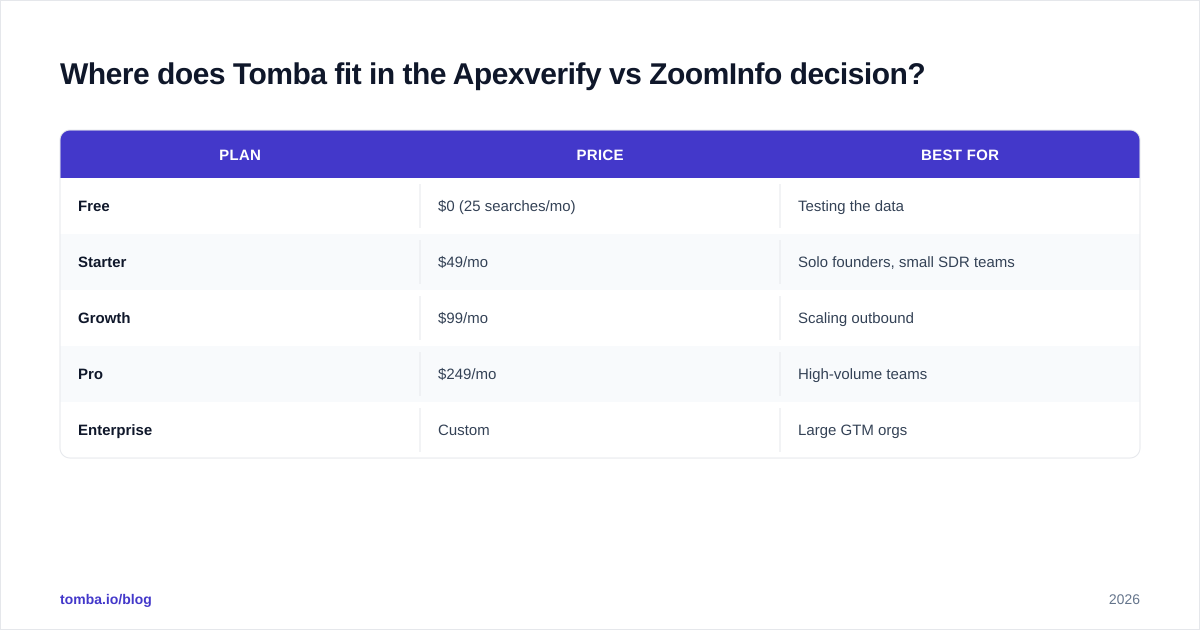
ZoomInfo to do a finder's job, that's the gap Tomba fills.
How should you choose in 2026?#
Decide by bottleneck, in this order:
- Can't find the right accounts? That's a discovery problem.
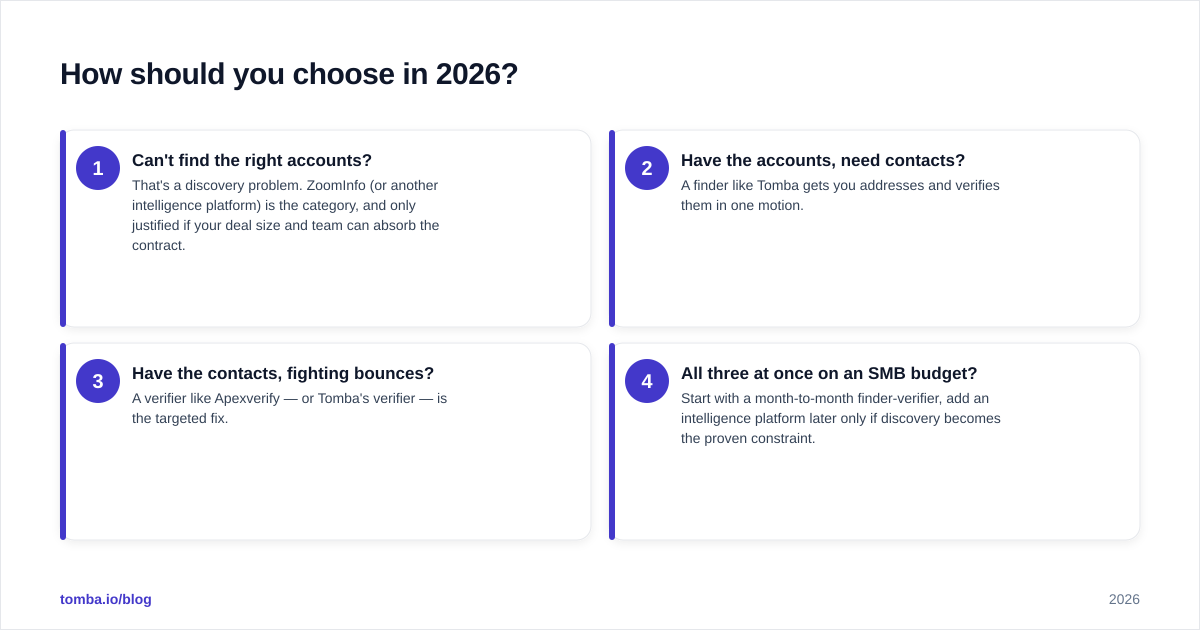
ZoomInfo (or another intelligence platform) is the category, and only justified if your deal size and team can absorb the contract. 2. Have the accounts, need contacts? A finder like Tomba gets you addresses and verifies them in one motion. 3. Have the contacts, fighting bounces? A verifier like Apexverify — or Tomba's verifier — is the targeted fix. 4. All three at once on an SMB budget? Start with a month-to-month finder-verifier, add an intelligence platform later only if discovery becomes the proven constraint.
The expensive error is buying top-of-funnel breadth to solve a bottom-of-funnel deliverability problem. Map the spend to the actual gap.
The bottom line#
Apexverify and ZoomInfo aren't really rivals: one is a verification scalpel, the other a sales-intelligence battleship. Buy the scalpel when your problem is clean, deliverable contacts and a sane monthly bill. Buy the battleship only when net-new account discovery and intent signals are the proven constraint and your deal economics support an annual contract.
If you want one tool that finds the email and verifies it without locking you into a contract, start with the Tomba Email Finder. Use the free 25-search tier to test the data against your own target list, then scale to the $49/month Starter plan only once it's paying for itself, no annual commitment, no five-figure surprise.
Ready to find emails that actually work?
Join 150,000+ professionals who stopped guessing and started sending. Free credits on signup — no credit card required.
Get the Tomba newsletter
Practical outbound tactics and product updates — once every two weeks.
About the author