9 Best Apify Alternatives for Web Scraping in 2026
Apify is powerful but not for everyone. Compare 9 Apify alternatives for web scraping, automation, and lead data — by pricing, ease of use, and scale.
TL;DR
- Apify is a flexible scraping-and-automation cloud, but its actor/credit model gets expensive and steep for non-developers.
- The best Apify alternatives split into three camps: no-code scrapers (Octoparse, ParseHub), developer APIs (ScrapingBee, Zyte, Scrapingdog), and enterprise proxy networks (Bright Data, Oxylabs).
- Pick by who's doing the work: marketers want point-and-click, engineers want a clean API, and data teams want raw proxy scale.
- Scraping is only half the job — raw HTML still has to become verified, usable contact data before sales can touch it.
- If your goal is B2B leads rather than generic page data, a dedicated enrichment layer beats wiring a scraper to do detective work it was never built for.
What is Apify and why look for alternatives?#
Apify is a cloud platform for web scraping and browser automation. You either run pre-built "actors" from its store or write your own in JavaScript/Python, then schedule them and pull structured data out. It is genuinely good software. The reason people search for Apify alternatives usually comes down to four friction points.
First, pricing. Apify runs on a compute-unit and actor-rental model that is hard to forecast. A job that looks cheap in testing can balloon once you scale runs, add proxies, and pay per-actor rental fees on top of the platform plan. Second, the learning curve. Getting real value out of Apify rewards people who can read code; the no-code path exists but feels bolted on. Third, you are renting other people's actors, which means your pipeline depends on a third-party maintainer keeping their scraper alive. Fourth — and this is the big one for sales teams — Apify gives you pages, not people. It hands back HTML and JSON. Turning that into a clean, deliverable contact list is a separate problem entirely.
None of that makes Apify bad. It makes it a specific tool for a specific buyer. If you are not that buyer, the right move is to match a different tool to the job you actually have.
What should you look for in an Apify alternative?#
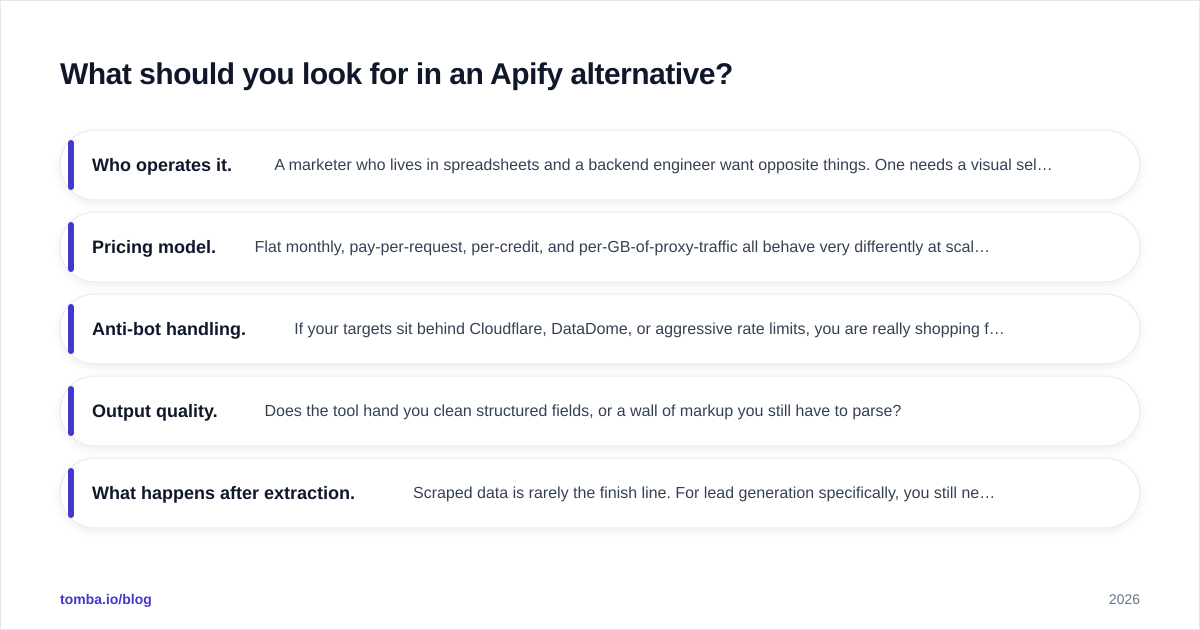
Before comparing logos, get honest about which of these you actually need:
- Who operates it. A marketer who lives in spreadsheets and a backend engineer want opposite things. One needs a visual selector; the other needs a documented REST endpoint and a rate limit they can reason about.
- Pricing model. Flat monthly, pay-per-request, per-credit, and per-GB-of-proxy-traffic all behave very differently at scale. Per-request pricing is predictable; compute-unit pricing rewards optimization but punishes mistakes.
- Anti-bot handling. If your targets sit behind Cloudflare, DataDome, or aggressive rate limits, you are really shopping for proxy rotation and JavaScript rendering, not a scraper UI.
- Output quality. Does the tool hand you clean structured fields, or a wall of markup you still have to parse?
- What happens after extraction. Scraped data is rarely the finish line. For lead generation specifically, you still need to find work emails, verify them, and enrich the record before anyone sends a message.
That last point is where most "scrape my way to leads" projects quietly fail, so we'll come back to it.
What are the best Apify alternatives in 2026?#
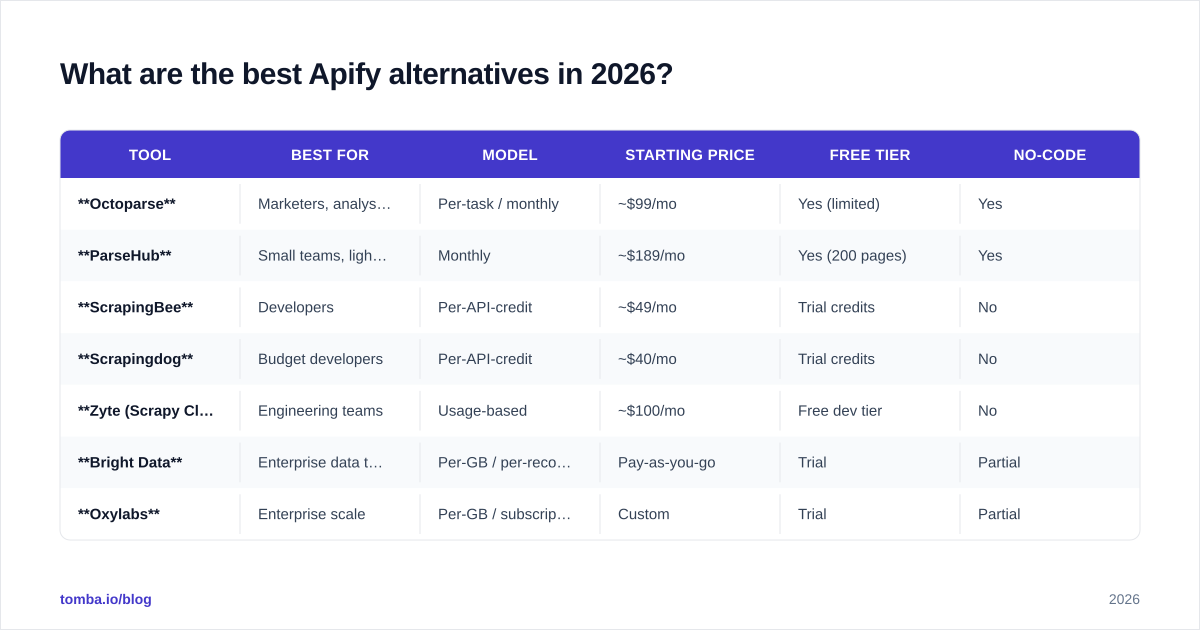
Here is the short list, grouped by the kind of buyer each one fits. Pricing is starting tier and changes often — treat it as a ballpark, not a quote.
| Tool | Best for | Model | Starting price | Free tier | No-code |
|---|---|---|---|---|---|
| Octoparse | Marketers, analysts | Per-task / monthly | ~$99/mo | Yes (limited) | Yes |
| ParseHub | Small teams, light jobs | Monthly | ~$189/mo | Yes (200 pages) | Yes |
| ScrapingBee | Developers | Per-API-credit | ~$49/mo | Trial credits | No |
| Scrapingdog | Budget developers | Per-API-credit | ~$40/mo | Trial credits | No |
| Zyte (Scrapy Cloud) | Engineering teams | Usage-based | ~$100/mo | Free dev tier | No |
| Bright Data | Enterprise data teams | Per-GB / per-record | Pay-as-you-go | Trial | Partial |
| Oxylabs | Enterprise scale | Per-GB / subscription | Custom | Trial | Partial |
| Browse AI | No-code monitoring | Per-credit | ~$48/mo | Yes (50 credits) | Yes |
| Tomba | B2B contact data | Per-search / monthly | $49/mo | Yes (25/mo) | Yes |
Octoparse — the no-code default#
Octoparse is the tool most non-engineers reach for when they bounce off Apify. It is a point-and-click desktop and cloud scraper: you load a page, click the elements you want, and it builds the extraction logic for you. Templates cover common targets like e-commerce listings and directories. It struggles with the gnarliest anti-bot setups and the pricing climbs once you need cloud concurrency, but for "I need this table off this site every week" it is hard to beat on simplicity.
ParseHub — flexible visual scraping#
ParseHub plays in the same no-code lane as Octoparse with a generous-ish free tier (200 pages per run) and a strong visual editor that handles interactive sites, dropdowns, and infinite scroll well. The trade-off is speed and a paid tier that jumps quickly. Good for prototypes and modest recurring jobs.
ScrapingBee and Scrapingdog — APIs for developers#
If you can write code and just want the proxy/headless-browser headache to disappear, these are the cleanest swaps for Apify. You send a URL to one API endpoint, they handle rotating proxies, JavaScript rendering, and CAPTCHAs, and you get HTML or JSON back. ScrapingBee bills per API credit with rendering costing more credits; Scrapingdog is the budget-leaning equivalent. No actor store, no compute units — just a request and a response.
Zyte — the Scrapy heavyweight#
Zyte is built by the team behind Scrapy, the open-source Python scraping framework. Its Scrapy Cloud plus smart-proxy and automatic-extraction products are aimed squarely at engineering teams running scraping as real infrastructure. More setup than an API, more control than a no-code tool.
Bright Data and Oxylabs — enterprise proxy networks#
When the bottleneck is getting blocked rather than parsing the page, you are shopping for proxies. Bright Data and Oxylabs run massive residential and datacenter proxy networks plus ready-made scraper APIs and pre-collected datasets. They are powerful and priced like it — usually per gigabyte of traffic or per record — which is overkill for a marketer pulling a few hundred rows but exactly right for a data team collecting at serious volume.
Browse AI — monitoring and no-code robots#
Browse AI leans into a specific use case: train a "robot" to extract data, then monitor a page for changes and get alerted. It is friendly, credit-based, and great for tracking competitor prices or job boards, less suited to one giant bulk crawl.
How do these Apify alternatives compare on the things that actually break?#
Feature lists hide where projects die. Three failure modes matter more than the marketing:
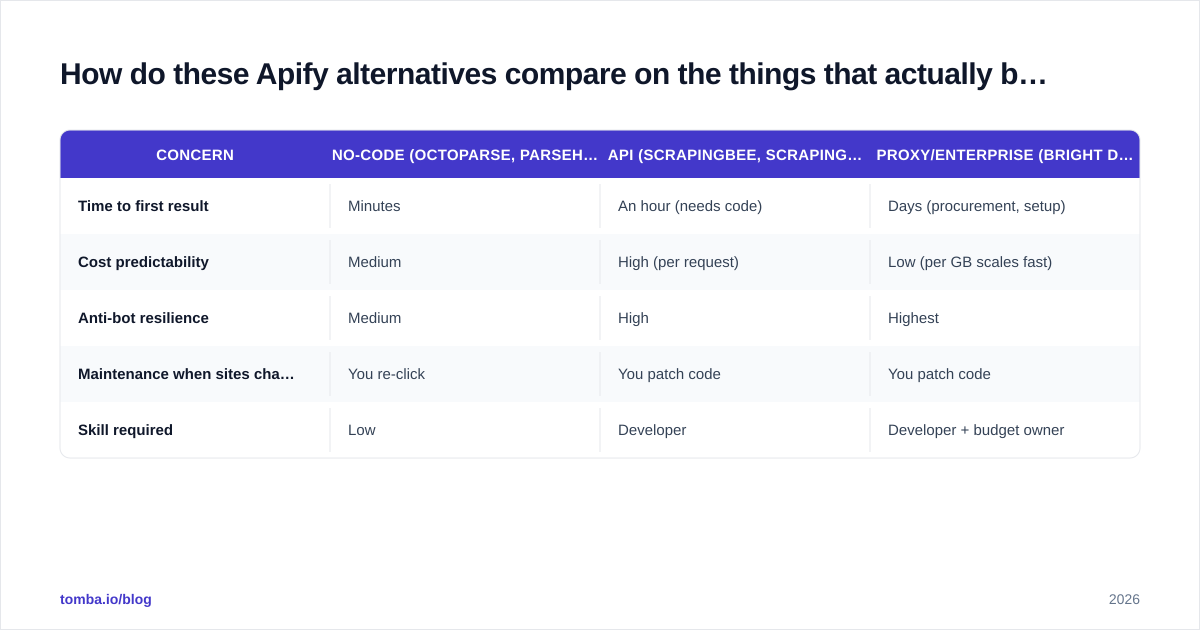
| Concern | No-code (Octoparse, ParseHub) | API (ScrapingBee, Scrapingdog) | Proxy/Enterprise (Bright Data, Oxylabs) |
|---|---|---|---|
| Time to first result | Minutes | An hour (needs code) | Days (procurement, setup) |
| Cost predictability | Medium | High (per request) | Low (per GB scales fast) |
| Anti-bot resilience | Medium | High | Highest |
| Maintenance when sites change | You re-click | You patch code | You patch code |
| Skill required | Low | Developer | Developer + budget owner |
The honest summary: no-code tools win on speed-to-value and lose on hard targets. APIs win on predictability and require a developer. Enterprise proxy networks win on scale and lose on cost and simplicity. There is no single "best Apify alternative" — there is the one that matches your team and target sites. Compare current user sentiment on G2 and Capterra before you commit, since reliability on specific sites changes month to month.
What about turning scraped data into usable leads?#
Here is the trap almost every "scrape leads with Apify" project falls into: you build the scraper, it runs, and you end up with a CSV of company names and URLs — and no way to actually reach a human. Scraping the page was never the hard part. Finding the right person's verified work email is.
This is where a scraping tool and a contact-data tool are genuinely different products. A scraper extracts whatever is rendered on a page. It does not know which of info@, firstname.lastname@, or f.lastname@ actually lands in an inbox, and it cannot verify deliverability. Send to guessed addresses and you torch your sender reputation fast.
So a lot of teams end up running a two-step pipeline: a scraper for the raw web data, then a dedicated layer to find and verify the contacts. That second layer is exactly what Tomba's email finder is built for. Feed it a company domain and it returns the real email patterns and named contacts; run those through the email verifier to drop bounces before you send. For bigger lists, the bulk email finder processes thousands of rows at once, and data enrichment fills in job titles, social profiles, and company details on the skeleton your scraper produced.
If your end goal is reaching people, that split — scrape for context, enrich for contact — beats forcing a general-purpose crawler to do verification work it was never designed for. And if you'd rather skip scraping for visitors entirely, website visitor reveal identifies anonymous traffic without any crawl at all.
How does Apify itself stack up against these alternatives?#
To keep this fair: Apify is still the most flexible option on the list. Its actor model means almost anything is scriptable, the store saves you from building common scrapers from scratch, and its scheduling and integration story is mature. You can read the full feature set on the official Apify site.
The case for switching is narrow and specific:
- You're not a developer → Octoparse, ParseHub, or Browse AI remove the code entirely.
- You want predictable per-request billing → ScrapingBee or Scrapingdog beat compute units.
- You're fighting heavy anti-bot defenses at scale → Bright Data or Oxylabs out-muscle a general platform.
- Your real goal is verified B2B contacts, not raw pages → a contact-data platform like Tomba does the part scrapers can't.
If none of those describe you, staying on Apify is a perfectly reasonable answer. Tooling decisions should follow the job, not the hype.
Which Apify alternative should you choose?#
Decide in one pass:
- Are you writing code? No → Octoparse or ParseHub. Yes → keep going.
- Do you want a single API call or a framework? API → ScrapingBee / Scrapingdog. Framework →
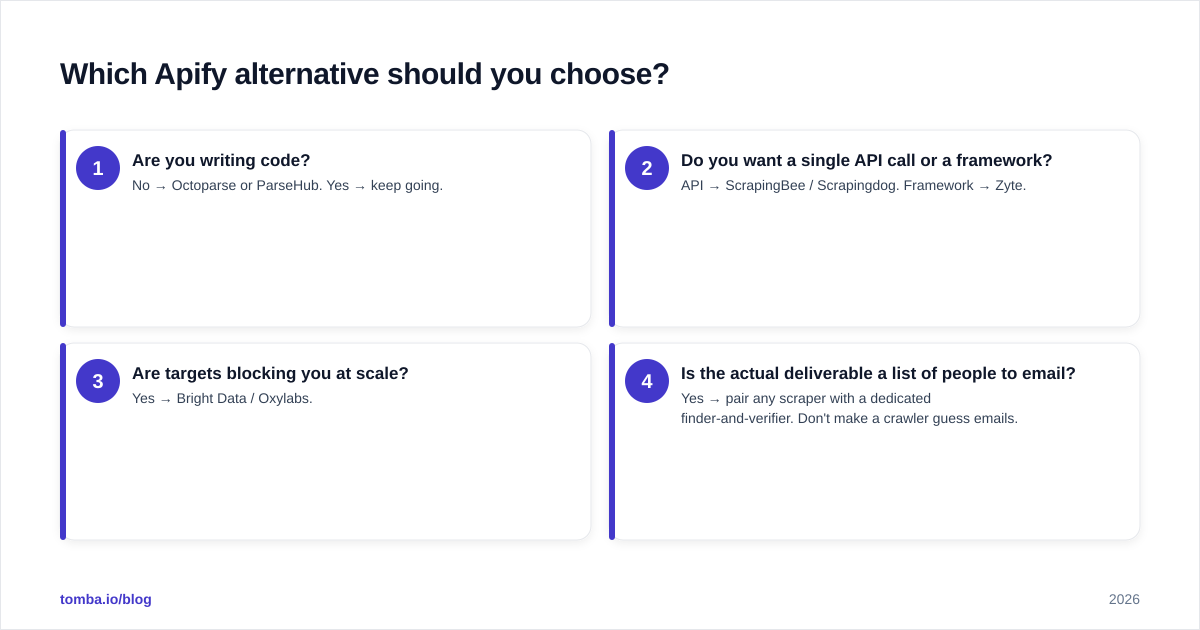
Zyte. 3. Are targets blocking you at scale? Yes → Bright Data / Oxylabs. 4. Is the actual deliverable a list of people to email? Yes → pair any scraper with a dedicated finder-and-verifier. Don't make a crawler guess emails.
Match the tool to step you're stuck on. The biggest waste in this space is buying enterprise proxy infrastructure to extract data a no-code robot could've grabbed in ten minutes — or scraping a thousand pages only to realize you never had a way to contact anyone on them.
Frequently asked questions#
Is there a free Apify alternative? Yes. Octoparse, ParseHub (200 pages/run), and Browse AI (50 credits) all have free tiers for light use. For contact data, Tomba's free plan includes 25 searches a month, and most scraping APIs ship trial credits.
What's the cheapest Apify alternative for developers? Scrapingdog and ScrapingBee tend to be the most cost-predictable because they bill per API request rather than per compute unit, so you always know what a job costs before you run it.
Can I use these tools to build a sales lead list? You can scrape the source pages, but a scraper alone won't give you verified emails. Pair it with a finder/verifier, or use the Tomba API to find and validate contacts directly from a domain or name.
Are web scrapers legal? Scraping publicly available data is broadly permitted in many jurisdictions, but terms of service, rate limits, and personal-data laws (GDPR, CCPA) all apply. See the general background on web scraping and always check the target site's terms.
The bottom line#
The best Apify alternative is the one that matches who's doing the work and what the finished data needs to be. No-code tools win on speed, APIs win on predictability, proxy networks win on scale — and if the real deliverable is people you can actually email, none of them finish the job on their own.
That last mile is the whole point of Tomba's Email Finder: turn the domains and companies your scraper collects into verified, deliverable contacts your team can act on. Start free with 25 searches a month, scale to the $49/mo Starter plan when your pipeline grows, and stop letting good scraped data die in a CSV nobody can send to.
// get started
Find, verify and enrich your first contacts today
Start on the free plan with 25 searches a month, then scale when your team is ready.
Free plan · No credit card required · GDPR & CCPA
Get the Tomba newsletter
Product and data updates
// about the author