Apify vs Octoparse 2026: Which Web Scraping Tool Wins?
Apify vs Octoparse compared on pricing, ease of use, scale, and B2B data quality. See which web scraper fits your team in 2026 — and what to do after the scrape.
TL;DR
- Apify is a developer-first scraping and automation cloud built around reusable "Actors," proxies, and a real API. Pick it when you need scale, custom logic, or to pipe data into other systems.
- Octoparse is a no-code, point-and-click desktop+cloud scraper. Pick it when non-engineers need structured data from a handful of sites without writing code.
- On price, Octoparse has a simpler tiered subscription; Apify uses usage-based pricing (compute units + proxy traffic) that's cheaper at small scale and more predictable for engineers.
- Both stop at "raw data." Neither verifies that a scraped email actually exists — that's where a dedicated tool like a real email verifier earns its keep.
- For B2B contact data specifically, scraping is the messy first mile; enrichment and verification are what make the list usable.
What are Apify and Octoparse?#
Apify and Octoparse solve the same core problem — turning web pages into structured rows — but they aim at opposite users.
Apify is a cloud platform for web scraping and browser automation. Its unit of work is an Actor: a containerized program (often Node.js or Python, frequently built on Playwright or Puppeteer) that you run on demand or on a schedule. Apify ships a marketplace of pre-built Actors (Google Maps, Instagram, Amazon, generic crawlers), a rotating proxy network, storage for datasets, and a full REST API. It's built so that a developer — or a non-developer borrowing someone else's Actor — can scrape at scale and wire the output into a pipeline.
Octoparse is a no-code scraper. You load a target page in its visual interface, click the elements you want, and it builds an extraction workflow for you. It runs locally or in Octoparse's cloud, handles pagination and basic anti-blocking, and exports to Excel, CSV, or databases. The whole pitch is "no coding required," which is exactly why analysts, marketers, and researchers reach for it.
Think of it like cooking. Octoparse is a meal kit — the steps are laid out, you assemble, you eat. Apify is a stocked professional kitchen — far more powerful, but you're expected to know how to cook (or hire someone who does).
Apify vs Octoparse: the quick comparison#
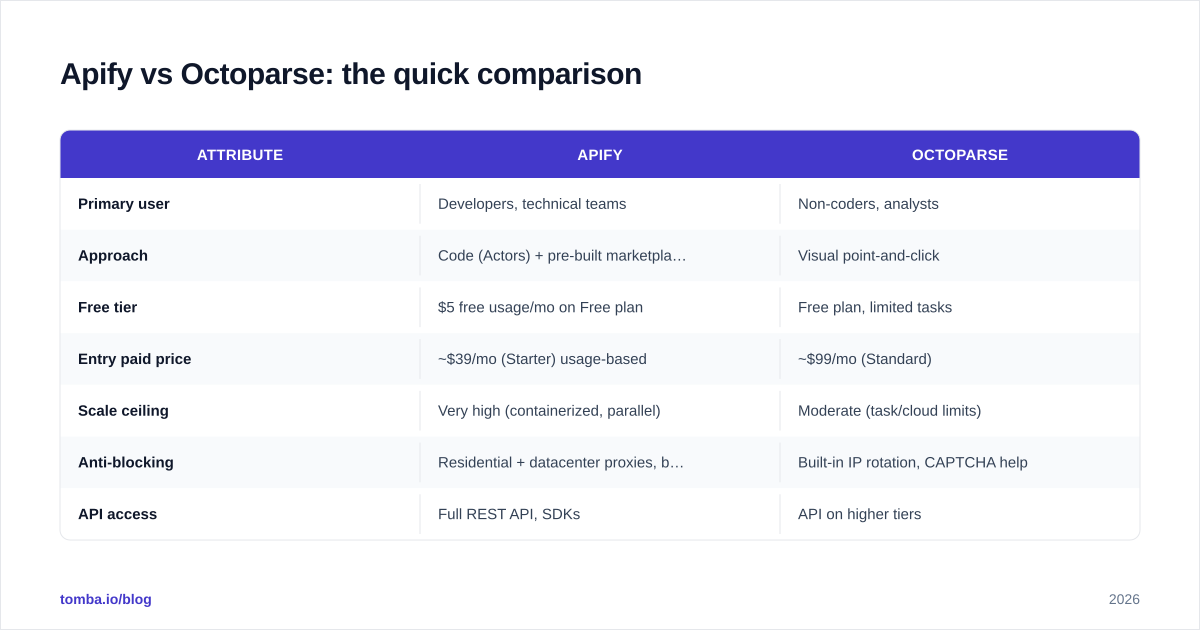
Here's the head-to-head before we go deeper.
| Attribute | Apify | Octoparse |
|---|---|---|
| Primary user | Developers, technical teams | Non-coders, analysts |
| Approach | Code (Actors) + pre-built marketplace | Visual point-and-click |
| Free tier | $5 free usage/mo on Free plan | Free plan, limited tasks |
| Entry paid price | ~$39/mo (Starter) usage-based | ~$99/mo (Standard) |
| Scale ceiling | Very high (containerized, parallel) | Moderate (task/cloud limits) |
| Anti-blocking | Residential + datacenter proxies, browser fingerprinting | Built-in IP rotation, CAPTCHA help |
| API access | Full REST API, SDKs | API on higher tiers |
| Output | Datasets, JSON, CSV, webhook, integrations | Excel, CSV, JSON, database |
| Learning curve | Steep (gentler with marketplace Actors) | Gentle |
| Best for | Custom, large, recurring scrapes | One-off or small structured pulls |
Prices shift, so confirm current numbers on each vendor's pricing page before you commit. The shape of the difference, though, is stable: Apify charges for what you consume, Octoparse charges for a seat and a quota.
Is Apify better than Octoparse?#
Neither is "better" — they're tuned for different buyers. The honest answer depends on who's doing the work and how much data you need.
Apify wins when:
- You need to scrape at volume or on a recurring schedule across many sites.
- You want the output to flow automatically into a CRM, warehouse, or enrichment step via API or webhook.
- You have engineering capacity (or you're comfortable configuring a marketplace Actor).
- You need serious anti-blocking — its proxy network and headless-browser fingerprinting handle hostile sites better than most no-code tools.
Octoparse wins when:
- The people who need the data don't write code and won't learn to.
- The targets are a small, stable set of sites — a few directories, a competitor catalog, a real-estate portal.
- You want results in a spreadsheet today, not a pipeline next sprint.
- Budget predictability via a flat subscription matters more than per-run efficiency.
A useful gut check: if your scraping plan ends with "…and then a human opens the Excel file," Octoparse is probably enough. If it ends with "…and then the data updates a system automatically," you want Apify.
How do Apify and Octoparse handle anti-blocking and scale?#
This is where the gap is widest, and it's the part people underestimate.
Modern sites fight scrapers with rate limits, IP bans, CAPTCHAs, and browser fingerprinting. Apify treats this as a first-class problem: it bundles a proxy network (datacenter and residential), automatic retries, session rotation, and headless browsers that mimic real user fingerprints. Because Actors are containerized, you can run many in parallel, so a job that would take a desktop tool all night finishes in minutes. For large or defensive targets, this is the difference between a complete dataset and a half-empty one.
Octoparse includes IP rotation and some CAPTCHA assistance, and its cloud runs let you offload jobs from your machine. That's plenty for friendly, well-structured sites. But push it against an aggressive anti-bot stack or millions of pages, and you'll hit ceilings — both technical (blocks) and practical (task quotas).
If your work is mostly B2B prospecting — pulling company and contact details from directories — raw scraping is only step one. Scraped data is dirty: stale emails, guessed formats, duplicates, and "info@" catch-alls. That's why teams pair a scraper with a bulk email finder and verification layer instead of trusting scraped strings blindly. Scraping gets you a name and a domain; a proper domain search turns that into a real, deliverable address.
A note on ethics and law: scraping public data is broadly legal in many jurisdictions, but respect robots.txt, terms of service, rate limits, and privacy regulations like GDPR/CCPA. Both tools can be used responsibly or recklessly — that's on the operator, not the vendor.
What does Apify vs Octoparse cost in 2026?#
Two different pricing philosophies, so compare them on your workload, not on the sticker.
Octoparse uses classic SaaS tiers. There's a free plan with limited tasks and local runs, then paid tiers (Standard and Professional) that unlock more concurrent tasks, cloud runs, scheduling, and API access. You pay a fixed monthly fee for a capacity bucket. Easy to forecast; you may overpay if you scrape lightly, or hit walls if you scrape heavily.
Apify is usage-based. The Free plan includes a small monthly platform credit; paid plans (Starter, Scale, Business) raise your credit allowance and limits. You're billed on compute units (how long Actors run, at what memory) plus proxy traffic and storage. For small, efficient jobs this is dramatically cheaper than a fixed subscription. For massive jobs it can climb — but it climbs with value delivered, and you can cap it.
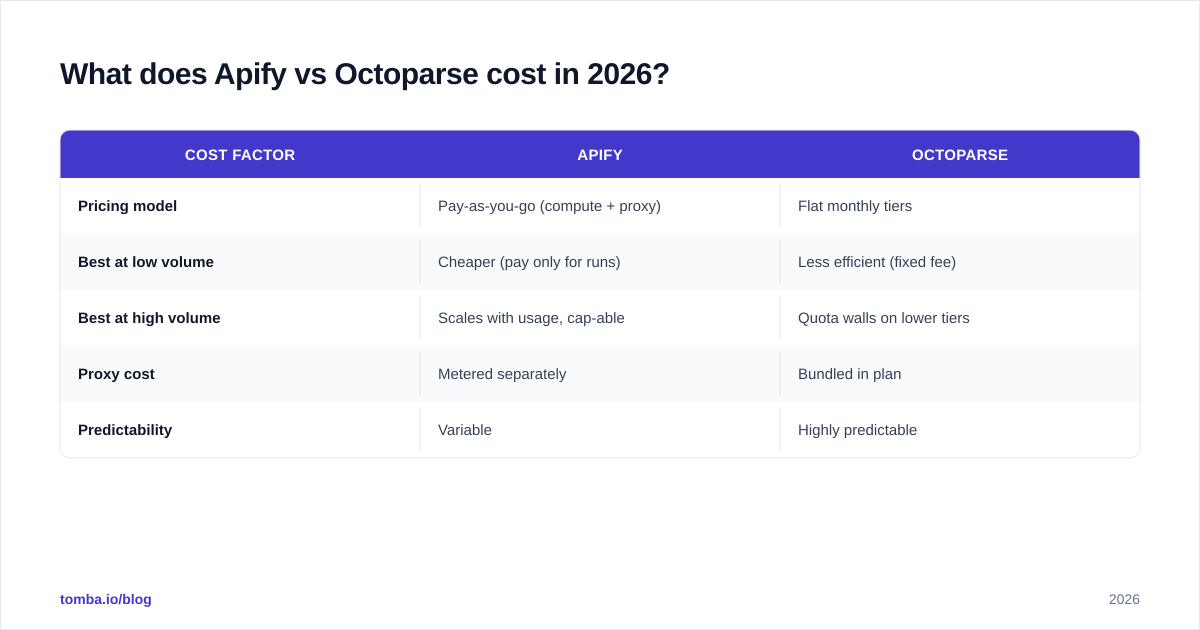
| Cost factor | Apify | Octoparse |
|---|---|---|
| Pricing model | Pay-as-you-go (compute + proxy) | Flat monthly tiers |
| Best at low volume | Cheaper (pay only for runs) | Less efficient (fixed fee) |
| Best at high volume | Scales with usage, cap-able | Quota walls on lower tiers |
| Proxy cost | Metered separately | Bundled in plan |
| Predictability | Variable | Highly predictable |
Rule of thumb: light or spiky usage → Apify; steady, known-volume usage by a non-technical team → Octoparse. Compare both against third-party reviews on G2 before signing, since real-world quotas change.
Can you connect Apify or Octoparse to your sales stack?#
Yes — and this is where Apify's developer DNA pays off again.
Apify exposes a full REST API, official SDKs, webhooks, and native integrations, so an Actor's dataset can trigger the next step automatically: dump into a warehouse, post to Slack, or hand off to an enrichment service. Octoparse offers API access on higher tiers and clean exports, but it's more "scrape, then export, then import elsewhere" than "scrape, then auto-flow."
For B2B teams, the integration question is really: how does scraped data become usable contact data? Tomba sits at that handoff. If you already run scrapes through automation, the Apify integration and the broader Tomba API let you push scraped domains and names straight into email discovery and verification — no manual spreadsheet shuffle.
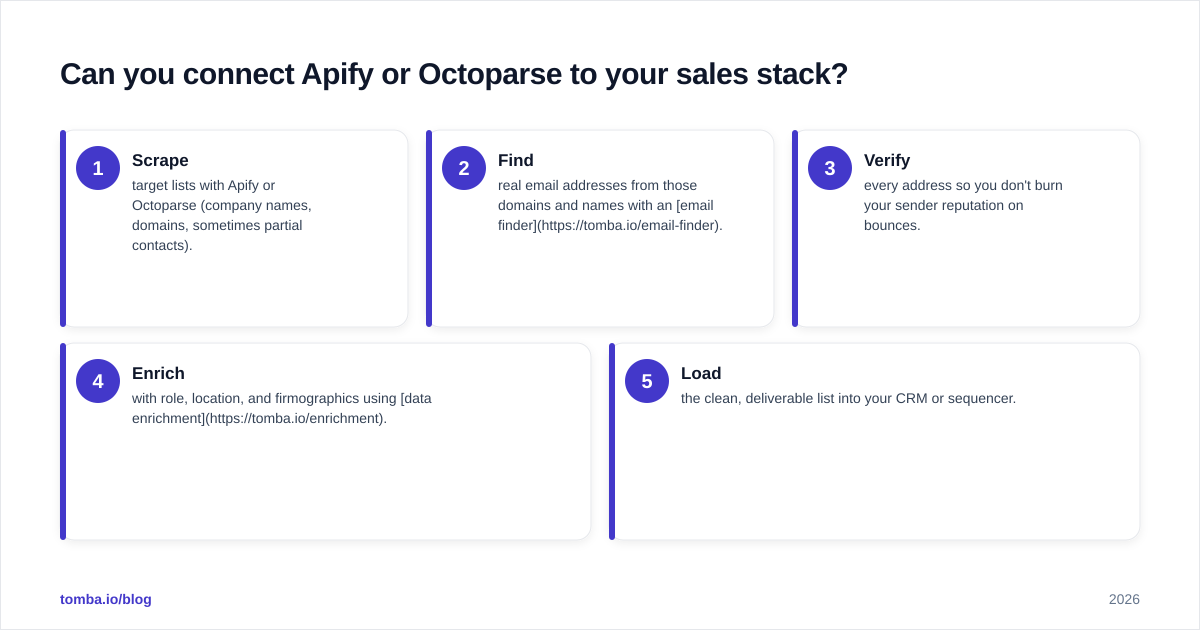
A realistic B2B pipeline looks like this:
- Scrape target lists with Apify or Octoparse (company names, domains, sometimes partial contacts).
- Find real email addresses from those domains and names with an email finder.
- Verify every address so you don't burn your sender reputation on bounces.
- Enrich with role, location, and firmographics using data enrichment.
- Load the clean, deliverable list into your CRM or sequencer.
Steps 2–5 are exactly what scrapers don't do. Treating Apify or Octoparse as the whole solution is the most common mistake — they're the raw-material supplier, not the finished product.
Which should you choose — Apify or Octoparse?#
Decide by mapping the tool to the operator and the workload, not by feature-count.
Choose Octoparse if: you're a marketer, analyst, or researcher; you don't code and don't want to; your targets are a small, friendly set of sites; you want spreadsheet output fast; and you value a flat, predictable bill. It's the lower-friction starting point for non-technical teams.
Choose Apify if: you have technical capacity (even one developer); you scrape at scale, on schedules, or across defensive sites; you want the data to flow into other systems automatically; and you'd rather pay for what you use. It's the higher ceiling and the better long-term backbone for a data pipeline.
Choose both, sometimes: plenty of teams prototype a scrape in Octoparse to prove the data exists, then rebuild it as an Apify Actor once it needs to run reliably at scale.
| Your situation | Recommended tool |
|---|---|
| Non-technical, small site list, fast spreadsheet | Octoparse |
| Developer team, large/recurring scrapes | Apify |
| Need auto-flow into CRM/warehouse | Apify |
| Tight, predictable monthly budget | Octoparse |
| Hostile anti-bot targets at scale | Apify |
| B2B contact lists that must be deliverable | Either + verification/enrichment |
Whatever you pick, remember the limit both share: they extract, they don't validate. A scraped email is a guess until something proves it lands.
The bottom line#
Apify vs Octoparse isn't a winner-take-all fight — it's a fork in the road based on who's driving and how far you're going. Octoparse gets non-coders to structured data fast and cheap for small jobs. Apify gives technical teams the scale, anti-blocking, and API plumbing to make scraping a dependable part of their stack. Match the tool to your team and your volume, confirm live pricing on each vendor's site, and you'll choose right.
But scraping is the first mile of B2B data, not the last. The contacts you pull are unverified, often stale, and frequently wrong until something cleans them up. That's the job built for Tomba's Email Finder: feed it the domains and names your scraper collects, and get back real, verified, deliverable email addresses — with enrichment and bulk processing on top. Start on the free tier (25 searches/month) or scale up through transparent Tomba pricing when your pipeline grows. Scrape with Apify or Octoparse; make the data usable with Tomba.
// get started
Find, verify and enrich your first contacts today
Start on the free plan with 25 searches a month, then scale when your team is ready.
Free plan · No credit card required · GDPR & CCPA
// about the author