7 Best Apiscrapy Alternatives for B2B Data Scraping in 2026
Apiscrapy is solid for AI web scraping, but it is not the only option. Here are 7 Apiscrapy alternatives compared on price, data quality, and B2B fit.
TL;DR
- Apiscrapy is a capable AI-driven web scraping and data-automation platform, but it is not the right fit for every team — especially if your real goal is clean B2B contact data, not raw HTML.
- The best apiscrapy alternatives split into two camps: general-purpose scrapers (Apify, Bright Data, Octoparse, Zyte, ParseHub) and B2B data/enrichment platforms (Tomba, Clearbit, Apollo).
- If you scrape mainly to build prospect lists, an enrichment-first tool will save you weeks of parsing, deduping, and verification work.
- Pricing ranges from free tiers up to four-figure monthly enterprise contracts. Match the tool to the job before you look at the sticker price.
- Use the framework below to pick: define the data type, the volume, the freshness need, and how much engineering time you can spend maintaining scrapers.
What is Apiscrapy and why look for alternatives?#
Apiscrapy is an AI-based web scraping and data-as-a-service platform. It promises automated extraction, ready-to-use scraping APIs, and data delivery without you writing or maintaining crawlers. For teams that need product listings, pricing data, or large unstructured web datasets, that pitch lands well.
So why shop around? A few common reasons:
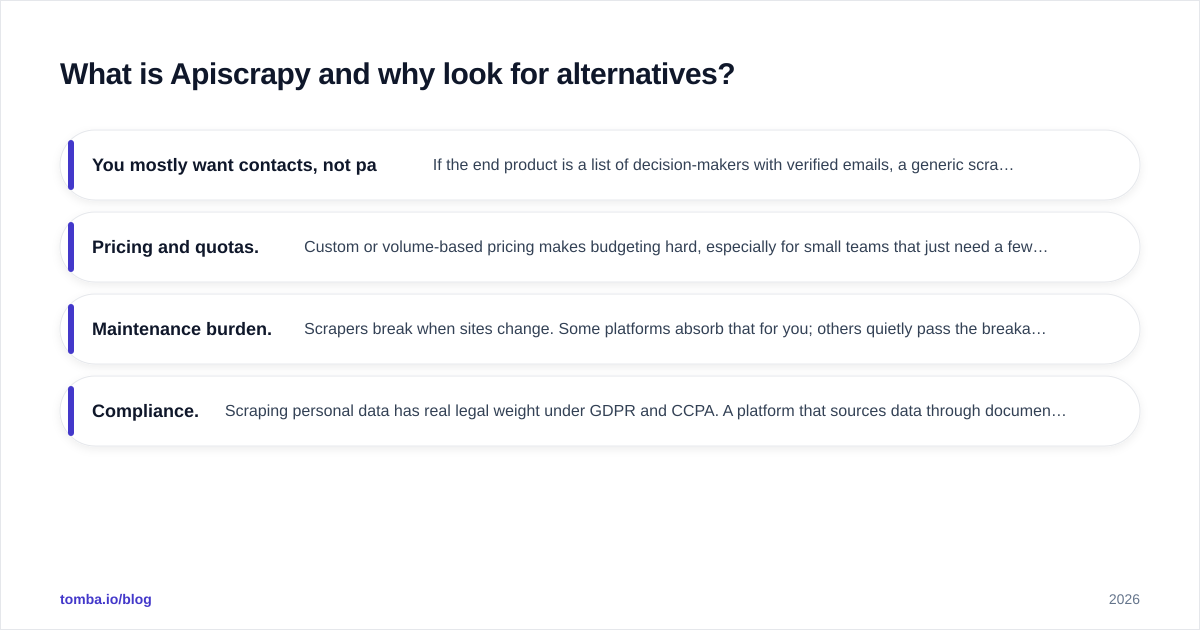
- You mostly want contacts, not pages. If the end product is a list of decision-makers with verified emails, a generic scraper hands you raw HTML you still have to parse, clean, and verify. That is a project, not a feature.
- Pricing and quotas. Custom or volume-based pricing makes budgeting hard, especially for small teams that just need a few thousand records a month.
- Maintenance burden. Scrapers break when sites change. Some platforms absorb that for you; others quietly pass the breakage downstream.
- Compliance. Scraping personal data has real legal weight under GDPR and CCPA. A platform that sources data through documented, consent-aware channels reduces your exposure.
The point is not that Apiscrapy is bad. It is that "web scraping tool" covers at least three different jobs, and you should buy for the job you actually have.
How do you choose the right apiscrapy alternative?#
Before comparing logos, answer four questions. They route you to the correct category faster than any feature list.
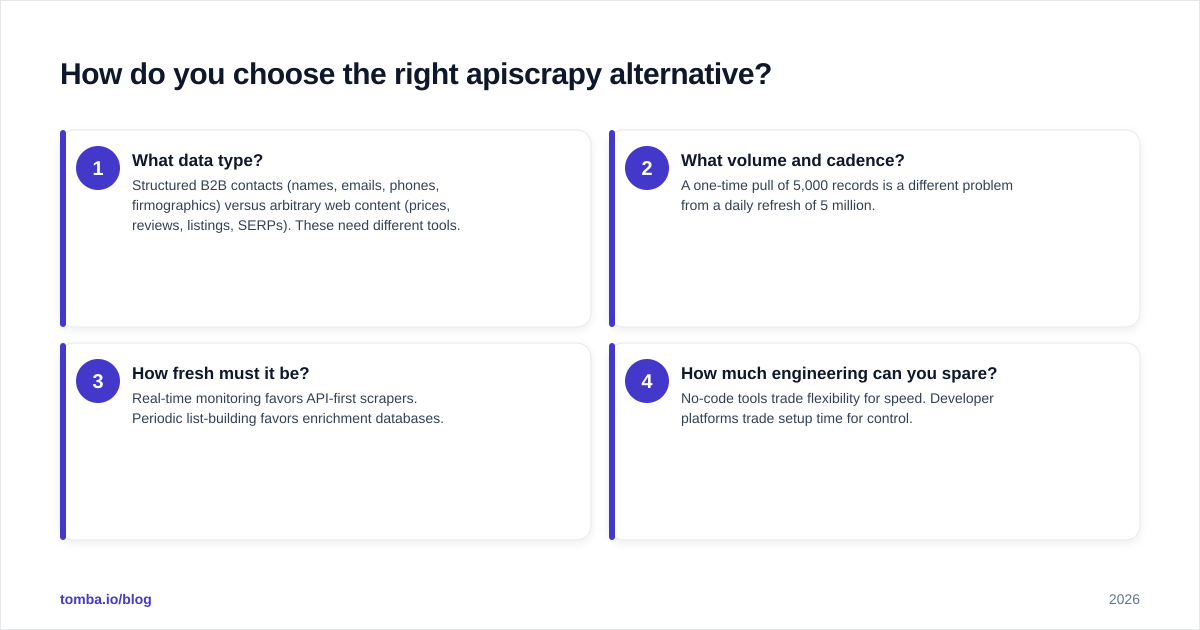
- What data type? Structured B2B contacts (names, emails, phones, firmographics) versus arbitrary web content (prices, reviews, listings, SERPs). These need different tools.
- What volume and cadence? A one-time pull of 5,000 records is a different problem from a daily refresh of 5 million.
- How fresh must it be? Real-time monitoring favors API-first scrapers. Periodic list-building favors enrichment databases.
- How much engineering can you spare? No-code tools trade flexibility for speed. Developer platforms trade setup time for control.
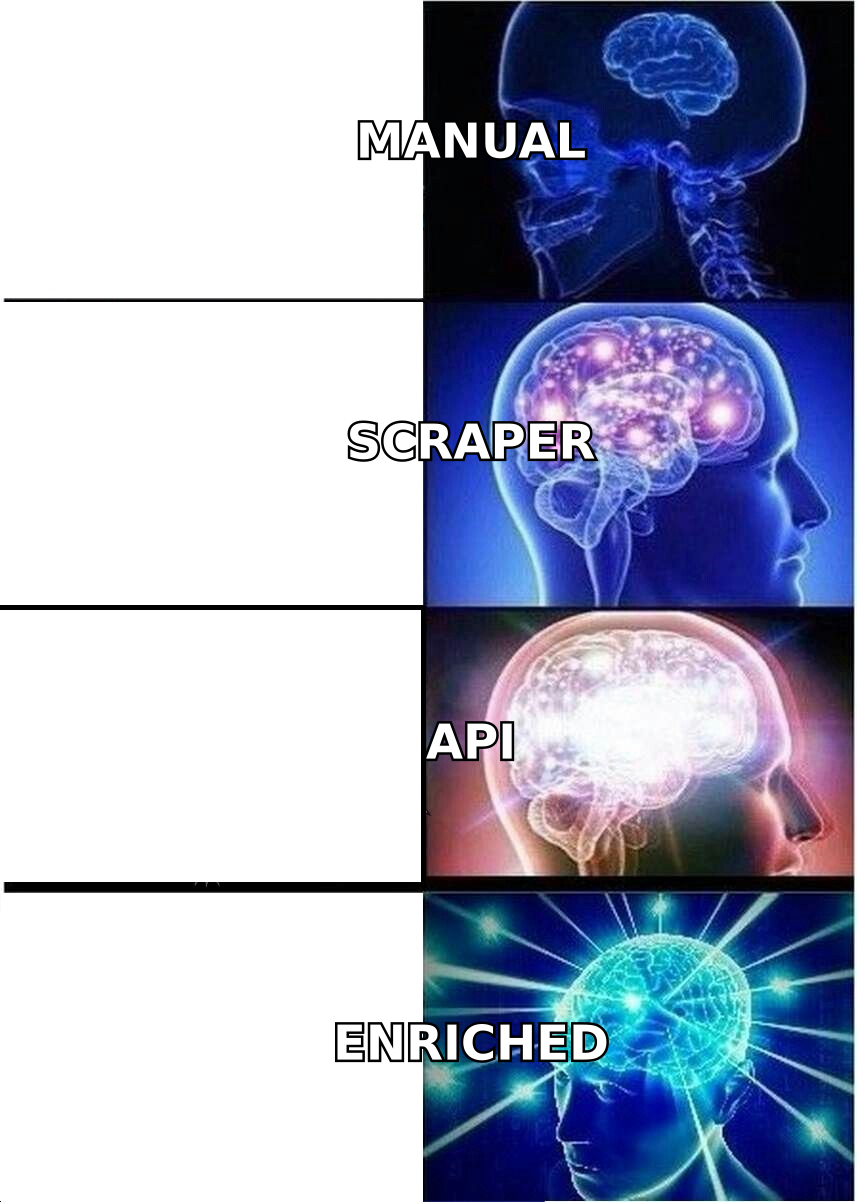
If your honest answers point at "B2B contacts, moderate volume, periodic, minimal engineering," you probably want a data and enrichment platform rather than a raw scraper. That is the lane where a tool like Tomba's data enrichment and B2B database replace most of the scraping pipeline entirely.
What are the best apiscrapy alternatives in 2026?#
Here is the shortlist, grouped by what they are actually good at.
General-purpose web scrapers#
- Apify — A marketplace of pre-built "Actors" plus a platform to run your own. Strong for developers who want flexibility without standing up infrastructure.
- Bright Data — Enterprise-grade proxy network and scraping infrastructure. Powerful, compliance-focused, and priced for serious volume.
- Octoparse — No-code desktop and cloud scraper. Friendly for non-engineers extracting from a known set of sites.
- Zyte (formerly Scrapinghub) — Built by the team behind the Scrapy framework. Developer-first, with automatic extraction and proxy management.
- ParseHub — Visual, point-and-click scraper with a generous free tier for small projects.
B2B data and enrichment platforms#
- Tomba — Email finder, verifier, domain search, and enrichment. Built specifically to turn company and person inputs into verified contact data.
- Clearbit — Firmographic and person enrichment, now part of HubSpot. Strong for go-to-market data inside a CRM workflow.
- Apollo — Combined database, enrichment, and sales engagement. Broad, but you pay for the all-in-one bundle.
How do these apiscrapy alternatives compare on price and fit?#
The table below is the fast way to see where each tool lands. Prices are entry points and change often — confirm on each vendor's site before you commit.
| Tool | Category | Entry price | Free tier | Best for |
|---|---|---|---|---|
| Apiscrapy | AI scraper / DaaS | Custom quote | Limited trial | Custom extraction projects |
| Apify | Dev scraper platform | $49/mo | $5 free credit/mo | Developers, custom Actors |
| Bright Data | Enterprise scraping | Pay-as-you-go | 7-day trial | High-volume, compliance-heavy |
| Octoparse | No-code scraper | $99/mo | 10 tasks free | Non-technical extraction |
| Zyte | Dev scraper / API | ~$100/mo | Free dev plan | Scrapy users, auto-extract |
| ParseHub | Visual scraper | $189/mo | 200 pages free | Small visual projects |
| Tomba | Email + enrichment | $49/mo | 25 searches/mo | B2B contact data |
| Apollo | Database + engagement | ~$49/seat/mo | Limited free | All-in-one GTM |
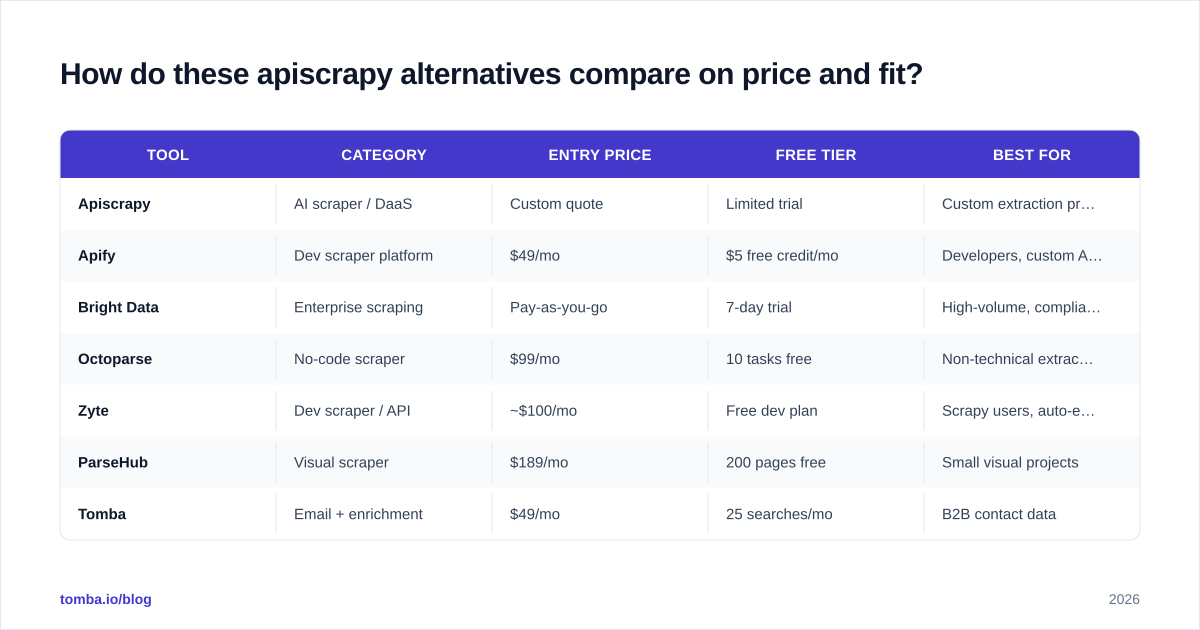
Two takeaways. First, "scraper" pricing and "enrichment" pricing are not comparable line items — one charges by pages or compute, the other by records or searches. Second, the cheapest entry point is not the cheapest outcome. A $49 scraper that needs ten hours of parsing and verification a week is more expensive than a $99 enrichment plan that ships clean data.
When should you pick a scraper over an enrichment platform?#
Choose a general scraper (Apify, Bright Data, Octoparse, Zyte, ParseHub) when:
- You need non-contact web data — competitor pricing, product catalogs, reviews, real-estate listings, SERP results.
- You need custom logic that no off-the-shelf database covers.
- You have engineering time to build and maintain extraction, or budget for managed services.
- You need real-time or high-frequency pulls at scale.
Bright Data and Zyte are the strongest picks when compliance and scale both matter; Apify is the best balance of flexibility and ease for developers; Octoparse and ParseHub win for non-technical users with a fixed list of target sites. You can sanity-check current user sentiment on a neutral review site like G2 before you trial any of them.
When is a B2B data platform the better apiscrapy alternative?#
Choose an enrichment-first platform when your real deliverable is people you can contact. Scraping LinkedIn-style profiles or company sites for emails is exactly the workflow that breaks most often, carries the most legal risk, and produces the dirtiest data. A purpose-built tool solves all three.
This is where Tomba fits. Instead of scraping and then guessing at email formats, you run a domain or a name through a verified pipeline:
- Email finder — turn a name plus company into a verified professional email.
- Email verifier — validate deliverability before you send, protecting your sender reputation.
- Domain search and enrichment — pull every public role at a company, then enrich with firmographics.
- Tomba API — wire all of the above into your own stack, the same way you would integrate a scraping API.
The difference is that the data arrives structured, deduped, and verified, rather than as HTML you have to wrestle into a spreadsheet. For most sales and marketing teams, that is the whole job.
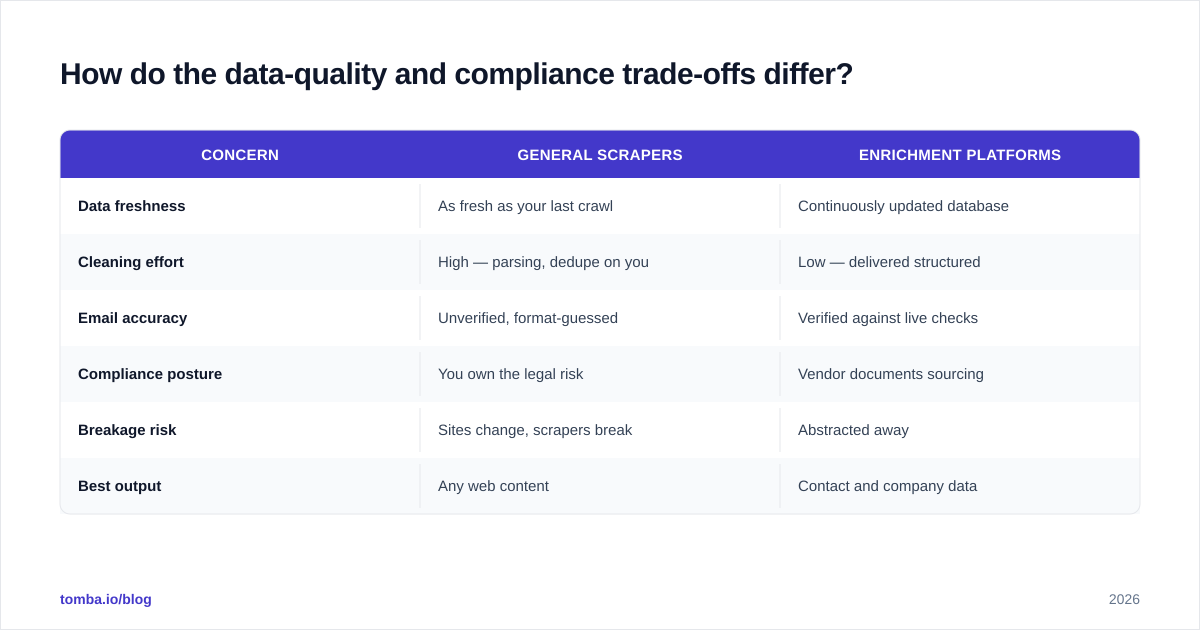
How do the data-quality and compliance trade-offs differ?#
Raw scraping and sourced enrichment fail in different ways, and the failure modes matter more than the feature checklists.
| Concern | General scrapers | Enrichment platforms |
|---|---|---|
| Data freshness | As fresh as your last crawl | Continuously updated database |
| Cleaning effort | High — parsing, dedupe on you | Low — delivered structured |
| Email accuracy | Unverified, format-guessed | Verified against live checks |
| Compliance posture | You own the legal risk | Vendor documents sourcing |
| Breakage risk | Sites change, scrapers break | Abstracted away |
| Best output | Any web content | Contact and company data |
A scraper gives you reach into anything on the open web, at the cost of cleanup and risk. An enrichment platform gives you a narrow but clean, verified, and compliant slice. Neither is universally "better" — they answer different questions.
For deliverability specifically, scraped email lists are a known way to torch your domain reputation. Verified data is not optional if you plan to actually send. Bright Data publishes detailed compliance documentation on how it sources data, and it is worth reading regardless of which vendor you choose, because it sets the bar for what responsible sourcing looks like.
What does a realistic decision look like?#
Three quick scenarios:
- You run competitor price monitoring across 200 retail sites. Pick Apify or Zyte. This is genuinely a scraping problem, and an enrichment database has nothing to offer you. Apify's Actor marketplace likely already has a scraper for your targets — see the Apify Store.
- You build outbound prospect lists for a sales team. Pick Tomba or Apollo. You do not want to maintain scrapers; you want verified contacts that flow into your CRM. Tomba is the leaner, lower-cost option focused on data quality; Apollo bundles in sequencing if you want one tool for everything.
- You need both web data and contacts. Run a scraper for the web content and an enrichment platform for the people. They are complementary, not competing — and that combination is almost always cheaper and more reliable than forcing one tool to do both.
Check Tomba pricing against your record volume before assuming the all-in-one bundle is cheaper; for contact-only workloads it usually is not.
The bottom line#
The best apiscrapy alternative is the one matched to your actual deliverable. If you need arbitrary web data at scale, Apify, Bright Data, and Zyte are the strongest engineering-grade choices, with Octoparse and ParseHub covering no-code needs. If your real output is verified B2B contacts, skip the scraping pipeline and its maintenance, freshness, and compliance headaches entirely.
For that second job — turning companies and names into verified, sendable contact data — start with the Tomba Email Finder. The free tier gives you 25 searches a month to test accuracy on your own target accounts, and paid plans start at $49/mo with verification, domain search, and enrichment built in. You get clean data on day one instead of a scraper you have to babysit. Find the emails, skip the parsing.
// get started
Find, verify and enrich your first contacts today
Start on the free plan with 25 searches a month, then scale when your team is ready.
Free plan · No credit card required · GDPR & CCPA
// about the author