Apiscrapy Pricing, Reviews, Pros and Cons (2026 Guide)
A neutral breakdown of Apiscrapy pricing, real user reviews, and the pros and cons of its AI web-scraping platform — plus where it fits in a 2026 B2B data stack.
Looking for the truth about Apiscrapy pricing and reviews? You are in the right place. Apiscrapy markets itself as an AI-driven, no-code web scraping platform. Maybe you are weighing it for lead lists, price monitoring, or a B2B data pipeline. If so, you want three things. You want to know what it costs, whether real users like it, and where it breaks down. This guide answers all three, with no sales gloss.
TL;DR#
- Apiscrapy is a managed web-scraping / data-as-a-service platform, not a verified email database. It pulls whatever is on a page, then leaves accuracy and compliance to you.
- Pricing is quote-based for most real workloads. The public "free" and entry options are limited, so plan for a custom plan as volume grows.
- Strengths: no-code scrapers, ready-made datasets, API delivery, and human QA for messy sites.
- Weaknesses: opaque pricing, uneven data freshness, and a learning curve when sites change.
- Best paired with a dedicated email finder and verifier. Apiscrapy gets you raw rows; tools like Tomba turn them into deliverable contacts.
What is Apiscrapy?#
Apiscrapy is a web data extraction service. It combines automated scrapers, pre-built datasets, and an "AI-augmented" delivery layer. That layer pushes results to you as CSV, JSON, or an API feed. Think of it as a contractor crew rather than a power tool. Instead of building and maintaining your own scrapers, you describe the data you want. The platform then handles collection, structuring, and (on higher tiers) quality checks.
It sits in the B2B data and intelligence layer of a go-to-market stack. That is the part that sources raw records. This distinction matters for the rest of the review. A scraper's job ends when the data lands in your warehouse. Turning those rows into accurate, deliverable contacts is a separate job, and scrapers are not built to do it well.
Typical use cases people reach for Apiscrapy to solve:
- E-commerce price and product monitoring
- Real-estate and travel listings aggregation
- Lead lists scraped from directories and company sites
- Market and competitor research feeds
- Recurring dataset delivery into a BI tool or CRM
How much does Apiscrapy cost?#
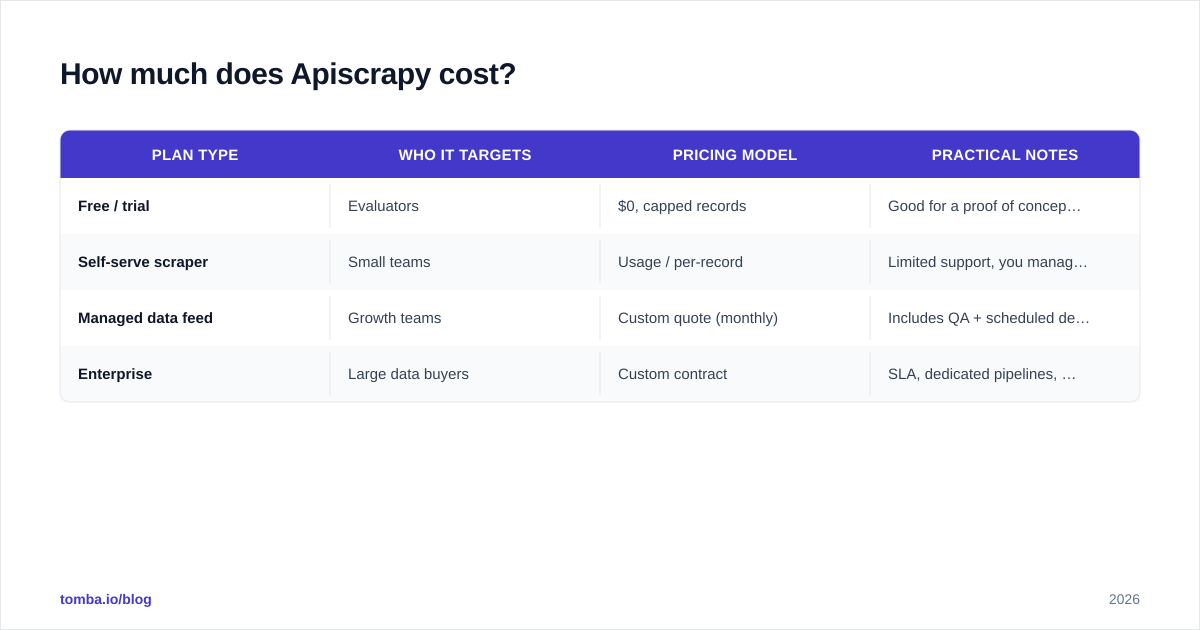
Short answer: most serious usage is quote-based. So the "list price" you see rarely reflects what you'll actually pay. Apiscrapy aims at managed and enterprise buyers. Pricing scales with the number of sites, record volume, frequency, and the human QA you need. That is normal for data-as-a-service vendors. It also makes a like-for-like comparison hard.
Here is how the tiers generally break down. Treat the numbers as indicative ranges, not a locked quote. Always confirm current Apiscrapy pricing on their own site before you commit.
| Plan type | Who it targets | Pricing model | Practical notes |
|---|---|---|---|
| Free / trial | Evaluators | $0, capped records | Good for a proof of concept, not production |
| Self-serve scraper | Small teams | Usage / per-record | Limited support, you manage configs |
| Managed data feed | Growth teams | Custom quote (monthly) | Includes QA + scheduled delivery |
| Enterprise | Large data buyers | Custom contract | SLA, dedicated pipelines, compliance review |
A few budgeting realities reviewers mention again and again:
- Volume changes everything. A one-off scrape of a few thousand rows is cheap. A daily multi-site feed with QA is an enterprise line item.
- Re-scrapes cost money. Sites change layout. A broken scraper means re-work, and that can land back on your invoice or your timeline.
- Data delivery is not data quality. You pay for collection. Cleaning, de-duping, and verification are still on you unless you negotiate them in.
For comparison, a verification-and-finder tool like Tomba publishes flat Tomba pricing. The tiers are Free (25 searches/mo), Starter $49/mo, Growth $99/mo, and Pro $249/mo. You can forecast cost without a sales call. It is a different job, but a useful benchmark for what clear pricing looks like in this category.
/blog/generated/memes/2026-06-14/apiscrapy-pricing-reviews-pros-and-cons-meme-1.png
Apiscrapy pricing and reviews: what users actually say#
Feedback from public review sites paints a consistent picture. People like the "we handle it for you" model. They dislike the unpredictability. Read through listings on G2 and Capterra and the same themes repeat.
Common praise:
- No-code setup for non-engineers who just want the data
- Responsive support and human QA on managed plans
- Flexible output formats and API delivery that drop into existing pipelines
- Handles messy, JavaScript-heavy sites that break simple scrapers
Common complaints:
- Pricing is opaque. You can't estimate cost before you talk to sales.
- Data freshness varies. Some feeds lag, especially on fast-changing sites.
- Onboarding and turnaround can be slow for complex requests.
- When a target site redesigns, output quality dips until the scraper is fixed.
The honest read: Apiscrapy reviews are solid but not spotless. It is a credible managed-scraping option, not a one-click data source. Reviewers who treat it as the start of a pipeline are happy. The flow is simple: collect, then clean, then verify, then use. Reviewers who expect plug-and-play, sales-ready contacts are the ones who churn.
What are the pros and cons of Apiscrapy?#
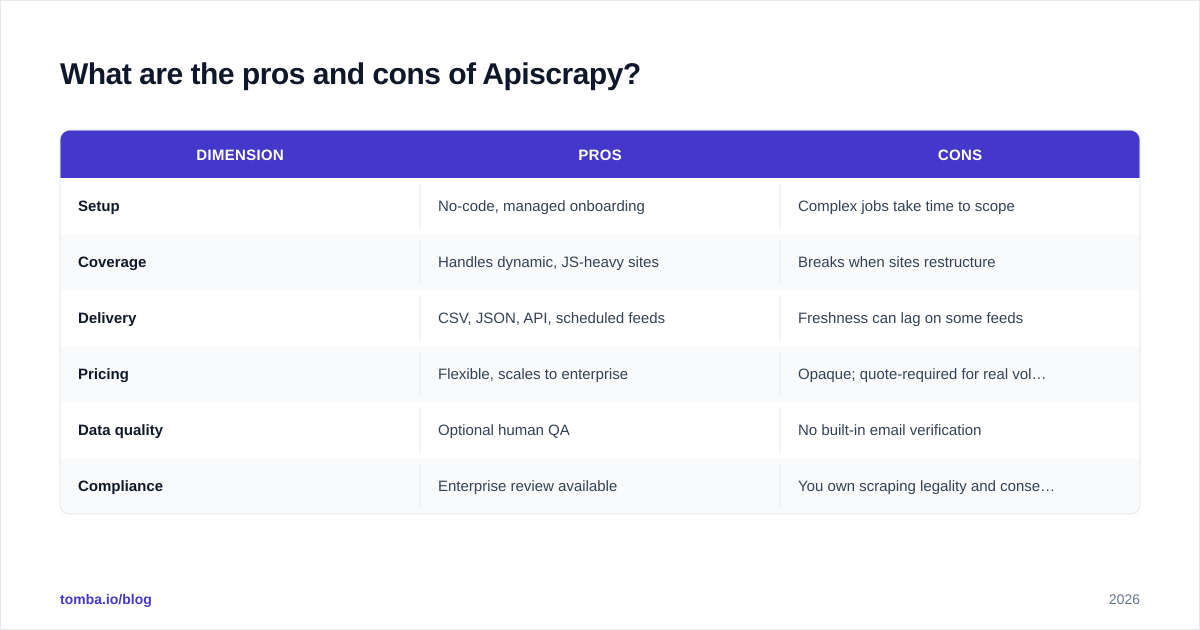
Here is the balanced scorecard most buyers need.
| Dimension | Pros | Cons |
|---|---|---|
| Setup | No-code, managed onboarding | Complex jobs take time to scope |
| Coverage | Handles dynamic, JS-heavy sites | Breaks when sites restructure |
| Delivery | CSV, JSON, API, scheduled feeds | Freshness can lag on some feeds |
| Pricing | Flexible, scales to enterprise | Opaque; quote-required for real volume |
| Data quality | Optional human QA | No built-in email verification |
| Compliance | Enterprise review available | You own scraping legality and consent |
The single most important "con" for sales and marketing teams is simple. Apiscrapy gives you data, not deliverability. A scraped email is just a string of characters. It means nothing until something proves it can receive mail. Send to unverified scraped lists and you will damage your sender reputation fast. That is why scraping and verification are two separate line items in any mature stack.
Is Apiscrapy good for B2B lead generation?#
It can be a source, but it should never be your only step. Scraping directories and company sites gives you raw rows. You get names, titles, URLs, and sometimes emails in inconsistent formats. Before any of that touches a campaign, it needs three things Apiscrapy does not specialize in.
- Pattern resolution — turning "name + company" into a real corporate email. A dedicated email finder works out and confirms the right address instead of guessing the format.
- Verification — confirming the mailbox exists. An email verifier checks syntax, MX records, and SMTP response so you don't bounce.
- Enrichment — filling the gaps such as firmographics, phone, and LinkedIn. Good data enrichment makes the record usable by reps.
In practice the cleanest workflow looks like this.
Scrape the full list of targets with a tool like Apiscrapy. Then run the output through a finder and verifier before anything reaches your CRM or sequencer. The scraper is the net. The finder and verifier are the sorting table. Skip the sorting table and teams end up with 30% bounce rates and blocked domains.
How does Apiscrapy compare to alternatives?#
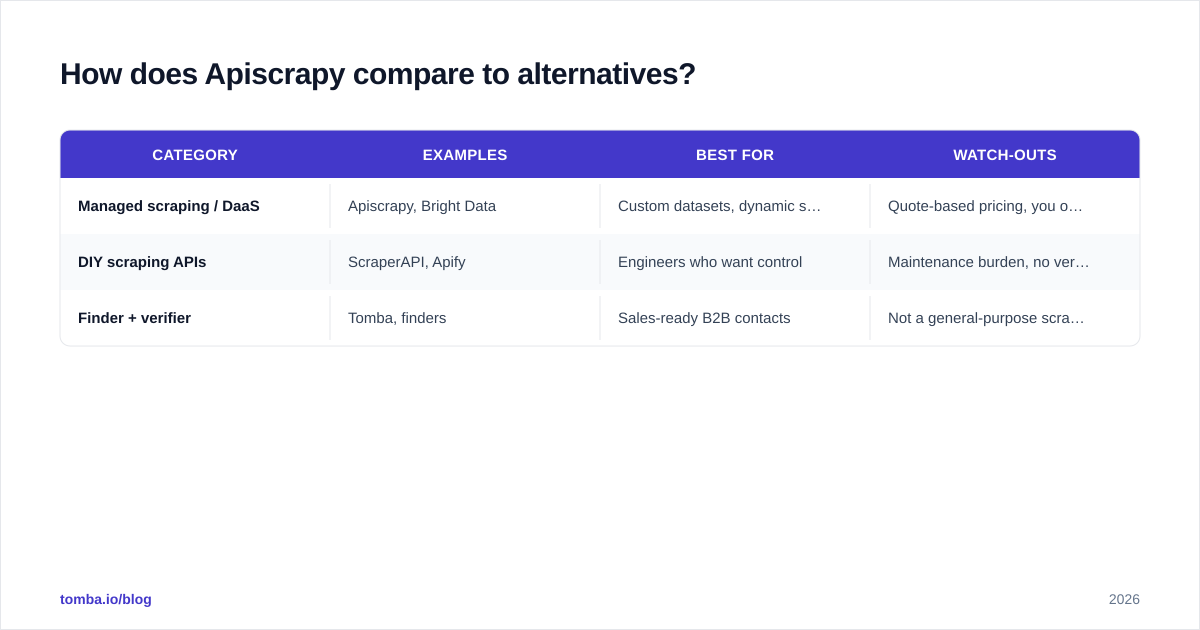
There are three broad camps in this space. The "best" choice depends on the job you are hiring the tool to do.
| Category | Examples | Best for | Watch-outs |
|---|---|---|---|
| Managed scraping / DaaS | Apiscrapy, Bright Data | Custom datasets, dynamic sites | Quote-based pricing, you own QA |
| DIY scraping APIs | ScraperAPI, Apify | Engineers who want control | Maintenance burden, no verification |
| Finder + verifier | Tomba, finders | Sales-ready B2B contacts | Not a general-purpose scraper |
Say your need is "give me a structured feed of arbitrary web pages." Then a managed scraper is the right shape of tool. Say your need is "give me deliverable decision-maker emails for these companies." Then you want a purpose-built finder. Look for one with a verified B2B database and clear data sources behind it, not a generic scraper you then have to clean.
Most teams that get this wrong try to force one tool to do both jobs. Scrapers fall short on accuracy. Finders fall short on arbitrary-page coverage. The teams that win run both and connect them. They scrape broad, then verify narrow.
What should you check before buying Apiscrapy?#
Run this short due-diligence list before you sign anything.
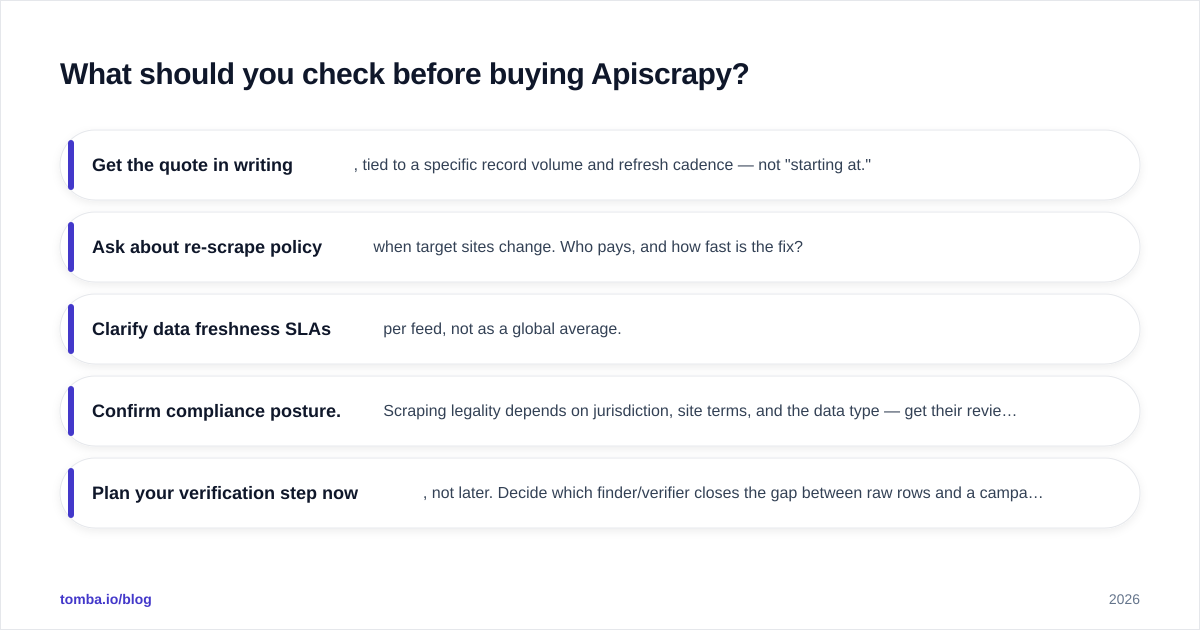
- Get the quote in writing. Tie it to a specific record volume and refresh cadence, not "starting at."
- Ask about the re-scrape policy when target sites change. Who pays, and how fast is the fix?
- Clarify data freshness SLAs per feed, not as a global average.
- Confirm compliance posture. Scraping legality depends on jurisdiction, site terms, and the data type. Get their review process documented. Background on the broader practice is well summarized on Wikipedia's web scraping entry.
- Plan your verification step now, not later. Decide which finder or verifier closes the gap between raw rows and a campaign-ready list.
Frequently asked questions#
Is Apiscrapy free? There is a free or trial tier for evaluation. Production volume needs a paid or custom plan. Don't size your project on the free tier's limits.
Does Apiscrapy verify emails? No. It extracts data. It does not confirm whether an email is deliverable. You need a separate email verification step.
Is web scraping legal? It depends on what you scrape, where, and how you use it. Public data, site terms, and privacy law all factor in. Treat compliance as a real workstream, not a checkbox.
Who is Apiscrapy best for? Data, BI, and ops teams that need recurring structured feeds from many sites. It suits teams that prefer a managed service over building scrapers in-house.
The bottom line#
Weigh the Apiscrapy pricing and reviews together and the verdict is fair. It is a legitimate managed web-scraping platform with real strengths. You get no-code setup, dynamic-site coverage, and flexible delivery. It is held back by opaque, quote-based pricing and the fact that it stops at collection. The reviews are honest: good as a data source, not a finished contact list. If you adopt it, adopt it as the first stage of a pipeline, not the whole pipeline.
The second stage turns scraped names and domains into verified, deliverable B2B emails. For that, start with the Tomba Email Finder. It resolves the right corporate address from a name and domain. It verifies that address before it reaches your sequencer. And it runs on flat, published pricing, so you can forecast cost without a sales call. Scrape broad with Apiscrapy if you like. Just verify narrow with Tomba before you hit send.
// get started
Find, verify and enrich your first contacts today
Start on the free plan with 25 searches a month, then scale when your team is ready.
Free plan · No credit card required · GDPR & CCPA
// about the author