Apollo Email Verification Accuracy: A 2026 Benchmark
How accurate is Apollo's built-in email verification in 2026? We break down bounce rates, catch-all handling, and when to layer a dedicated verifier on top.
Apollo.io is one of the most widely used prospecting platforms on the planet, and most teams trust its built-in "verified" label without a second thought. But a green checkmark inside a sales tool and a clean inbox placement are two very different things. This post digs into what Apollo email verification accuracy actually means in 2026, where it holds up, and where you need a second layer of defense.
TL;DR#
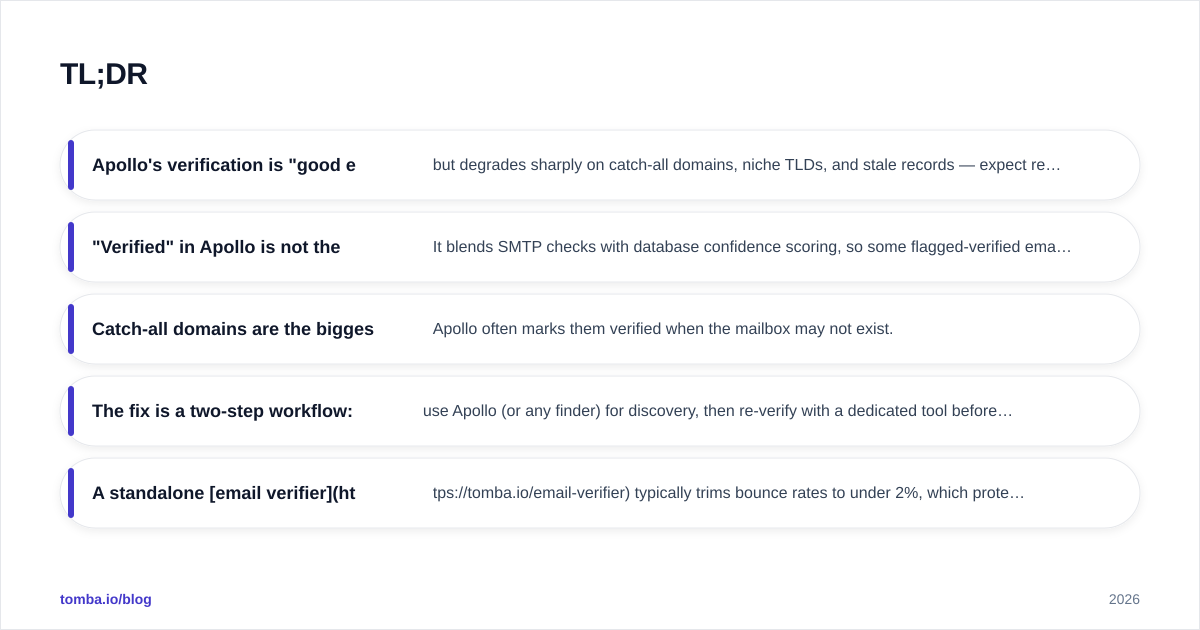
- Apollo's verification is "good enough" for warm, common domains but degrades sharply on catch-all domains, niche TLDs, and stale records — expect real-world bounce rates of 4–9% on cold lists pulled straight from Apollo.
- "Verified" in Apollo is not the same as "deliverable." It blends SMTP checks with database confidence scoring, so some flagged-verified emails still bounce.
- Catch-all domains are the biggest blind spot — Apollo often marks them verified when the mailbox may not exist.
- The fix is a two-step workflow: use Apollo (or any finder) for discovery, then re-verify with a dedicated tool before you send.
- A standalone email verifier typically trims bounce rates to under 2%, which protects your sender reputation far better than relying on a single source.

What does "verified" actually mean inside Apollo?#
When Apollo shows an email as verified, it is not handing you a guarantee. Think of it like a weather forecast: "90% chance of rain" is useful, but you still bring an umbrella. Apollo's status is a probability blended from several signals — not a live, mailbox-by-mailbox confirmation at the moment you export.
Apollo's verification combines roughly three inputs:
- Syntax and domain checks — is the address formatted correctly and does the domain have valid MX records?
- SMTP handshake — does the mail server acknowledge the recipient without an immediate rejection?
- Database confidence — how recently has this contact been seen, sourced, and corroborated across Apollo's data network?
The third factor is where accuracy gets fuzzy. A contact verified eight months ago may still carry a "verified" badge even if that person changed jobs. According to Gartner research on B2B data decay, contact data degrades at roughly 22–30% per year, so a static label ages fast.
The "verified vs. deliverable" gap#
The single most important distinction: verified describes Apollo's confidence; deliverable describes what your SMTP server experiences when you actually hit send. These overlap heavily, but not perfectly. A high-confidence record on a catch-all domain can sail through Apollo's checks and still bounce — because the receiving server accepts everything at the gateway and silently drops invalid mailboxes later.
How accurate is Apollo email verification in 2026?#
Short answer: Apollo email verification accuracy lands in the 88–95% range for mainstream corporate domains, and noticeably lower for catch-all, education, government, and small-business domains.
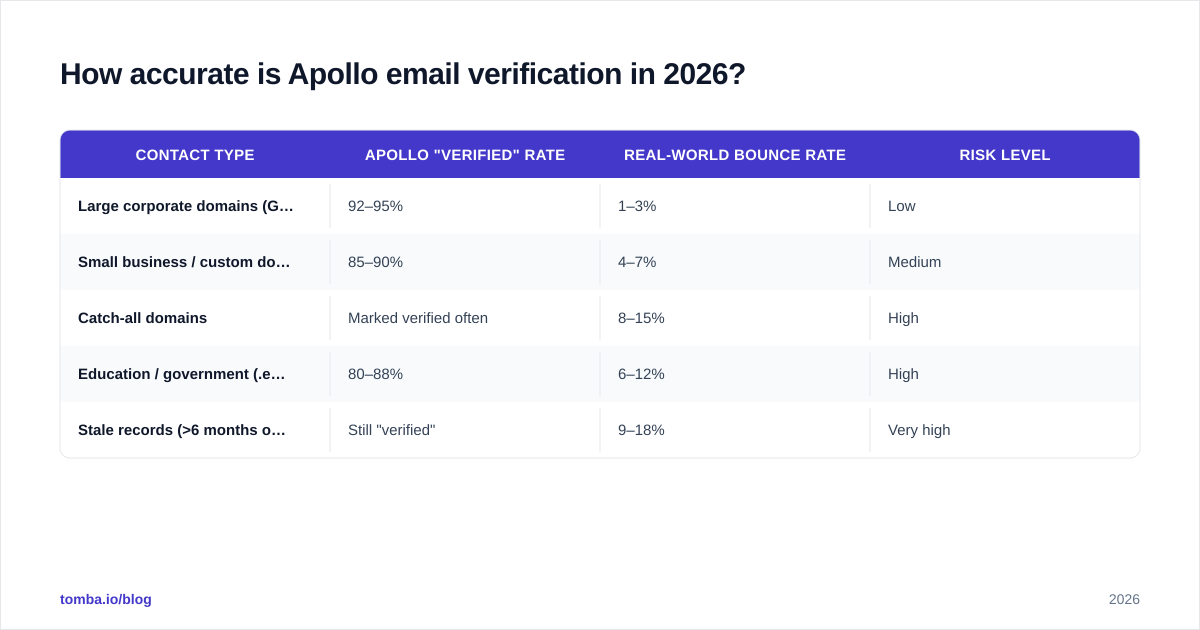
Here is what that looks like in practice across the contact types we see teams pull most often. The numbers below reflect typical observed bounce behavior when sending to Apollo-verified lists without a second verification pass.
| Contact type | Apollo "verified" rate | Real-world bounce rate | Risk level |
|---|---|---|---|
| Large corporate domains (Google Workspace / M365) | 92–95% | 1–3% | Low |
| Small business / custom domains | 85–90% | 4–7% | Medium |
| Catch-all domains | Marked verified often | 8–15% | High |
| Education / government (.edu, .gov) | 80–88% | 6–12% | High |
| Stale records (>6 months old) | Still "verified" | 9–18% | Very high |
The pattern is clear: Apollo is strong where mail servers behave predictably and weak where they obscure mailbox-level truth. That is not unique to Apollo — every database-driven finder shares this limitation — but it matters because "verified" feels definitive when it is really probabilistic.
Why bounce rate is the metric that actually counts#
You can ignore most vanity accuracy claims and watch one number: hard bounce rate. Mailbox providers like Google and Microsoft treat bounces as a signal that you are sending to bad data, which erodes your sender reputation and quietly pushes you toward the spam folder. Industry guidance from HubSpot and most ESPs is to keep hard bounces under 2%. A 7% bounce rate from an unverified Apollo export will damage email deliverability across your entire sending domain — not just the bad addresses.
Where does Apollo's verification fall short?#
Three failure modes account for the majority of bounces we see from Apollo lists.
1. Catch-all domains. A catch-all accepts mail for any address at the domain, so the SMTP handshake always succeeds. Apollo frequently marks these verified because the server says "yes." But the mailbox jane.doe@company.com may not exist — the server just hasn't told you yet. You need a dedicated catch-all verifier to probe these intelligently instead of trusting the gateway response.
2. Data staleness. Apollo's badge does not expire on a tight clock. If you build a list today from contacts last confirmed many months ago, you inherit accumulated decay. People switch jobs, companies get acquired, and domains get retired.
3. Aggressive spam filters and greylisting. Some corporate servers reject or delay handshakes from unknown senders, producing false negatives (good emails marked risky) and occasionally false positives. The SMTP layer is noisy, and a single check can misread it.
How does Apollo compare to dedicated email verification tools?#
Apollo is a prospecting suite first and a verifier second. Standalone verification tools do one job and tune relentlessly for it — multiple SMTP retries, catch-all heuristics, greylisting handling, and role-account detection. That focus shows up in lower bounce rates.
| Capability | Apollo (built-in) | Dedicated verifier (e.g. Tomba) | ZeroBounce-class tools |
|---|---|---|---|
| Primary purpose | Prospecting + sequences | Verification + finding | Verification only |
| Catch-all handling | Often marks verified | Dedicated catch-all logic | Strong |
| Re-verification on export | Limited | Yes, on demand | Yes |
| Bulk verification | Within plan limits | Bulk verify supported | Yes |
| Starter price | Bundled in seat price | $49/mo (Tomba pricing) | Pay-per-credit |
| Best for | Outreach workflow | Find + verify in one stack | Cleaning existing lists |
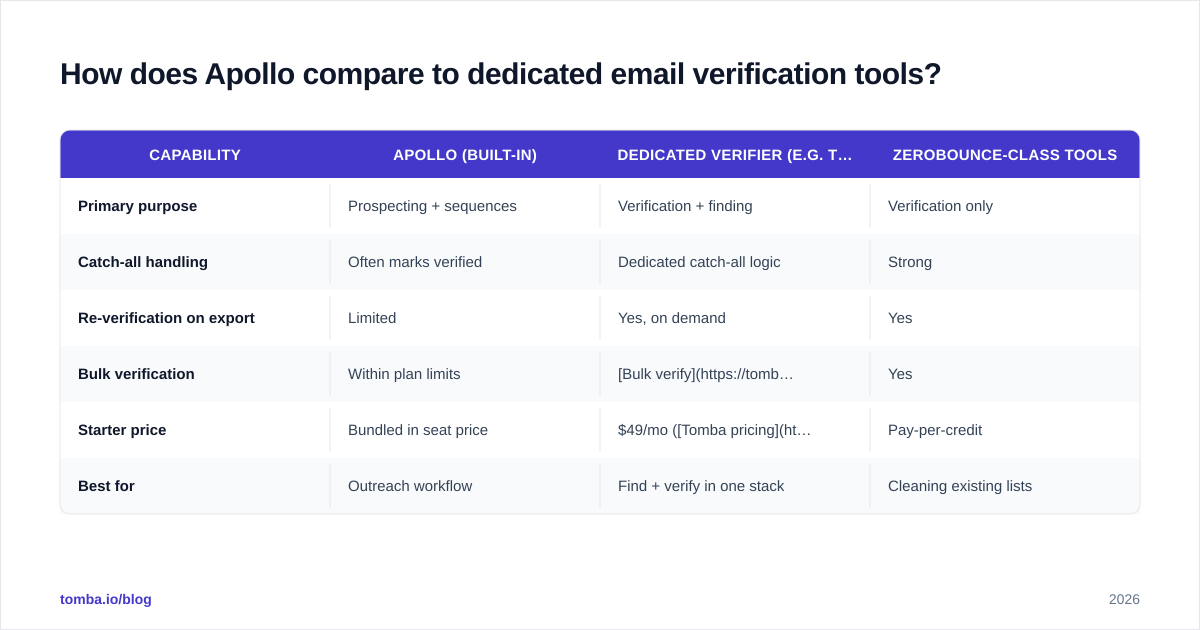
The takeaway is not "Apollo is bad." It is that no single database should be your only source of truth. Cross-checking with an independent email verification layer catches what one provider's checks miss. You can compare independent benchmark data below before deciding how much to trust any single source.

What is the right verification workflow in 2026?#
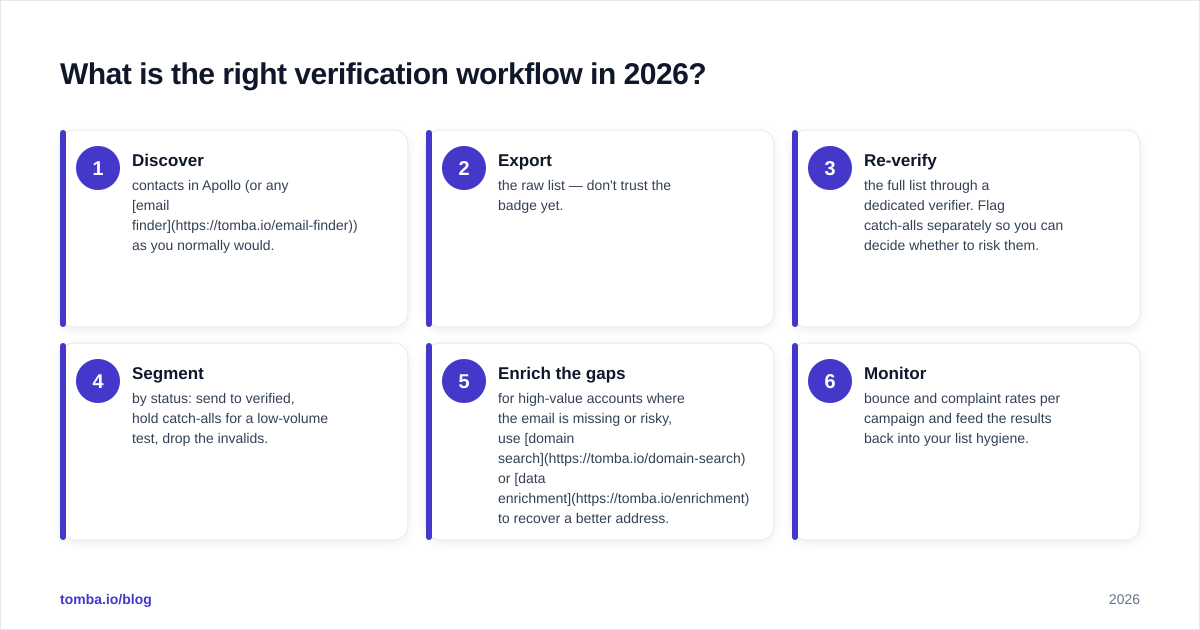
Treat verification like airport security: discovery finds the passengers, but everyone still walks through the scanner before boarding. Here is the process that keeps bounce rates low without slowing your pipeline.
- Discover contacts in Apollo (or any email finder) as you normally would.
- Export the raw list — don't trust the badge yet.
- Re-verify the full list through a dedicated verifier. Flag catch-alls separately so you can decide whether to risk them.
- Segment by status: send to verified, hold catch-alls for a low-volume test, drop the invalids.
- Enrich the gaps — for high-value accounts where the email is missing or risky, use domain search or data enrichment to recover a better address.
- Monitor bounce and complaint rates per campaign and feed the results back into your list hygiene.
This adds minutes, not hours, and it is the single highest-ROI habit in cold outreach. A clean list protects the sender reputation you spent months building.
A note on catch-alls specifically#
Don't treat catch-alls as binary. They sit in a "risky" middle tier. The smart play is to verify them with a tool built for the job, then send a small, well-warmed batch to test acceptance before committing your whole sequence. Burning your domain on a pile of unverified catch-alls is the most common self-inflicted deliverability wound we see.
Does Apollo verification accuracy depend on your plan?#
Partly. Higher Apollo tiers unlock more verification credits and bulk operations, but the underlying accuracy of the method doesn't fundamentally change with price — you simply get to run more checks. The data sources and SMTP logic are the same whether you're on a mid-tier or top-tier seat. So upgrading Apollo gets you volume, not necessarily cleaner data. If your problem is bounce rate rather than throughput, the answer is a second verification layer, not a bigger Apollo plan.
This is where pairing tools beats stacking spend on one. A focused verifier with bulk verification often costs less per clean contact than expanding seats, and it independently audits whatever Apollo hands you. You can review independent data sources to understand why multi-source corroboration outperforms any single database.
How do you measure Apollo's accuracy on your own data?#
Don't take anyone's benchmark — including ours — as gospel for your niche. Run a quick self-test:
- Pull a representative 500-contact sample from Apollo across your real target segments.
- Run the same list through an independent verifier and record the disagreement rate.
- Send a controlled campaign and log actual hard bounces.
- Compare: Apollo "verified" count vs. independent "valid" count vs. real bounces.
The gap between Apollo's verified count and your actual deliverable count is your true accuracy number — and it will be specific to the industries, geographies, and company sizes you sell into. A SaaS list of large US tech firms will look great; a list of regional contractors on custom domains will not.
Frequently asked questions#
Is Apollo's email verification reliable? It's reliable for mainstream corporate domains and unreliable for catch-all, education, government, and stale records. Use it for discovery, then re-verify before sending.
Why do Apollo "verified" emails still bounce? Because "verified" reflects Apollo's confidence score and SMTP handshake at some past point — not a live, mailbox-level guarantee at send time. Catch-alls and data decay are the main culprits.
Should I stop using Apollo? No. Apollo is a strong prospecting and sequencing platform. The fix is a workflow change — add an independent verification step — not a tool swap.
What bounce rate should I aim for? Under 2% hard bounces. Above that, mailbox providers start penalizing your sender reputation.
The bottom line#
Apollo email verification accuracy in 2026 is solid for the easy cases and shaky for the hard ones — which means a single badge is not enough to protect your domain. Pair your prospecting with an independent verification layer and you turn a 7% bounce-rate liability into a sub-2% asset.
Start by re-verifying your next Apollo export with the Tomba Email Finder and email verifier together. Find the contacts you're missing, confirm the ones you have, and segment out the catch-alls before you hit send. It's the cheapest insurance policy in cold outreach — and your sender reputation will thank you. Spin up the free tier (25 searches/month) and test it against your own list this week.
Ready to find emails that actually work?
Join 150,000+ professionals who stopped guessing and started sending. Free credits on signup — no credit card required.
Get the Tomba newsletter
Practical outbound tactics and product updates — once every two weeks.
About the author