11 Best Apollo.io Alternatives in 2026 (Ranked & Compared)
Apollo.io is powerful but pricey, noisy, and easy to outgrow. Here are 11 Apollo.io alternatives for 2026 ranked on data accuracy, price, and fit.
Apollo.io became the default prospecting stack for thousands of sales teams because it bundles a contact database, email finder, verifier, and sequencer into one login. But "all-in-one" cuts both ways. As your team scales, you start paying for seats you don't use, fighting credit limits, and questioning data that looks stale on close inspection. If any of that sounds familiar, you're in the market for an Apollo.io alternative.
This guide ranks 11 of them on the criteria that actually move your pipeline: data accuracy, pricing transparency, deliverability impact, and how well each tool fits a specific job rather than trying to do everything.
TL;DR#
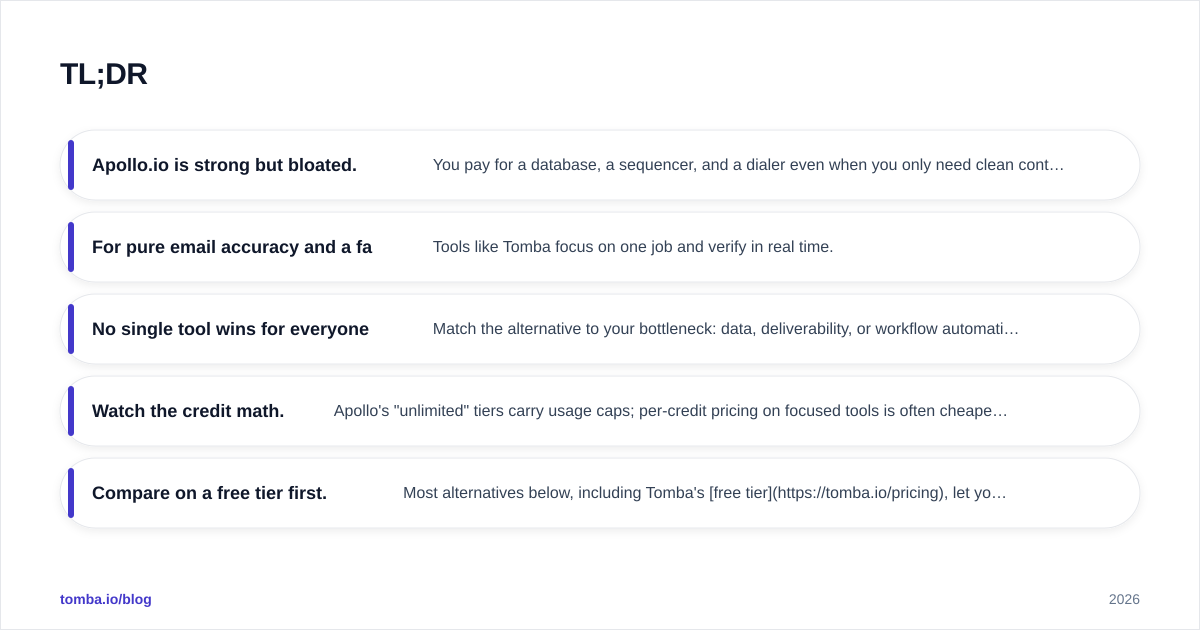
- Apollo.io is strong but bloated. You pay for a database, a sequencer, and a dialer even when you only need clean contact data.
- For pure email accuracy and a fair price, a dedicated email finder beats a bundle. Tools like Tomba focus on one job and verify in real time.
- No single tool wins for everyone. Match the alternative to your bottleneck: data, deliverability, or workflow automation.
- Watch the credit math. Apollo's "unlimited" tiers carry usage caps; per-credit pricing on focused tools is often cheaper at real volume.
- Compare on a free tier first. Most alternatives below, including Tomba's free tier, let you benchmark accuracy on your own list before paying.
Why look for an Apollo.io alternative at all?#
Apollo.io is a sales intelligence and engagement platform: a 275M+ contact database stapled to sequencing, a dialer, and basic CRM features. That breadth is the selling point and the problem.
Three complaints come up repeatedly. First, data freshness — contacts that were accurate two years ago still surface as current, so your bounce rate climbs. Second, pricing friction — the headline plans look cheap until you hit export caps or need the data-rich tiers, and per-seat costs stack fast. Third, feature bloat — if you already run Instantly or Outreach for sending, you're paying twice for a sequencer you ignore.
The fix isn't always a like-for-like replacement. Often it's unbundling: pair a precise data tool with the sender you already trust.
)
What should you evaluate in an Apollo.io alternative?#
Before comparing logos, lock down the criteria. Picking on brand recognition is how teams end up paying for the same gap twice.
Score every candidate on these five axes:
- Data accuracy — what percentage of emails are valid and reachable, verified at the moment of export, not cached from a crawl six months ago.
- Coverage — does it find the regions, seniorities, and industries you actually sell into.
- Pricing model — credits vs seats vs flat rate, and what happens at your real monthly volume.
- Deliverability impact — clean data protects your sender reputation; dirty data quietly torches it.
- Workflow fit — API, Chrome extension, CRM sync, and bulk processing that match how your team works.
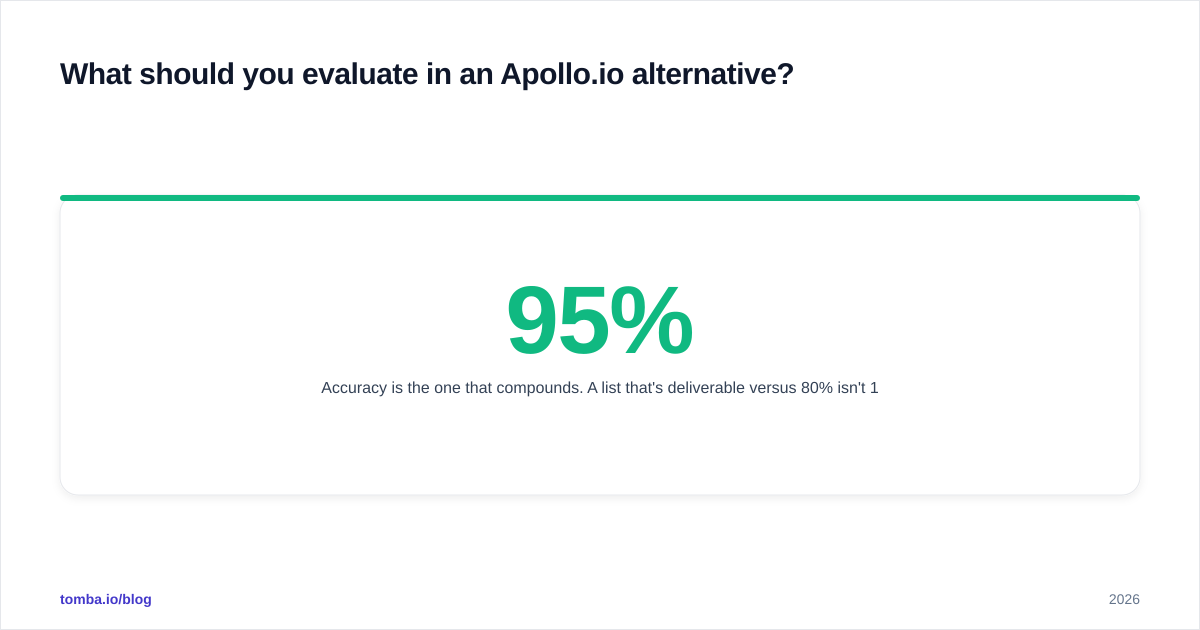
Accuracy is the one that compounds. A list that's 95% deliverable versus 80% isn't 15% better — it's the difference between a healthy domain and one stuck in spam folders by week three.

What are the 11 best Apollo.io alternatives in 2026?#
Here's the shortlist, grouped by the job each does best.
1. Tomba — best for accurate email finding at a fair price#
Tomba is a dedicated email finder and verification platform. Instead of bundling a sequencer you may not need, it focuses on returning verified professional emails by name, domain, or company — and verifies them in real time so your list is clean on arrival.
Where Apollo sells breadth, Tomba sells precision. Use domain search to pull every reachable contact at a target company, the email verifier to scrub an existing list, and the Tomba API to wire it all into your stack. Pricing starts at $49/mo with a genuine free tier (25 searches/mo) for benchmarking.
Best for: teams that want clean data without paying for a full engagement suite.
2. RocketReach — best for breadth of contact channels#
RocketReach leans into multi-channel: emails plus phone numbers and social profiles. Coverage is broad, though accuracy varies by region and pricing climbs quickly on higher-volume plans.
3. Hunter — best for simple domain-based lookups#
Hunter is the lightweight classic. Clean UI, reliable domain search, and a free tier. It's narrower than Apollo and lighter on enrichment, which is exactly why some teams prefer it.
4. Clearbit (Breeze Intelligence) — best for enrichment inside HubSpot#
Clearbit, now folded into HubSpot's intelligence layer, shines at enriching records you already have rather than net-new prospecting. If you live in HubSpot, it's frictionless; outside it, less so.
5. Lusha — best for a quick Chrome-extension workflow#
Lusha is built around its browser extension for grabbing contacts off LinkedIn. Fast for reps doing manual sourcing, but credit costs add up at team scale.
6. Seamless.AI — best for real-time search claims#
Seamless.AI markets a real-time search engine for leads. Volume is high; reviewers on G2 frequently flag accuracy and aggressive renewal terms, so test before committing.
7. LeadIQ — best for outbound capture into CRM#
LeadIQ focuses on capturing prospects and pushing them cleanly into Salesforce or HubSpot, with light sequencing. A good fit if CRM hygiene is your priority.
8. ContactOut — best for recruiter-style sourcing#
ContactOut specializes in personal and work emails surfaced from LinkedIn, popular with recruiters. Strong for hard-to-reach contacts, narrower for firmographic filtering.
9. Instantly — best if you mainly need sending and warmup#
If your real gap is sending volume and deliverability, Instantly handles inbox rotation and warmup. Pair it with a dedicated data tool rather than treating it as an Apollo clone.
10. Wiza — best for LinkedIn list exports#
Wiza turns LinkedIn Sales Navigator searches into verified email lists. Convenient for Navigator-heavy teams; dependent on LinkedIn as the source of truth.
11. Findymail — best for verified B2B emails with a deliverability promise#
Findymail markets verified emails with replacement for bounces. Solid for cold-email-first teams, though feature surface is narrow versus a full platform.
)
How do the top Apollo.io alternatives compare?#
The summary table below cuts through the marketing. Prices reflect entry paid tiers as of 2026; confirm current numbers on each vendor's site before you buy.

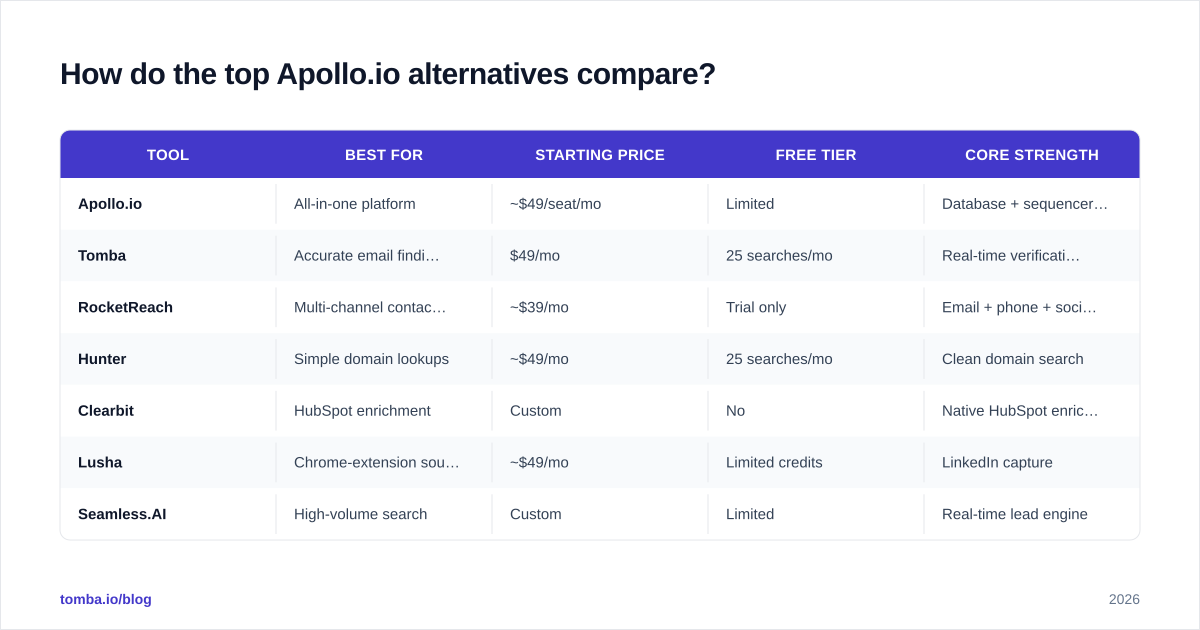
| Tool | Best for | Starting price | Free tier | Core strength |
|---|---|---|---|---|
| Apollo.io | All-in-one platform | ~$49/seat/mo | Limited | Database + sequencer bundle |
| Tomba | Accurate email finding | $49/mo | 25 searches/mo | Real-time verification + API |
| RocketReach | Multi-channel contacts | ~$39/mo | Trial only | Email + phone + social |
| Hunter | Simple domain lookups | ~$49/mo | 25 searches/mo | Clean domain search |
| Clearbit | HubSpot enrichment | Custom | No | Native HubSpot enrichment |
| Lusha | Chrome-extension sourcing | ~$49/mo | Limited credits | LinkedIn capture |
| Seamless.AI | High-volume search | Custom | Limited | Real-time lead engine |
| Instantly | Sending + warmup | ~$37/mo | No | Inbox rotation + warmup |
Two patterns jump out. First, most "starting" prices converge near $49 — so the deciding factor is what you get for it, not the headline number. Second, the tools with honest free tiers (Tomba, Hunter) are the easiest to validate before you spend, which matters more than any feature checkbox.
For a deeper look at how pricing scales with volume, the Tomba pricing page lays out per-search economics that bundles tend to obscure.
Is a dedicated email finder better than Apollo.io's all-in-one?#
For data quality, usually yes — and here's the honest reasoning. A focused tool has one job to get right. When a vendor's entire reputation rides on email accuracy, every engineering hour goes into verification, source freshness, and catch-all handling instead of building yet another dialer.
Think of it like buying a chef's knife versus a 20-function multitool. The multitool is convenient in a drawer, but no serious cook preps dinner with one. Apollo is the multitool: genuinely useful, rarely the best at any single cut.
That said, all-in-one earns its keep when consolidation beats precision — a small team with no existing stack, a limited budget, and a need to do everything in one tab. If that's you, Apollo is a defensible default. If you already own a sender and a CRM, unbundling to a precise data source like the Tomba Email Finder almost always raises deliverability and lowers cost.
One caveat worth stating plainly: switching tools won't fix a list you never verify. Whatever you choose, run every address through an email verifier before sending. The cleanest finder in the world can't protect a domain from a sender who skips that step.
How do you migrate off Apollo.io without losing momentum?#
Switching mid-quarter feels risky, but a staged move avoids any gap in pipeline.
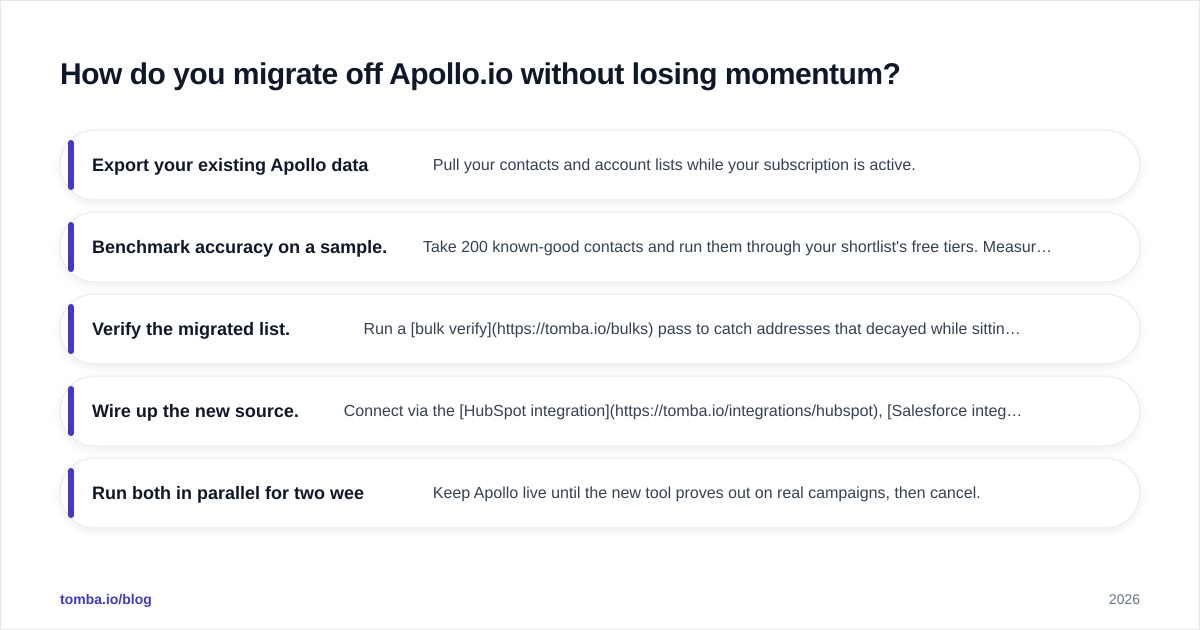
- Export your existing Apollo data. Pull your contacts and account lists while your subscription is active.
- Benchmark accuracy on a sample. Take 200 known-good contacts and run them through your shortlist's free tiers. Measure deliverability, not just match rate.
- Verify the migrated list. Run a bulk verify pass to catch addresses that decayed while sitting in Apollo.
- Wire up the new source. Connect via the HubSpot integration, Salesforce integration, or [
Zapier](https://tomba.io/integrations/zapier) so reps never leave their workflow.
- Run both in parallel for two weeks. Keep Apollo live until the new tool proves out on real campaigns, then cancel.
This approach also surfaces the truth about your old data. Teams routinely find that 15–25% of their "active" Apollo contacts bounce on re-verification — which is exactly the email deliverability tax that prompted the switch in the first place.
Which Apollo.io alternative is right for you?#
Match the tool to your actual bottleneck, not the longest feature list:
- Your emails bounce and reputation is slipping → a verification-first finder like Tomba.
- You need phone numbers as much as emails → RocketReach or phone finder coverage.
- You live inside HubSpot → Clearbit enrichment.
- You already send through Instantly or Outreach → unbundle; buy data, not another sequencer.
- You're a recruiter chasing personal emails → ContactOut.
- You're a small team that wants one tab → stay on Apollo, honestly.
There's no universal winner because "best" depends on the gap you're closing. The mistake is paying platform prices to solve a single-tool problem.
The bottom line#
Apollo.io isn't bad — it's broad, and breadth has a cost in price, freshness, and bloat. If your pipeline lives and dies on whether emails actually land, the smartest 2026 move is to unbundle: keep the sender and CRM you trust, and feed them verified data from a tool built for exactly that.
Start with a free benchmark on your own list. Run 25 of your toughest target accounts through the Tomba Email Finder, check the deliverability against what Apollo gave you, and let the bounce rate decide. Clean data is the cheapest growth lever you have — and it was always the part that mattered. Spin up a free Tomba account and prove it on your own pipeline before you renew anything.
// get started
Find, verify and enrich your first contacts today
Start on the free plan with 25 searches a month, then scale when your team is ready.
Free plan · No credit card required · GDPR & CCPA
// about the author