Apptivo vs Salesforce 2026: Which CRM Fits Your Team?
Apptivo vs Salesforce, compared honestly: pricing, features, scalability, and which CRM actually fits a lean SMB versus a complex enterprise sales org in 2026.
TL;DR
- Apptivo is a low-cost, all-in-one business suite (CRM + invoicing + projects + help desk) built for small teams that want broad functionality on a tight budget — paid plans start around $15/user/mo.
- Salesforce is the enterprise standard: deeper customization, a massive AppExchange ecosystem, and best-in-class reporting — but Sales Cloud Enterprise runs ~$165/user/mo before add-ons.
- Choose Apptivo if you're an SMB that values simplicity, bundled apps, and predictable cost. Choose Salesforce if you have complex sales processes, dedicated admins, and budget to match.
- Both CRMs are only as good as the contact data inside them. Garbage leads sink either platform.
- This guide compares pricing, features, scalability, support, and total cost of ownership so you can pick without a 12-month regret.
What are Apptivo and Salesforce?#
Think of it like choosing between a Swiss Army knife and a fully-equipped workshop. Apptivo is the Swiss Army knife — one affordable tool that does a surprising number of jobs reasonably well. Salesforce is the workshop — every specialized machine you could want, if you can afford the floor space and someone to run it.
Apptivo launched in 2009 as a cloud business-management suite. CRM is its anchor product, but the same login also gets you invoicing, project management, procurement, a help desk, and field-service tools. The pitch is consolidation: one vendor, one bill, fewer integrations to babysit.
Salesforce is the category-defining CRM and the largest by market share. Its Sales Cloud is endlessly configurable, backed by the AppExchange marketplace of thousands of add-ons, and trusted by enterprises that need custom objects, complex automation, and granular permissions. According to G2 it consistently ranks among the most-reviewed CRMs in the market.
The core tension in any apptivo vs salesforce decision is the same one every growing company faces: pay less for "good enough now," or pay more for "room to grow later."
How do Apptivo and Salesforce compare on price?#
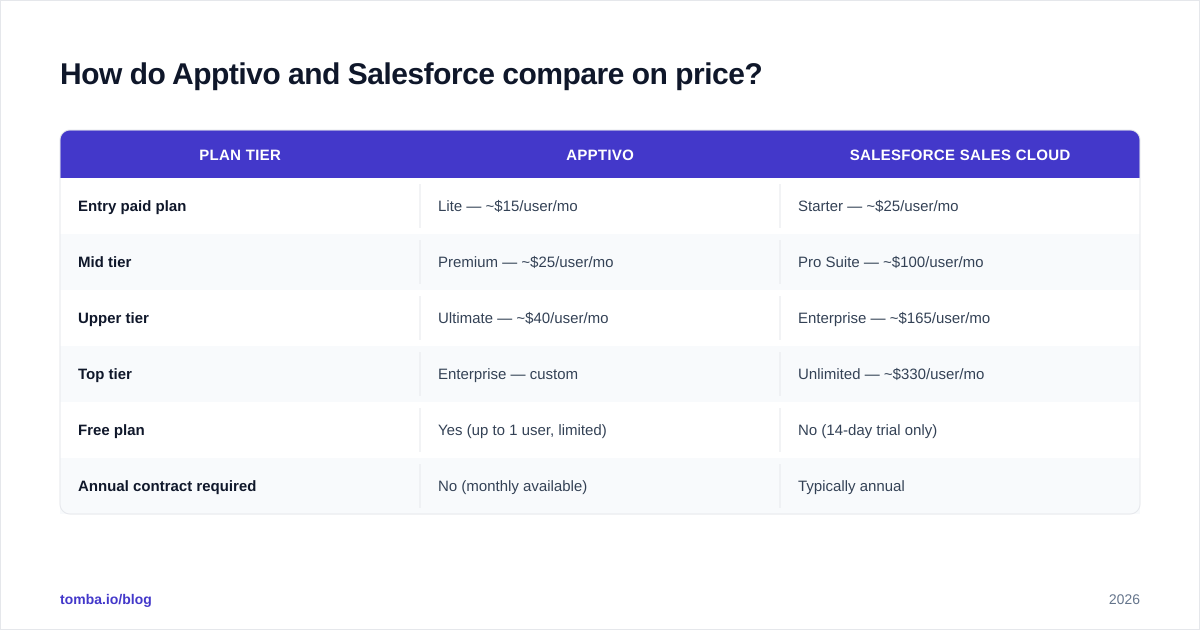
Pricing is where the two platforms separate most clearly. Apptivo competes on affordability; Salesforce competes on capability and charges accordingly.
| Plan tier | Apptivo | Salesforce Sales Cloud |
|---|---|---|
| Entry paid plan | Lite — ~$15/user/mo | Starter — ~$25/user/mo |
| Mid tier | Premium — ~$25/user/mo | Pro Suite — ~$100/user/mo |
| Upper tier | Ultimate — ~$40/user/mo | Enterprise — ~$165/user/mo |
| Top tier | Enterprise — custom | Unlimited — ~$330/user/mo |
| Free plan | Yes (up to 1 user, limited) | No (14-day trial only) |
| Annual contract required | No (monthly available) | Typically annual |
The headline: Apptivo's top paid tier costs less than Salesforce's mid tier. For a 10-person sales team, that gap compounds into tens of thousands of dollars a year.
But list price hides real-world cost. Salesforce's true total cost of ownership often includes paid AppExchange apps, sandbox environments, premium support, and — most significantly — an admin or consultant to configure and maintain it. Apptivo's cost stays closer to its sticker because it's designed to be self-administered by non-technical owners.
If you want a deeper look at how usage-based tools price themselves for lean teams, our breakdown of Tomba pricing shows the same SMB-friendly logic at work.
)
Which CRM has better features?#
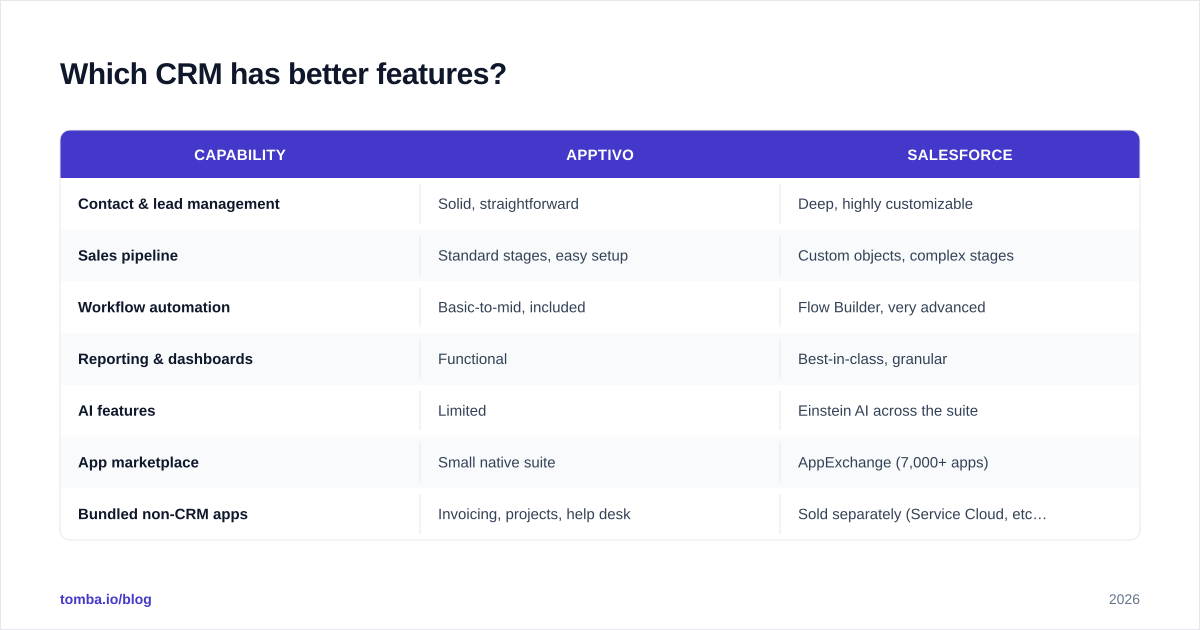
Both cover the CRM fundamentals — contacts, leads, opportunities, pipelines, email integration, and reporting. The difference is depth versus breadth.
| Capability | Apptivo | Salesforce |
|---|---|---|
| Contact & lead management | Solid, straightforward | Deep, highly customizable |
| Sales pipeline | Standard stages, easy setup | Custom objects, complex stages |
| Workflow automation | Basic-to-mid, included | Flow Builder, very advanced |
| Reporting & dashboards | Functional | Best-in-class, granular |
| AI features | Limited | Einstein AI across the suite |
| App marketplace | Small native suite | AppExchange (7,000+ apps) |
| Bundled non-CRM apps | Invoicing, projects, help desk | Sold separately (Service Cloud, etc.) |
| Mobile app | Yes | Yes, mature |
Where Apptivo wins: the bundled suite. If you invoice clients, run projects, and field support tickets, Apptivo handles all of it under one roof. Replicating that in the Salesforce ecosystem means buying Service Cloud, a billing app, and a project tool — three more line items.
Where Salesforce wins: depth. Custom objects, multi-step approval processes, territory management, Einstein AI lead scoring, and reporting that can slice data any way a RevOps team dreams up. If your sales motion is genuinely complex, Apptivo will eventually feel like a ceiling.
A useful gut check: list your five must-have workflows. If they're standard (capture lead, assign rep, track deal, send quote, follow up), Apptivo covers them cheaply. If even one requires conditional logic across custom objects, Salesforce earns its premium.
Is Apptivo or Salesforce easier to use?#
Apptivo wins on day-one usability; Salesforce wins on long-term power once configured.
Apptivo's interface is utilitarian and approachable. A small-business owner can sign up, import contacts, and run a pipeline the same afternoon. There's little to misconfigure because there's less to configure.
Salesforce is powerful precisely because it's malleable — and that malleability is the learning curve. Out of the box it can feel overwhelming, and most teams need an admin (or a paid implementation partner) to tailor it. Once dialed in, it's a productivity engine. Before then, it can be a source of "why is this so complicated" frustration.
The honest framing: Apptivo is easier to start. Salesforce is harder to start but harder to outgrow.
How do they scale as your company grows?#
This is the long-game question, and it usually decides the apptivo vs salesforce debate.
Apptivo scales well for SMBs and into the lower mid-market. It comfortably handles growing contact databases and additional users. But teams with intricate, multi-region, multi-product sales processes sometimes hit functional limits — the automation and customization simply don't go as deep.
Salesforce was architected for scale. It runs sales orgs with thousands of reps, custom data models, and integrations into ERP, marketing automation, and data warehouses. The same flexibility that makes it intimidating for a 5-person shop makes it indispensable for a 500-person one.
If you expect to stay small-to-mid and value simplicity, Apptivo's ceiling may be higher than you'll ever reach. If you're a venture-backed company planning aggressive headcount growth, starting on Salesforce avoids a painful migration later — and migrations between CRMs are rarely painless.
)
What about support and ecosystem?#
Salesforce has the larger ecosystem by a wide margin: Trailhead training, a global partner network, certified consultants, and the AppExchange. If you need an integration, it probably already exists. Premium support is available — at a premium.
Apptivo offers responsive support (often praised for being human and accessible at every tier, not just enterprise) but a far smaller third-party ecosystem. For most SMBs, Apptivo's native suite plus a few key integrations is enough. For complex stacks, Salesforce's marketplace is unmatched.
Both connect to common tools, and both can be enriched with external data. Whichever you pick, you'll want clean contact data flowing in — which is where a dedicated email finder and email verifier earn their keep regardless of CRM.
Apptivo vs Salesforce: which should you choose?#
Here's the decision boiled down.
| If you... | Pick |
|---|---|
| Are an SMB on a tight budget | Apptivo |
| Want CRM + invoicing + projects bundled | Apptivo |
| Need fast, no-admin setup | Apptivo |
| Have complex, multi-team sales processes | Salesforce |
| Plan aggressive headcount growth | Salesforce |
| Need advanced reporting and AI | Salesforce |
| Want the largest integration marketplace | Salesforce |
| Value lowest total cost of ownership | Apptivo |
Choose Apptivo if you're a cost-conscious small business that wants broad functionality without a dedicated admin. It's the pragmatic, bundled, budget-friendly choice.
Choose Salesforce if your sales process is complex, your team is scaling fast, and you have the budget and resources to configure and maintain a powerful platform. It's the long-term, enterprise-grade choice.
There's no universally "better" CRM here — only the better fit for your stage, complexity, and budget. Plenty of companies start on Apptivo and graduate to Salesforce; the trick is being honest about which phase you're actually in.
Does your CRM choice even matter without good data?#
A CRM is a filing cabinet. It's only as valuable as what you put in it — and the most valuable thing you put in it is accurate contact data.
Both Apptivo and Salesforce will happily store thousands of leads with missing emails, outdated phone numbers, and duplicate records. That dirty data quietly wrecks deliverability, skews your reporting, and wastes rep hours chasing dead ends. No amount of automation fixes a bad email address.
This is the layer most teams underinvest in. Before a lead ever hits your pipeline, you want a verified business email and, ideally, enriched company context. That's where dedicated tooling beats whatever native enrichment your CRM ships with.
Fill any CRM with leads that actually convert#
Whether you land on Apptivo's budget-friendly suite or Salesforce's enterprise machine, the platform is only half the equation — the other half is the quality of the contacts you feed it.
Tomba's Email Finder lets you find verified professional emails by name, company, or domain, then push clean, enrichment-ready contacts straight into your CRM. Use data enrichment to fill in missing fields and bulk email finder to build entire prospect lists in minutes. Start free with 25 searches a month, and only scale up once you've seen the lift in connect rates.
Pick the CRM that fits your stage — then make sure what's inside it is worth managing.
// get started
Find, verify and enrich your first contacts today
Start on the free plan with 25 searches a month, then scale when your team is ready.
Free plan · No credit card required · GDPR & CCPA
// about the author