Arcade Alternatives in 2026: 7 Interactive Demo Tools Compared
Arcade is great for quick GIF-style demos, but it isn't the only option. Here are 7 Arcade alternatives compared on price, features, and use case for 2026.
TL;DR
- Arcade is a fast, polished tool for screen-capture demos, but its pricing and editing limits push a lot of teams to look for alternatives.
- The strongest Arcade alternatives in 2026 are Storylane, Navattic, Supademo, Walnut, Reprise, Tourial, and Demostack — each tuned to a different buyer.
- Pick by use case: lightweight GIF-style demos (Supademo, Arcade), sales-led interactive demos (Storylane, Navattic), and enterprise demo environments (Reprise, Demostack).
- Budget matters: free tiers exist (Supademo, Storylane, Arcade), but mid-market plans run $40–$500/seat/month and enterprise is quote-only.
- A demo only converts if the right person sees it — pair your demo tool with clean prospect data so you're sending it to real, reachable buyers.
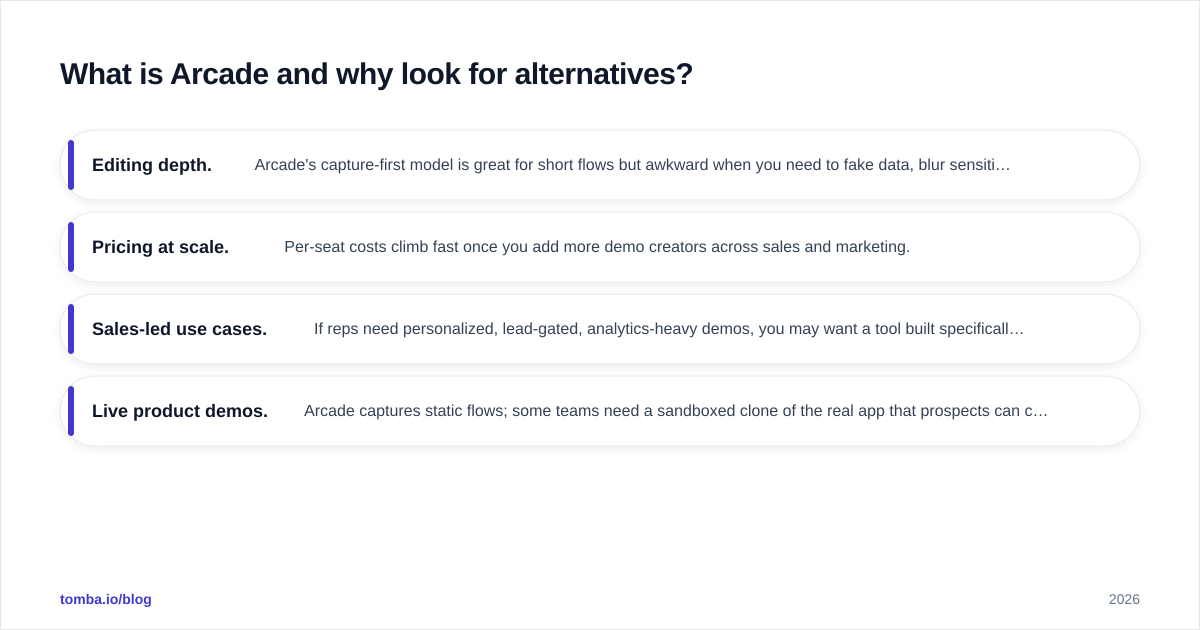
What is Arcade and why look for alternatives?#
Arcade is an interactive demo platform that turns a screen recording into a clickable, GIF-style walkthrough you can embed in a website, email, or sales deck. It's popular because it's quick: capture a flow, trim the steps, add a few hotspots, and ship. For product marketers who need a hero demo on a landing page tomorrow, it's hard to beat.
But "quick and polished" comes with trade-offs. Teams typically start hunting for Arcade alternatives for a few concrete reasons:
- Editing depth. Arcade's capture-first model is great for short flows but awkward when you need to fake data, blur sensitive fields, or stitch long multi-screen journeys.
- Pricing at scale. Per-seat costs climb fast once you add more demo creators across sales and marketing.
- Sales-led use cases. If reps need personalized, lead-gated, analytics-heavy demos, you may want a tool built specifically for that motion.
- Live product demos. Arcade captures static flows; some teams need a sandboxed clone of the real app that prospects can click through freely.
None of this makes Arcade bad — it makes it one option among several. Below is how the field actually stacks up.
How do the best Arcade alternatives compare?#
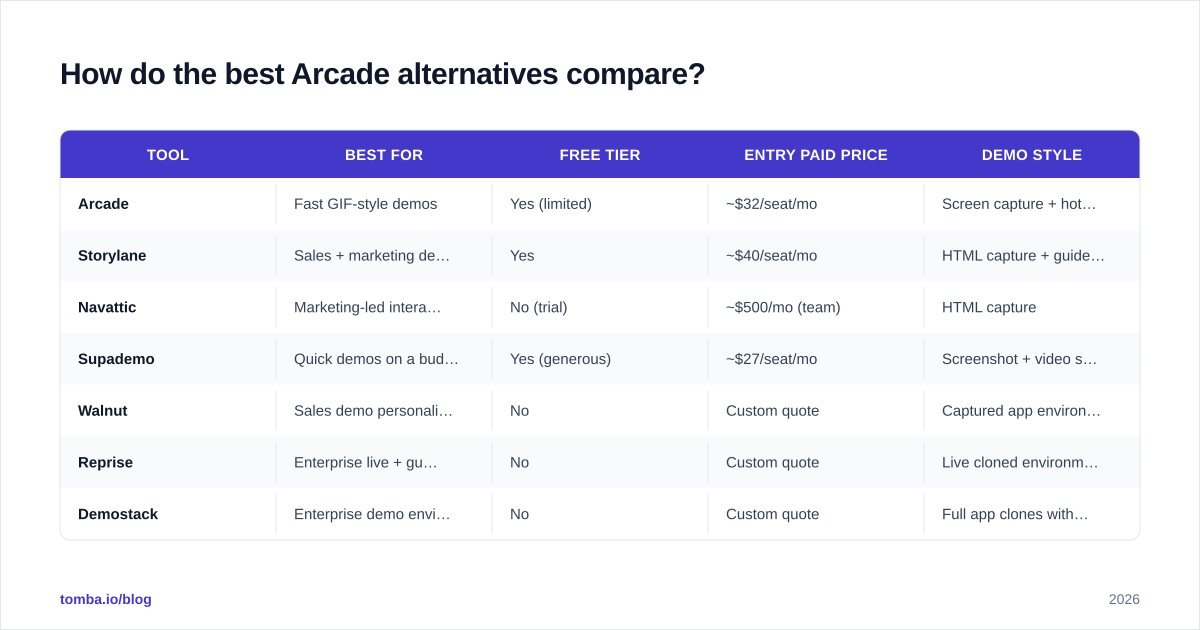
Here's a side-by-side of the seven tools most teams evaluate against Arcade in 2026. Prices are entry points for paid plans and move around, so treat them as directional and confirm on each vendor's site.
| Tool | Best for | Free tier | Entry paid price | Demo style |
|---|---|---|---|---|
| Arcade | Fast GIF-style demos | Yes (limited) | ~$32/seat/mo | Screen capture + hotspots |
| Storylane | Sales + marketing demos | Yes | ~$40/seat/mo | HTML capture + guided tours |
| Navattic | Marketing-led interactive demos | No (trial) | ~$500/mo (team) | HTML capture |
| Supademo | Quick demos on a budget | Yes (generous) | ~$27/seat/mo | Screenshot + video steps |
| Walnut | Sales demo personalization | No | Custom quote | Captured app environments |
| Reprise | Enterprise live + guided demos | No | Custom quote | Live cloned environments |
| Demostack | Enterprise demo environments | No | Custom quote | Full app clones with data |
A quick read of that table: the cheaper, self-serve end (Arcade, Supademo, Storylane) is where most small and mid-market teams live. The quote-only end (Walnut, Reprise, Demostack) is where enterprise sales orgs that demo complex, data-heavy products end up. Navattic sits in the middle, leaning marketing.
Which Arcade alternative fits your use case?#
Storylane — the balanced all-rounder#
Storylane is the alternative most teams shortlist first, because it does both marketing demos and sales demos well. It captures your live app as editable HTML (so you can swap text, blur data, and re-theme without re-recording), supports guided tours and sandbox modes, and includes lead capture plus analytics. The free tier is real, and paid plans start affordably for small teams. If you want one tool to serve both the website hero demo and reps' personalized walkthroughs, start here. Check current details on the Storylane site.
Navattic — marketing-led interactive demos#
Navattic is laser-focused on top-of-funnel: interactive product tours embedded on landing pages and in ad campaigns, with strong analytics on who engaged and how far they got. It's typically priced for teams rather than individuals, so it suits a product-marketing function that's serious about demo-led growth. Less ideal if your primary need is one-off rep demos.
Supademo — the budget-friendly pick#
Supademo is the closest spiritual cousin to Arcade: fast, screenshot-and-video step demos, a generous free tier, and per-seat pricing that undercuts most rivals. AI features (voiceovers, auto-translation, step descriptions) have made it a favorite for support and onboarding teams who crank out lots of short how-to demos. If your main complaint about Arcade is price, Supademo is the obvious test.
Walnut — sales demo personalization#
Walnut is built for sales orgs that demo the same product to many accounts and want each one personalized. Reps clone a captured environment, swap in the prospect's logo and data, and track engagement inside the deal. It's quote-only and aimed at mid-market and enterprise sales teams, not solo creators.
Reprise and Demostack — the enterprise environment players#
Both Reprise and Demostack go a level deeper than capture-based tools: they create live, sandboxed clones of your actual application that prospects (or reps) can click through freely, with realistic data baked in. That's the right answer when your product is too complex or stateful to fake with screenshots — think multi-step workflows, dashboards, and configurable apps. Expect enterprise pricing, longer setup, and a custom quote.
Tourial — demo centers and campaigns#
Tourial leans into "demo centers" — curated collections of interactive demos organized by use case or persona — plus demo automation for campaigns. It's a strong fit for marketing teams that want a structured demo library rather than scattered one-off tours.
What features should you actually evaluate?#
Don't get distracted by feature lists. When comparing Arcade alternatives, weigh these in order of impact:
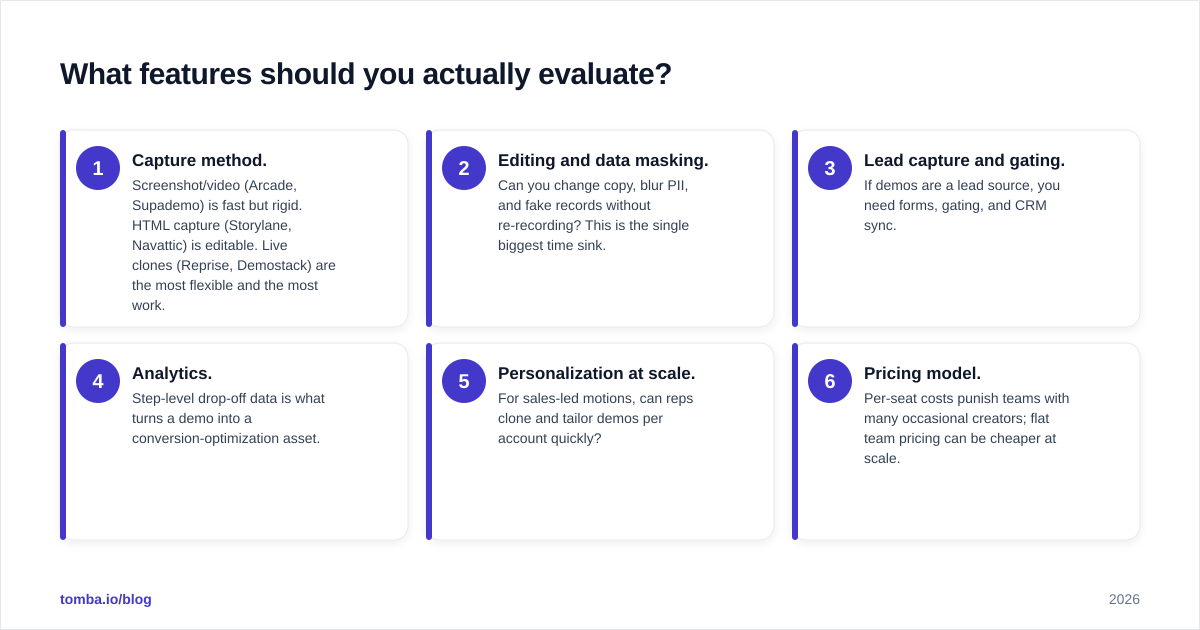
- Capture method. Screenshot/video (Arcade, Supademo) is fast but rigid. HTML capture (Storylane, Navattic) is editable. Live clones (Reprise, Demostack) are the most flexible and the most work.
- Editing and data masking. Can you change copy, blur PII, and fake records without re-recording? This is the single biggest time sink.
- Lead capture and gating. If demos are a lead source, you need forms, gating, and CRM sync.
- Analytics. Step-level drop-off data is what turns a demo into a conversion-optimization asset.
- Personalization at scale. For sales-led motions, can reps clone and tailor demos per account quickly?
- Pricing model. Per-seat costs punish teams with many occasional creators; flat team pricing can be cheaper at scale.

A practical rule: marketing-led teams optimizing a website demo should prioritize analytics and lead capture; sales-led teams should prioritize personalization and CRM sync; product-heavy enterprises should prioritize live environments and data realism.
Are free Arcade alternatives good enough?#
For many teams, yes — to start. Supademo and Storylane both offer free tiers that are genuinely usable for a handful of demos, and Arcade's own free plan covers light use. Free tiers are perfect for validating that demo-led content moves your numbers before you commit budget.
Where free breaks down is volume and control: watermarks, demo caps, limited analytics, and no custom domains. Once demos become a real channel, you'll want a paid plan for the branding, gating, and reporting. The good news is the mid-market paid tiers across these tools are affordable enough that the decision usually comes down to fit, not cost. You can compare published rates on a directory like G2 before you book a single sales call.
How do demos fit into your wider outbound and lead-gen stack?#
Here's the part most demo-tool roundups skip: a great interactive demo is worthless if the wrong person watches it. Demos are a conversion lever, not a discovery lever — they work best when you've already put them in front of the right, reachable buyer.
That's where your data layer matters. Before you send a personalized Walnut demo or gate a Navattic tour, you need accurate contact details for the accounts you're targeting. A typical flow looks like this:
- Identify target companies and the roles that buy your product.
- Use an email finder to get verified work emails for those contacts, or run a domain search to pull every relevant address at a target company.
- Enrich those records with firmographics and job titles via data enrichment so reps can personalize the demo to the buyer's role.
- Send the interactive demo as the centerpiece of a cold email or follow-up sequence.
In other words, your demo tool and your prospecting tool are complementary, not competing. The demo platform makes the asset; the data platform makes sure it reaches a real human who can buy. If you're building demos at scale for outbound, lining up data sources you trust is as important as the tool you record in.
How to choose: a simple decision path#
Run through these questions in order and you'll land on a shortlist of one or two:
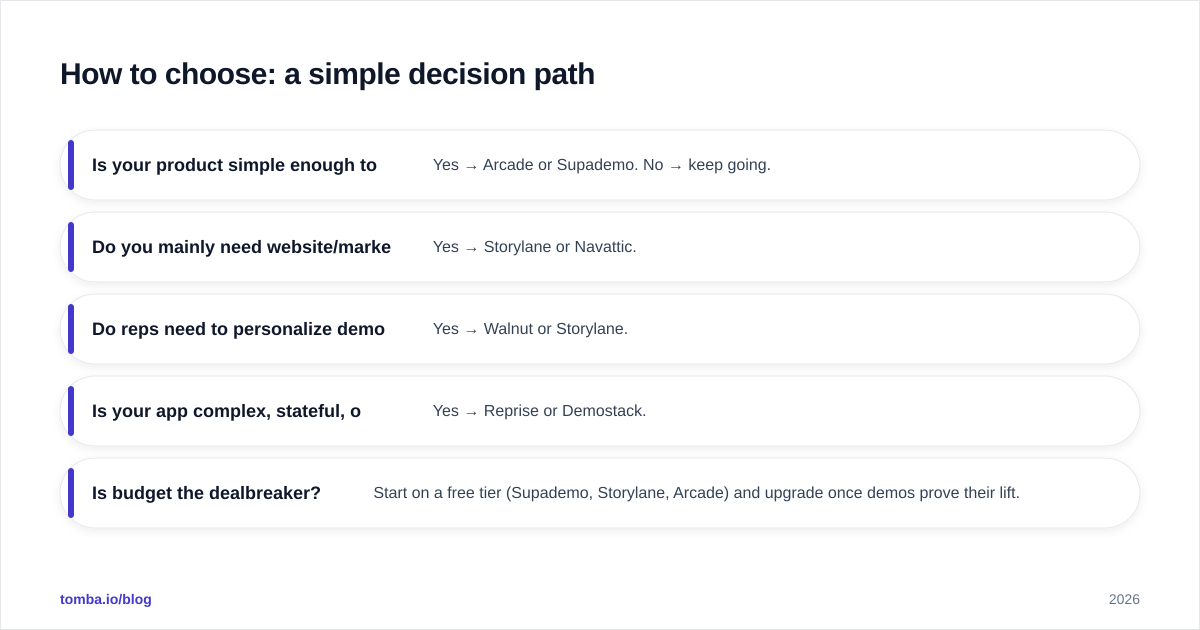
- Is your product simple enough to fake with screenshots? Yes → Arcade or Supademo. No → keep going.
- Do you mainly need website/marketing demos with analytics? Yes → Storylane or Navattic.
- Do reps need to personalize demos per account? Yes → Walnut or Storylane.
- Is your app complex, stateful, or data-heavy? Yes → Reprise or Demostack.
- Is budget the dealbreaker? Start on a free tier (Supademo, Storylane, Arcade) and upgrade once demos prove their lift.
Most teams over-buy. If you're not sure, pick the cheapest tool that clears your must-haves, ship a few demos, measure the conversion lift, and upgrade only when the data justifies it. You can always confirm the current feature set on the official Arcade site and compare directly against your shortlist before committing.
The bottom line#
Arcade is an excellent fast-demo tool, but it's one of seven solid options — and the "best" one depends entirely on whether you're optimizing a landing page, arming a sales team, or demoing a complex enterprise app. Match the tool to the motion, start cheap, and let conversion data drive the upgrade.
And remember the half of demo-led growth that has nothing to do with demo software: targeting. The slickest interactive demo still needs to land in the inbox of a real, qualified buyer. Tomba's Email Finder gives you verified, accurate work emails for the exact people you want clicking through your demo — so the asset you spent hours building actually reaches someone who can say yes. Start free with 25 searches a month, and see Tomba pricing when you're ready to scale your outbound.
// get started
Find, verify and enrich your first contacts today
Start on the free plan with 25 searches a month, then scale when your team is ready.
Free plan · No credit card required · GDPR & CCPA
// about the author