Archetype Data vs Cloduraai 2026: B2B Data Tools Compared
Archetype Data and Clodura.ai both promise clean B2B data and warm pipeline. Here's how they actually compare on coverage, accuracy, workflow, and price in 2026 — plus where a leaner stack wins.
TL;DR
- Archetype Data leans toward curated, ICP-shaped account and contact lists — strong when you want a tightly defined audience handed to you rather than a self-serve search engine.
- Clodura.ai is a broader sales-intelligence suite: prospecting database, org charts, technographics, intent signals, and a built-in sequencer aimed at running outreach inside one tool.
- Neither is a pure email-finder; both bundle contact data with workflow, which raises price and lock-in versus a focused finder + verifier.
- Accuracy is the deciding factor most teams underweight — a bounce-heavy list quietly burns sender reputation faster than any feature gap.
- If your real bottleneck is "find and verify correct work emails fast," a lean stack like the Tomba Email Finder plus an email verifier often beats paying suite pricing for modules you won't use.
What are Archetype Data and Clodura.ai?#
Short answer: both are B2B data platforms, but they solve the "who do I contact" problem from opposite ends.
Archetype Data positions itself around audience curation. The pitch is that you describe your ideal customer profile — industry, size, role, region — and you receive a contact and account set shaped to match, rather than digging through a giant search UI yourself. Think of it like a tailored grocery delivery: you hand over a recipe and someone fills the basket.
Clodura.ai is closer to a full sales-intelligence supermarket. It carries a self-serve prospecting database (the vendor cites a large multi-hundred-million contact pool), org charts, direct dials, technographic filters, buyer-intent signals, and a native email sequencer. You walk the aisles, filter, and load your own cart — then send from the same building. You can confirm the current feature set on the Clodura.ai site and read user reports on G2.
The practical difference: Archetype Data optimizes for done-for-you targeting, Clodura.ai optimizes for do-it-yourself breadth plus built-in execution.
How do they compare feature by feature?#
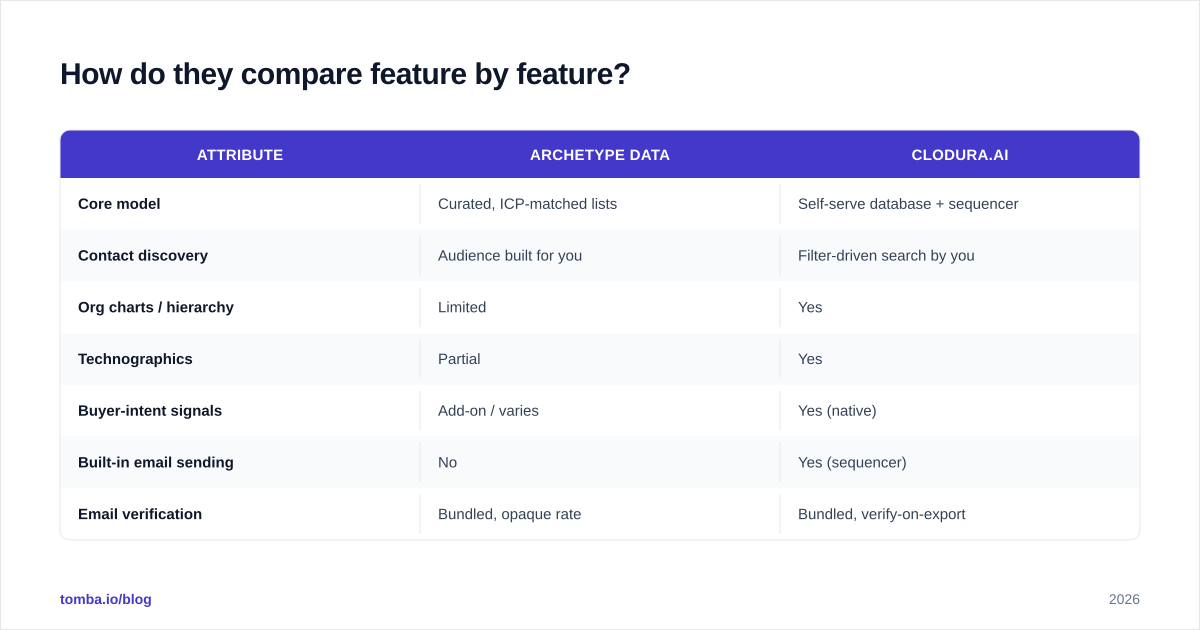
Here's the head-to-head on the attributes that actually change your day-to-day workflow and cost.
| Attribute | Archetype Data | Clodura.ai |
|---|---|---|
| Core model | Curated, ICP-matched lists | Self-serve database + sequencer |
| Contact discovery | Audience built for you | Filter-driven search by you |
| Org charts / hierarchy | Limited | Yes |
| Technographics | Partial | Yes |
| Buyer-intent signals | Add-on / varies | Yes (native) |
| Built-in email sending | No | Yes (sequencer) |
| Email verification | Bundled, opaque rate | Bundled, verify-on-export |
| Best-fit team | Focused niche ICP | Full-cycle SDR teams |
| Pricing transparency | Quote-based | Tiered + quote for scale |
Two things stand out. First, Clodura.ai is the wider tool — if you want intent and sequencing under one login, it consolidates more of the stack. Second, neither vendor publishes a hard, independently audited accuracy figure, which is exactly the number you should weigh most. A platform can have 400M contacts and still hand you a list where one in four emails bounces.

Which one has more accurate data?#
Conclusion first: assume both lists need re-verification before you send, regardless of vendor claims.
B2B data decays fast — people change jobs, companies rebrand, domains migrate. Industry estimates routinely put contact-data decay at roughly 20–30% per year, and analyst firms like Gartner have long flagged poor data quality as a direct drag on revenue operations. That decay is why a "verified at export" badge from any suite is a snapshot, not a guarantee, by the time your sequence actually fires next week.
This is where buying a giant bundled database can backfire. You pay for breadth, trust the built-in verification, and only discover the bounce rate after your domain reputation has already taken the hit. The cleaner pattern is to treat sourcing and verification as two separate, swappable jobs:
- Source contacts (from Archetype, Clodura, LinkedIn, or your CRM).
- Re-verify every address right before send with a dedicated checker.
A standalone email verifier catches catch-all traps, role accounts, and dead mailboxes that a bundled "verified" flag often waves through. If you want to understand why coverage and accuracy claims differ so much across vendors, Tomba documents its own data sources openly — a transparency bar worth holding every provider to.
Is one better for prospecting workflow?#
It depends on whether you want execution inside the tool or a clean data hand-off.
Choose Clodura.ai if you want a single pane of glass: search the database, see the org chart, read intent signals, drop contacts into a sequence, and track replies without exporting anywhere. For a small SDR team that hates tool-switching, that consolidation is real time saved. The trade-off is the classic suite tax — you pay for sequencing, intent, and dialer modules even if you already run Smartlead, Instantly, or HubSpot for sending.
Choose Archetype Data if your motion is narrow and well-defined, and you'd rather receive a sharp list than operate a search engine. If your ICP is "Series B fintech, VP Eng, US, 50–200 headcount," a curated hand-off removes the filtering grunt work. The trade-off is flexibility: the moment you want to pivot segments or run an ad-hoc search, a self-serve database is faster.
Where both stumble is the messy middle — when you already own a CRM full of accounts and just need the missing work emails and direct dials filled in. That's an enrichment job, not a "buy a new database" job. A focused data enrichment layer or a bulk email finder appends the gaps without forcing you to migrate your source of truth into someone else's platform.
What does each cost in 2026?#
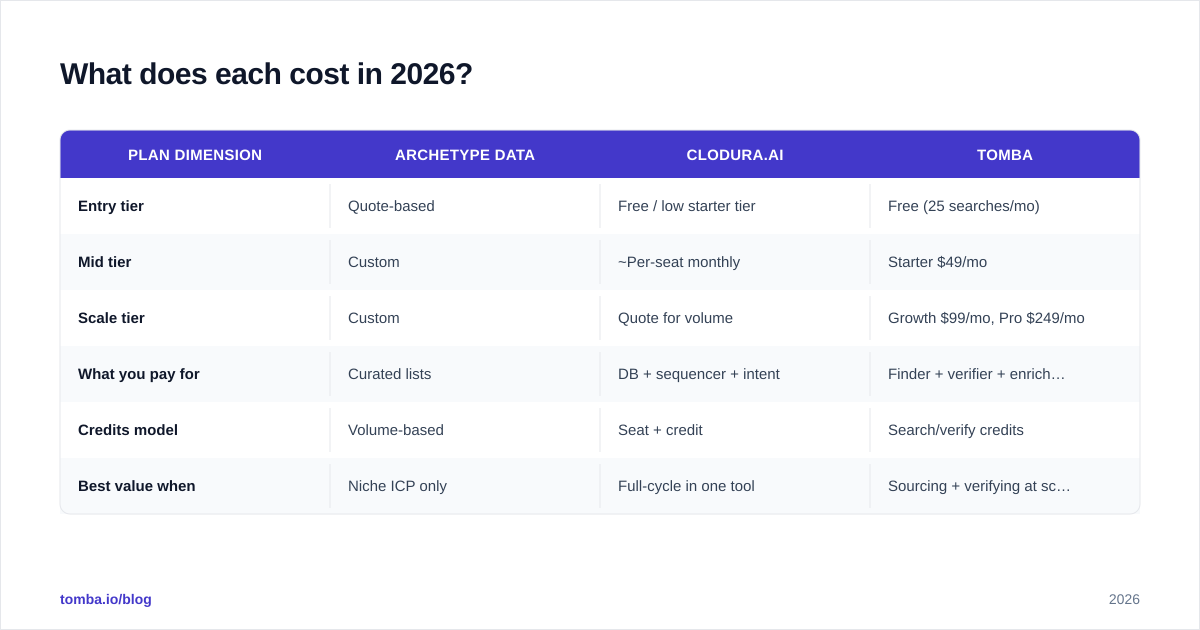
Both lean on quote-based or tiered-plus-quote pricing, which makes apples-to-apples hard. The pattern below reflects how these suites typically package value — confirm live numbers directly with each vendor.
| Plan dimension | Archetype Data | Clodura.ai | Tomba |
|---|---|---|---|
| Entry tier | Quote-based | Free / low starter tier | Free (25 searches/mo) |
| Mid tier | Custom | ~Per-seat monthly | Starter $49/mo |
| Scale tier | Custom | Quote for volume | Growth $99/mo, Pro $249/mo |
| What you pay for | Curated lists | DB + sequencer + intent | Finder + verifier + enrichment |
| Credits model | Volume-based | Seat + credit | Search/verify credits |
| Best value when | Niche ICP only | Full-cycle in one tool | Sourcing + verifying at scale |
The strategic point: with a suite, a large share of your spend funds modules you may already cover elsewhere. If you only need accurate contact data — and you handle sending in a tool you already trust — suite pricing is overpaying for shelf space. You can see Tomba's transparent, published pricing as the contrast: no "contact sales" wall to find out the cost of finding an email.
A simple budgeting heuristic:
- Need intent + sequencing + data, all-in-one? A suite like Clodura.ai can justify itself.
- Need a curated niche list, occasionally? Archetype Data's hand-off model may fit.
- Need to find and verify the right emails, repeatedly, at a predictable price? A focused finder + verifier wins on cost and control.
What are the pros and cons of each?#
Archetype Data — pros
- Done-for-you targeting removes filtering effort.
- Good fit for a single, stable ICP.
- Less tool sprawl if you only need lists.
Archetype Data — cons
- Less flexible for ad-hoc or shifting segments.
- Opaque, quote-based pricing.
- Verification quality is hard to audit before you buy.
Clodura.ai — pros
- Broad suite: database, org charts, technographics, intent, sequencer.
- Strong for SDR teams wanting one login.
- Self-serve search gives you control.
Clodura.ai — cons
- You pay for modules you may duplicate elsewhere.
- Bundled verification still needs a re-check before send.
- Suite complexity can slow onboarding.
Is there a leaner alternative to both?#
Yes — and for many teams it's the better answer.
The honest framing: Archetype Data and Clodura.ai are both reasonable if you genuinely need their full scope. But a large slice of buyers reach for these platforms to solve one narrow problem — get correct, deliverable contact details for a known list of accounts — and end up financing intent dashboards and sequencers they barely touch.
If that's you, decouple the stack:
- Use the Tomba Email Finder to find professional emails by name, company, or domain.
- Run a domain search to pull every public email pattern at a target company.
- Verify everything with the email verifier before it touches your sequencer.
- Append gaps in your existing CRM via data enrichment instead of re-buying a database.
This keeps your sending tool, your CRM, and your data layer independent — so when one vendor's accuracy slips or price jumps, you swap a single piece instead of migrating your whole motion. It's the difference between renting a furnished apartment you can't rearrange and owning modular furniture you can move at will.
Which should you choose?#
- Pick Archetype Data if you have one tight ICP and want a curated list handed over with minimal effort.
- Pick Clodura.ai if you want an all-in-one sales-intelligence suite — database, intent, and sequencing — and you'll actually use the breadth.
- Pick a lean finder + verifier stack if your core job is sourcing and verifying accurate contact data at a predictable, transparent price, while keeping your existing CRM and sender tooling.
Whatever you choose, treat data accuracy as the headline metric, not feature count. The flashiest suite still loses you deals if a quarter of its emails bounce.
Ready to test the leanest path first? Start free with the Tomba Email Finder — 25 searches a month, no quote call, no suite tax. Find the right work emails, verify them before you send, and only scale up to paid plans when the pipeline proves it's worth it. It's the fastest way to see whether you ever needed the full platform at all.
Ready to find emails that actually work?
Join 150,000+ professionals who stopped guessing and started sending. Free credits on signup — no credit card required.
Get the Tomba newsletter
Practical outbound tactics and product updates — once every two weeks.
About the author