Archetype Data vs DiscoverOrg: B2B Data Compared (2026)
DiscoverOrg became ZoomInfo, while Archetype Data targets lean, intent-led teams. Here's an honest 2026 breakdown of coverage, accuracy, pricing, and fit.
Choosing a B2B data provider in 2026 is less about who has "the most contacts" and more about who has the right contacts, refreshed often enough to matter, at a price your revenue team can defend. That's the real question behind Archetype Data vs DiscoverOrg — two names that represent very different eras and philosophies of go-to-market data.
This guide breaks down both honestly: where each wins, where each frustrates, and how to pick without signing a contract you'll regret in Q3.
TL;DR#
- **DiscoverOrg is effectively
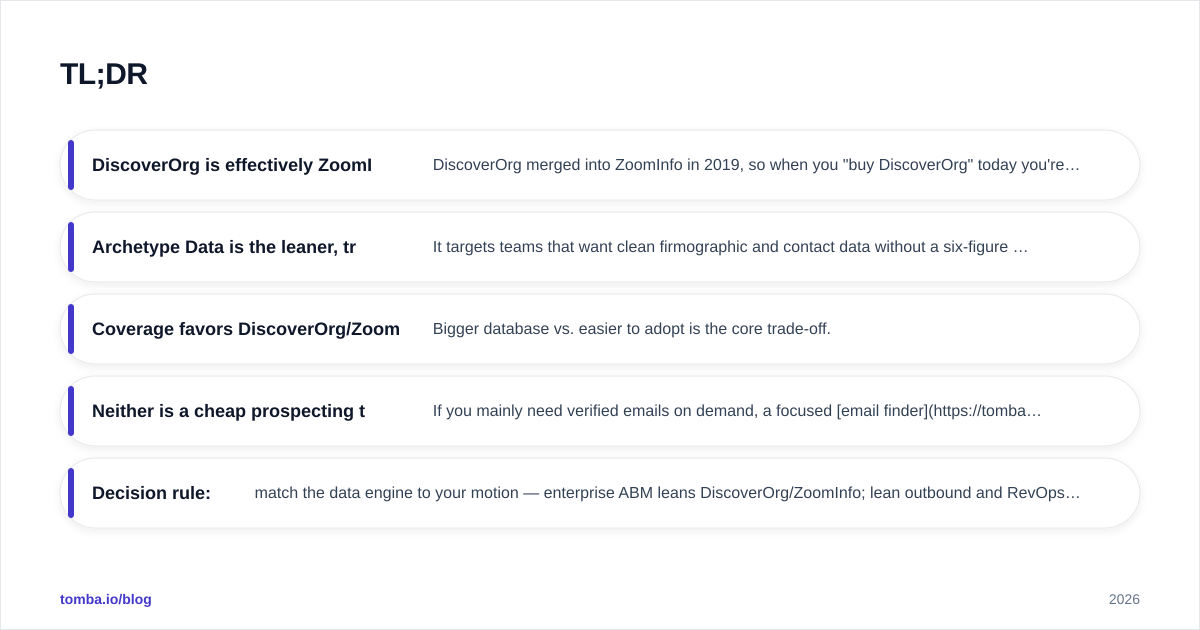
ZoomInfo now.** DiscoverOrg merged into ZoomInfo in 2019, so when you "buy DiscoverOrg" today you're buying the ZoomInfo platform — deep firmographics, org charts, intent, and a high-touch enterprise price tag.
- Archetype Data is the leaner, transparency-first option. It targets teams that want clean firmographic and contact data without a six-figure commitment or a 12-month lock-in.
- Coverage favors DiscoverOrg/ZoomInfo; agility and price favor Archetype. Bigger database vs. easier to adopt is the core trade-off.
- Neither is a cheap prospecting tool. If you mainly need verified emails on demand, a focused email finder plus an email verifier can cover 80% of the job for a fraction of the cost.
- Decision rule: match the data engine to your motion — enterprise ABM leans DiscoverOrg/ZoomInfo; lean outbound and RevOps experimentation lean Archetype or a stack of focused tools.
What is DiscoverOrg in 2026?#
DiscoverOrg was, for over a decade, the gold standard for human-verified org charts and technographic data in B2B sales. In 2019 it acquired ZoomInfo and then took the ZoomInfo name to market. So the practical answer to "what is DiscoverOrg today" is: it's the deep-data backbone inside ZoomInfo. You can read the corporate history straight from ZoomInfo's own site.
What you get with that lineage:
- Large contact and company database with global coverage
- Org charts and reporting hierarchies for enterprise accounts
- Intent signals, technographics, and scoops (trigger events)
- Native CRM and sales-engagement integrations
- Enterprise security, compliance, and admin controls
What you also get: enterprise sales cycles, annual contracts, and pricing that typically starts in the five figures and climbs fast with seats and data exports. For a 200-person sales org chasing named accounts, that math works. For a five-person team running outbound experiments, it rarely does.
What is Archetype Data?#
Archetype Data positions itself as a modern, transparency-first B2B data provider for teams that found legacy platforms too heavy and too expensive. The pitch is straightforward: clean firmographic and contact data, clearer pricing, and faster onboarding, without forcing you into the full enterprise suite you'll only half-use.
Where Archetype tends to win:
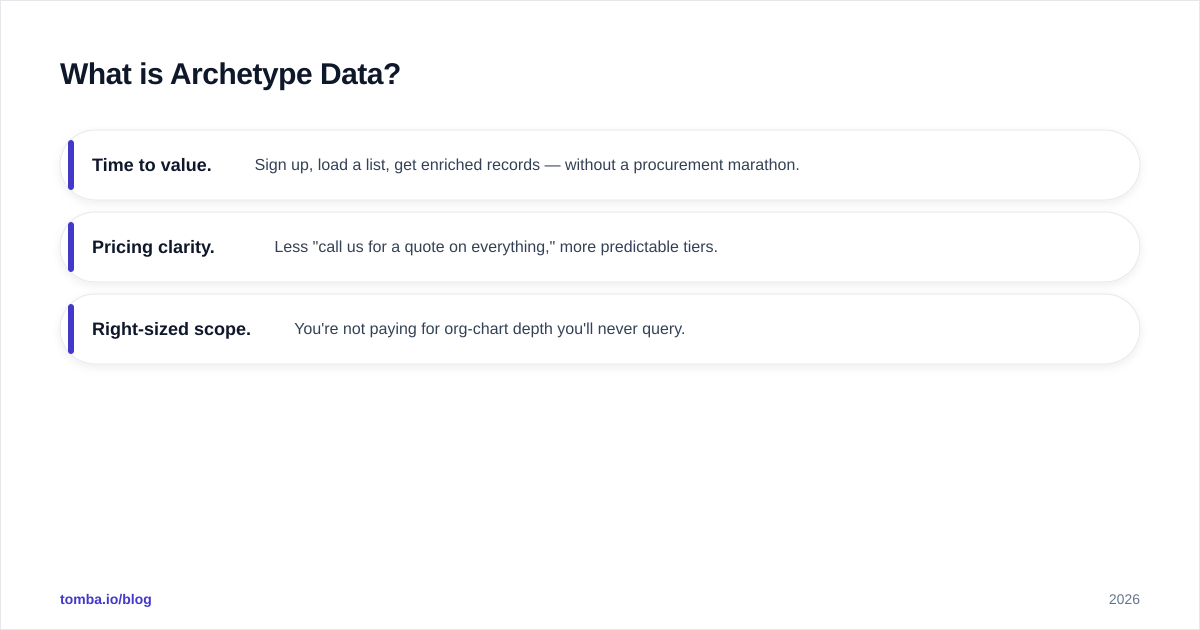
- Time to value. Sign up, load a list, get enriched records — without a procurement marathon.
- Pricing clarity. Less "call us for a quote on everything," more predictable tiers.
- Right-sized scope. You're not paying for org-chart depth you'll never query.
Where it's weaker than the incumbent: raw coverage and the depth of human-verified org charts. If your motion depends on mapping a 14-person buying committee inside a Fortune 100 account, the legacy DiscoverOrg/
ZoomInfo dataset still has the edge.
The honest framing: Archetype is a sharp tool for a defined job, where DiscoverOrg/ZoomInfo is a platform that wants to own your entire data layer.

Archetype Data vs DiscoverOrg: how do they compare head-to-head?#
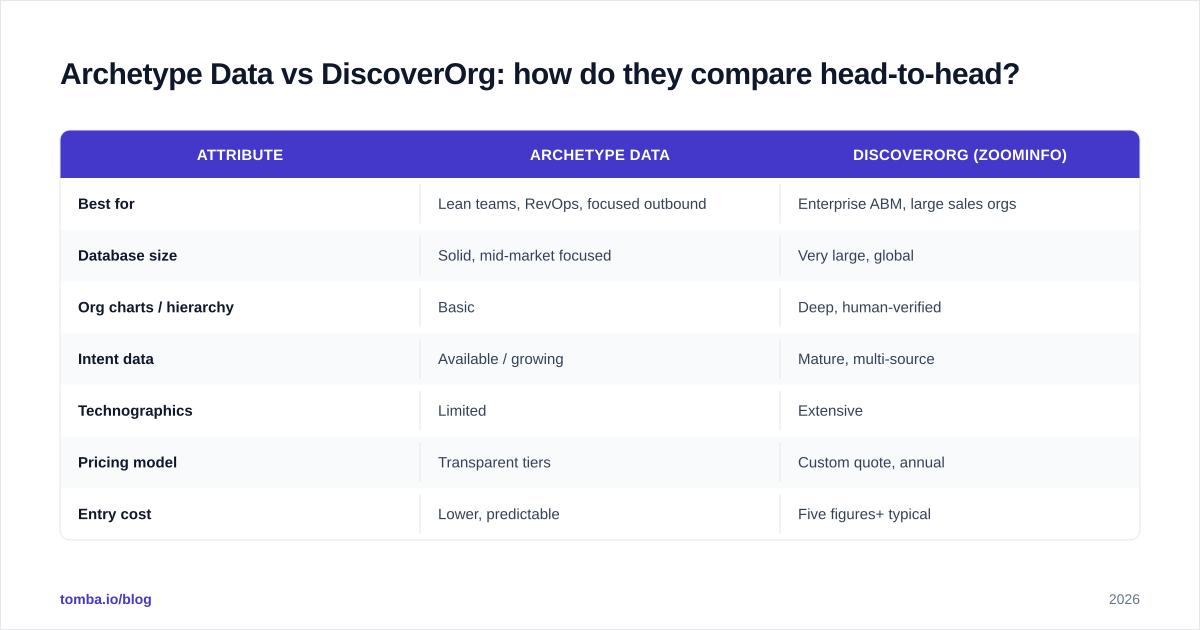
Here's the side-by-side. Treat exact pricing as directional — both vendors quote based on seats, data volume, and modules, and enterprise data contracts are notoriously negotiable.
| Attribute | Archetype Data | DiscoverOrg (ZoomInfo) |
|---|---|---|
| Best for | Lean teams, RevOps, focused outbound | Enterprise ABM, large sales orgs |
| Database size | Solid, mid-market focused | Very large, global |
| Org charts / hierarchy | Basic | Deep, human-verified |
| Intent data | Available / growing | Mature, multi-source |
| Technographics | Limited | Extensive |
| Pricing model | Transparent tiers | Custom quote, annual |
| Entry cost | Lower, predictable | Five figures+ typical |
| Contract | Flexible | Annual commitment |
| Time to onboard | Days | Weeks |
| CRM integrations | Core (HubSpot, Salesforce) | Broad + native sync |
A useful sanity check: read third-party reviews on G2 before you commit. Pay attention to the low ratings, not the highlight reel — that's where you learn how each vendor handles data decay, refunds for bad records, and contract renewals.
Is the data accuracy actually different?#
Accuracy is where the marketing claims and the reality diverge, so judge it on process, not percentages.
DiscoverOrg's historical advantage was human verification — research teams calling and confirming records. That legacy still shows up in the depth and reliability of ZoomInfo's enterprise records, especially org charts. The trade-off is that any large database decays: people change jobs constantly, so even verified data needs continuous refresh.
Archetype leans on a mix of automated collection and validation. For mid-market and standard firmographic fields, that's often more than good enough. For deep, niche, or executive-level records, the legacy verified dataset still pulls ahead.
Two rules apply no matter which you choose:
- Never trust a single source for contactability. Always re-validate emails before a send. Running records through an independent email verification step protects your sender reputation regardless of where the data came from.
- Measure decay, not just accuracy at purchase. A 95%-accurate database in January can be 80% accurate by July. Ask both vendors how often they refresh and whether they credit you for bounced records.
If your core need is simply finding and confirming the right email for a known person or company, a dedicated domain search tool often beats paying enterprise data rates for fields you'll never use.
When should you pick DiscoverOrg / ZoomInfo?#
Pick the DiscoverOrg/ZoomInfo platform when these are true:
- You sell into enterprise accounts with large, multi-stakeholder buying committees.
- You run account-based marketing and need org charts, intent, and technographics in one place.
- You have the budget and headcount to actually use a full data platform.
- You need deep CRM and sales-engagement integration with admin governance.
- Procurement, security review, and annual contracts are normal parts of how you buy software.
In that world, the price premium buys you coverage and depth that are hard to replicate by stitching point tools together. The risk is over-buying: many teams pay for the full suite and use a third of it.
When should you pick Archetype Data?#
Pick Archetype when:
- You're a startup or mid-market team that needs clean data without enterprise overhead.
- Predictable pricing matters more than maximum coverage.
- You want to test and iterate on outbound without a 12-month lock-in.
- Your buying committees are smaller, so deep org charts aren't critical.
- You'd rather own your stack than rent an all-in-one platform.
The strategic upside of the lean choice is optionality. You keep budget free to layer in specialized tools — a phone finder for calling motions, data enrichment for CRM hygiene, or bulk lead generation for list building — instead of paying one vendor for everything and being captive to their roadmap.
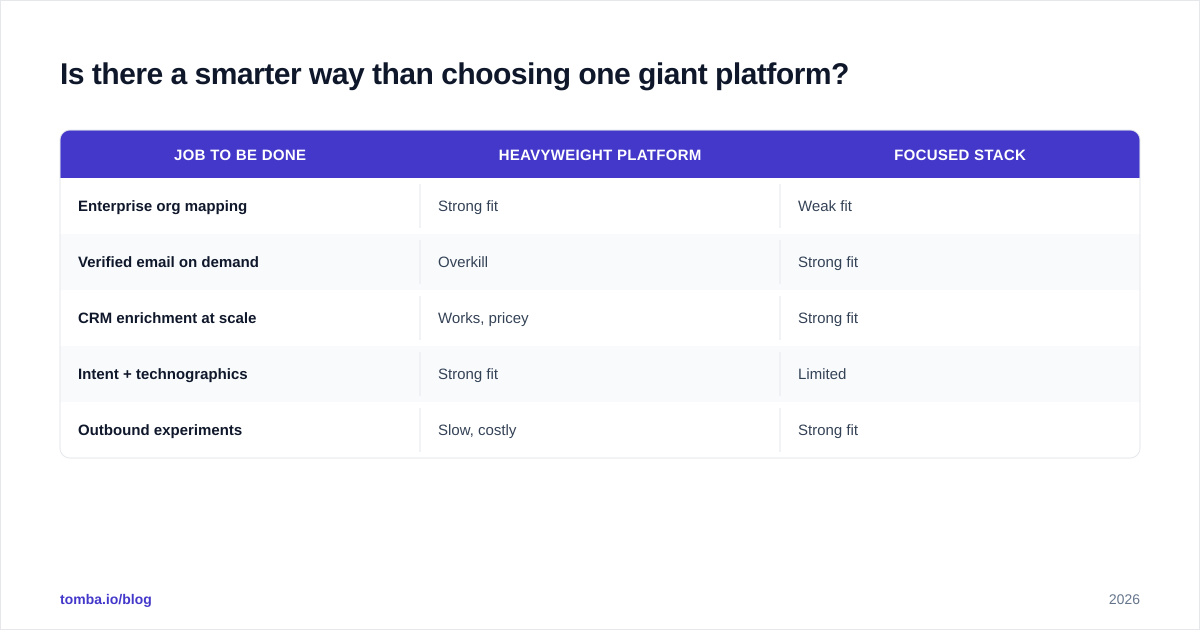
Is there a smarter way than choosing one giant platform?#
For many teams in 2026, yes: unbundle the data layer.
The old assumption was that you needed one massive provider for everything. But the modern stack is modular. You can decide what you actually need and buy exactly that:
- Need verified emails on demand? A focused email finder plus verifier covers it.
- Need company-level prospecting? Domain search returns every email pattern at an org.
- Need CRM enrichment? An enrichment API fills gaps on records you already own.
- Need intent or org charts? That's where a heavyweight like DiscoverOrg/
ZoomInfo earns its price.
Use this framework to decide where each dollar goes:
The point isn't that DiscoverOrg or Archetype is "wrong." It's that paying enterprise platform rates for jobs a focused tool does better is the most common — and most expensive — mistake in GTM tooling. Map your motion first, then buy the smallest thing that covers it.
A practical hybrid many teams run:
| Job to be done | Heavyweight platform | Focused stack |
|---|---|---|
| Enterprise org mapping | Strong fit | Weak fit |
| Verified email on demand | Overkill | Strong fit |
| CRM enrichment at scale | Works, pricey | Strong fit |
| Intent + technographics | Strong fit | Limited |
| Outbound experiments | Slow, costly | Strong fit |
If most of your rows land in the "focused stack" column, you probably don't need a full DiscoverOrg/ZoomInfo contract — or an Archetype suite — to start. You need clean, verified contact data and the discipline to validate before you send.
What about pricing and total cost of ownership?#
Sticker price is the smallest part of the cost. Factor in:
- Onboarding time. Weeks of setup is a real cost in a fast-moving team.
- Seat sprawl. Per-seat enterprise pricing punishes growth.
- Data decay credits. Does the vendor refund bounced or stale records?
- Export limits. Some contracts cap how much data you can pull — a hidden tax on scale.
- Switching cost. Annual lock-in means a bad fit is your problem for 12 months.
Archetype's transparency-first model tends to lower the first four. DiscoverOrg/ZoomInfo's depth justifies the higher number only if you use the depth. Before signing either, run a 30-day pilot against your own ICP list and measure bounce rate, connect rate, and meetings booked — not vendor-supplied accuracy stats. For a cost comparison on the focused-stack side, the transparent Tomba pricing tiers give you a clear baseline to benchmark enterprise quotes against.
Frequently asked questions#
Is DiscoverOrg the same as ZoomInfo? Functionally, yes. DiscoverOrg acquired ZoomInfo in 2019 and adopted the ZoomInfo brand, so buying "DiscoverOrg" today means buying the ZoomInfo platform that inherited its verified-data DNA.
Is Archetype Data accurate enough for enterprise? For mid-market firmographics and standard contact data, generally yes. For deep executive org charts inside very large accounts, the legacy verified dataset still leads.
Can I just use an email finder instead? If your main need is finding and verifying emails for known targets, a dedicated email finder and verifier covers most of the job at a fraction of enterprise data cost. You'd add a platform only when you need intent, org charts, or technographics.
Which is cheaper, Archetype or DiscoverOrg? Archetype is almost always the lower and more predictable cost. DiscoverOrg/ZoomInfo pricing is custom, annual, and typically starts in the five figures.
The bottom line#
Archetype Data vs DiscoverOrg comes down to one honest question: do you need a platform, or do you need data? DiscoverOrg/ZoomInfo is the right call when enterprise depth — org charts, intent, technographics — directly drives revenue and you'll use all of it. Archetype is the smarter pick for lean teams that want clean data, transparent pricing, and the freedom to keep their stack modular.
And if, after mapping your motion, most of what you need is the right email for the right person, verified before you hit send — you don't need a six-figure contract to get there. Start with Tomba Email Finder to pull accurate, verified business emails by name, company, or domain, then scale up only when org charts and intent become the bottleneck. Buy the smallest thing that covers the job, prove the ROI, and let your data spend follow your results — not a sales rep's quota.
// get started
Find, verify and enrich your first contacts today
Start on the free plan with 25 searches a month, then scale when your team is ready.
Free plan · No credit card required · GDPR & CCPA
// about the author