Archetype Data vs FindThatLead: 2026 Email Tool Showdown
Archetype Data vs FindThatLead compared on accuracy, coverage, pricing, and workflow fit — plus where a verified email finder like Tomba beats both for cold outreach in 2026.
You are picking between two very different B2B data tools, and the marketing pages do not make the difference obvious. Archetype Data sells itself as an intent-and-enrichment data layer for go-to-market teams. FindThatLead is an older, prospecting-first platform built around finding and emailing leads. They overlap on one promise — "get contact data for the people you want to sell to" — but they are not built the same way, priced the same way, or accurate to the same degree.
This guide compares Archetype Data vs FindThatLead on the things that actually move pipeline: data accuracy, coverage, deliverability impact, pricing, and which team each one fits. It also explains, honestly, where a dedicated, verification-first email finder like Tomba beats both for cold outreach.
TL;DR#
- Archetype Data is best for teams that want enriched account and contact data with intent signals feeding a CRM — it leans toward data ops, not solo prospectors.
- FindThatLead is a prospecting suite (finder + verifier + cold-email sender) aimed at SMBs and agencies who want one tool to find and email leads.
- Accuracy is the real decider. Both surface emails; neither is built around aggressive multi-source verification, so bounce risk varies by domain.
- Pricing favors FindThatLead for starters; Archetype skews enterprise. Budget and seat count matter more than feature lists here.
- If deliverability is the priority, pair or replace them with a verification-first finder like Tomba ($49/mo Starter, free tier to test) before you load a sender.
What is Archetype Data?#
Archetype Data is a B2B data and enrichment platform. The core pitch is a clean, structured contact and company database you can use to enrich records you already have, fill gaps in your CRM, and layer on buying-intent signals so reps prioritize accounts that are actually in-market.
In practice that means Archetype is most useful downstream of a list, not as your first prospecting click. You bring accounts or domains, it returns firmographics, contacts, and signals. That is the classic data enrichment workflow: take a thin record, make it sales-ready.
Strengths show up when you run a structured GTM motion — account-based selling, revenue operations hygiene, territory planning. The trade-off is that enrichment platforms assume you already know who you are targeting. If you are starting from "I need 500 marketing directors at Series B SaaS companies," an enrichment-first tool is the wrong starting gear.
What is FindThatLead?#
FindThatLead is a prospecting suite that has been around since the mid-2010s. It bundles an email finder, an email verifier, a domain/company search, a "Prospector" segment builder, and a built-in cold-email sender (Scoring/Sender). The whole thing is designed so one person can go from "I have an idea of my ICP" to "emails are going out" without leaving the app.
That all-in-one shape is its biggest strength and its biggest weakness. Strength: simplicity for SMBs and agencies who do not want a five-tool stack. Weakness: when one vendor does finding, verifying, and sending, each piece tends to be "good enough" rather than best-in-class — and the verification step is the one you cannot afford to be merely good enough.
FindThatLead's Prospector lets you build lists by job title, location, and industry, which is genuinely closer to a true prospecting starting point than Archetype's enrichment-first model. If you want to understand the broader category, our guide to sales prospecting workflows covers where finders fit.
Archetype Data vs FindThatLead: how do they compare?#
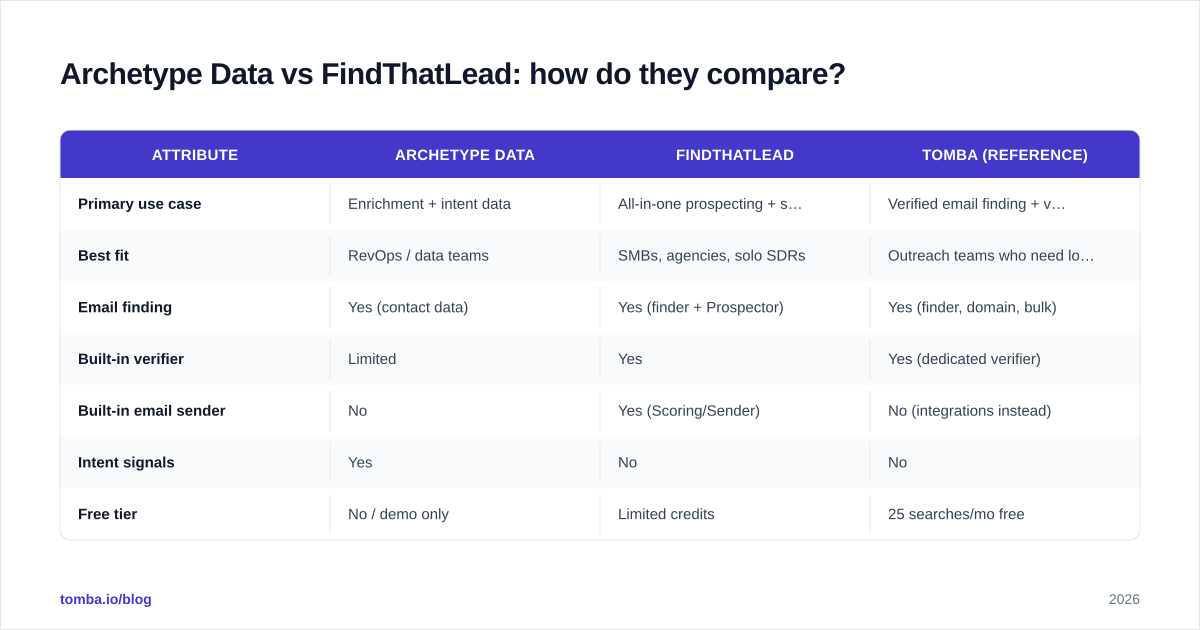
Here is the honest side-by-side. Treat published accuracy numbers from any vendor as marketing until you test them on your own domains — accuracy is wildly domain-dependent.
| Attribute | Archetype Data | FindThatLead | Tomba (reference) |
|---|---|---|---|
| Primary use case | Enrichment + intent data | All-in-one prospecting + sending | Verified email finding + verification |
| Best fit | RevOps / data teams | SMBs, agencies, solo SDRs | Outreach teams who need low bounce |
| Email finding | Yes (contact data) | Yes (finder + Prospector) | Yes (finder, domain, bulk) |
| Built-in verifier | Limited | Yes | Yes (dedicated verifier) |
| Built-in email sender | No | Yes (Scoring/Sender) | No (integrations instead) |
| Intent signals | Yes | No | No |
| Free tier | No / demo only | Limited credits | 25 searches/mo free |
| Entry paid price | Enterprise-leaning | ~$49/mo range | $49/mo Starter |
| API access | Yes | Yes | Yes (Tomba API) |
The pattern: Archetype is a data layer, FindThatLead is a do-everything app, and a finder like Tomba is a precision tool. They are not strictly substitutes — which is exactly why "vs" framing alone can mislead you.
)
Which one is more accurate?#
Accuracy is where the comparison gets real, because a contact record that looks complete but bounces costs you twice: wasted send and damaged sender reputation.
Enrichment platforms like Archetype optimize for coverage and structure — they want a field filled for as many records as possible. Prospecting suites like FindThatLead optimize for breadth — find as many plausible contacts as fast as possible, then verify in a second step. Neither is architected the way a verification-first finder is, where every returned email passes SMTP and pattern checks before it reaches you.
That is the gap Tomba targets. The email verifier runs multi-step validation, and the catch-all verifier handles the domains that quietly wreck campaigns — catch-all servers accept everything at SMTP time, so a "valid" result from a weak verifier is often a coin flip. If you send a lot, that distinction is the whole ballgame.

Which tool fits your use case?#
Forget the feature lists for a second. Match the tool to the job.
You run RevOps or own CRM data quality. Archetype Data's enrichment-plus-intent model fits. You already have accounts; you need them complete, deduplicated, and prioritized. Pair it with a finder for the contact-discovery gaps it leaves.
You are an agency or SMB running cold email end-to-end. FindThatLead's all-in-one is the lowest-friction path. One login, find-to-send. Just budget for the bounce risk and consider verifying lists through a stronger verifier before the sender touches them.
You are an SDR or founder doing targeted outbound and you live and die by deliverability. A verification-first finder wins. Use domain search to pull every contact at a target company, the finder for named-person lookups, and the bulk email finder for lists — all verified on the way out. Then push clean records to your sequencer.
What about pricing?#
Pricing shapes the decision more than any single feature, so be concrete about volume and seats.
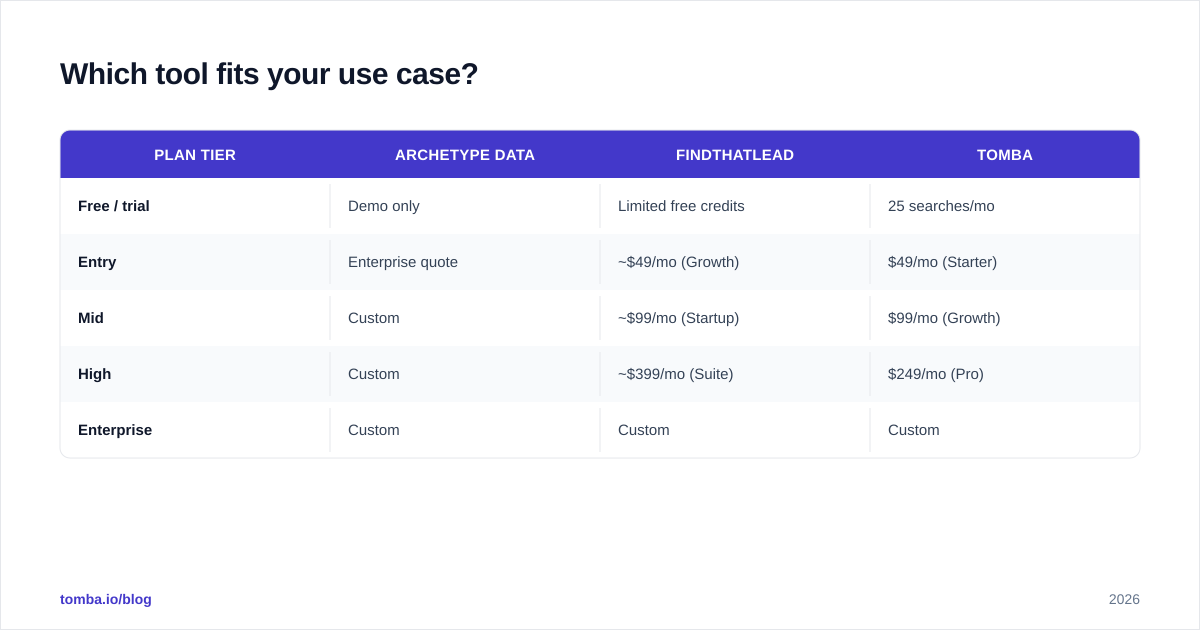
| Plan tier | Archetype Data | FindThatLead | Tomba |
|---|---|---|---|
| Free / trial | Demo only | Limited free credits | 25 searches/mo |
| Entry | Enterprise quote | ~$49/mo (Growth) | $49/mo (Starter) |
| Mid | Custom | ~$99/mo (Startup) | $99/mo (Growth) |
| High | Custom | ~$399/mo (Suite) | $249/mo (Pro) |
| Enterprise | Custom | Custom | Custom |
Two takeaways. First, Archetype's enterprise-leaning model means you will talk to sales before you see a real number — fine for funded teams, friction for everyone else. Second, FindThatLead and Tomba sit in the same accessible band, but you are buying different things: FindThatLead bundles a sender, Tomba concentrates the budget on finding and verifying accurately. Compare the full Tomba pricing tiers against whichever quote you get.
)
Does an all-in-one beat a specialist stack?#
Short answer: it depends on how much you send and how much a bounce costs you.
All-in-one tools like FindThatLead win on convenience and onboarding speed. For a low-volume team sending a few hundred emails a month, the simplicity is worth more than the marginal accuracy you lose. The math flips at volume. Once you are sending thousands of cold emails, a 5% accuracy difference is the line between a healthy domain and a blacklisted one. At that scale a specialist stack — best finder, best verifier, then a dedicated sender like Instantly or Smartlead — pays for itself.
Archetype sits outside this debate. It is not trying to be your sender; it is trying to be your data truth. The realistic enterprise pattern is Archetype for enrichment + intent, a precision finder for discovery, a sequencer for sending — three specialists, not one suite.
If you want to keep finding and verifying tight without committing to a heavy platform, Tomba's Chrome extension and Google Sheets add-on drop verified lookups into where you already work, and the Tomba API wires the same data into your own pipeline.
How do you actually evaluate them?#
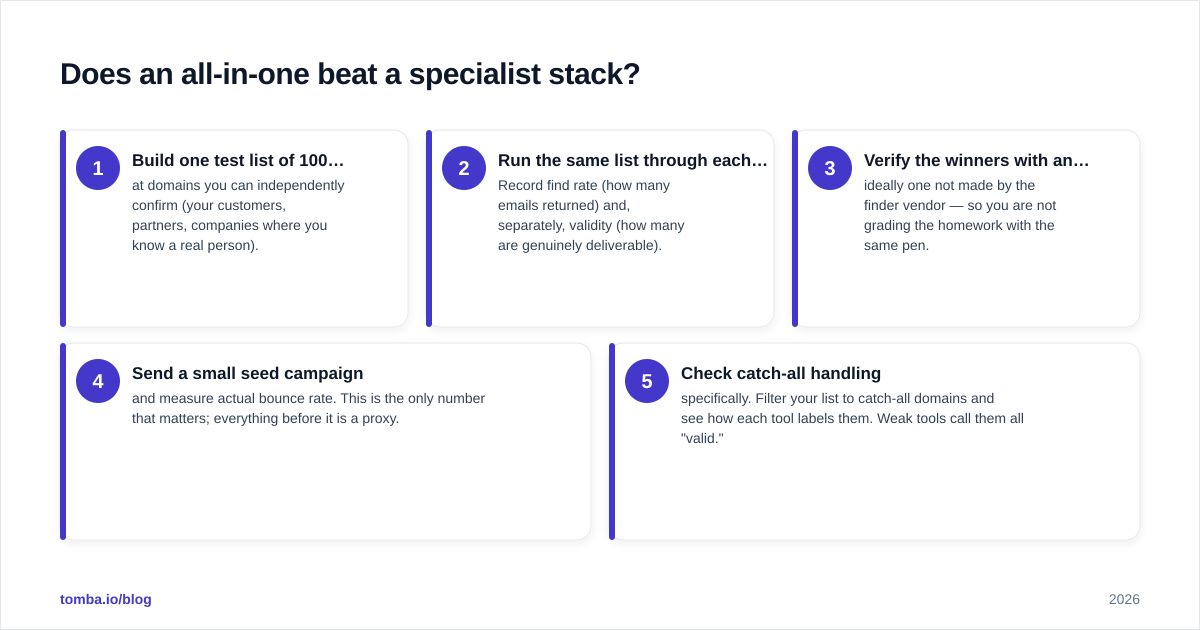
Do not trust any vendor's accuracy claim, including ours. Run a controlled test:
- Build one test list of 100 contacts at domains you can independently confirm (your customers, partners, companies where you know a real person).
- Run the same list through each tool. Record find rate (how many emails returned) and, separately, validity (how many are genuinely deliverable).
- Verify the winners with an independent verifier — ideally one not made by the finder vendor — so you are not grading the homework with the same pen.
- Send a small seed campaign and measure actual bounce rate. This is the only number that matters; everything before it is a proxy.
- Check catch-all handling specifically. Filter your list to catch-all domains and see how each tool labels them. Weak tools call them all "valid."
This five-step test takes an afternoon and beats a month of arguing over spec sheets. Tools like G2 and Capterra are useful for surfacing recent user complaints — sort reviews by most recent and look for patterns about bounce rates and refund disputes.
Pros and cons at a glance#
Archetype Data
- Pros: rich enrichment, intent signals, strong fit for ABM and RevOps, structured data model.
- Cons: enterprise-leaning pricing, not a prospecting starting point, overkill for solo sellers, opaque entry cost.
FindThatLead
- Pros: true all-in-one (find, verify, send), accessible pricing, Prospector segment builder, fast onboarding.
- Cons: jack-of-all-trades accuracy, bundled verifier weaker than a specialist, sender deliverability depends heavily on your own warmup hygiene.
Where a verified finder fits either way
- Pros: highest practical deliverability, dedicated catch-all verification, generous free tier to test, transparent pricing, API/CLI/extension coverage.
- Cons: not a sender (by design — you bring your own sequencer), not an intent-data platform.
So which should you choose?#
Decide by your starting point, not the brand.
- Start with accounts, need data truth and intent → Archetype Data, paired with a finder for contact gaps.
- Start with an ICP, want one tool to find and send, low-to-mid volume → FindThatLead.
- Start with named targets, send at volume, deliverability is non-negotiable → lead with a verification-first finder and add a dedicated sender.
There is no universal winner here — there is a winner for your motion. The fastest way to know is to stop reading comparison posts (including this one) and run the 100-contact test above on all three.
If your bottleneck is finding the right email and trusting it will land, that is exactly the problem the Tomba Email Finder is built for. Start on the free tier — 25 searches a month, no card — find a handful of contacts you can independently verify, and check the bounce rate yourself. If the data holds up on your domains, scale into the $49/mo Starter plan and keep your sender's reputation clean while you grow. Let the deliverability numbers, not the marketing, make the call.
// get started
Find, verify and enrich your first contacts today
Start on the free plan with 25 searches a month, then scale when your team is ready.
Free plan · No credit card required · GDPR & CCPA
// about the author