Archetype Data vs Generect (2026): B2B Lead Data Compared
Archetype Data vs Generect: a neutral 2026 breakdown of coverage, accuracy, pricing, and workflow fit — plus where a dedicated email finder beats both.
TL;DR
- Archetype Data leans toward intent-rich, account-level B2B records and enrichment for teams that want firmographic depth and signal layering.
- Generect focuses on LinkedIn-sourced lead lists and real-time lookups, popular with outbound teams who live inside prospecting workflows.
- Neither is a pure email finder — both bundle contact data into broader platforms, so per-contact cost and verification quality vary a lot.
- If your bottleneck is reaching people (not just listing them), pair either tool with a dedicated finder-and-verifier so bounce rates stay under control.
- Pricing, GDPR posture, and data freshness — not logos — should decide this. We break down all three below.
What are Archetype Data and Generect?#
Quick answer: they solve the same job — get B2B contact and company data into your pipeline — but from opposite ends.
Think of it like buying produce. Archetype Data is the wholesaler that sells you a curated crate with provenance labels: who the account is, what they're signaling, and how the records were enriched. Generect is the fast-turn market stall: you describe the prospect, it pulls fresh leads from LinkedIn-style sources on demand, and you move. Both feed you. The difference is how much context, freshness, and verification come attached.
Archetype Data positions itself around enriched, account-aware B2B records — the kind of data a revenue operations or demand team uses to score and route accounts. Generect positions itself around speed and list-building for outbound SDRs who want to go from "ideal customer profile" to a usable list in minutes.
Here's the catch that most comparison posts skip: a record existing in a database is not the same as a deliverable email. That gap is where your bounce rate — and your sender reputation — gets decided.
How do Archetype Data and Generect compare on core features?#
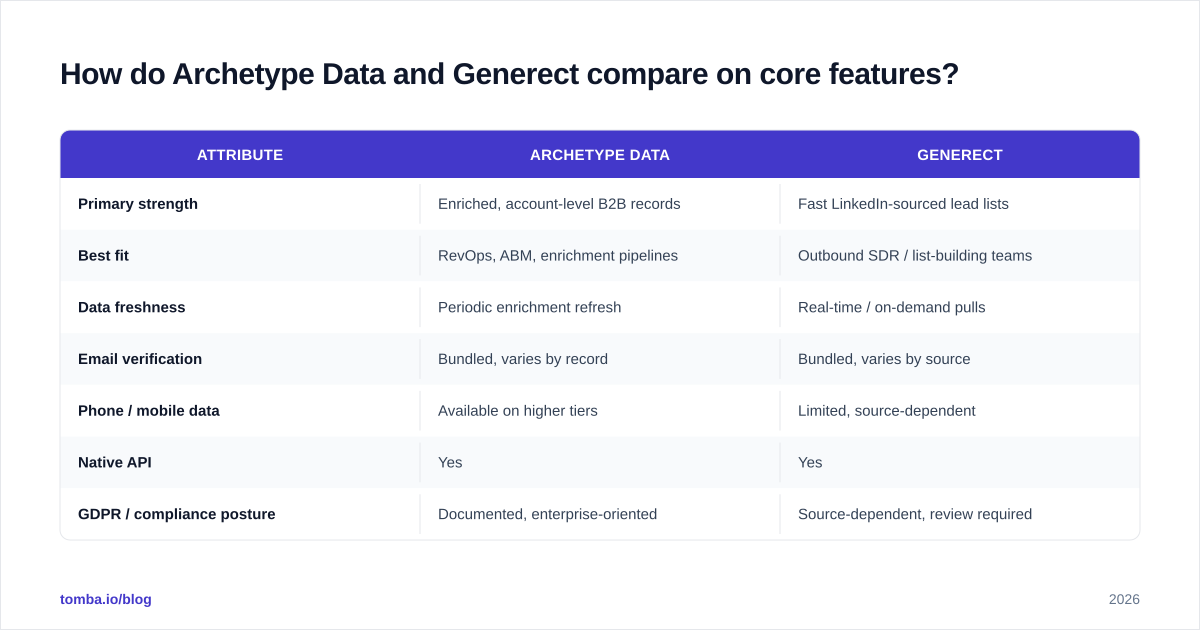
The honest version: you're comparing a depth play against a speed play. Use the table as a starting filter, then weight the rows that map to your actual workflow.
| Attribute | Archetype Data | Generect |
|---|---|---|
| Primary strength | Enriched, account-level B2B records | Fast LinkedIn-sourced lead lists |
| Best fit | RevOps, ABM, enrichment pipelines | Outbound SDR / list-building teams |
| Data freshness | Periodic enrichment refresh | Real-time / on-demand pulls |
| Email verification | Bundled, varies by record | Bundled, varies by source |
| Phone / mobile data | Available on higher tiers | Limited, source-dependent |
| Native API | Yes | Yes |
| GDPR / compliance posture | Documented, enterprise-oriented | Source-dependent, review required |
| Typical buyer | Mid-market to enterprise | SMB to mid-market |
| Per-contact cost clarity | Lower (bundled credits) | Moderate |
Two things to notice. First, both bundle verification rather than treating it as a first-class step — which means you can't always see the SMTP-level confidence behind a given address. Second, "real-time" (Generect) and "enriched" (Archetype) are not better-or-worse; they answer different questions. Real-time wins for net-new prospecting. Enriched wins for scoring and routing accounts you already care about.
If your team is doing both, you'll end up stitching one of these to a separate verification layer anyway. More on that below.
Is Archetype Data better than Generect for accuracy?#
Conclusion first: accuracy depends less on the brand and more on how each tool handles the email it hands you. Account-level enrichment (Archetype's lane) tends to be strong on firmographics and weaker on individual mailbox liveness. Real-time LinkedIn pulls (Generect's lane) tend to be fresh on job changes but inherit whatever pattern-guessing the source used to construct the email.

Both failure modes hit the same KPI: bounce rate. A 90%-accurate list still puts you near the danger zone if you're sending cold at volume, because mailbox providers read bounces as a spam signal. That's why serious outbound teams run every list — no matter how reputable the source — through an independent email verifier before the first send. It's the cheapest insurance in the stack.
A practical accuracy checklist when you trial either tool:
- Pull 200 records and verify them with a third-party verifier. Compare claimed vs. real deliverability.
- Check catch-all handling. Domains that accept everything inflate "valid" counts — a dedicated catch-all verifier tells you what's actually safe.
- Spot-check job titles against live LinkedIn. Stale titles are the silent killer of personalization.
- Measure time-to-list for a realistic ICP, not the demo's cherry-picked one.
Run that and you'll have evidence, not vibes. The vendor with the better demo rarely wins the bounce test.

What about pricing — which is cheaper in 2026?#
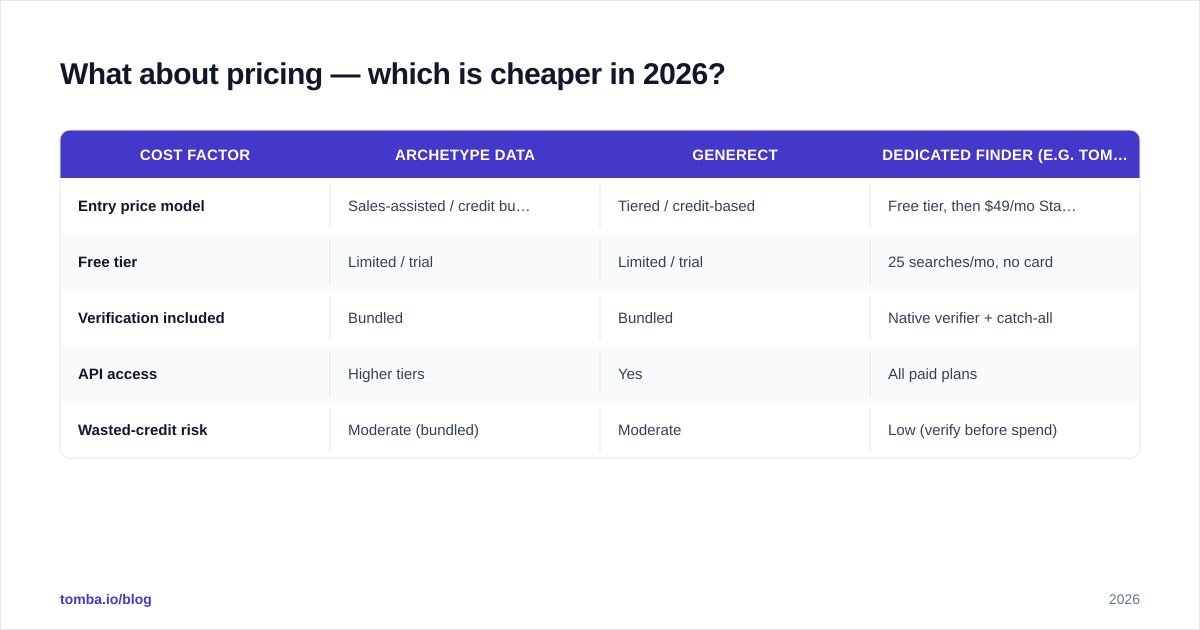
Straight answer: neither publishes pricing the way a self-serve tool does, so your real cost is per-usable-contact, not per-seat. Both lean toward sales-assisted plans, credit bundles, and annual commitments. That makes line-item comparison hard — and makes it easy to overpay for records you'll never email.
| Cost factor | Archetype Data | Generect | Dedicated finder (e.g. Tomba) |
|---|---|---|---|
| Entry price model | Sales-assisted / credit bundles | Tiered / credit-based | Free tier, then $49/mo Starter |
| Free tier | Limited / trial | Limited / trial | 25 searches/mo, no card |
| Verification included | Bundled | Bundled | Native verifier + catch-all |
| API access | Higher tiers | Yes | All paid plans |
| Wasted-credit risk | Moderate (bundled) | Moderate | Low (verify before spend) |
A note on the right-hand column, kept honest: a focused finder like Tomba isn't a full ABM data platform, and it won't replace intent layering. What it does cleanly is the one job both providers bundle loosely — turn a name and domain into a verified address — at transparent pricing. You can see the Tomba pricing tiers publicly: Free (25 searches), Starter $49/mo, Growth $99/mo, Pro $249/mo. No "contact sales" wall to learn the number.
The buying lesson regardless of vendor: negotiate on deliverable contacts, not raw records. Ask each vendor to commit to a bounce-rate SLA on a sample. If they won't, that tells you how confident they are in their own data.
Which tool fits your workflow — RevOps, ABM, or outbound?#
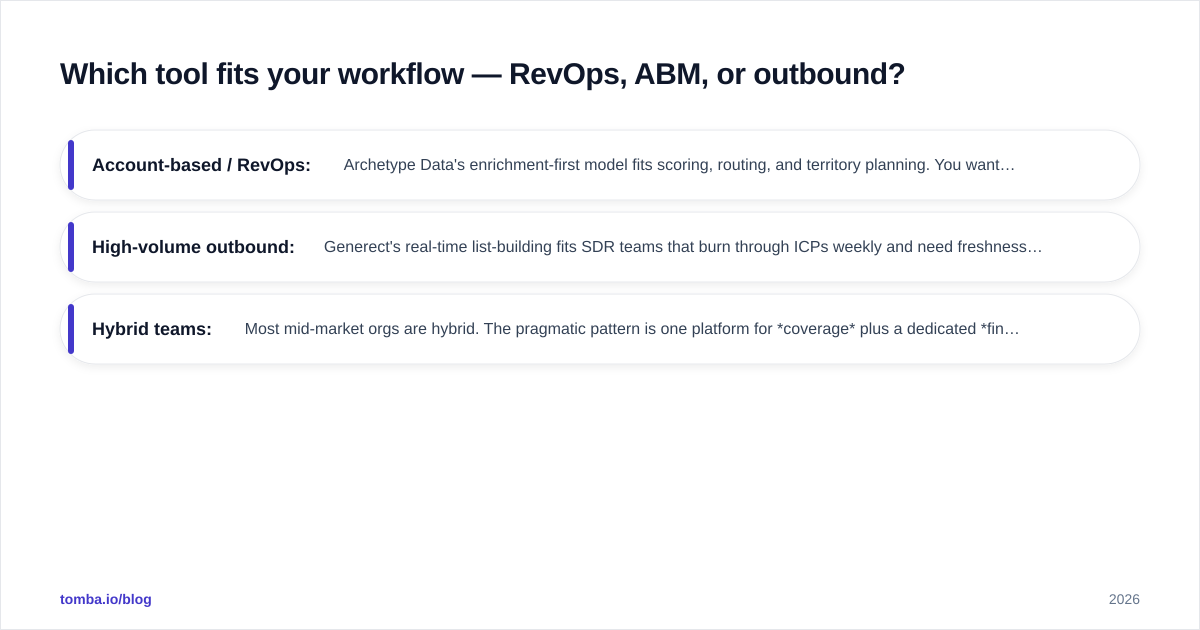
Match the tool to the motion, not the hype.
- Account-based / RevOps: Archetype Data's enrichment-first model fits scoring, routing, and territory planning. You want depth per account and clean fields to feed your CRM and lead-scoring rules.
- High-volume outbound: Generect's real-time list-building fits SDR teams that burn through ICPs weekly and need freshness over depth.
- Hybrid teams: Most mid-market orgs are hybrid. The pragmatic pattern is one platform for coverage plus a dedicated finder + verifier for the last mile, wired together through a Tomba API call or a no-code [
Zapier integration](https://tomba.io/integrations/zapier).
If you mostly start from company domains rather than names, a domain search workflow can short-circuit a lot of platform shopping — point it at a target company and pull the role-based contacts directly, then verify.
How do they handle compliance and data sourcing?#
This is the row that gets teams in trouble after the deal closes. B2B data sourced from scraped or LinkedIn-derived signals carries GDPR and CCPA obligations — lawful basis, opt-out handling, and data-subject requests don't disappear because a vendor pre-packaged the record.
Archetype Data, being more enterprise-oriented, tends to document its sourcing and compliance posture in detail, which procurement teams will ask for. Generect's freshness comes partly from LinkedIn-style sources, so review exactly what's collected and how consent and suppression are handled before you scale sends in the EU.
Two non-negotiables when you evaluate either:
- Get the data-sourcing statement in writing. "Publicly available" is not a lawful basis by itself.
- Confirm suppression and DSAR support. You need a clean path to delete a contact on request.
For your own outbound hygiene, email deliverability starts before the send — verified, consented, role-appropriate contacts keep your domain off blocklists. Tooling that lets you understand where the data comes from is worth more than a slightly larger record count.
What are the pros and cons of each?#
Archetype Data — pros: strong firmographic and account-level depth; enrichment fits scoring and routing; enterprise-grade compliance documentation; good for ABM. Archetype Data — cons: individual-mailbox liveness can lag; pricing is sales-gated; overkill for a small SDR team that just needs lists.
Generect — pros: fast, real-time list-building; fresh on job changes; SDR-friendly workflow; quick time-to-first-list. Generect — cons: source-dependent verification and compliance; depth-per-account is thinner; you'll still want an independent verifier before volume sends.
The shared gap (both): verification is bundled, not transparent. You rarely see the SMTP confidence behind an address, so you're trusting a number you can't audit. That's fixable — bolt on a verifier you control.
How should you decide between Archetype Data vs Generect?#
Decide with a 7-day bake-off, not a feature sheet:
- Define one real ICP. Specific titles, specific industries, specific company sizes.
- Pull 200 contacts from each tool.
- Verify all 400 with a neutral third party. Record true deliverability, catch-all rate, and bad-syntax rate.
- Score freshness. Sample 25 records per tool against live profiles for title accuracy.
- Price it per usable contact — total spend divided by verified-deliverable records, not raw records.
- Check compliance fit for your sending regions.
- Pick the winner on cost-per-deliverable, not coverage claims.
Whichever you choose, the last-mile job is the same: take the name and domain, return a verified email, keep your bounce rate low. That's the exact slot a dedicated finder fills cleanly. For a deeper benchmark on how standalone finders stack up on accuracy and price, this 2026 comparison is a useful reference:

For broader context on how analysts categorize B2B data providers, see G2's data intelligence category and the GDPR overview on Wikipedia before you commit to a sourcing model. If you're formalizing an ABM motion, HubSpot's account-based marketing resources are a solid neutral primer.
The bottom line#
Archetype Data wins when you need account depth and enrichment for scoring and ABM. Generect wins when you need fresh lists fast for high-volume outbound. Both bundle verification loosely — and that's the seam where deliverability slips.
Close that seam. Run your prospects through the Tomba Email Finder to turn names and domains into verified, send-ready addresses with transparent pricing and a free tier to test on your own list first. Start free at 25 searches a month, verify before you spend a credit, and let the bounce test — not the sales deck — pick your winner.
// get started
Find, verify and enrich your first contacts today
Start on the free plan with 25 searches a month, then scale when your team is ready.
Free plan · No credit card required · GDPR & CCPA
// about the author