Archetype Data vs Hunter: Which B2B Data Tool Wins in 2026?
Archetype Data vs Hunter compared on accuracy, coverage, pricing, and workflow fit — plus where a verification-first finder beats both for cold outreach in 2026.
Choosing between Archetype Data and Hunter usually comes down to one question your spreadsheet never answers directly: do you need a broad B2B data layer, or do you need clean, reach-the-inbox emails? These two tools sit on opposite ends of that spectrum, and picking the wrong one quietly taxes every campaign you run.
This breakdown compares Archetype Data vs Hunter on accuracy, coverage, pricing, and workflow fit — then shows where a verification-first finder changes the math.
TL;DR#
- Hunter is a mature, email-first finder and verifier with strong domain search and a generous free tier — best when your primary need is finding and validating professional email addresses.
- Archetype Data leans toward broader B2B data and enrichment (firmographics, contact records, signals) — better when you need account context, not just an inbox.
- Accuracy gap matters most. A large database with stale records costs you more in bounces than a smaller, verified one saves you in volume.
- Pricing: Hunter scales by monthly searches/verifications; Archetype-style data platforms tend to price by records or seats, which gets expensive fast at scale.
- Best move for cold outreach: pair finding with real-time verification. That's where Tomba's email finder and its built-in email verifier close the gap both tools leave open.
What is Archetype Data?#
Archetype Data is positioned as a B2B data and enrichment layer. The pitch is account intelligence: firmographic detail, contact records tied to companies, and signals you can route into a CRM or outbound sequence. You're buying breadth — the ability to build target lists around company attributes and then attach contacts to them.
That model is useful when your motion is account-based. If you sell into specific industries, headcounts, or tech stacks, a data platform helps you define the universe before you ever look at an individual person's email.
The trade-off is that broad data platforms optimize for coverage over freshness. Records age. People change jobs roughly every two to three years, and a contact row that looked perfect at import can be a hard bounce by the time your sequence fires. Enrichment breadth and email deliverability are not the same problem, and tools built for the first rarely solve the second well.
What is Hunter?#
Hunter is one of the most recognized email-finding tools on the market. Its core is simple and it does it well: give it a domain, and it returns the email addresses associated with that company, the most likely pattern, a confidence score, and sources. It also ships a standalone verifier, a Chrome extension, a Campaigns module for basic cold email, and an API.
Hunter's strength is focus. It's an email tool, not a sprawling data suite, so the finding and verification workflow is clean. The free tier (limited monthly searches and verifications) is genuinely usable for evaluation, which is why so many SDRs start there.
The limits show up at scale. Coverage outside well-indexed company domains thins out, personal and hard-to-find contacts are weaker, and credits get consumed quickly when you're running thousands of lookups a month.
Archetype Data vs Hunter: how do they compare?#
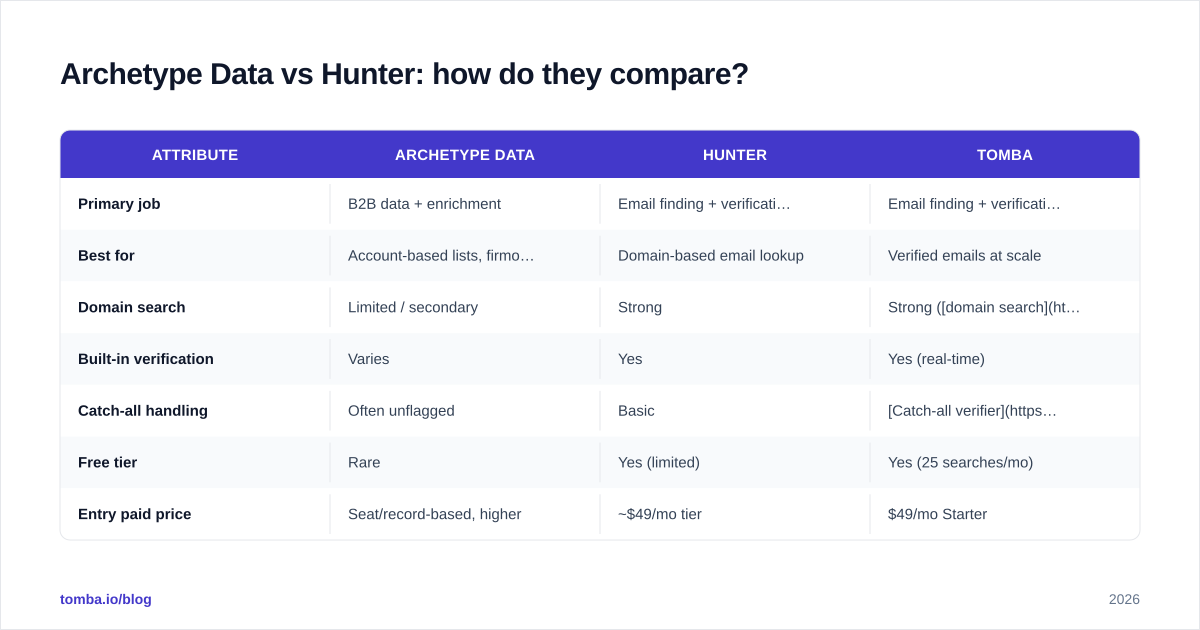
Here's the practical side-by-side. Treat any vendor's stated accuracy as a ceiling, not a guarantee — real-world numbers depend on your target segment.
| Attribute | Archetype Data | Hunter | Tomba |
|---|---|---|---|
| Primary job | B2B data + enrichment | Email finding + verification | Email finding + verification |
| Best for | Account-based lists, firmographics | Domain-based email lookup | Verified emails at scale |
| Domain search | Limited / secondary | Strong | Strong (domain search) |
| Built-in verification | Varies | Yes | Yes (real-time) |
| Catch-all handling | Often unflagged | Basic | Catch-all verifier |
| Free tier | Rare | Yes (limited) | Yes (25 searches/mo) |
| Entry paid price | Seat/record-based, higher | ~$49/mo tier | $49/mo Starter |
| API | Yes | Yes | Yes (Tomba API) |
The pattern is clear: Archetype-style platforms win on context, Hunter wins on focused email work, and the deciding factor for outbound teams is whether verification is real and built in.

Which is more accurate for email?#
Accuracy is the whole game, and it splits into two numbers people constantly conflate: match rate (did the tool return an email?) and deliverability (will that email actually land?).
A broad data platform like Archetype can show a high match rate because it returns something for most contacts. But if those records are stale or unverified, the deliverability rate underneath collapses. Hunter ties its results to a confidence score and sources, which makes the email-finder accuracy story more honest — you can see why it thinks an address is valid.
The image below frames why benchmark numbers diverge so much between vendors: they measure different things.

The fix is the same regardless of which tool you start with: verify before you send. A bounce rate above 3-5% is the fastest way to wreck sender reputation, and once that's damaged even your verified emails start landing in spam. This is why a real-time email verifier and a proper catch-all finder belong in the workflow, not as an afterthought.
How does pricing compare?#
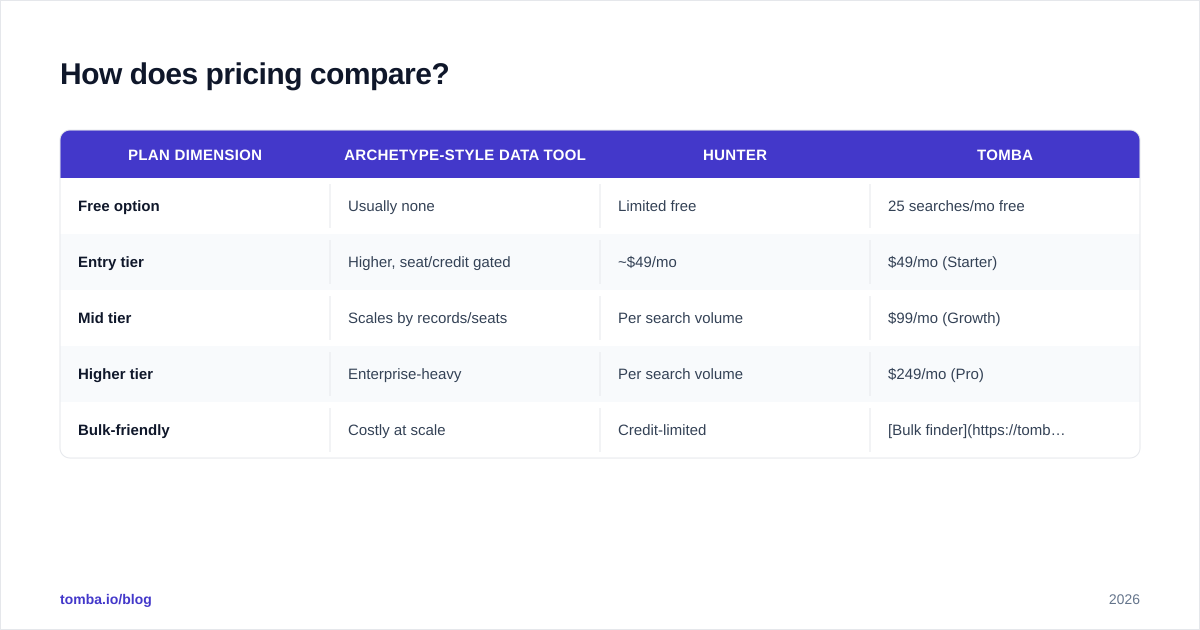
Pricing models differ enough that a flat "X is cheaper" misses the point.
| Plan dimension | Archetype-style data tool | Hunter | Tomba |
|---|---|---|---|
| Free option | Usually none | Limited free | 25 searches/mo free |
| Entry tier | Higher, seat/credit gated | ~$49/mo | $49/mo (Starter) |
| Mid tier | Scales by records/seats | Per search volume | $99/mo (Growth) |
| Higher tier | Enterprise-heavy | Per search volume | $249/mo (Pro) |
| Bulk-friendly | Costly at scale | Credit-limited | Bulk finder included |
Data platforms tend to charge for breadth you may never fully use, and the per-record math punishes large lists. Hunter's per-search model is predictable but can get expensive once you're verifying tens of thousands of contacts. For a transparent middle path, compare against Tomba pricing, which keeps a real free tier and a $49/mo Starter without seat lock-in.
When should you pick each one?#
Pick Archetype Data if your motion is account-based and you need firmographics, signals, and company context to even build a target list. You're buying intelligence about who to target, and you accept that you'll verify contact data separately before outreach.
Pick Hunter if your core need is finding and validating professional emails by domain, you want a clean focused tool, and the free tier covers your evaluation. It's a strong default for SDRs who live in domain search.
Pick a verification-first finder if deliverability is your bottleneck — high-volume cold outreach where every bounce compounds. You want finding, real-time verification, catch-all handling, and data enrichment in one pass, without juggling two subscriptions.
Most teams discover they're really running two jobs: build the account universe, then reach individuals reliably. Archetype handles the first; you still need a deliverability-grade finder for the second.
Where does Tomba fit between them?#
Tomba sits where most outbound teams actually operate: you need accurate emails and you need them to land. It combines the email finder, real-time verification, catch-all detection, and enrichment so you're not stitching a data platform to a separate verifier.
A few concrete differences:
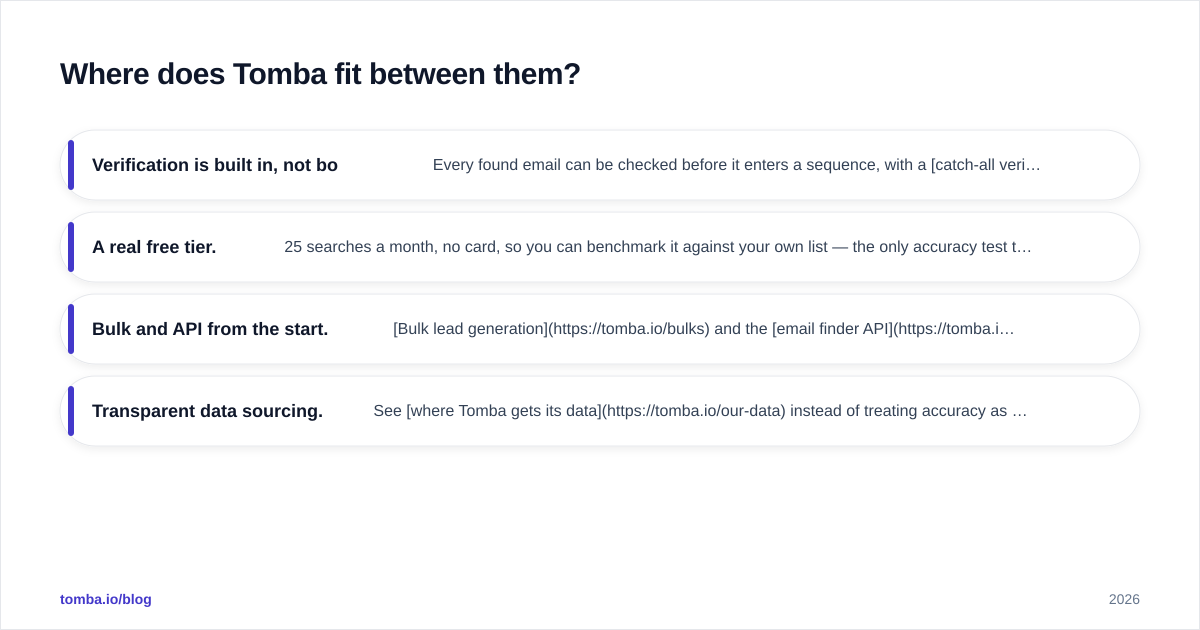
- Verification is built in, not bolted on. Every found email can be checked before it enters a sequence, with a catch-all verifier for the domains that trip up other tools.
- A real free tier. 25 searches a month, no card, so you can benchmark it against your own list — the only accuracy test that matters.
- Bulk and API from the start. Bulk lead generation and the email finder API mean the workflow scales from a single rep to a full RevOps pipeline.
- Transparent data sourcing. See where Tomba gets its data instead of treating accuracy as a black box.
The comparison table below puts the email-finder field side by side so you can see how focus and verification stack up across tools.

How do you actually test which one wins?#
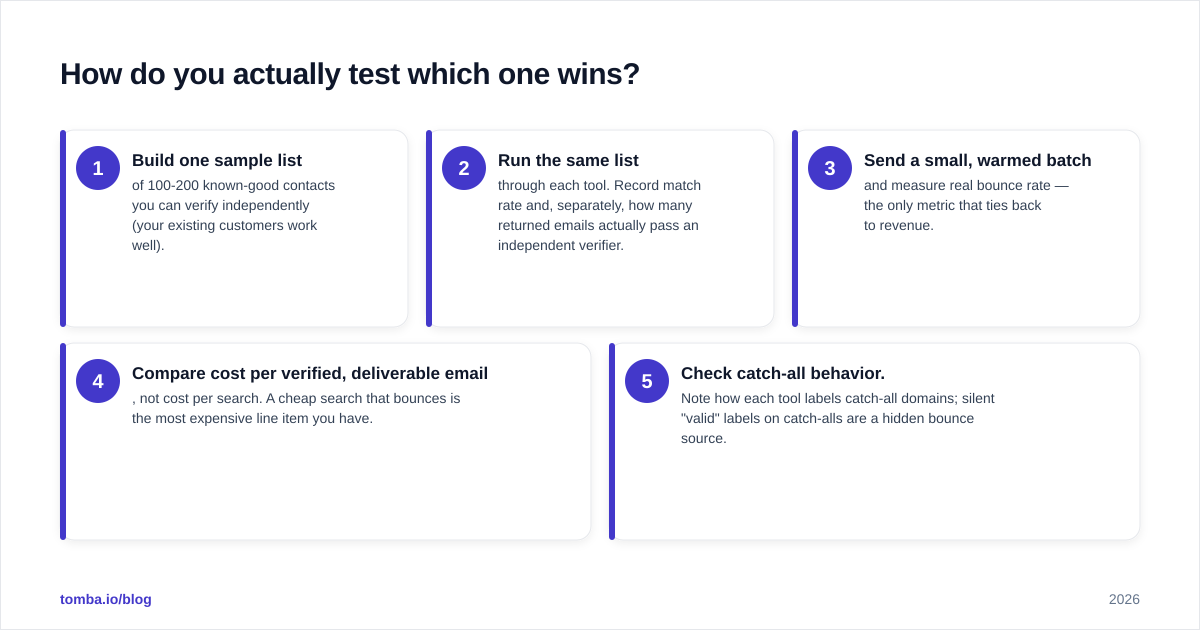
Don't trust marketing accuracy numbers — including the ones in this post. Run a controlled bake-off:
- Build one sample list of 100-200 known-good contacts you can verify independently (your existing customers work well).
- Run the same list through each tool. Record match rate and, separately, how many returned emails actually pass an independent verifier.
- Send a small, warmed batch and measure real bounce rate — the only metric that ties back to revenue.
- Compare cost per verified, deliverable email, not cost per search. A cheap search that bounces is the most expensive line item you have.
- Check catch-all behavior. Note how each tool labels catch-all domains; silent "valid" labels on catch-alls are a hidden bounce source.
This is also how you protect email deliverability before a campaign instead of after. Run the test once and the Archetype Data vs Hunter debate usually answers itself for your segment.
Frequently asked questions#
Is Archetype Data better than Hunter? Neither is universally better. Archetype Data wins for account-level B2B data and enrichment; Hunter wins for focused email finding and verification by domain. The right pick depends on whether your bottleneck is targeting or deliverability.
Does Hunter verify emails? Yes. Hunter includes a verifier and attaches confidence scores to found emails. For high-volume sending you should still confirm bounce rates with an independent check before launching a sequence.
What's the cheapest way to get verified B2B emails? Start with a tool that offers a real free tier and built-in verification so you don't pay twice. Tomba's free plan (25 searches/mo) and $49/mo Starter let you validate accuracy on your own list before committing.
Can I replace both with one tool? Often, yes — if your main job is reaching individuals reliably. A combined finder-plus-verifier covers most outbound needs without a separate data subscription, though dedicated account-intelligence platforms still help heavy ABM teams.
The bottom line#
Archetype Data vs Hunter is really a question of breadth versus deliverability. Archetype gives you the account picture; Hunter gives you focused, scored email lookups. Both leave a gap exactly where outbound revenue is won or lost: clean, verified emails that reach the inbox at scale.
If that's your bottleneck, start with the Tomba Email Finder. Find emails by domain, name, or company, verify them in real time, handle catch-alls, and run it free for your first 25 searches — then benchmark the results against your own list. Let the bounce rate decide.
// get started
Find, verify and enrich your first contacts today
Start on the free plan with 25 searches a month, then scale when your team is ready.
Free plan · No credit card required · GDPR & CCPA
// about the author