Archetype Data vs LeadGenius: B2B Data Compared (2026)
Archetype Data and LeadGenius both promise custom, human-verified B2B data — but they fit very different teams. Here's how they compare on accuracy, coverage, and cost in 2026.
Choosing a B2B data partner is rarely about who has "the most contacts." It's about who can hand you accurate, fit-for-purpose records for the exact segment you sell into — and do it without burning your budget or your sender reputation. Archetype Data and LeadGenius both play in this managed-data space, but they solve the problem from different angles.
This guide breaks down how the two stack up in 2026, where each one wins, and when a self-serve tool is the smarter call.
TL;DR#
- Archetype Data leans toward programmatic, API-first enrichment and account intelligence — good for teams that want data piped straight into their stack.
- LeadGenius is a managed, human-in-the-loop research service — strong for hard-to-find niches and custom data points that scrapers miss.
- Accuracy is comparable on common firmographics; the gap shows up on obscure roles, non-US regions, and bespoke attributes.
- Pricing for both is quote-based and enterprise-weighted — expect annual commitments, not a credit card and a $49 plan.
- If you mostly need verified emails and firmographics at a predictable price, a self-serve finder like the Tomba Email Finder often covers 80% of the job for a fraction of the cost.
What is Archetype Data?#
Archetype Data positions itself as a B2B data and enrichment provider built for go-to-market teams that want clean records flowing into their CRM and outbound tools automatically. The emphasis is on integration — APIs, enrichment webhooks, and account-level intelligence that scores and segments companies rather than just dumping a contact list on you.
In practice, that means Archetype is most comfortable when it sits inside an existing RevOps motion: you have a CRM, you have a defined ICP, and you want missing fields filled and stale records refreshed on a schedule. It's less of a "give me a list" vendor and more of a "keep my database healthy" one.
What is LeadGenius?#
LeadGenius takes the opposite starting point. It's a managed data service with a human research layer on top of automation. You tell LeadGenius the exact accounts, personas, and custom attributes you need — including things no off-the-shelf database tracks, like "uses a specific competitor's product" or "has more than 50 delivery vans" — and a combination of software and human researchers compiles it.
That human-in-the-loop model is LeadGenius's whole pitch. For unusual segments, international markets, or data points that require judgment, a researcher can find what a crawler can't. The trade-off is turnaround time and cost: custom research is slower and pricier than pulling from a pre-built index.
)
How do Archetype Data and LeadGenius compare?#
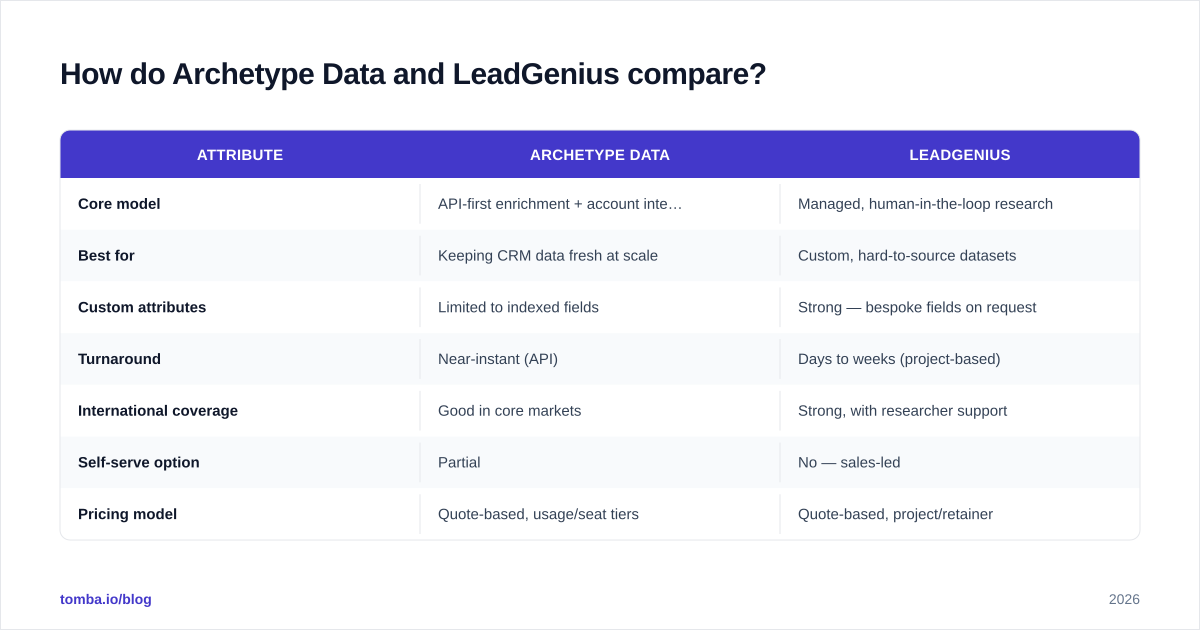
Here's the head-to-head on the attributes that actually move a buying decision.
| Attribute | Archetype Data | LeadGenius |
|---|---|---|
| Core model | API-first enrichment + account intelligence | Managed, human-in-the-loop research |
| Best for | Keeping CRM data fresh at scale | Custom, hard-to-source datasets |
| Custom attributes | Limited to indexed fields | Strong — bespoke fields on request |
| Turnaround | Near-instant (API) | Days to weeks (project-based) |
| International coverage | Good in core markets | Strong, with researcher support |
| Self-serve option | Partial | No — sales-led |
| Pricing model | Quote-based, usage/seat tiers | Quote-based, project/retainer |
| Typical buyer | RevOps / data ops | Demand gen / niche outbound |
The pattern is clear: Archetype optimizes for speed and automation, LeadGenius optimizes for depth and customization. Neither is strictly "better" — they're tuned for different jobs.
A framework for choosing#
Before you sit through either sales demo, score your need against three axes: how standard your data points are, how fast you need them, and how custom your ICP is.
If your answers cluster toward "standard, fast, common ICP," neither premium vendor may be necessary — that's the zone where a self-serve data enrichment tool wins on cost. If you land on "bespoke attributes, niche segment, willing to wait," LeadGenius's research model earns its premium.
Which has better data accuracy?#
Accuracy is where these comparisons usually get hand-wavy, so let's be precise about where it matters.
On common firmographics — company name, size, industry, headquarters, standard job titles at mid-to-large companies — Archetype and LeadGenius both perform well. So do most reputable providers. This is largely a solved problem because the underlying signals (websites, filings, LinkedIn) are widely available.
The accuracy gap opens up in three places:
- Obscure roles and small companies. A "Head of Facilities at a 30-person logistics firm in Portugal" is exactly the kind of record where automated indexes go stale or guess. LeadGenius's human layer has the edge here.
- Bespoke attributes. If you need a field that no database natively tracks, accuracy depends entirely on the research process — which is LeadGenius's home turf.
- Email validity. A correct name and a deliverable email are not the same thing. Both vendors should validate, but you should always run your own check before a send.
That last point is non-negotiable regardless of which vendor you pick. Even a 95%-accurate list will tank your deliverability if the dead 5% are catch-all or spam-trap addresses. Run any purchased or enriched list through an email verifier and a catch-all verifier before your first campaign. Industry analysts like Gartner consistently flag data decay — roughly 2–3% of B2B contacts go stale every month — as the silent killer of outbound performance.
How do they handle coverage and international data?#
Coverage is a function of breadth (how many records) versus fit (how many records match your exact ICP). The two vendors trade off differently.
Archetype's API model favors breadth in core markets. If you sell to US and Western European tech companies, you'll get strong coverage instantly. Push into long-tail geographies or industries and you'll hit the same ceiling every index-based provider hits — the data is only as good as the public signals feeding it.
LeadGenius's researcher network is its coverage advantage in hard markets. Need verified contacts in Southeast Asian manufacturing, or decision-makers at family-owned distributors with no LinkedIn presence? A human can dig those out. The cost is throughput: you're commissioning research, not querying a database.
For most teams, the realistic middle path is to cover the easy 80% of your list with a self-serve tool and a solid B2B database, then commission custom research only for the high-value accounts that automation can't reach. Spending researcher-rate dollars on contacts you could find in seconds is how data budgets get wasted.
What about pricing?#
Both Archetype Data and LeadGenius use quote-based, enterprise-oriented pricing. Neither publishes a public price card, and both typically expect annual commitments. That's standard for managed-data vendors, but it has consequences:
- You can't "try before you buy" with a credit card.
- Minimums are often in the tens of thousands per year.
- Cost scales with volume, custom fields, and research intensity.
This is the single biggest reason smaller teams bounce off both products. If you're a five-person sales team that needs a few thousand verified emails a month, an enterprise data contract is the wrong tool — like renting a freight train to move a couch.
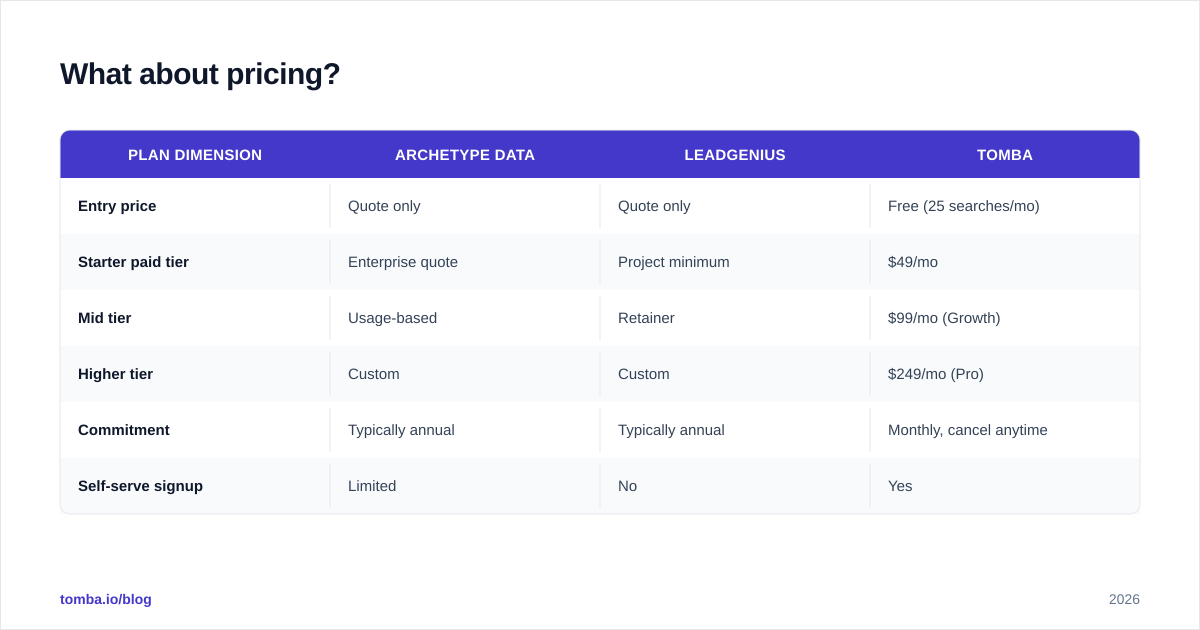
Here's how the cost models compare against a transparent self-serve alternative:
| Plan dimension | Archetype Data | LeadGenius | Tomba |
|---|---|---|---|
| Entry price | Quote only | Quote only | Free (25 searches/mo) |
| Starter paid tier | Enterprise quote | Project minimum | $49/mo |
| Mid tier | Usage-based | Retainer | $99/mo (Growth) |
| Higher tier | Custom | Custom | $249/mo (Pro) |
| Commitment | Typically annual | Typically annual | Monthly, cancel anytime |
| Self-serve signup | Limited | No | Yes |
You can see the full Tomba pricing for comparison. The point isn't that Tomba replaces a managed-research vendor for every use case — it's that most teams overestimate how much custom data they actually need, and underestimate how far a transparent, self-serve finder goes.
)
When should you use a self-serve tool instead?#
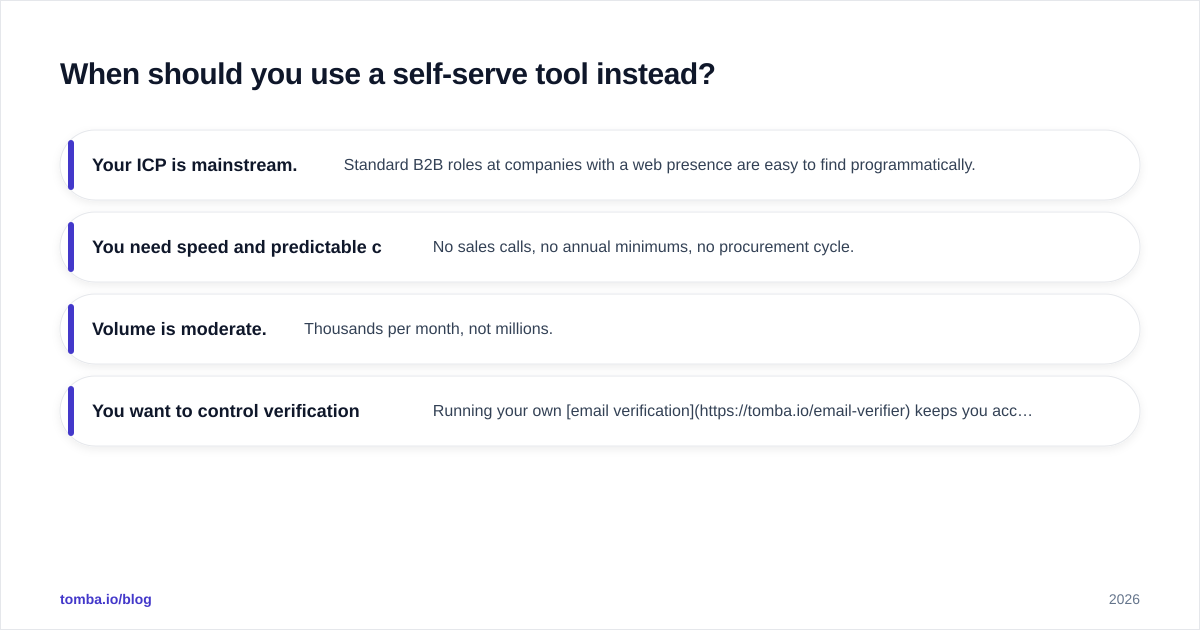
Reach for a self-serve email finder and enrichment stack — rather than Archetype or LeadGenius — when:
- Your ICP is mainstream. Standard B2B roles at companies with a web presence are easy to find programmatically.
- You need speed and predictable cost. No sales calls, no annual minimums, no procurement cycle.
- Volume is moderate. Thousands per month, not millions.
- You want to control verification. Running your own email verification keeps you accountable for deliverability.
A typical self-serve workflow looks like this: use domain search to pull every reachable contact at a target company, find the specific decision-maker's address with the email finder, enrich the record, then verify before sending. For account-based plays you can run the whole thing in bulk with a bulk email finder.
Reserve a managed vendor like LeadGenius for the genuinely hard 10–20% — the bespoke attributes, the unusual geographies, the data points that need a human to judge. That hybrid approach gets you the depth of managed research without paying researcher rates for contacts a tool could surface in seconds.
Archetype Data vs LeadGenius: which should you pick?#
Pick Archetype Data if you're a RevOps or data-ops team that wants enrichment automated inside your stack — APIs, scheduled refreshes, and account intelligence feeding your CRM. The value is in keeping a large database clean without manual effort.
Pick LeadGenius if your edge depends on data nobody else has — custom attributes, obscure segments, or international markets where human research beats crawlers. You're buying a research capability, not just a list.
Pick a self-serve tool if your needs are mainstream, your budget is real, and you want to start this week instead of next quarter. Check independent reviews on G2 to validate any vendor's claims against real customer feedback before you commit.
Whichever route you choose, the verification step is yours to own. A list is only as valuable as the percentage that actually lands in the inbox.
Find and verify B2B contacts without an enterprise contract#
If most of your prospecting targets standard B2B roles at companies with a website, you probably don't need a six-figure data contract to reach them. The Tomba Email Finder lets you find professional email addresses by name, domain, or company, verify them before you send, and enrich the records — starting free with 25 searches a month and scaling at a transparent $49/mo, no sales call required. Start there, prove the motion, and commission custom research only for the accounts that truly need it.
// get started
Find, verify and enrich your first contacts today
Start on the free plan with 25 searches a month, then scale when your team is ready.
Free plan · No credit card required · GDPR & CCPA
// about the author